
Remulla’s Message is Clear: Even the Wealthy Heirs Can’t Escape the Anti-Corruption Hammer
By Louis ‘Barok‘ C. Biraogo — April 28, 2026
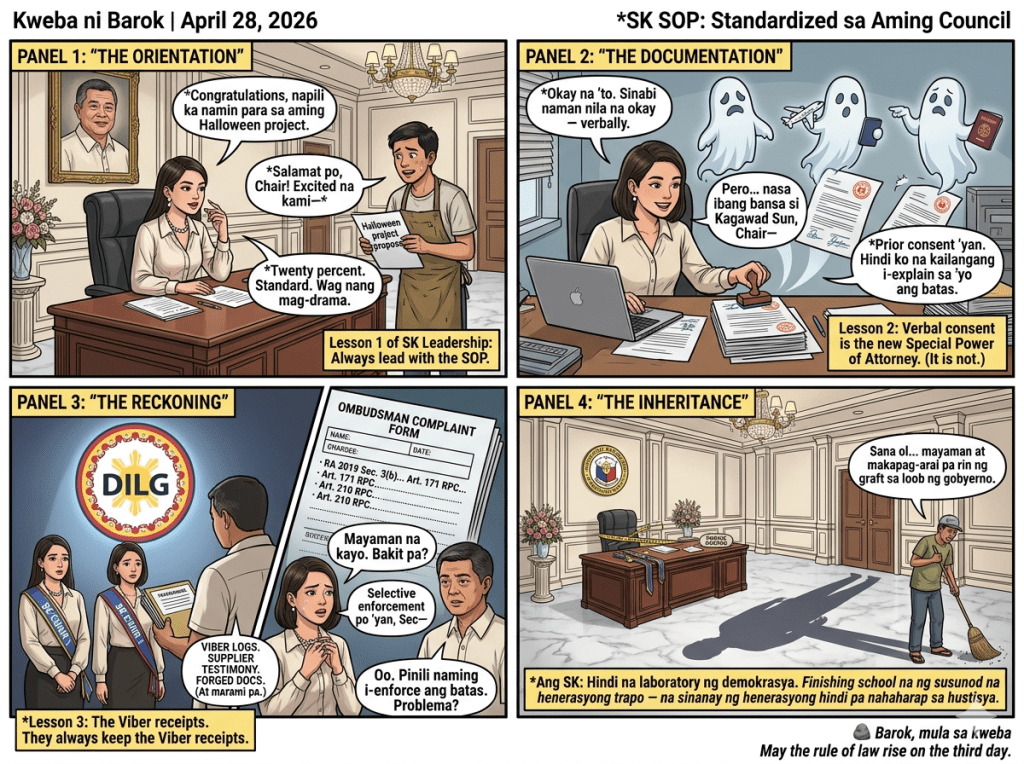
MAKATI, mga ka-kweba: Where the rich kids don’t just inherit wealth — they inherit the family tradition of creative procurement. Yet here we are, courtesy of Interior Secretary Jonvic Remulla and the DILG, watching two Sangguniang Kabataan (SK) chairpersons—Natalia Georgina Tupaz of Dasmariñas Village and Cecilia Louise Yabut of Magallanes Village—get suspended, shamed, and now slated for criminal complaints before the Ombudsman. Kickbacks. Forged signatures. Viber messages that read like a how-to manual for graft.
And the best part? They didn’t even have the decency to be subtle.
Ang pinakamahal na corruption sa Pilipinas ay ang sa mga hindi na kailangang magnakaw.”
Let’s start with the evisceration, because these two aren’t “naive youth leaders” who made “youthful mistakes.” They are precocious apprentices of the patronage machine, already fluent in the dialect of entitlement that their elders speak so fluently.
Tupaz allegedly demanded a 20 percent “SOP” from long-time supplier GM BC Catering and Services for a barangay Halloween project. When the supplier balked and reported it, Tupaz—via Viber and phone call—calmly affirmed the cut, uttering the immortal line: “Yan ang standardized sa aming council.” She later “generously” settled for ₱70,000. Oh, and she directed the sibling of her SK secretary (who was conveniently out of town) to sign an official resolution. Forgery as family service. This wasn’t a one-off lapse in judgment. This was corruption 101, delivered with the serene confidence of someone who believed the system existed to serve her, not the other way around.
Yabut’s defense is even more deliciously absurd. Procurement documents for another Halloween project bore the forged signatures of three SK kagawads—including Kagawad Ethan Sun, who was literally abroad at the time. When caught, Yabut admitted the signatures weren’t theirs but insisted she had “prior consent” and that it was “standard practice.” Ladies and gentlemen, behold the legal genius: prior verbal permission magically transforms forgery into authorized delegation.
Newsflash, Counselor Yabut: Public documents are not your barangay Facebook group chat. Under Philippine law, forging signatures on official resolutions, purchase requests, and certifications is straight-up Falsification of Public Documents (Act No. 3815 (Revised Penal Code), Art. 171). Verbal “consent” doesn’t cut it. You need a Special Power of Attorney—not a casual “go ahead, girl.” The law demands formality precisely because public office is a public trust (Article XI, Section 1 of the 1987 Constitution of the Republic of the Philippines). Your “everyone does it” defense is the same intellectually bankrupt drivel we hear from every trapo caught with his hand in the till. It doesn’t work for congressmen. It certainly doesn’t work for SK chairpersons who are supposed to be the antidote to, not the mirror of, adult venality.
These are not isolated sins. They are symptoms of a system that has turned the SK—once envisioned under Republic Act No. 10742 (Sangguniang Kabataan Reform Act of 2015) as a laboratory for democratic participation—into a finishing school for future dynasts. In elite barangays like Dasmariñas and Magallanes, where money is supposed to insulate against temptation, corruption doesn’t just survive; it thrives with better catering. Kickbacks learned before legislation. Forgery practiced before the first election poster. The SK has become less a training ground for public service than a mirror of adult political venality, where the children of privilege absorb the lesson that public office is transactional, signatures are flexible, and “SOP” is just another line item.
Cue the inevitable chorus: “Selective enforcement! Political timing! Makati factional rivalries!” Spare me. That critique is the intellectual equivalent of a white flag waved by apologists for the corrupt. Yes, Philippine politics is tribal. Yes, Remulla is no saint. But pretending that exposing graft in affluent enclaves is somehow unfair because “bigger fish” exist elsewhere is the laziest defense imaginable. A sincere anti-corruption crusade has to start somewhere—and starting with the small fry who will one day become the big fish is not just strategically sound; it is morally imperative. These SK chairs are not victims of selective prosecution. They are the canaries in the coal mine, proving that impunity doesn’t discriminate by age, wealth, or barangay class. Remulla’s move isn’t political theater. It’s the reluctant but necessary application of the scalpel to a wound that has been festering while everyone pretended youth politics was immune.
The administrative suspensions—six months for Tupaz, three for Yabut—are a mere appetizer. The criminal prosecution is the main course. Administrative cases run on substantial evidence; criminal ones demand proof beyond reasonable doubt. But the Ombudsman’s probable-cause threshold? Viber messages, supplier testimony, forged documents, and the chairs’ own admissions already clear that bar with room to spare. Republic Act No. 3019 (Anti-Graft and Corrupt Practices Act) Section 3(b) (demanding kickbacks in connection with government transactions) and Section 3(e) (grossly disadvantageous contracts through bad faith or manifest partiality) fit like a glove. Direct Bribery under RPC Art. 210 seals the kickback angle. Falsification under Art. 171 handles the signatures. And Constantino v. Sandiganbayan reminds us that actual damage to the government isn’t even required—bad faith alone suffices. Republic Act No. 6713 (Code of Conduct and Ethical Standards for Public Officials and Employees)’s Code of Conduct? Shattered. Fiduciary duty? Laughable.
And let’s talk about the invisible co-conspirators: the barangay officials who supposedly oversaw these “youth leaders.” Did they know? Did they condone? Did they instruct? The forged documents didn’t materialize in a vacuum. Their negligence—or worse, complicity—is the invisible ink on every falsified page. The ecosystem doesn’t stop at two chairpersons. It demands a full forensic sweep.
Tupaz has already resigned. Cute. But Pagano v. Nazarro (G.R. No. 149072, 2007) is crystal clear: resignation does not moot a validly filed administrative case, nor does it erase criminal liability. You don’t get to torch the house and then claim the insurance doesn’t apply because you moved out.
The likely trajectory? Ombudsman investigation, probable cause finding, Sandiganbayan trial. Or, in the more cynical Philippine tradition, a quiet political settlement and gentle fade into obscurity. The former restores faith. The latter confirms the cynicism. Remulla, to his credit, is pushing the former—coordinating with the Ombudsman, floating SK abolition if constitutional reform allows, and stating the obvious: “Ang nakakainis dito, mayaman na ang mga ’to—gusto pang magpayaman gamit ang pera ng gobyerno.”
This scandal is a clarifying revelation. It obliterates the patronizing myth that poverty breeds corruption. Here, in Makati’s richest enclaves, graft blooms in the hothouse of affluence and entitlement. It is a devastating blow to whatever civic morale the SK still possessed. But it is also a potential catalyst for genuine reckoning.
The rallying cry must be unequivocal:
Immediate, transparent investigation that extends beyond Tupaz and Yabut into the entire barangay ecosystem—treasurers, BAC members, barangay captains who looked the other way.
Full criminal prosecution of everyone liable. No plea bargains. No “youthful indiscretion” discounts. Public office is a public trust; betray it, and the law must bite.
Real reforms: Professionalize SK bookkeeping and procurement. Mandate digital signatures with audit trails. Third-party audits. Ethics certification. And yes—Remulla is right to force a national conversation on whether the SK, in its current form, is salvageable or whether it has become an expensive, redundant incubator of the very rot it was meant to cure.
Because if we cannot purge this foundational corruption from the roots, then all the lofty rhetoric about “youth empowerment” is just expensive theater. Jonvic Remulla didn’t create this mess. He’s simply refusing to look away from it. In a country drowning in selective amnesia, that alone makes his stance the only intellectually honest one on the table.
The rest is just noise from those who prefer their corruption with a side of plausible deniability.
Barok has spoken.
Key Citations
A. Legal & Official Sources
- Philippines. The 1987 Constitution of the Republic of the Philippines. 1987. Official Gazette of the Republic of the Philippines.
- Philippines. Republic Act No. 10742: An Act Establishing Reforms in the Sangguniang Kabataan Creating Enabling Mechanisms for Meaningful Youth Participation in Nation-Building, and for Other Purposes. 15 Jan. 2016. Official Gazette of the Republic of the Philippines.
- Philippines. Act No. 3815: An Act Revising the Penal Code and Other Penal Laws. 8 Dec. 1930. Lawphil.net.
- Philippines. Republic Act No. 3019: Anti-Graft and Corrupt Practices Act. 1960. Lawphil.net.
- Philippines. Republic Act No. 6713: An Act Establishing a Code of Conduct and Ethical Standards for Public Officials and Employees. 1989. Lawphil.net.
- Philippines, Supreme Court. Constantino v. Sandiganbayan. G.R. No. 140656, 13 Sept. 2007. Lawphil.net.
- Philippines, Supreme Court. Pagano v. Nazarro. G.R. No. 149072, 21 Sept. 2007. Lawphil.net.
B. News Reports
- ₱8B BBM Pork: CCTV for Every Captain’s Kumpare?
- ₱8.9 Billion, 331 Ghost Police Stations: The TIKAS Scandal Explained

- ₱8.4 Billion, 42,000 Barangays, 1 Election: The “Bawat Barangay Makikinabang” Vote-Buying Masterclass

- ₱75 Million Heist: Cops Gone Full Bandit

- ₱6.77B Ghost Haunts Duterte: RTC Dismisses Mans Carpio’s Desperate Plea

- ₱6.77 Billion and Zero Cash: The Sara Duterte SALN Math That Doesn’t Add Up

- ₱6.7-Trillion Temptation: The Great Pork Zombie Revival and the “Collegial” Vote-Buying Circus

- ₱58.53B, Zero Receipts: The LGSF Pork Barrel Nobody Wants to Name
- ₱53 Million Man Tells ₱695-a-Day Workers to Stop Being ‘Mayabang’: The Audacity of BSP’s Remolona

- ₱4.4 Billion and a Witness Who Can’t Explain It: The Duterte Impeachment’s Most Expensive Non-Answer
- ₱3.06 Billion for Evacuation Centers—But Nobody Knows Where They’ll Stand (Or If They’ll Exist)
- ₱16 Billion, 280 Accounts, 8 Helicopters: Boying Remulla’s Case Against the Yaps Is Not a Drill





Leave a Reply