
“Protective Custody” or Criminal Conspiracy? Carpio’s Brutal Takedown
By Louis ‘Barok‘ C. Biraogo — May 23, 2026
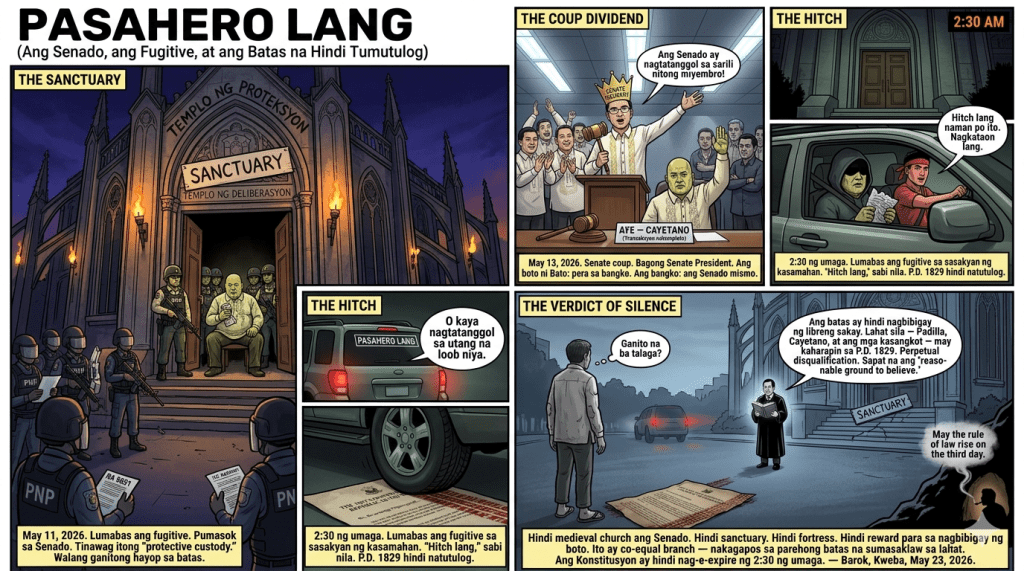
CUE the drama: Just past 2:30 in the morning on May 14, 2026, as the Senate pulled off its greatest disappearing act. The Philippine Senate — that supposed temple of deliberation — has just hosted a three-day standoff worthy of a bad action movie. Gunfire echoes in the legislative chamber on May 13. A senator with an active International Criminal Court (ICC) arrest warrant for crimes against humanity (murder, no less, tied to 32 deaths in the drug war) slips out not in a blaze of defiance, but in the passenger seat of a colleague’s vehicle. The Philippine National Police confirms it: the getaway car is registered to Senator Robin Padilla. Padilla himself admits the vehicle is his but insists, with a straight face, that Bato dela Rosa merely “asked to hitch a ride.”
The GMA News report frames this as a procedural drama centered on former Justice Antonio Carpio’s blistering legal takedown. It spotlights Carpio’s warnings while dutifully noting the “hitch” defense and the fresh Senate leadership under Alan Peter Cayetano. Yet the subtext screams louder than the gunfire: this is no innocent ride-share. A wanted man, shielded for days inside the Senate after resurfacing on May 11, uses a fellow senator’s SUV as his escape pod while the institution that once gave him cover pivots to call it a casual favor. The report subtly ties the escape to the “Senate coup” that installed Cayetano as president — a vote in which dela Rosa played kingmaker. Implicit conflict drips from every paragraph: law enforcement circling outside, a chamber suddenly declaring itself a fortress, and a new Senate leader now politically indebted to the fugitive. Unresolved tensions? The warrant’s enforceability, the meaning of “protective custody,” and whether the Senate just became an accessory after the fact. This is not politics as usual. It is the opening scene of a constitutional tragedy — a high-stakes farce where the rule of law is the punchline, and the audience (the Filipino people) is left wondering if the final act ends in accountability or another elite escape.
Carpio’s Legal Hammer: Irrefutable
Justice Carpio does not offer mere opinion; he delivers an irrefutable convergence of black-letter law, constitutional text, and binding precedent. His scalpel cuts clean.
On obstruction: Providing a getaway car and three days of “protective custody” are textbook violations of Presidential Decree No. 1829 (P.D. 1829). Section 1(c) criminalizes harboring, concealing, or facilitating the escape of any person one knows or has reasonable ground to believe has committed an offense. For public officers, conviction triggers the accessory penalty of perpetual absolute disqualification from holding office under the Revised Penal Code. Mock all you want the notion of the Senate chamber as a sanctuary — it is no such thing. The Senate is not a medieval church granting asylum; it is a co-equal branch bound by the same penal laws as everyone else.
On the farcical “immunity” defense: Article VI, Section 11 of the 1987 Constitution is mercilessly clear: Senators enjoy privilege from arrest only for offenses punishable by not more than six years imprisonment while Congress is in session. Crimes against humanity under Republic Act No. 9851 (RA 9851) carry reclusion temporal to reclusion perpetua — far exceeding six years. Carpio is textually unassailable. Even during session, arrest is permissible. People v. Jalosjos cements the principle: public office is not a get-out-of-jail-free card. Membership in Congress does not suspend criminal liability or turn the chamber into a safe house.
On the “no local warrant” canard: The Office of the Solicitor General has it right — the ICC warrant is domestically enforceable under RA 9851, which domesticates international criminal law and expressly allows cooperation with international courts. The Supreme Court’s Pangilinan v. Cayetano ruling drives the final nail: withdrawal from the Rome Statute does not erase pre-existing obligations for acts committed while the Philippines was still a member. The ICC Pre-Trial Chamber already found reasonable grounds; domestic enforcement does not require a separate Philippine court warrant in this context.
Every rationale Carpio advances stands on unbreachable constitutional and statutory ground. On the law, he is inescapably correct. The only missing ingredient is the political will to enforce it.
Defenders’ Flimsy Excuses: Collapsed
The defenders’ arguments collapse under the slightest pressure.
The “no intent” (mens rea) defense — that laughable “hitch” story — is a pathetic fig leaf. Knowledge of the widely publicized ICC warrant was inescapable. Coordinated actions over three days, a dramatic late-night departure in a colleague’s vehicle after a shooting incident, and the Senate’s own “protective custody” posture demonstrate willful blindness at best, deliberate facilitation at worst. P.D. 1829 does not require a signed confession; reasonable ground to believe is enough.
The separation of powers / Senate autonomy argument fares no better. “Protective custody” is exactly the “nonexistent legal animal” Carpio mocked. No constitutional provision, Senate rule, or statute grants the chamber power to shield a member from lawful criminal process. This is not inter-branch comity; it is a transparent conspiracy to harbor a fugitive — a grave abuse that no doctrine of legislative independence protects. Precedents involving arrests of sitting senators on Senate premises prove the point.
The sovereignty / ICC non-recognition argument is dispatched by Pangilinan v. Cayetano and RA 9851 itself. Domestic law provides the basis for cooperation. The real assault on sovereignty comes from officials who transform a legislative chamber into a lawless bastion, thumbing their noses at both domestic penal law and the state’s international obligations.
Rogues’ Gallery: Survival Circus
Strip away the legalese and what remains is pure Game of Thrones with worse acting.
Bato dela Rosa: No longer the swaggering former police chief, but a fugitive propelled by primal survival instinct — terrified of joining his former boss in The Hague.
Robin Padilla: The loyalist sidekick whose “hitch” defense is a masterclass in convenient ignorance. His motivation? Political solidarity and fear of a domino effect that could drag other Duterte-era figures into the dock.
Senate President Alan Peter Cayetano: The indispensable man of the hour. Dela Rosa’s decisive vote installed him in the coup; now the Senate has become a fortress to repay that debt. Transactional politics at its most naked — the entire institution placed in hock for one man’s escape.
The Marcos Administration: Caught in a self-made triangulation. It wants to appear compliant internationally while avoiding the domestic political cost of crossing a powerful loyalist bloc. The result is half-measures and dangerous ambiguity.
Forked Roads: Justice or Impunity?
The DOJ and Ombudsman must take the constitutionally sound path: immediate filing of obstruction charges under P.D. 1829 against Padilla, Cayetano, and involved security officials. The threat of perpetual disqualification is existential and overdue.
A quiet political settlement — accountability traded for legislative cooperation — is the most historically plausible outcome in this country, but it would be constitutionally devastating. It would legitimize elite impunity and leave a festering wound on the rule of law.
The Supreme Court must affirm RA 9851’s enforceability and Pangilinan’s logic, stripping away remaining fig leaves. Anything less invites perpetual crisis.
Barok’s Battle Cry: No One Above Law
This is not a mere scandal. It is a constitutional stress test for the Republic.
The rule of law must reign supreme — without exception, without favor, without expiration dates at 2:30 in the morning. Justice, fairness, and legality are not suggestions for the powerful; they are the iron girders holding the state together.
Demand an immediate, independent, transparent investigation into every sordid detail — from the Senate coup to the midnight “hitch,” from the gunfire to the getaway car. Let the public see exactly who aided and abetted a fugitive.
Above all, demand strict, meaningful accountability. Those responsible must answer fully to the law. Perpetual disqualification is not vengeance; it is prophylaxis. Institutional reforms must follow: clear protocols preventing the Senate — or any branch — from ever again becoming a criminal sanctuary. Strengthen inter-branch mechanisms so that “protective custody” remains the legal fiction it always was.
The verdict is as suspenseful as it is final: This affair will prove whether the Philippine Republic still believes that no one — not a senator, not a president-maker, not an entire chamber — stands above the law. The Constitution does not expire at 2:30 AM.
May the rule of law rise — and may the rogues fall.
Key Citations
A. Legal & Official Sources
- The 1987 Constitution of the Republic of the Philippines. LawPhil, https://lawphil.net/consti/cons1987.html.
- Presidential Decree No. 1829. Penalizing Obstruction of Apprehension and Prosecution of Criminal Offenders. 1981. LawPhil, https://lawphil.net/statutes/presdecs/pd1981/pd_1829_1981.html.
- Republic Act No. 9851. An Act Defining and Penalizing Crimes Against International Humanitarian Law, Genocide and Other Crimes Against Humanity, Organizing Jurisdiction, Designating Special Courts, and for Related Purposes. 2009. LawPhil, https://lawphil.net/statutes/repacts/ra2009/ra_9851_2009.html.
- Republic of the Philippines. Act No. 3815: An Act Revising the Penal Code and Other Penal Laws (The Revised Penal Code). 8 Dec. 1930, http://www.officialgazette.gov.ph/1930/12/08/act-no-3815-s-1930/.
- People of the Philippines v. Romeo G. Jalosjos. G.R. Nos. 132875-76. Supreme Court of the Philippines, 16 Nov. 2001, https://lawphil.net/judjuris/juri2001/nov2001/gr_132875_2001.html.
- Pangilinan v. Cayetano. G.R. No. 238875. Supreme Court of the Philippines, 16 Mar. 2021, https://lawphil.net/judjuris/juri2021/mar2021/gr_238875_2021.html.
B. News Reports
- Bonzo, Lyjah Tiffany. “Antonio Carpio: Officials, Bato Dela Rosa Penalty.” GMA News Online. GMA Network, https://www.gmanetwork.com/news/topstories/nation/988626/antonio-carpio-officials-bato-dela-rosa-penalty/story/.

- “Forthwith” to Farce: How the Senate is Killing Impeachment—And Why Enrile’s Right (Even If You Can’t Trust Him)
- “HINDI AKO NAG-RESIGN!”

- “I’m calling you from my new Globe SIM. Send load!”

- “Mahiya Naman Kayo!” Marcos’ Anti-Corruption Vow Faces a Flood of Doubt

- “Manageable” Debt, Unmanageable Lies: DBM’s ₱21 Trillion Fairy Tale
- “Meow, I’m calling you from my new Globe SIM!”

- “Natrabaho”: One Word, One Ombudsman, and a Judiciary on Trial

- “No Special Jail for Crooks!” Boying Remulla Slams VIP Perks for Flood Scammers

- “Philippine-Controlled” or Yankee Gas Station? The Davao Fuel Depot Farce Exposed

- “PLUNDER IS OVERRATED”? TRY AGAIN — IT’S A CALCULATED KILL SHOT

- “Several Lifetimes,” Said Fajardo — Translation: “I’m Not Spending Even One More Day on This Circus”

- “Shimenet”: The Term That Broke the Internet and the Budget





 KWEBA ni BAROK
Leave a comment