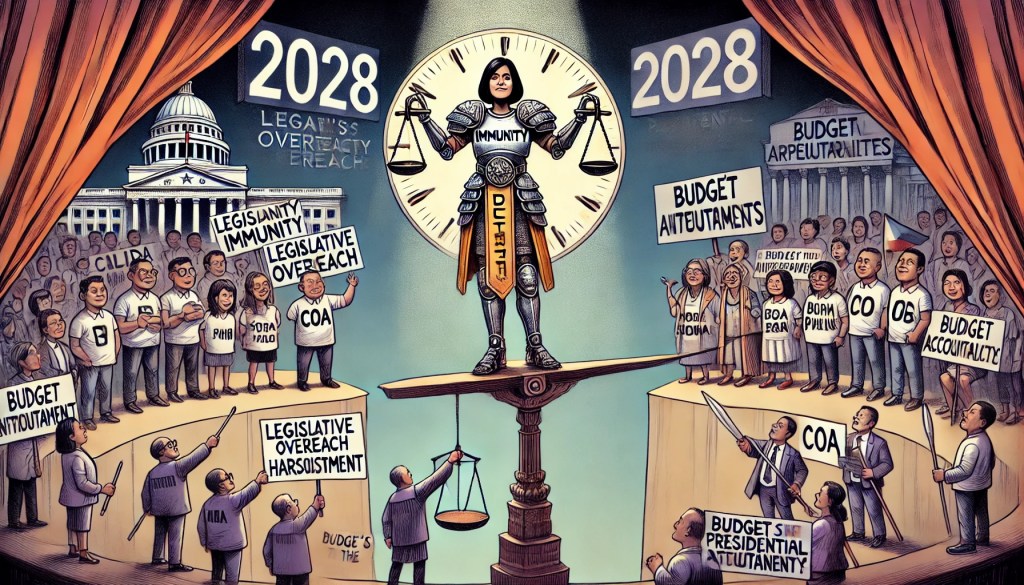
IN A gripping clash of power and principle, the recent House inquiry into the Office of the Vice President’s budget has thrown a harsh spotlight on Vice President Sara Duterte. With questions swirling about missing funds and unexplained expenses, Duterte’s bold refusal to participate in the investigation has sent shockwaves through the Philippine political landscape. But is this a sign of bureaucratic defiance—or a calculated move for the 2028 presidential race? The answer could shape the future of the executive and legislative branches.
The Heart of the Matter: Budget Mismanagement and Absentee Accountability
The controversy erupted with the findings by the COA and House panel pointing to questionable financial practices within the OVP and Department of Education, where Duterte concurrently served as Secretary. These allegations have pushed Congress to scrutinize OVP officials, who have repeatedly declined to attend, citing their roles as mere “resource persons” based on the Supreme Court’s Calida v. Trillanes ruling. This tactic, however, has drawn accusations of contempt—an extraordinary escalation that includes detention orders issued to four officials for evading subpoenas.
Legal Maneuvering: The Limits of Calida v. Trillanes
Duterte’s legal rationale rests heavily on Calida v. Trillanes, a Supreme Court precedent that protects government officials called as “resource persons” in legislative inquiries, arguing they are not under the same compulsion as defendants in a criminal case. But this interpretation skirts key distinctions: while Calida may protect officials from coercion in certain circumstances, it does not give blanket immunity to defy a subpoena—especially when there are clear allegations of misuse of public funds.
Moreover, the OVP officials’ actions—repeatedly ignoring both invitations and subpoenas—stretch beyond the scope of Calida. Under the Philippine Ethical Standards for Public Officials and Employees, government employees are required to act “with transparency and accountability.” Legal precedents stress that no official is exempt from oversight where there is a compelling legislative interest.
Philippine procedural law also delineates clear guidelines: if a House committee issues a subpoena, ignoring it invites contempt charges and, as seen here, even detention. Their position paper, though eloquent, fails to address the core obligation of public accountability under Article XI, Section 1 of the Philippine Constitution, which mandates all public officials to “at all times be accountable to the people.” Calida offers no refuge when the stakes involve substantive allegations of budget irregularities rather than mere “resource” appearances.
The Calculated Risk: A Presidential Gambit?
On the political front, Duterte’s refusal to engage appears less about constitutional nuance and more about the 2028 presidential race. The refusal to testify aligns with her narrative of being a persecuted candidate, framing herself as a target of a politically motivated investigation. This stance solidifies her support base and paints her as a crusader against perceived “legislative overreach,” a tactic intended to resonate with her voter base and shield her from immediate accountability.
This political calculus aims to shield Duterte until she potentially gains the ultimate immunity: the presidency. By cultivating an image of strength in the face of supposed harassment, Duterte strengthens her hand with allies while conveniently sidestepping legal jeopardy. In this sense, the strategy mirrors classic populist tactics—deflecting accountability through defiance.
Legal Reality Check: The Advantage Lies with Congress
Despite Duterte’s legal and political maneuvering, the current legal standing appears to favor Congress. Philippine jurisprudence reinforces Congress’s authority to investigate and hold officials accountable. The legislative branch, acting in its oversight capacity, has broad powers to summon witnesses and impose sanctions for contempt if defied. While Duterte and her team leverage public sentiment, their arguments face formidable hurdles under Philippine law.
Furthermore, their reasoning about “resource persons” carries limited weight when transparency laws and ethical standards unequivocally require public servants to address legitimate inquiries. The doctrine of legislative oversight is clear: Congress has an essential right to probe budgetary matters involving public funds, and this case is no exception.
The Path Forward: Toward Transparency and Accountability
For Duterte and her OVP officials, prolonging this standoff will only heighten suspicions and cement their perceived culpability. The OVP must confront the inquiry head-on, recognizing that even if politically inconvenient, accountability is foundational to democratic governance. Ignoring subpoenas exacerbates public mistrust and invites legal challenges that could damage Duterte’s presidential ambitions. Cooperating with Congress, albeit in limited capacity, may signal a commitment to transparency and disarm her critics.
The House of Representatives, meanwhile, should pursue a balanced approach, enforcing accountability without veering into overt partisanship. The House must exercise its oversight powers decisively while maintaining procedural fairness. Moreover, Congress should consider legislative reforms to clarify the scope of Calida in future cases, defining the rights and limitations of “resource persons” with precision.
Finally, the Filipino public must demand clear answers from their elected officials. True accountability can only be achieved when citizens hold leaders to account for their decisions and the public funds they administer. In this crucial prelude to the 2028 election, Filipinos deserve to know if those aspiring to lead them have acted with integrity and transparency.
In a political landscape rife with questions and shadows, only one path forward shines clear: accountability must prevail, and it must do so now.
- ₱8B BBM Pork: CCTV for Every Captain’s Kumpare?

- ₱8.9 Billion, 331 Ghost Police Stations: The TIKAS Scandal Explained

- ₱8.4 Billion, 42,000 Barangays, 1 Election: The “Bawat Barangay Makikinabang” Vote-Buying Masterclass

- ₱75 Million Heist: Cops Gone Full Bandit

- ₱6.77B Ghost Haunts Duterte: RTC Dismisses Mans Carpio’s Desperate Plea
- ₱6.7-Trillion Temptation: The Great Pork Zombie Revival and the “Collegial” Vote-Buying Circus

- ₱53 Million Man Tells ₱695-a-Day Workers to Stop Being ‘Mayabang’: The Audacity of BSP’s Remolona
- ₱3.06 Billion for Evacuation Centers—But Nobody Knows Where They’ll Stand (Or If They’ll Exist)
- ₱10B Ghost in New Clark City: Matibag’s Haunted Séance for Cayetano

- ₱1.9 Billion for 382 Units and a Rooftop Pool: Poverty Solved, Next Problem Please

- ₱1.35 Trillion for Education: Bigger Budget, Same Old Thieves’ Banquet

- ₱1 Billion Congressional Seat? Sorry, Sold Out Na Raw — Si Bello Raw Ang Hindi Bumili





Leave a comment