By Louis ‘Barok‘ C. Biraogo — April 4, 2025
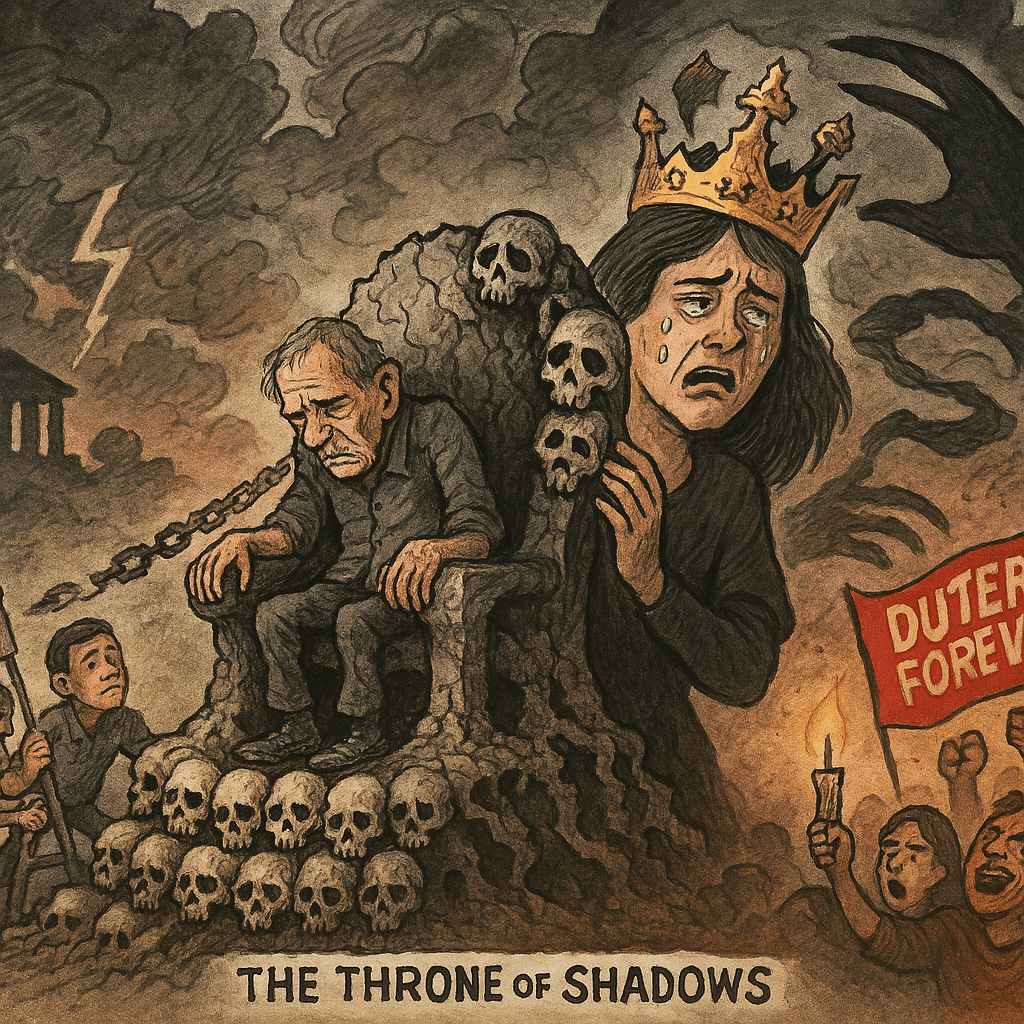
GRAY stone. Cold air. A black SUV slicing through the silence outside Scheveningen Prison. Then, Sara Duterte. Her expression? Unreadable. But the hurried steps of the two women trailing her – one her half-sister Kitty, the other their father’s partner Honeylet Avanceña – spoke volumes. Inside that formidable structure, the reason for this somber arrival sat alone: Rodrigo Duterte. The name alone once commanded headlines; now, it echoed in the stark confines of a cell.
As the heavy doors clanged shut, Sara embraced her father, tears streaming down her cheeks. “I have to thank Bongbong Marcos,” she later told reporters, “because there was forgiveness between me and my father.” Outside, a knot of loyalists chanted Rodrigo’s name, their voices a fading echo of the fervor that once swept him to power.
It was a scene drenched in irony: a family reunited not by triumph but by the cold grip of international justice, their gratitude directed at the man who facilitated Rodrigo’s arrest—President Ferdinand “Bongbong” Marcos Jr. This moment, raw and surreal, lays bare the collision of personal reconciliation and public downfall that defines the Duterte family’s current crisis.
Thrones Built on Blood: The Dynastic Roots of Power
The Philippines is a land where political power runs thick through bloodlines, a tapestry woven by families like the Marcoses, the Aquinos, and the Dutertes. Nearly 80% of candidates in the 2025 elections hail from political clans, a stark reminder that kinship, not merit, often dictates who rules.
The Dutertes are no exception. Rodrigo’s ascent from Davao City mayor to president in 2016 was built on a foundation of local dominance, a legacy he handed to his daughter Sara, who followed as mayor before rising to vice president in 2022. Her brothers, Paolo and Sebastian, have staked their own claims in the political arena, cementing the family’s grip.
Rodrigo’s presidency was a bloody affair, his “war on drugs” leaving over 30,000 dead—sons, daughters, brothers—according to human rights groups. It was a campaign that horrified the world but electrified a nation hungry for order, propelling him to an 80% approval rating by term’s end. Sara, riding that wave, has defended her father’s brutal legacy, her own star rising alongside his.
But the 2022 alliance with Marcos, a marriage of convenience between two dynasties, has since crumbled, exposing the fragility of their inherited authority.
Shackled Ties and Savage Fights: A Family Under Siege
Sociology offers a lens to decode the Duterte family’s unraveling. Family systems theory suggests that families are ecosystems, each member’s actions rippling through the whole. Rodrigo’s detention has forced a seismic shift: once a clan fueled by political ambition, they now huddle in a prison cell, trading strategies for stories.
Sara’s words reveal the depth of this change: “Growing up, he was always busy with work. Now, we have this every day with him talking about life, talking about family.” It’s a bond forged in crisis, a father and daughter finding intimacy amid the ICC’s shackles. Yet, as she notes, “It’s sad… inside the detention,” a reminder that justice has hijacked their private lives.
Zoom out, and conflict theory frames the broader war. The Marcos-Duterte feud is a Shakespearean clash of titans, two dynasties vying for supremacy. Their 2022 “UniTeam” victory masked simmering rivalries, but by 2025, the facade had shattered. Sara’s impeachment in February for corruption and incitement, coupled with Rodrigo’s arrest in March, marks the alliance’s collapse.
Her October 2024 outburst—threatening to “exhume Marcos Sr.’s corpse”—is a grotesque emblem of this decay, a daughter’s rage boiling over into dynastic vendetta. It’s a power struggle writ large, the Dutertes’ populist fire clashing with the Marcoses’ institutional muscle.
Then there’s Sara herself, a woman navigating a man’s game. In a patriarchal society, she’s crafted a “tough mayor” persona, punching sheriffs and defying norms. Yet she also plays the mother, her “Inday Sara” nickname blending strength with warmth. Her defiance of Marcos—death threats and all—empowers some, proving a woman can roar. But it risks alienating others, feeding stereotypes of female volatility in a system that spares men such scrutiny. Her balancing act is a tightrope walk, her gender both weapon and wound.
Heroes or Villains? The People’s Verdict
The Dutertes still command a loyal legion. Rodrigo’s charisma—crude, relatable, unapologetic—won hearts despite the blood on his hands. Sara inherits that magic, her base seeing resilience where others see recklessness.
But the ICC trial, targeting Rodrigo for crimes against humanity, and Sara’s scandals—misuse of funds, incitement—cast a long shadow. “My brother was gunned down in the streets,” says Maria Santos, a drug war widow, her voice trembling. “For us, there’s no forgiveness. Justice is long overdue.”
Human rights advocates cheer the ICC’s move, but loyalists outside Scheveningen chant on, blind to the graves left behind. What does it mean when a nation equates brutality with strength, when 80% cheer a leader accused of mass murder? It’s a question that haunts the Philippines, a society torn between charisma and accountability.
Double-Dealing on the World Stage: A Global Reckoning
The Marcos administration’s role in this drama reeks of duplicity. They handed Rodrigo to the ICC, a convenient purge of a rival, yet decry the court as a sovereignty thief. It’s a tightrope act: appease the world, appease the base.
This hypocrisy mirrors a global tug-of-war—nations wrestling with justice versus pride. The Philippines’ choice here ripples outward, a test case for whether accountability can pierce the shield of national ego.
Dynasty’s Doomsday? The Road Ahead
The 2025 midterms loom like a storm, a crucible for the Duterte dynasty’s fate. Paolo fights to hold his ground, running for reelection as Representative of Davao City’s 1st District, his campaign a bid to anchor the family’s stronghold. Sebastian, the incumbent Mayor, now aims lower, targeting Vice Mayor of Davao City, while their father, Rodrigo—despite his ICC shackles—runs for Mayor, a defiant jab from behind bars. It’s a desperate gambit to resurrect the Duterte flame, their name still a potent rallying cry in Mindanao. Yet the ICC trial, with Rodrigo at its core, and Sara’s impeachment threaten to extinguish their resurgence. Younger Filipinos—60% of voters under 35—grow restless, their TikTok feeds ablaze with calls to end dynastic rule. The election could be a reckoning: a clan clawing back power or a dynasty finally entombed.
Smashing the Crown: A Way Out
Filipinos hold the key. The 1987 Constitution bans political dynasties, a promise gathering dust. It’s time to enforce it—push lawmakers, fund grassroots, back independents. Educate the young, amplify the victims’ cries.
The Duterte saga is a warning: when families become kingdoms, democracy bleeds.
Reflections in a Broken Mirror: The Nation’s Soul
This isn’t just the Dutertes’ story—it’s the Philippines’ soul laid bare. A family clings together in a cell, their power fraying, their nation watching.
Will it choose reform over reverence, justice over lineage? The answer rests not with Sara or Rodrigo, but with the people they’ve shaped—and scarred.

- “Ang Hirap Maging Mahirap”: The PAO Scandal That Proves Government Contempt Is Nothing New
- “Far-Off” My Axx: Malacañang’s Claire Castro Drowns in Her Own Legal Gaslighting
- “Forthwith” to Farce: How the Senate is Killing Impeachment—And Why Enrile’s Right (Even If You Can’t Trust Him)

- “HINDI AKO NAG-RESIGN!”

- “I Know Nothing”: Baste Duterte’s Amnesia Defense Meets ₱33M in GenCorp Contracts
- “I’m calling you from my new Globe SIM. Send load!”

- “Mahiya Naman Kayo!” Marcos’ Anti-Corruption Vow Faces a Flood of Doubt

- “Manageable” Debt, Unmanageable Lies: DBM’s ₱21 Trillion Fairy Tale
- “Meow, I’m calling you from my new Globe SIM!”

- “Natrabaho”: One Word, One Ombudsman, and a Judiciary on Trial
- “No Special Jail for Crooks!” Boying Remulla Slams VIP Perks for Flood Scammers

- “Philippine-Controlled” or Yankee Gas Station? The Davao Fuel Depot Farce Exposed




Leave a comment