By Louis ‘Barok‘ C. Biraogo — July 7, 2025
IMAGINE an 82-year-old widow, hands trembling as she counts coins at a Manila grocery counter, forced to choose between discounted rice and heart medication because a “promo price” voids her senior citizen discount. Picture a wheelchair-bound war veteran, his medals hidden in a drawer, denied a 20% markdown on a discounted hospital bill, pride eroded by a cashier’s shrug. These are not hypotheticals but daily indignities faced by millions of senior citizens and persons with disabilities (PWDs) in the Philippines, where systemic loopholes turn equity promises into cruel mirages.
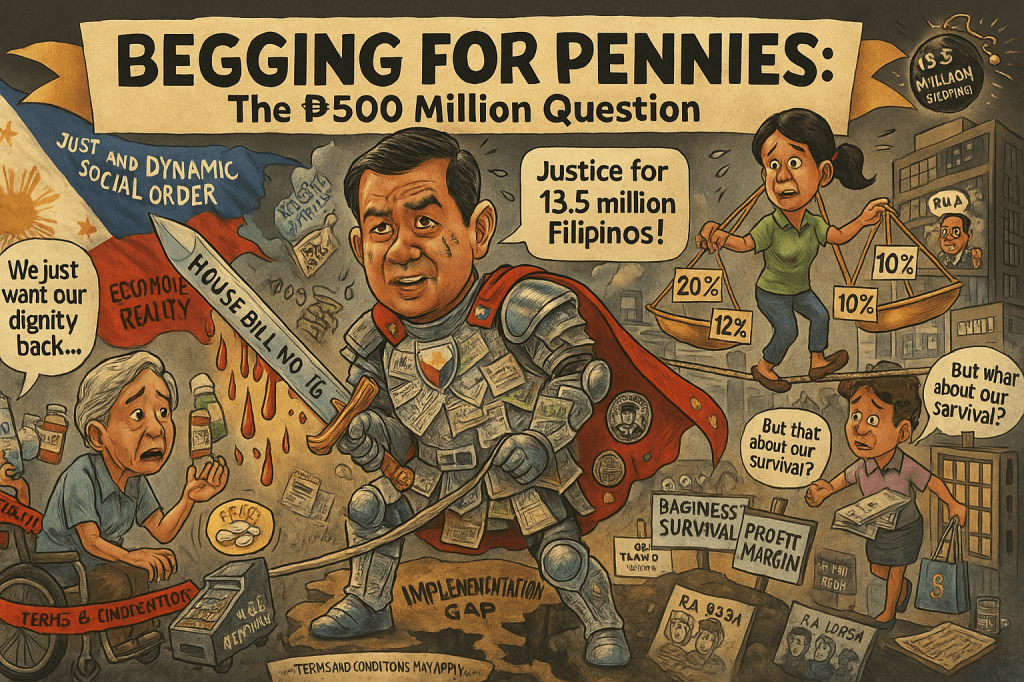
Enter House Bill No. 16, a high-stakes gambit by Leyte 1st District Rep. Ferdinand Martin Romualdez, a populist crusader whose latest battle could either uplift 13.5 million Filipinos or unravel small businesses’ fragile margins. Filed on June 30, 2025, this bill is a ticking time bomb—its fuse lit by moral urgency, shadowed by economic peril. Will it deliver justice, or collapse under its own ambition?
Faces of Forgotten Promises: The Human Toll
The urgency of House Bill No. 16 pulses through stories like Aling Rosa’s, a 67-year-old diabetic grandmother I met in Quezon City. She recounted how a pharmacy refused her senior discount on discounted insulin, citing “store policy.” Her ₱8,000 monthly pension barely covers rent and food, yet she navigates a labyrinth of loopholes to afford life-saving drugs. Then there’s Mang Tony, a 72-year-old stroke survivor, denied a discount on a promo-priced wheelchair because “it’s already on sale.”
These are not outliers but symptoms of a broken system. The Philippines’ 12 million seniors and 1.5 million PWDs lose an estimated ₱500 million annually to non-stacked discounts, translating into skipped meals, forgone treatments, and eroded dignity Philippine News Agency, July 4, 2025.
Romualdez casts himself as a relentless champion, building on his 2016 victory with Republic Act No. 10754, which secured VAT exemptions for PWDs, benefiting 1.5 million Filipinos Philstar, July 4, 2025. Yet, nearly a decade later, the spirit of that reform is betrayed by businesses sidestepping discounts during promotions. A 2024 Starbucks scandal, where confusion over a one-item discount policy sparked viral outrage, exposed the chaos Inquirer.net, January 30, 2024.
House Bill No. 16, co-authored with Tingog Party-list Reps. Jude Acidre and Andrew Julian Romualdez, mandates that the 20% discount and 12% VAT exemption apply on top of promotional offers. This isn’t a tweak—it’s a war on a system forcing the vulnerable to beg for their rightful benefits.
Clash of Ideals: Justice vs. Survival
For the Bill: A Moral Reckoning
House Bill No. 16 is rooted in the Philippine Constitution’s Article XIII, which demands a “just and dynamic social order” prioritizing marginalized groups. The current system, where seniors and PWDs choose between promo prices or their mandated 20% discount and VAT exemption, betrays this mandate.
The ₱65 weekly grocery discount cap, set by a 2010 DTI-DA order, is a pittance against inflation rates exceeding 6% in recent years Philippine News Agency, March 19, 2024. For a senior spending ₱1,300 weekly on groceries, the cap limits savings to ₱65, while stacking discounts could save ₱260 or more. Romualdez’s bill ensures these benefits apply even to promo-priced goods, potentially saving families hundreds monthly.
Economically, the bill isn’t a reckless handout. By allowing businesses to treat discounts and VAT exemptions as deductible expenses under Section 34 of the National Internal Revenue Code, it cushions profit margins Inquirer.net, July 5, 2025. This compromise nods to market realities, encouraging compliance without crippling retailers. The bill aligns with 2024’s increase in monthly grocery discounts to ₱500, boosting purchasing power for 13.5 million Filipinos and potentially stimulating retail, which drives 70% of GDP.
Against the Bill: The Cost of Compassion
Opponents warn of a “death by discounts” for small and medium enterprises (SMEs), which employ 60% of the workforce. A sari-sari store owner in Davao told me stacking a 20% discount atop a 10% promo could erase her margins, forcing price hikes for non-seniors. The Philippine Retailers Association, while silent on this bill, has historically cautioned that excessive discounts strain micro-businesses Manila Bulletin, January 15, 2024.
Large retailers might offset losses by raising base prices, indirectly burdening all consumers. Implementation is a nightmare waiting to unfold. The 2024 Starbucks scandal showed how poorly trained staff can spark disputes over discounts Inquirer.net, January 30, 2024. Cashiers, often minimum-wage workers, may struggle with stacked discount calculations, leading to conflicts or refusals.
Critics also highlight fraud risks, with 1,700 variants of fake PWD IDs circulating, per the Hotel and Restaurant Association, complicating compliance Manila Bulletin, January 15, 2024.
Echoes Beyond the Counter: Social and Political Stakes
Socially, the bill could restore dignity to seniors and PWDs, who feel like second-class citizens when denied benefits. Yet, there’s a risk of stigma if businesses view them as “profit-killers,” a sentiment whispered in retail circles.
Politically, Romualdez is playing a high-stakes game. His advocacy—from the 2016 PWD law to 2024’s DTI crackdown—brands him a champion of the vulnerable, a narrative that could propel him toward higher office in a populist-leaning nation Philippine News Agency, March 19, 2024. Failure to balance business interests, however, could alienate a powerful constituency, tarnishing his legacy.
Globally, the bill stands out. Japan’s 10% non-stackable senior discounts prioritize simplicity but offer less relief, while Sweden’s universal cash subsidies require fiscal muscle the Philippines lacks OECD Social Protection Report, 2024. Stacking discounts suits the Philippines’ cash-poor context, where direct subsidies are underfunded.
But the bill’s ambition rests on a fragile pillar: enforcement. Past laws, like the 2010 Expanded Senior Citizens Act, languished until Romualdez’s 2024 probes forced compliance Philippine News Agency, March 19, 2024. Without vigilance, House Bill No. 16 risks the same fate.
Romualdez’s fight is not new—his past battles reveal a pattern of ambition and obstacles, as this sidebar explores.
Sidebar: Romualdez’s Battle Against History
House Bill No. 16 is not Romualdez’s first clash with discount loopholes, nor the Philippines’ first brush with unfulfilled promises. The 2010 Expanded Senior Citizens Act (R.A. 9994) promised 20% discounts and VAT exemptions, but lax enforcement left benefits unrealized. Romualdez’s 2016 law (R.A. 10754) expanded PWD benefits, yet businesses exploited the “promo exemption” loophole Philstar, July 4, 2025.
In 2024, House Bills 10061–10063 aimed to stack discounts but stalled in the Senate Philippine News Agency, March 19, 2024. House Bill No. 16 adds tax deductions to win business buy-in, but history warns: bold laws falter without follow-through. Will this bill break the cycle, or join its predecessors in the dustbin of good intentions?
The Uncomfortable Truth: Enforcement Over Intent
Here’s the inconvenient reality: the bill’s success hinges not on its passage but on its execution. Romualdez’s 2024 DTI crackdown exposed rampant non-compliance—hotels, pharmacies, and coffee chains flouting discount laws. The Pasig City Prosecutor’s Office charged a hotel for denying a senior’s discount, a rare win in a sea of violations Manila Bulletin, January 15, 2024.
House Bill No. 16’s promise of stacked discounts is a moral triumph, but can the math hold? Without robust enforcement—clear DTI guidelines, trained inspectors, and penalties with teeth—it risks becoming another paper reform, leaving Aling Rosa and Mang Tony fighting for scraps.
This bill is a litmus test for the Philippines’ commitment to its 12 million seniors and 1.5 million PWDs, navigating rising costs and shrinking safety nets. Romualdez’s vision is bold, but boldness alone won’t suffice. As the bill moves through Congress, it carries the weight of millions of lives.
When a nation’s elders must beg for pennies off promos, who truly pays the price of indifference?
Path Forward: Recommendations for Success
To ensure House Bill No. 16 delivers without destabilizing businesses:
- Phased SME Rollout: Implement gradually, starting with large retailers in 2026, giving SMEs until 2028 to adapt systems and budgets.
- Anti-Fraud Biometric IDs: Integrate senior and PWD IDs into the eGov PH Super App with biometric verification to curb fake IDs, as proposed in House Bill 10063 Philippine News Agency, March 19, 2024.
- DTI Complaint Hotline: Establish a dedicated hotline and online portal for seniors/PWDs to report non-compliance, with fines for repeat offenders.
- Subsidized Training for Businesses: Offer government-funded workshops to train cashiers and managers on discount calculations and compliance.
- Biannual Economic Review: Mandate a DTI-led review every two years to assess impacts on prices, promotions, and SME viability, adjusting tax deductions as needed.
A Nation’s Soul on Trial: Will Justice Prevail?
This bill tests the Philippines’ commitment to its 12 million seniors and 1.5 million PWDs, who navigate rising costs with shrinking safety nets. Romualdez’s vision is a beacon, but beacons alone don’t guide ships to shore. The stories of Aling Rosa, Mang Tony, and millions like them demand more than promises—they demand action. Enforcement, not intent, will determine whether this bill ignites change or gathers dust. As Congress debates, the nation must confront a searing truth: a society that forces its elders to beg for pennies off promos betrays its own soul. Will the Philippines rise to honor its vulnerable, or pay the price of indifference?
Key References
- Philippine Constitution’s Article XIII: Demands a “just and dynamic social order” prioritizing marginalized groups.
- Philippine News Agency, July 4, 2025: Details House Bill No. 16’s provisions and Romualdez’s statements.
- Philstar, July 4, 2025: Covers the bill’s filing and its alignment with past PWD reforms.
- Inquirer.net, July 5, 2025: Outlines the bill’s tax deduction provisions and economic balance.
- Philippine News Agency, March 19, 2024: Discusses 2024 legislative efforts and the increase in grocery discount caps.
- Inquirer.net, January 30, 2024: Covers the Starbucks discount controversy and public discourse.
- Manila Bulletin, January 15, 2024: Reports on Romualdez’s investigations into discount non-compliance.
- OECD Social Protection Report, 2024: Provides global context on senior and disability benefits.






Leave a Reply