By Louis ‘Barok‘ C. Biraogo — July 8, 2025
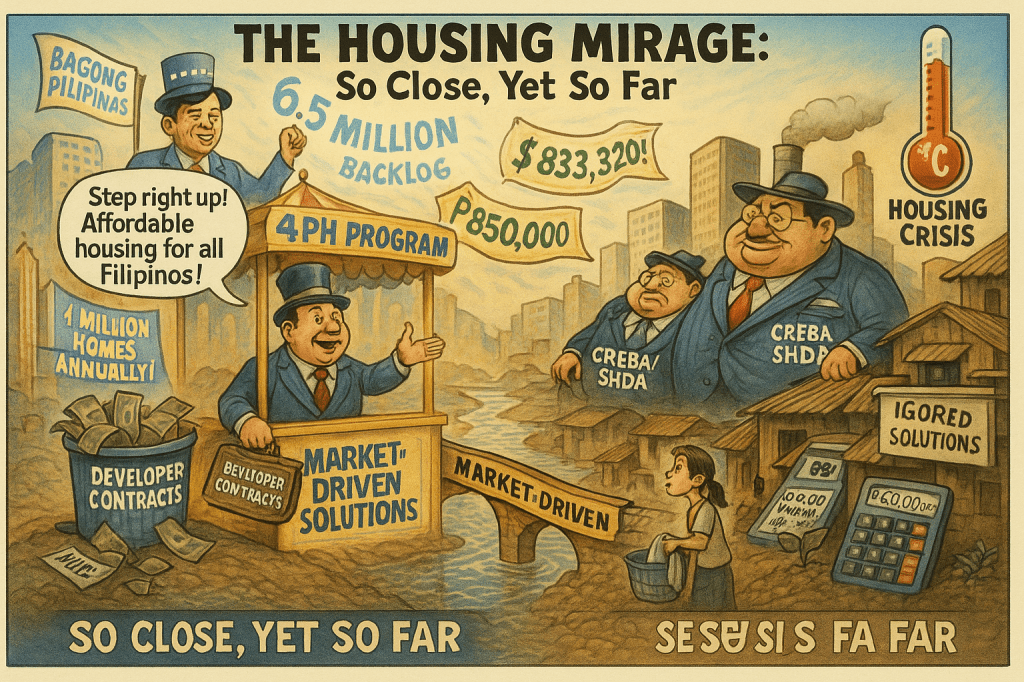
IN Manila’s teeming slums, where families like Juanita’s—a 34-year-old laundry worker earning 1,500 pesos ($25) a week—huddle in fragile shanties, the Philippine government’s Pambansang Pabahay para sa Pilipino (4PH) Program dangles a tantalizing promise: a million homes annually, a roof for every Filipino by 2028. Yet, as the Department of Human Settlements and Urban Development (DHSUD) pushes price ceilings skyward—up to 1.62 million pesos ($27,000) for a 27-square-meter condo—the program’s fatal flaw glares: it’s crafting homes for a market the poor can’t touch.
The Great Housing Divide: Promises vs. Harsh Realities
The DHSUD, led by Secretary Jose Ramon P. Aliling, defends raising price ceilings under Joint Memorandum Circular No. 2023-003 as essential to entice private developers, whose capital is deemed vital to scale the 4PH program and tackle a 6.5-million-unit housing backlog. The argument is simple: construction costs have spiked since 2018, making old caps—like 580,000 pesos for subdivision units—unworkable. New ceilings, from 850,000 pesos for 28-square-meter subdivision homes to 1.62 million for high-rise condos, aim to keep projects profitable, spurring developers to meet the goal of a million units yearly.
Assistant Secretary Frank Lloyd Gonzaga calls this a balance of “affordability and sustainability,” echoing President Marcos’ vision of a “Bagong Pilipinas” where “no Filipino is left behind” (DHSUD, 2025).
But the data tells a bleaker story. A 2023 Philippine Institute for Development Studies (PIDS) report found that 70% of Filipinos couldn’t afford the previous price ceilings, let alone the new ones. For Juanita’s family, scraping by on 6,000 pesos monthly, a 933,320-peso condo—the cheapest under new caps—demands amortizations of 3,500–4,000 pesos, dwarfing the 30% income threshold (1,800 pesos) for affordability (Inquirer, 2023).
Urban planner Nathaniel von Einsiedel warns these adjustments make housing “even more unaffordable to the majority” (CREBA, 2024). Senate Minority Leader Aquilino Pimentel III slams the condo-centric model as “out of tune” for rural poor or street-dwellers needing livelihood-compatible homes (Inquirer, 2023).
The contradiction is glaring: DHSUD’s pledge of inclusivity crashes against a reality where the poorest are priced out. The agency’s market-driven approach assumes private developers can solve a crisis rooted in systemic poverty. As PIDS notes, “the problem of low-income housing is not housing; it’s low income” (PIDS, 2023).
Aliling’s Pivot: Bold Reform or Developer-Friendly Facade?
Aliling’s leadership marks a shift from former Secretary Jose Rizalino Acuzar’s condo-heavy focus, expanding 4PH to include horizontal housing and aligning with an 8-Point Agenda for sustainability and stakeholder engagement. The Technical Working Group (TWG), tasked with reviewing price ceilings by October 2025, includes industry giants like the Chamber of Real Estate and Builders’ Associations (CREBA) and Subdivision and Housing Developers Association (SHDA) (DHSUD, 2025).
But is this progress or posturing? Horizontal housing could address condos’ unsuitability for informal settlers, who need space for tools or small businesses. Yet, the TWG’s developer-heavy makeup raises red flags. CREBA, a vocal advocate for higher price ceilings and tax breaks, prioritizes industry profits over the marginalized, who lack a seat at the table (CREBA, 2024).
PIDS, by contrast, pushes for public housing and rental models, noting that ownership-focused programs cede asset control, undermining long-term affordability (PIDS, 2023).
The October 2025 deadline signals caution, not urgency. With the target slashed from 6 million to 3.2 million units and only 400 condos ready for turnover in Davao City by January 2025 (BusinessWorld, 2024), the program lags its lofty rhetoric. Aliling’s agenda hints at reform, but without clear income criteria—say, targeting households below 24,000 pesos monthly—it risks being a developer-friendly rebrand rather than a pro-poor overhaul.
Priced Out and Pushed Away: The Poor’s Plight
For the poorest Filipinos, 4PH is a cruel paradox. Juanita, washing clothes in Tondo’s slums, earns 1,500 pesos weekly, barely covering food and utilities. A 4,000-peso amortization is unthinkable. The condo-centric model, while land-efficient, often relocates informal settlers to peripheral sites, severing ties to jobs and social networks (Inquirer, 2023).
Valenzuela City’s Disiplina Village, with 300-peso monthly rentals, proves local solutions can work, using land banking to keep housing central and affordable (PIDS, 2023). Why isn’t this model national?
The numbers are merciless: families earning 10,000 pesos monthly face amortizations eating 40% of income, flouting affordability standards. PIDS estimates 70% subsidies are needed for ownership to work for the poor, yet current subsidies favor lower-middle-income earners with 20,000 pesos monthly (PIDS, 2023). This risks 4PH units serving salaried workers or OFWs, not the 6.5 million households in dire need. Condos, rigid in design, also fail informal workers needing space for livelihoods, unlike Valenzuela’s flexible rentals.
Ignored Solutions: Why Not Rethink Housing Entirely?
DHSUD’s resistance to Community Land Trusts (CLTs) baffles. Globally, CLTs—where nonprofits own land and lease it affordably for 99 years—ensure permanent affordability. Over 260 CLTs thrive in the U.S., controlling resale prices to keep homes accessible (PIDS, 2023). Valenzuela’s low-rent model echoes this, yet DHSUD clings to developer-driven ownership.
Why? Developer lobbying looms: CREBA and SHDA, key TWG players, profit from higher price ceilings and tax breaks, while CLTs threaten their margins by de-commodifying land (CREBA, 2024).
PIDS champions rental housing and land banking, where LGUs acquire tax-delinquent properties for public use. Valenzuela’s use of eminent domain proves this viable, yet few LGUs follow, despite mandates under the Urban Development and Housing Act (PIDS, 2023). Ownership models, where units are sold, strip government control, unlike rentals that preserve assets for future needs. PIDS also pushes beneficiary-focused subsidies, like vouchers, which empower the poor directly, not developers.
Fixing the Broken Blueprint: A Roadmap Forward
To make 4PH truly inclusive, DHSUD must act boldly:
- Immediate: Anchor price ceilings to regional income data, capping amortizations at 30% of median incomes (e.g., 1,800 pesos for 6,000-peso earners). Mandate LGUs to adopt CLTs or land banking, scaling Valenzuela’s model.
- Structural: Redirect subsidies from developer tax breaks to direct beneficiary aid, like vouchers, which PIDS deems more effective (PIDS, 2023). Prioritize rentals to retain public asset control and ensure long-term affordability.
- Transparency: Launch a public DHSUD dashboard tracking unit occupancy, beneficiary incomes, and project costs, exposing whether 4PH serves the poorest or subsidizes the lower-middle class.
A Reckoning for “Bagong Pilipinas”
The 4PH’s vow of “zero informal settlers” mocks families like Juanita’s, for whom a 1.62-million-peso condo is as distant as the moon. If the government seeks a true housing revolution, it must face a hard truth: zero accountability in its housing calculus. By embracing CLTs, empowering LGUs, and centering the poorest, the Philippines can build not just homes but hope. Anything less betrays the “Bagong Pilipinas” it claims to forge.
Key References
- DHSUD reviews housing price ceilings to support 4PH. Daily Tribune, July 5, 2025.
- 4PH housing program: inspired, but…. CREBA, September 17, 2024.
- Rethinking the government’s socialized housing program. Philippine Daily Inquirer, November 2, 2023.
- 4PH Program: Government’s tool in addressing the housing crisis. BusinessWorld, February 14, 2024.
- 4PH: Many still can’t afford P4,000 monthly housing payment. Philippine Daily Inquirer, July 29, 2023.
- Philippine Institute for Development Studies (PIDS). PIDS Reports, October 26, 2023.

- ₱9 Billion in ‘Savings’? DILG’s Fire Truck Deal Smells Like Smoke

- ₱8B BBM Pork: CCTV for Every Captain’s Kumpare?
- ₱8.9 Billion, 331 Ghost Police Stations: The TIKAS Scandal Explained

- ₱8.4 Billion, 42,000 Barangays, 1 Election: The “Bawat Barangay Makikinabang” Vote-Buying Masterclass

- ₱75 Million Heist: Cops Gone Full Bandit

- ₱6.77B Ghost Haunts Duterte: RTC Dismisses Mans Carpio’s Desperate Plea

- ₱6.77 Billion and Zero Cash: The Sara Duterte SALN Math That Doesn’t Add Up

- ₱6.7-Trillion Temptation: The Great Pork Zombie Revival and the “Collegial” Vote-Buying Circus

- ₱58.53B, Zero Receipts: The LGSF Pork Barrel Nobody Wants to Name
- ₱53 Million Man Tells ₱695-a-Day Workers to Stop Being ‘Mayabang’: The Audacity of BSP’s Remolona

- ₱4.4 Billion and a Witness Who Can’t Explain It: The Duterte Impeachment’s Most Expensive Non-Answer
- ₱3.06 Billion for Evacuation Centers—But Nobody Knows Where They’ll Stand (Or If They’ll Exist)







Leave a Reply