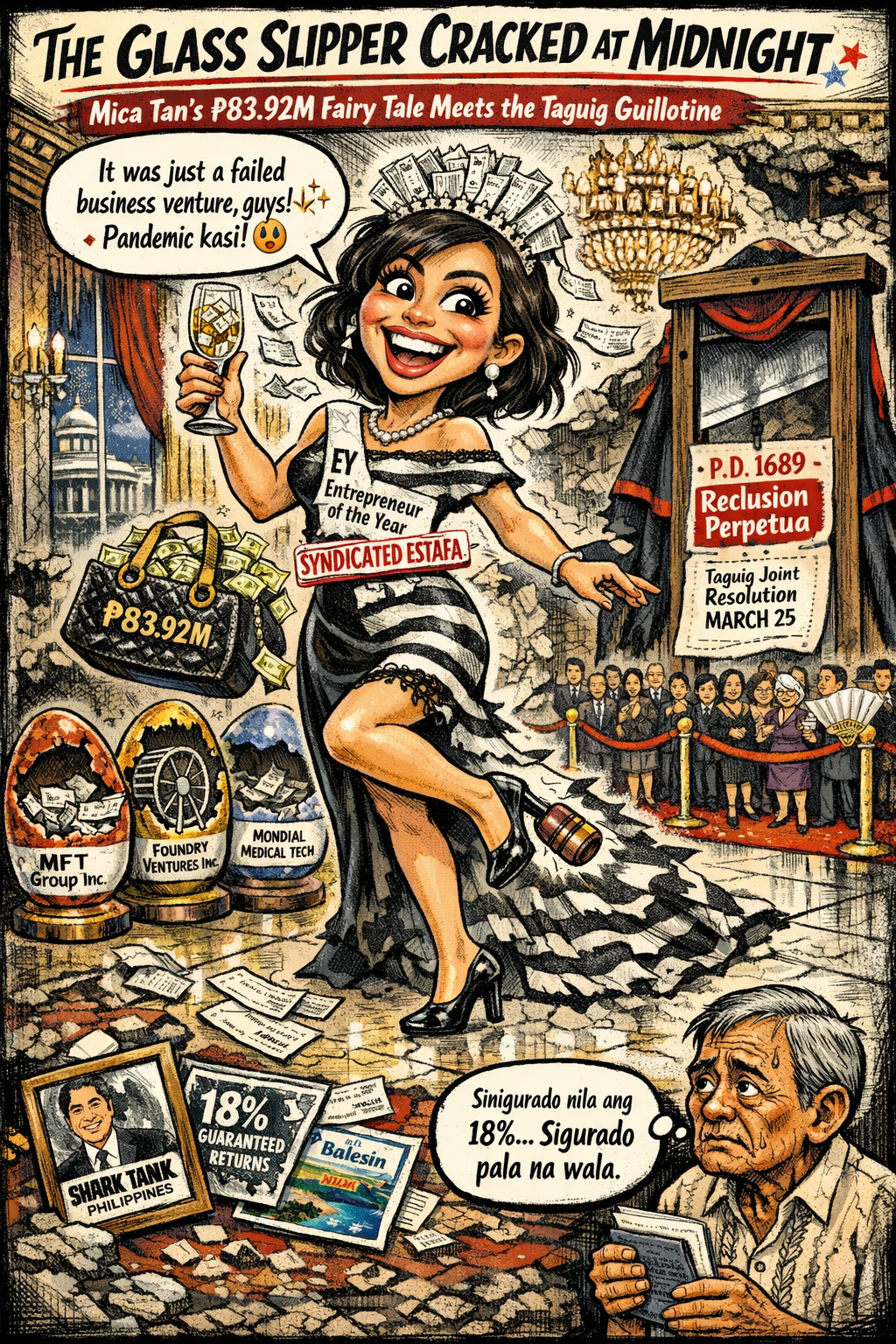
From Shark Tank Darling to Syndicated Estafa Accused: The ₱83M MFT Empire Collapses
By Louis ‘Barok‘ C. Biraogo — April 16, 2026
MGA ka-kweba, ladies and gentlemen, grab your gavels and your strongest coffee. On April 13, 2026, Bilyonaryo dropped the kind of bombshell that makes defense counsel choke on their La Tondena. The Taguig City Prosecutor’s Office—bless their 48-page joint resolution dated March 25—has just handed down what amounts to a legal death sentence in everything but name: non-bailable syndicated estafa against Maria Francesca Dela Fuente Tan-Cancio (a.k.a. Mica Tan, millennial Shark Tank darling, EY Entrepreneur of the Year nominee, Balesin junket queen) and exactly four of her alleged co-conspirators.
Five souls. ₱83.92 million. Nineteen complaints consolidated from 32 allegedly fleeced investors. One gleaming corporate troika—MFT Group of Companies Inc., Foundry Ventures I Inc., Mondial Medical Technologies Inc.—now rebranded by the State as a “Rube Goldberg machine of financial chicanery” bearing every “hallmark of a Ponzi-type scheme.”
But wait—there’s a catch in the fine print of this resolution, mga ka-kweba. Thirty-five other respondents, including family matriarch Florita F. Tan, walk away untouched. Batas Pambansa Blg. 22 (B.P. 22) charges? Poof—dismissed for insufficient evidence. And the defense is already sharpening its Motion to Quash, whispering the magic words: “failed business venture.”
Buckle up. We are not here to summarize. We are here to eviscerate.
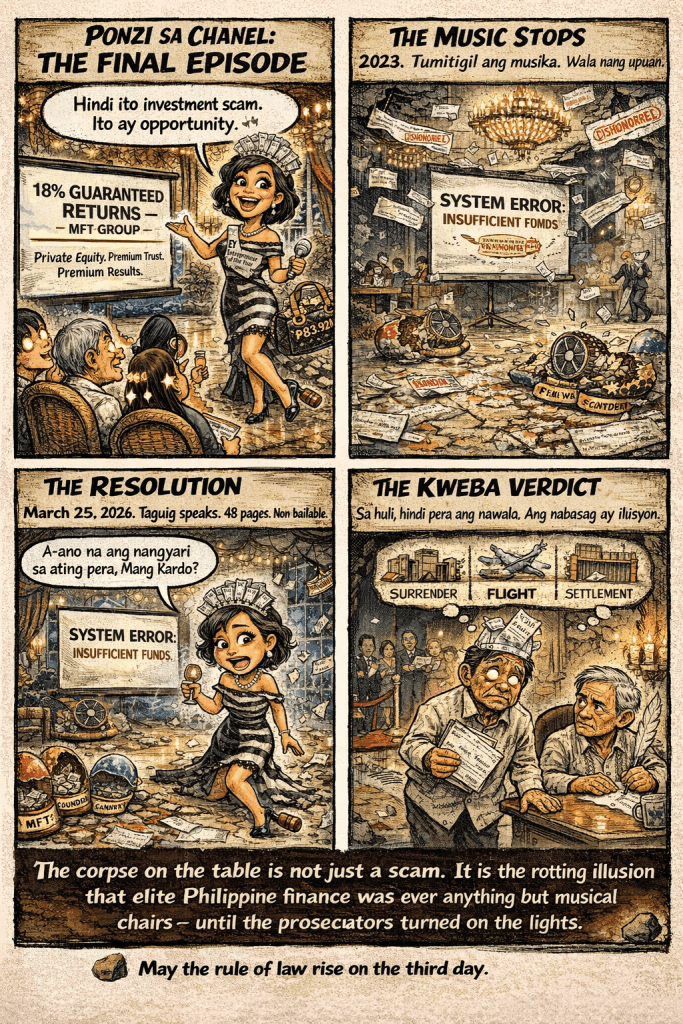
Ponzi Pretense or Pandemic Excuse? The Bouncing Checks Scream Fraud
Let us begin with the core question prosecutors have already answered with prosecutorial thunder: Was this a legitimate private-equity darling that simply caught the pandemic’s cold, or a pre-engineered fraud architecture dressed up in PowerPoint slides and 18% “guaranteed” returns?
The resolution doesn’t mince words. It finds prima facie evidence of systematic solicitation, false pretenses, misrepresentations, and—crucially—the classic Ponzi choreography: new investor money quietly funneled to pay old ones to keep the illusion of legitimacy alive. That, my friends, is not “mismanagement.” That is the silent, screaming corpus delicti.
Enter the Post-Dated Checks Charade. Even though the B.P. 22 charges were tossed (insufficient evidence, they say), those bouncing instruments remain the prosecution’s Exhibit A. Post-dated checks issued against Taguig banks, handed to investors like IOUs from a casino high-roller who knew the vault was empty. They weren’t “reassurance.” They were fraudulent inducement wrapped in negotiable paper. When the music stopped, the checks bounced louder than a bad karaoke night in Boracay. Intent? Crystal. The checks didn’t just bounce—they screamed “we knew this was coming.”
Now, the Insolvency Timeline—the single most damning factual pivot. The resolution implies the house of cards was insolvent long before the final domino fell. Investor funds allegedly never recorded as liabilities or equity in audited statements (hello, PwC Philippines affiliate Isla Lipana & Co. scrutiny). Instead, they were recharacterized as “dividends” to inflate the books. When did liquidity evaporate? Not in the cruel spring of 2023 when complaints rained down. The prosecutors smell inception-level deceit: the very incorporation and solicitation of the MFT troika was built on the premise of cycling money, not creating value. Pandemic? Convenient scapegoat. This wasn’t a business that “imploded.” This was a scheme that ran out of fresh marks.
Cynical takeaway: A legitimate venture fails. A Ponzi collapses exactly when new suckers stop lining up. The resolution just called the latter by its government name.
Cast of Five: Why the Inner Circle Fries While the Untouchable 35 Swim Free
Ah, the “Why Only Five?” Mystery—prosecutorial precision or the oldest game in Philippine justice: small fish in the net, big fish in the yacht?
Charged: Mica Tan herself, Charles Edward Tan, Enrique Eduardo Tan, Christian Konstantin P. Agbayani, and Roxanne Agbayani. All incorporators, officers, directors, or “active participants” acting with “single criminal intent.” Cleared: Thirty-five others, including the family’s very own Florita F. Tan, the matriarch of the Tan clan and mother of Mica Tan. The resolution cites “lack of prima facie evidence with reasonable certainty of conviction.” Translation: the evidence against the Untouchable 35 was apparently too thin to survive the “reasonable certainty” test. Or—whisper it—was the net cast wide enough to satisfy public outrage but narrow enough to protect the real money?
Mica Tan & Co.’s Motivation Autopsy: Greed wrapped in grandiose delusion and a “girlboss” PR campaign that aged like unrefrigerated leche flan. Her defense? “Smear campaign” by faceless enemies with “ulterior motives.” A five-year “recovery program” was supposedly offered. Pandemic force majeure, private loans between consenting adults, yada yada. The resolution’s response is withering: the operation bore every Ponzi hallmark. The media-savvy “prodigy” persona, the Balesin junkets for big-ticket investors, the recruitment commissions—these weren’t marketing. They were the velvet rope into the trap.
The Cleared 35? The stench of respondeat superior without the handcuffs. Nominal directors, passive incorporators, family members who apparently knew nothing while the money flowed. Or so the prosecutors decided. Cynics will call it selective justice. The rest of us call it the Philippine way: the pyramid stays intact if you cut off only the visible tip.
The Victims? Let us retire the “greedy investor” trope with extreme prejudice. Yes, some were high-net-worth sharks chasing 18% in a 3% world—FOMO is a hell of a drug. But others were guppies who sold assets, raided retirement funds, or borrowed from relatives because a charismatic Tsinoy scion promised the moon. Blame the victims? Only if you enjoy kicking widows on the way to the bank. The real scandal is how easily trust and celebrity turned private equity into a high-yield slaughterhouse.
Cynical takeaway: In the Philippines, justice is blind—but it has excellent peripheral vision when it comes to who gets charged.
Legal Guillotine Loaded: Statutory Nukes and SC Precedents Ready to Fire
The prosecutors did not come to play. They came armed with:
- Article 315 of the Revised Penal Code (Act No. 3815) – deceit + damage via false pretenses and fraudulent inducement.
- Presidential Decree No. 1689 (P.D. 1689) – the nuclear option: five or more persons (check), corporation/association soliciting public funds (double check), single criminal intent to siphon (triple check). Penalty: reclusion perpetua to death. Non-bailable when evidence of guilt is strong.
- Republic Act No. 8799 (Securities Regulation Code) – unregistered investment contracts, unlicensed solicitation, fraud in securities transactions. The promissory notes and PDCs? Classic “investment contracts” under the Howey Test Philippine edition (see Power Homes Unlimited).
Jurisprudential backup is ironclad. People v. Balasa (G.R. No. 106357) confirms P.D. 1689 covers any corporate vehicle used to solicit public funds. People v. Aquino (G.R. No. 234818) and People v. Mateo (G.R. No. 210612) are the prosecution’s love letters: organized group + misappropriation of solicited money = life behind bars.
Now, the Defense’s Hail Mary — this hypothetical Motion to Quash lurking in the wings. “This is a mere failed business venture!” it wails. “Civil liability at most!” The audacity is chef’s kiss. The motion argues absence of fraudulent intent at inception, no true syndicate, vague allegations, improper joinder, and — my personal favorite — misapplication of syndicated estafa because these were supposedly “private loans between individuals.”
Mockery level: maximum. You cannot stand in open court, face life imprisonment, and claim “oops, just a civil dispute” while your corporate layering, post-dated checks, and Ponzi mechanics stare back like a guilty verdict in waiting. The motion is theater. It buys time for a bail petition, a DOJ review, or—let’s be real—a quiet settlement that makes this all disappear with a wrist-slap and a confidentiality clause.
Cynical takeaway: When the penalty is life, every defense motion suddenly discovers the “failed business” defense. The Supreme Court has seen this movie before. Spoiler: it rarely ends with acquittal.
Elite Fallout: Surrender, Flight, or Wrist-Slap Settlement? Rule of Law vs. Sacred Cows
Options for Team Tan?
- Surrender and fight in Taguig RTC—risking immediate detention because non-bailable.
- Flight risk (again?)—the 2025 Batangas warrant drama suggests this is not their first rodeo. Extradition treaties exist, assets are frozen, and “fugitive status” looks terrible on LinkedIn.
- Settlement—the quiet Philippine specialty. Offer restitution, plead to a lesser charge, let the civil suits evaporate in mediation. Victims get pennies on the dollar, the Tsinoy elite preserve face, and everyone goes home for dinner.
The chilling effect on Philippine venture capital is already glacial. Who wants to touch private equity when a “guaranteed” 18% return can land you in Muntinlupa? The reputational nuclear winter for the Tsinoy elite is brutal: the very surname that once opened doors now triggers SEC audits. And the SEC? Its credibility war against unregistered “investment contracts” just received a 48-page shot of adrenaline.
The Resolution – No Sacred Cows: The rule of law demands supremacy here. No “but she’s a girlboss” exceptions, no family-name discounts, no “pandemic made me do it.”
Concrete recommendations:
– DOJ: Fast-track trial, resist easy plea bargains that dilute the syndicate precedent.
– SEC: Mandatory registration and audited disclosures for any note/PDC promising returns above bank rates.
– Investing public: If it sounds too good to be true and comes with Balesin tickets, it is a Ponzi wearing perfume.
The Taguig resolution is not the end. It is the opening argument in a legal thriller whose final act will either restore faith in Philippine markets—or confirm that in this country, the house always wins until the prosecutors finally says “checkmate.”
Cynical takeaway: In the end, the corpse on the table is not just an ₱83.92-million investment scam. It is the rotting illusion that Philippine elite finance was ever anything but a high-stakes game of musical chairs—until the music stopped and the prosecutors turned on the lights.
Barok has spoken. The autopsy is complete. Pass the body bags.
Key Citations
A. Legal & Official Sources
- Philippines. Act No. 3815: An Act Revising the Penal Code and Other Penal Laws. 8 Dec. 1930. Lawphil.
- Philippines. Batas Pambansa Blg. 22: An Act Penalizing the Making or Drawing and Issuance of a Check Without Sufficient Funds or Credit and for Other Purposes. 1979. Lawphil.
- Philippines, Supreme Court. Power Homes Unlimited Corporation v. Securities and Exchange Commission. G.R. No. 164182, 26 Feb. 2008, LawPhil.
- Philippines, Supreme Court. People of the Philippines v. Aquino. G.R. No. 234818, 5 Nov. 2018. Lawphil.
- Philippines, Supreme Court. People of the Philippines v. Balasa. G.R. No. 106357, 3 Sept. 1998. Lawphil.
- Philippines, Supreme Court. People of the Philippines v. Mateo. G.R. No. 210612, 9 Oct. 2017. Lawphil.
- Philippines. Presidential Decree No. 1689: Increasing the Penalty for Certain Forms of Swindling or Estafa. 6 Apr. 1980. Lawphil.
- Philippines. Republic Act No. 8799: The Securities Regulation Code. 2000. Lawphil.
- Motion to Quash. Hypothetical defense pleading for Maria Francesca Dela Fuente Tan-Cancio et al. in the Taguig syndicated estafa case, 2026. Kweba ni Barok. – PDF
B. News Reports
- Mencias, Eileen. “Mica Tan, 4 Others Face Non-Bailable Estafa Charges in MFT-Linked Investment Scam.” Bilyonaryo.com, 13 Apr. 2026.
- Camus, Miguel R. “How PwC Philippines Got Entangled in Mica Tan’s MFT Group Scandal.” InsiderPH, 11 July 2025.
“`





Leave a Reply