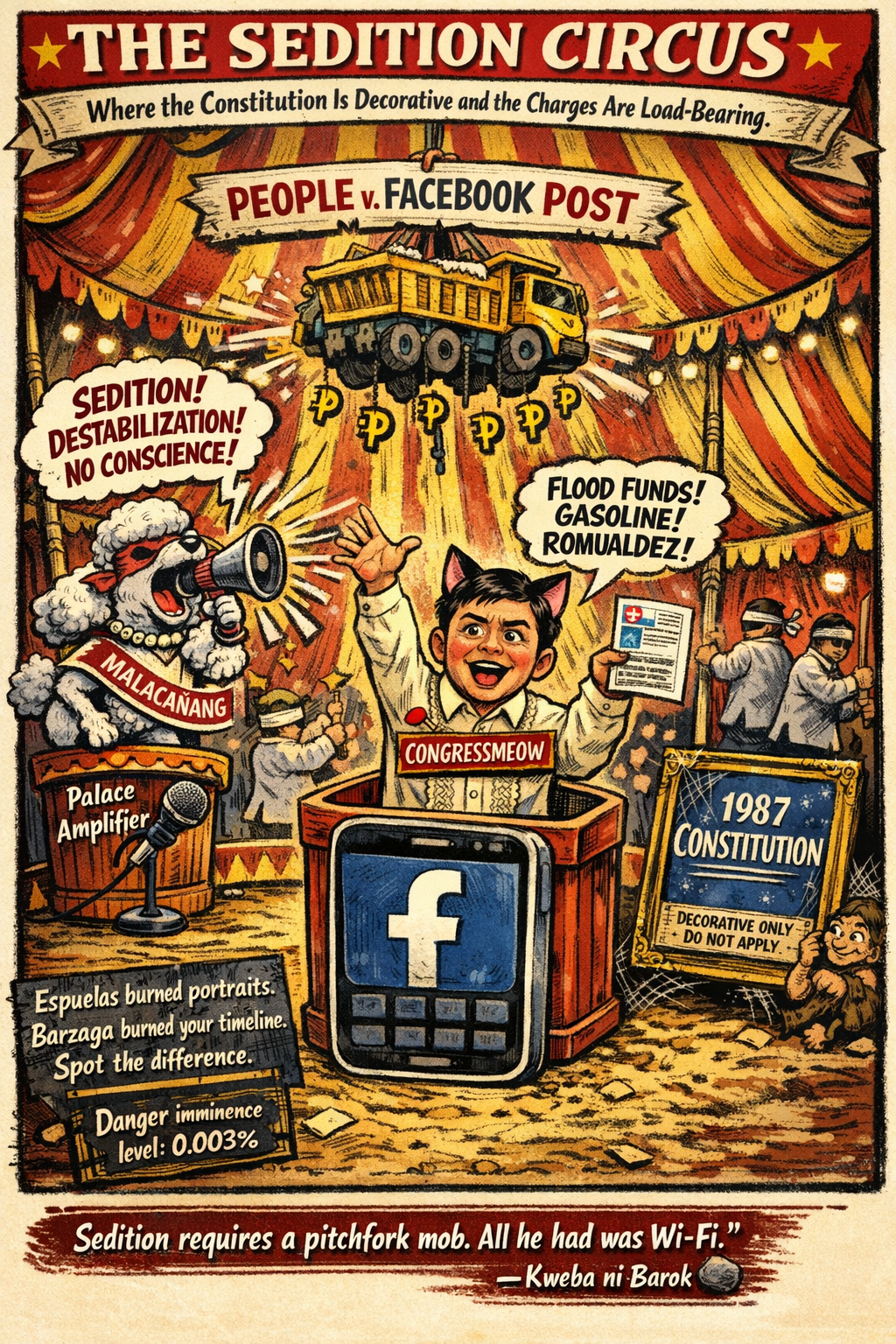
Protected Speech or Destabilization Plot? The Absurd Legal Theater Starring Barzaga, Marcos, and Claire Castro
By Louis ‘Barok‘ C. Biraogo — April 16, 2026
Legal Starvation Diet: Palace Threat Constitutionally Constipated
MGA ka-kweba, ladies and gentlemen, welcome to the latest episode of Philippine Democracy: The Reckoning—a tawdry telenovela where a 27-year-old congressman with a “Congressmeow” TikTok brand accuses the President of pocketing flood-control billions, the Palace screams “sedition!” like a Victorian maiden spotting a bare ankle, and the entire cast forgets that the Constitution is not optional reading.
Cavite 4th District Rep. Kiko Barzaga surrenders on eight cyberlibel warrants (private complainants, thank you very much), posts a scorched-earth Facebook manifesto blaming Marcos for his “imprisonment,” flood-fund theft, and gasoline Armageddon, and—poof!—Palace mouthpiece Claire Castro declares it “inciting to sedition.” The date is April 15, 2026. The venue: the court of public derision. Curtain up. Let the evisceration begin.
Article 142 of Act No. 3815 (Revised Penal Code) demands more than a salty Facebook rant. It punishes speeches, writings, or posts that
- (1) incite others to commit the acts in Article 139 (tumultuous uprising to prevent law execution or oust officials by force/intimidation) or
- (2) utter seditious words/libels that “lead or tend” to disturb peace, obstruct officers, or “stir up the people against the lawful authorities.”
The Supreme Court has long insisted on the clear-and-present-danger test—not the dusty “dangerous tendency” relic of the American colonial era. See Cabansag v. Fernandez (1957) and its progeny: the evil must be “extremely serious” and the “degree of imminence extremely high.”
Barzaga’s post? A political broadside from an elected representative alleging corruption in flood projects and fuel pricing, capped with a call for removal. Unwise? Possibly. Seditious? Legally malnourished. No “rise up now with torches and pitchforks.” No mobilization. No imminent riot. Just the same performative fury every opposition congressman has hurled since Quezon. The Palace’s “inciting” label fails the test spectacularly—exactly as Bayan v. Ermita (G.R. No. 169838, 2006) warned when it struck down the Calibrated Preemptive Response policy: speech restrictions require actual danger, not administrative panic.
Republic Act No. 10175 (Cybercrime Prevention Act of 2012) fares no better as a blunt instrument. Disini v. Secretary of Justice (G.R. No. 203335, 2014) upheld cyberlibel but only because libel remains unprotected speech when false and malicious. Barzaga’s bribery allegations against Romualdez allies and Razon? If unsubstantiated, they stink of malice. But as fair comment on public-interest scandals (flood-control kickbacks documented in COA reports and Senate whispers), they sit squarely in the zone of qualified privilege. The eight counts smell like SLAPP—Strategic Lawsuit Against Public Participation—weaponized by the powerful to bankrupt critics.
Under the 1987 Constitution of the Republic of the Philippines: “No law shall be passed abridging the freedom of speech, of expression, or of the press…” Chavez v. Gonzales (G.R. No. 168338, 2008) eviscerated prior-restraint attempts on the “Hello Garci” tapes precisely because government warnings chill dissent without proving imminent harm. Espuelas v. People (G.R. No. L-2990, December 17, 1951)—the Palace’s favorite ghost—convicted a man for a fake suicide note urging children to burn presidential portraits. That was scurrilous libel calculated to inflame. Barzaga’s post is closer to a campaign speech than a Molotov cocktail.
Verdict on the law: The sedition threat is constitutionally constipated—full of gas, zero substance. It collapses under clear-and-present-danger scrutiny.
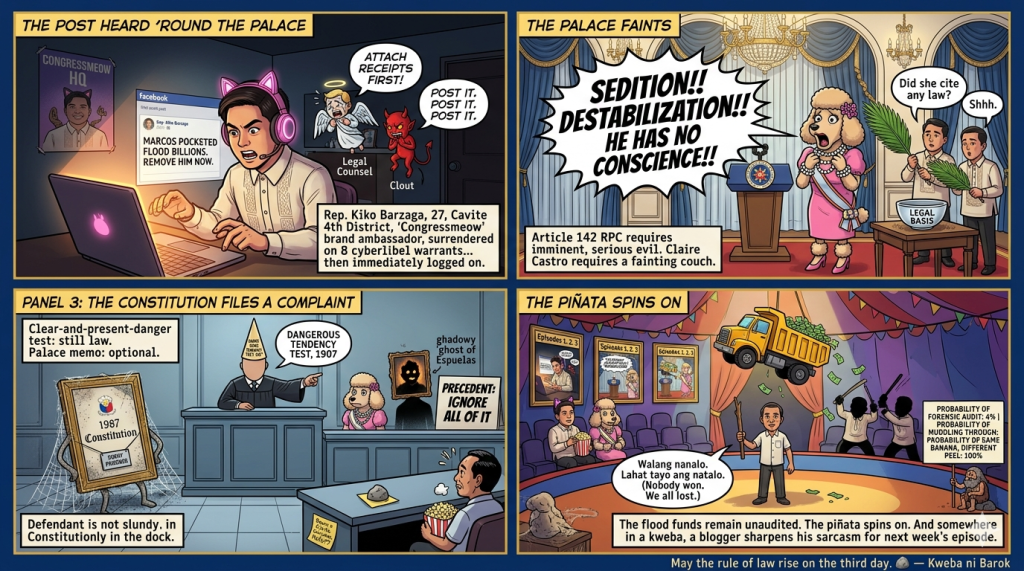
Autopsy of the Absurd: Equal-Opportunity Evisceration
Elpidio “Kiko” Barzaga Jr. –
- For: Whistleblower cosplaying as Gen-Z hero exposing flood-control industrial complex kickbacks (10-25% documented in whistleblower testimony).
- Against: Dynasty scion who apologized, deleted posts, then escalated to “remove Marcos now” without dropping a single forensic receipt. Plausible motivation? Political repositioning after resigning from the majority—classic Cavite revenge porn.
- Strategic blunder: eight cyberlibel counts he still hasn’t substantiated.
- Hypocrisy score: 9/10.
- Merciless verdict: Heroic in ambition, amateur in evidence. Produce the receipts or retract, Congressman Meow.
Ferdinand “Bongbong” Marcos Jr. / Malacañang –
- For: Duty to defend stability amid fuel-price pain and flood scandals. Private complainants filed the libel suits, not the Palace—technically correct.
- Against: Labeling criticism “destabilization” reeks of the old martial-law playbook. Overreach aroma? Pungent. Chilling effect? Already freezing netizens who remember Duterte-era sedition drag-nets.
- Motivation: coalition discipline and narrative control.
- Blunder: turning a backbencher into martyr.
- Verdict: The Emperor is not amused, but the Emperor is also not above the law.
Claire Castro – The Palace’s designated attack poodle.
- For: Accurate on the private-complainant point.
- Against: “No conscience” ad-hominem is what happens when you have no facts.
- Performance: Oscar-worthy in contempt, zero in persuasion.
- Verdict: Loyal soldier in a losing war of optics.
Behind the Curtain: Hidden Hands and Institutional Rot
Behind the curtain lurks Martin Romualdez and the flood-control industrial complex—billions in “ghost” projects, 10-25% kickbacks, COA flags, Senate probes, and a resigned Speaker. Barzaga’s original sin was naming Razon and NUP lawmakers in the Romualdez speaker-support bribery saga. This isn’t Marcos vs. Barzaga; it’s intra-coalition fracture with the flood-fund piñata at stake.
Zoom out: DOJ selective prosecution (cyberlibel as SLAPP), judicial capture (dynasty-friendly benches), congressional oversight as cosplay, and the eternal Philippine talent for “muddling through” instead of forensic audits or lifestyle checks. The system isn’t broken; it’s working exactly as designed—by the powerful, for the powerful.
Scalpel Time: Free Speech Fault Lines and the Chilling Freeze
- Protected Political Speech: Art. III, Sec. 4 + Bayan v. Ermita + Chavez v. Gonzales = Barzaga’s core is shielded. Criticism of public officials on public funds is the oxygen of democracy.
- No Imminent Threat: Clear-and-present-danger requires imminence, not “could theoretically rile someone up.” Barzaga has no army, no rally turnout, no “rise up” operational plan.
- Palace Overreach & Authoritarian Aroma: Sedition threats against elected critics echo PP 1017-era abuses struck down in Bayan v. Ermita.
- Chilling Effect: Every congressman now wonders if tomorrow’s Facebook post earns a warrant. Democracy shivers.
- Political Weaponization Perception: Cyberlibel + sedition = rule-of-law erosion. Public already believes the game is rigged. Perception is reality when trust is zero.
Action Stations: Receipts or Retraction, Now
- Barzaga: Drop the evidence in open court or retract like a man. No more “shitposting” without spreadsheets.
- Strengthen institutions: Pass the Anti-Dynasty Bill (yes, again), full FOI, genuine anti-SLAPP legislation.
- Rule of law: Independent flood-control prosecutor, mandatory lifestyle checks on all involved, forensic audit of DPWH 2023-2025 disbursements.
Resolution Roulette: Philippine Muddling-Through Odds
- Muddling Through (85%): Preliminary investigations drag, Barzaga posts more memes, Palace issues more press releases, public forgets by next typhoon. Classic.
- Political Settlement (10%): Backchannel deal—Barzaga moderates, cases quietly dismissed.
- Legal Bloodbath (4%): SC eventually slaps down sedition (see Chavez v. Gonzales precedent) but cyberlibel grinds on for years.
- Escalation to Impeachment/Protests (1%): Requires 1/3 House votes and actual public rage. LOL.
Fallout Forecast: Trust Erosion and Precedent Poison
- Free Speech Precedent: If sedition sticks, Chavez v. Gonzales and Bayan v. Ermita are hollow. Dissent contracts.
- Governance Credibility: Flood funds remain black hole; gasoline anger festers.
- Political Stability: Signals coalition cracks; emboldens Duterte-adjacent factions.
- Public Trust: What little remains evaporates. Filipinos already know the score: “same banana, different peel.”
Manifesto from the Kweba: The Line That Must Not Bend
Philippine democracy does not die in darkness—it dies in the fluorescent glare of Malacañang press briefings where “inciting to sedition” is the new “fake news.” The line between dissent and sedition must remain bright, not politically adjustable. Barzaga must prove his case or shut up. The Palace must defend with evidence, not epithets. And the rest of us—citizens, bloggers, lawyers in caves—must keep spelunking the rot until the flood-control vampires and their enablers are dragged into the sunlight.
Because if the Constitution is merely decorative, then we are not a republic. We are a reality show with worse writing than a Sunday soap opera.
— Barok
(Kweba ni Barok, where the truth is always under construction and the sarcasm is load-bearing.)
Key Citations
A. Legal & Official Sources
- Philippines. Act No. 3815: An Act Revising the Penal Code and Other Penal Laws. 8 Dec. 1930. Official Gazette of the Republic of the Philippines.
- Philippines. Republic Act No. 10175: An Act Defining Cybercrime, Providing for the Prevention, Investigation, Suppression and the Imposition of Penalties Therefor and for Other Purposes. 12 Sept. 2012. Official Gazette of the Republic of the Philippines.
- Philippines. The 1987 Constitution of the Republic of the Philippines. 1987. Official Gazette of the Republic of the Philippines.
- Philippines, Supreme Court. Cabansag v. Fernandez, G.R. No. L-8974, 18 Oct. 1957, The LawPhil Project.
- Philippines, Supreme Court. Bayan v. Ermita. G.R. No. 169838, 25 Apr. 2006. Lawphil Project.
- Philippines, Supreme Court. Chavez v. Gonzales. G.R. No. 168338, 15 Feb. 2008. Lawphil Project.
- Philippines, Supreme Court. Disini v. Secretary of Justice. G.R. No. 203335, 11 Feb. 2014. Lawphil Project.
- Philippines, Supreme Court. Espuelas v. People. G.R. No. L-2990, 17 Dec. 1951. Lawphil Project.
B. News Reports
- ₱8B BBM Pork: CCTV for Every Captain’s Kumpare?
- ₱8.9 Billion, 331 Ghost Police Stations: The TIKAS Scandal Explained

- ₱8.4 Billion, 42,000 Barangays, 1 Election: The “Bawat Barangay Makikinabang” Vote-Buying Masterclass

- ₱75 Million Heist: Cops Gone Full Bandit

- ₱6.77B Ghost Haunts Duterte: RTC Dismisses Mans Carpio’s Desperate Plea
- ₱6.7-Trillion Temptation: The Great Pork Zombie Revival and the “Collegial” Vote-Buying Circus

- ₱53 Million Man Tells ₱695-a-Day Workers to Stop Being ‘Mayabang’: The Audacity of BSP’s Remolona
- ₱3.06 Billion for Evacuation Centers—But Nobody Knows Where They’ll Stand (Or If They’ll Exist)
- ₱10B Ghost in New Clark City: Matibag’s Haunted Séance for Cayetano

- ₱1.9 Billion for 382 Units and a Rooftop Pool: Poverty Solved, Next Problem Please

- ₱1.35 Trillion for Education: Bigger Budget, Same Old Thieves’ Banquet

- ₱1 Billion Congressional Seat? Sorry, Sold Out Na Raw — Si Bello Raw Ang Hindi Bumili




Leave a comment