₱500 Monthly Rental vs ₱300 One-Time: The GPS Heist That’s Bleeding Jeepney Drivers Dry
By Louis ‘Barok‘ C. Biraogo — April 16, 2026
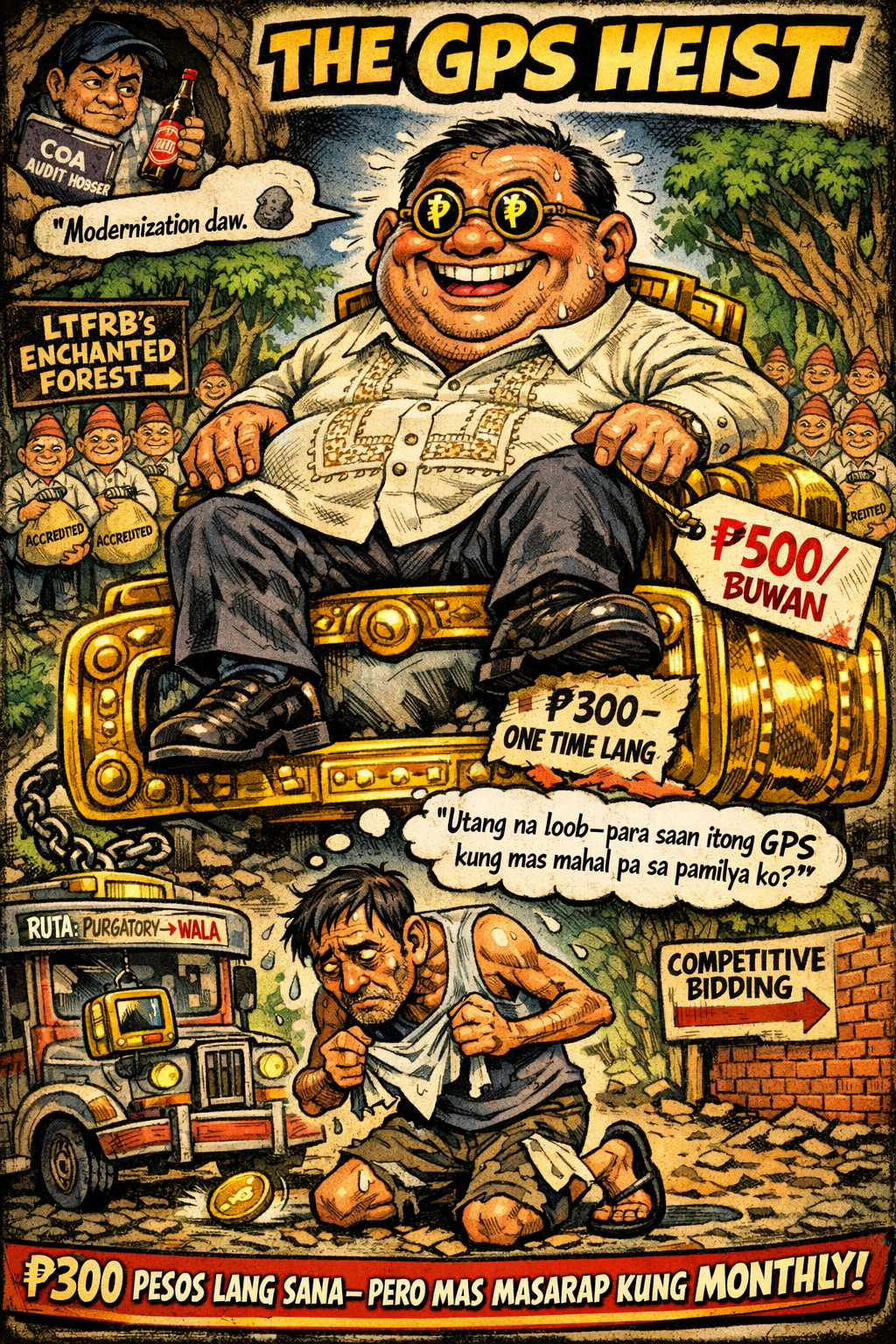
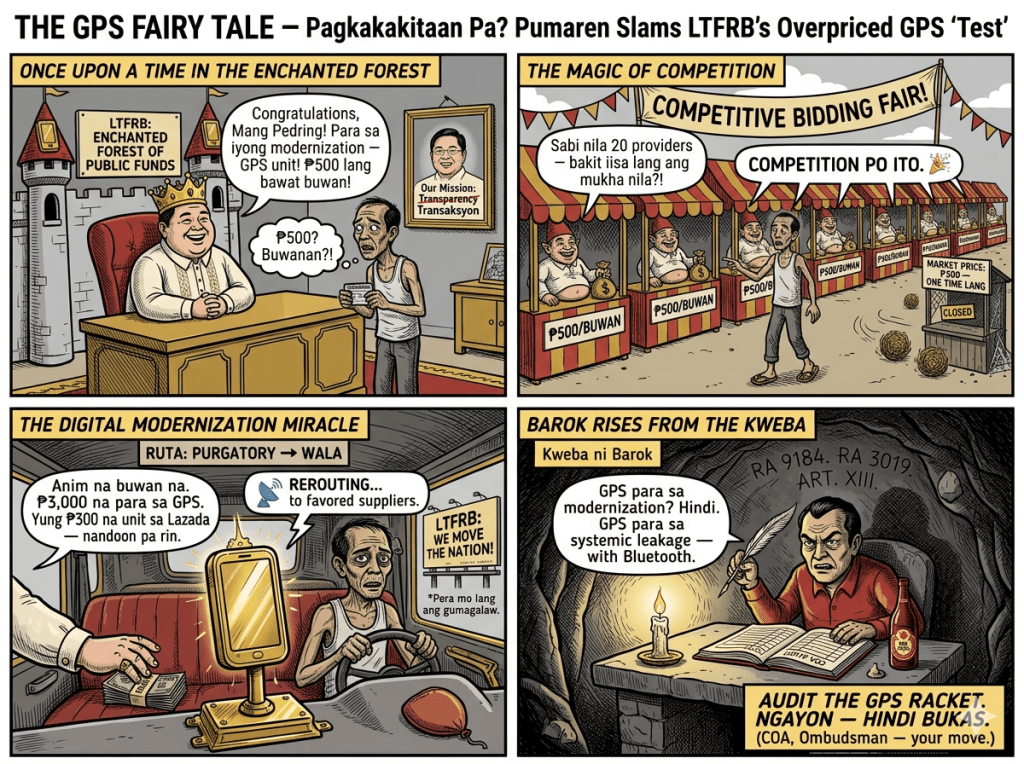
MGA ka-kweba, listen to this procurement fairy tale straight from the LTFRB’s enchanted forest of public funds. Congressman Donato Pumaren drops the bomb: ₱500 a month for a GPS device that’s “just a test.” One-time market alternatives? A measly ₱300. Do the math, kabayan. That’s not a device rental — that’s a sophisticated monthly subscription to the Great Philippine Heist. In six months alone, one operator shells out ₱3,000 for what could have been bought outright for ₱300. Multiply that by thousands of PUVs in the service contracting program and you’re looking at millions funneled into… what? “Data transmission and monitoring systems”? Please. My COA auditor soul is already vomiting.
This is textbook Violation of Procurement Law under Republic Act No. 9184 (Government Procurement Reform Act) that supposedly demands competitive bidding, transparency, and the most advantageous price for the government and the riding public. Instead, we get a closed-shop negotiation with “20 providers” (oh, how convenient, twenty magical fairies all charging the exact same inflated rate). Section 3(e) and 3(g) of Republic Act No. 3019 (Anti-Graft and Corrupt Practices Act) screams undue injury to the government and the already-broke jeepney drivers who must shoulder this. Section 3(g) nails the grossly disadvantageous contract — manifestly overpriced, suspiciously recurring, and suspiciously recurring to the same circle of “accredited” suppliers.
The “20 providers” claim? That’s not competition, that’s a Sophisticated Mechanism for Systemic Leakage. Twenty different companies, same racket. Same monthly blood-letting from operators who are already drowning in fuel costs. Classic. The LTFRB didn’t procure — they facilitated the perfect rent-seeking ecosystem. Fairy tale indeed. More like a horror story with a happy ending for the right pocket.
(The acronym they never printed on the brochure)
Rent-Seeking Masquerade: Fraud Prevention or Pocket-Lining?
Pumaren hits the nail on the head: operators collect the old-school pamasahe at full rate, then line up for the DOTr rebate like it’s Christmas in April. Full fare + government subsidy. That’s not anti-fraud, that’s a Double-Dip invitation engraved on gold-plated GPS units.
Articles 171 and 172 of Act No. 3815 (The Revised Penal Code) and Article 315 (Estafa) are already sharpening their teeth. Manipulate the GPS data, inflate the mileage, ghost a few trips, and the rebate flows like Red Horse on a Friday night. The LTFRB’s brilliant solution? “We have GPS now!” Except the safeguards are weaker than a politician’s promise. Drivers on thin margins get crushed by the monthly ₱500, while the real fraud risk sits comfortably at the administrative level — where the people who approve the rebates, audit the data, and choose the “20 providers” operate with all the transparency of a blacked-out van in Quiapo.
The paradox is deliciously evil: the government claims GPS prevents driver-level fraud, yet creates an even juicier administrative-level rent-seeking paradise. Burden the marginal operators (who can barely afford diesel) while the real leakage happens upstairs. Classic Philippine governance — punish the small guy, protect the system.
Test Subjects Betrayal: Constitutional Abortion Unveiled
Pumaren’s quote should be framed in the Hall of Shame: “We don’t use people as a testing ground.” Yet here we are — drivers and operators turned into lab rats for the LTFRB’s half-baked “digital modernization” experiment while the country is choking on oil price hikes. “Just a test,” they say, as if ₱500 a month is some kind of noble sacrifice for the greater algorithmic good.
This directly violates the spirit of Article XIII (Social Justice) of the 1987 Constitution — the one that supposedly protects marginalized sectors, including transport workers operating on razor-thin margins. Instead of relief, we give them another recurring cost disguised as progress. The burden is not on “the system.” The burden is on the jeepney driver feeding his family while the LTFRB plays tech startup with public money.
Let’s stop pretending “Digital Modernization” is the motivation. The far more plausible explanation is Graft and Corruption — the quiet, sophisticated kind where a monthly rental fee creates a perpetual revenue stream for favored suppliers. Modernization? My ass. This is modernization of the leakage pipeline.
Arias Doctrine Shredded: Willful Blindness Supreme
Enter the Arias v. Sandiganbayan Doctrine — the Supreme Court’s stinging reminder that public officials cannot hide behind “I relied on my subordinates.” You have a duty to detect irregularities when the red flags are waving like a giant Philippine flag on Independence Day. Here, the red flags are neon: ₱500 vs. ₱300, “20 providers,” double-dip rebates, and a program rolled out as a “test” on crisis-hit operators.
- LTFRB and Isagani Victorino: Willful blindness personified. They imposed (then “clarified” as encouraged) the requirement without ensuring competitive pricing or iron-clad safeguards.
- Pumaren: At least he’s yelling from the House floor. But yelling isn’t enough — file the resolution, call the hearing, drag the records into daylight.
- COA: Where are you? This screams for a Special Audit on the service contracting program’s GPS component. Follow the money.
- Ombudsman: Your move. Section 3(e) and 3(g) of RA 3019 are already knocking. Don’t wait for another “test” to bleed the public dry.
Barokian Call to Arms: Audit the Graft Machine Now!
Immediate investigation. Full transparency on the “20 providers” contracts. Publication of every peso paid, every kilometer rebated, every GPS unit deployed.
I demand a COA Special Audit — yesterday. Not the usual COA ballet. A full, unhinged, forensic evisceration of this entire service contracting GPS racket.
Because this isn’t about GPS. This is the forensic dismantling of the widespread, systemic, and institutionalized corruption in government — the kind that wears a digital mask, calls itself “modernization,” and robs blind the very citizens it claims to serve.
True public service and pro-people governance worthy of Article XIII of the 1987 Constitution? Bullshit. That would mean putting public funds in the pockets of the people who actually move the nation, not into the recurring ₱500 GPS tithe funneled to favored providers while drivers drown in costs.
Hanggang dito na muna, mga ginoo. Red Horse is calling. But the fight? That’s just getting started.
Barok out.
Key Citations
A. Legal & Official Sources
- Act No. 3815. The Revised Penal Code. 8 Dec. 1930, The LawPhil Project.
- Arias v. Sandiganbayan. G.R. No. 81563, Supreme Court of the Philippines, 19 Dec. 1989, The LawPhil Project.
- Republic Act No. 3019. Anti-Graft and Corrupt Practices Act. 17 Aug. 1960, The LawPhil Project.
- Republic Act No. 9184. Government Procurement Reform Act. 10 Jan. 2003, The LawPhil Project.
- The 1987 Constitution of the Republic of the Philippines. Official Gazette of the Republic of the Philippines, 1987.




 KWEBA ni BAROK
Leave a comment