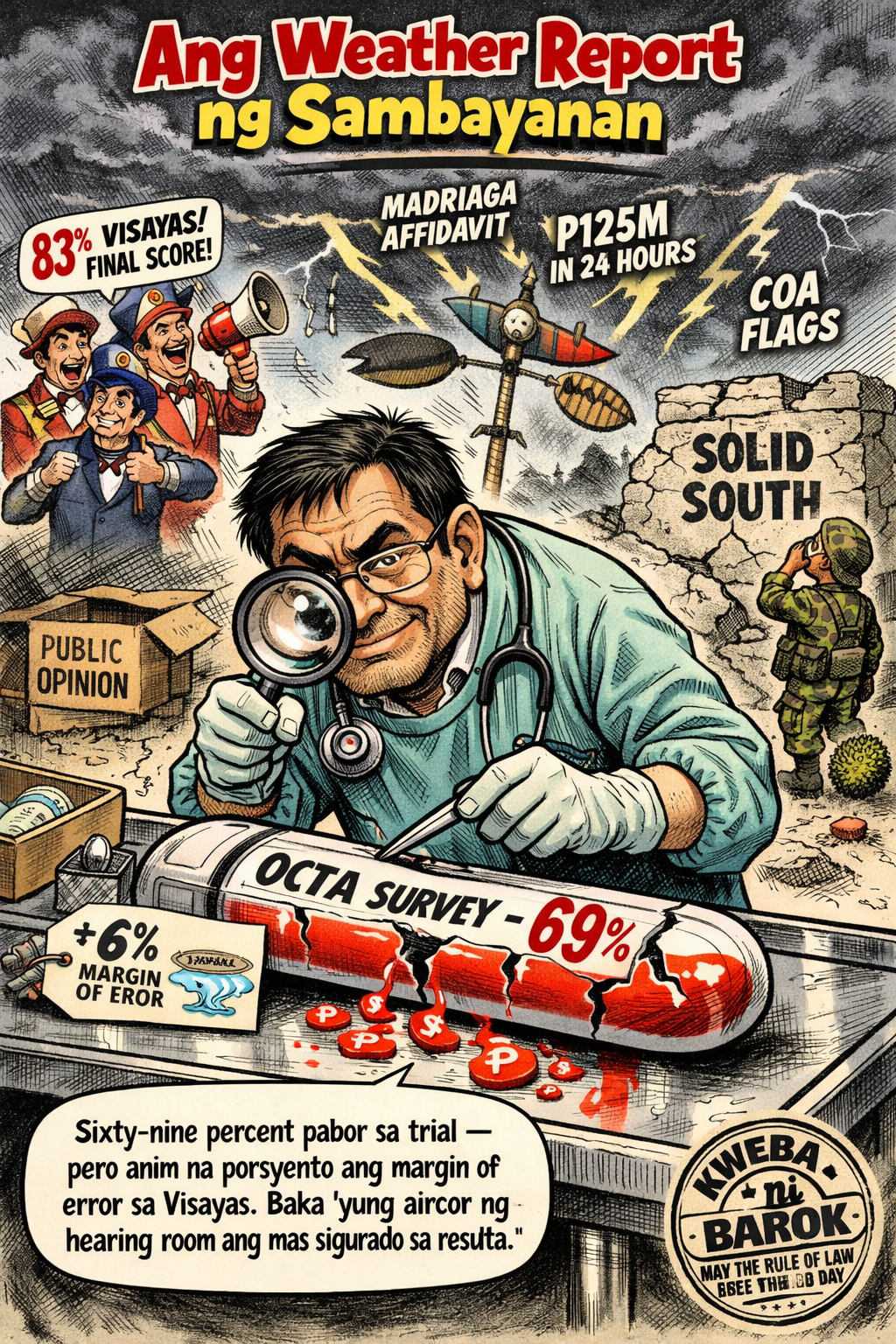
Public Opinion Isn’t a Verdict — It’s Just a Weather Report Full of Spin
By Louis ‘Barok‘ C. Biraogo — April 15, 2026
I HAVE dissected more cadavers of Philippine public opinion than most pathologists have seen in a lifetime, but this one still makes the scalpel tremble.
The OCTA Tugon ng Masa survey, released like a headline grenade this week, declares that 69 percent of adult Filipinos want Vice President Sara Duterte to face an impeachment trial.
The numbers look decisive on paper—until you hold them up to the autopsy light. Because in the Philippines, a poll is never just data. It is a Rorschach test for spin doctors, a weather vane for the next bandwagon, and sometimes a loaded gun pointed at the wrong target.
Welcome to the operating table. Let us cut.
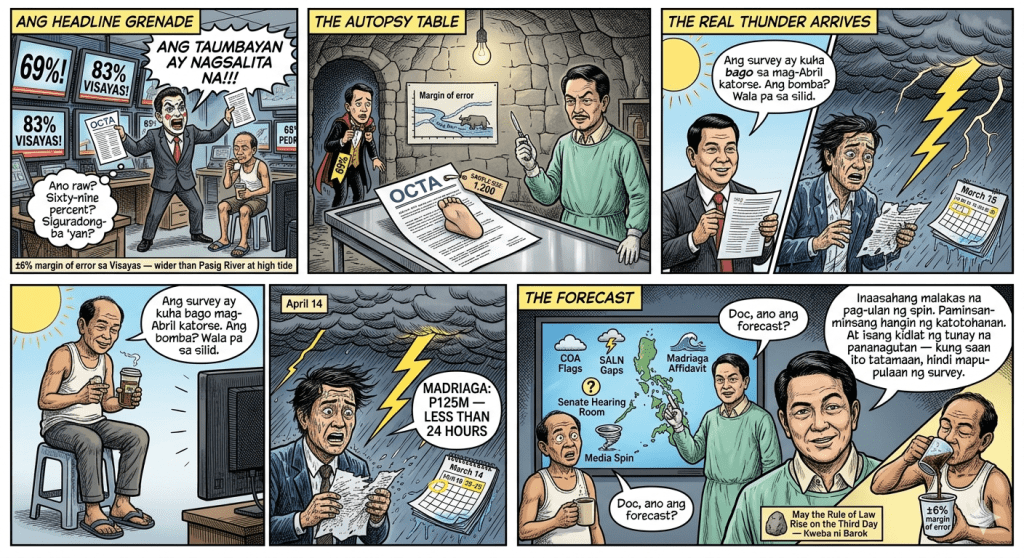
I. The Opening Autopsy (The 69% Mirage)
OCTA’s face-to-face poll of 1,200 souls, conducted March 19 to 25, carries the usual disclaimers: ±3 percent national margin of error, ±6 percent for the regions.
Six percent. That is wider than the Pasig River at high tide and twice as murky.
Yet headline writers across the archipelago treated the Visayas’ 83 percent and the National Capital Region’s 81 percent as if they were final scores in a basketball final, not statistical noise that could evaporate before the next typhoon.
Media spin doctors, those professional alchemists, turned “support for a trial” into “the people have spoken—off with her head!”
Let us be forensic here, not hysterical. The question was never “Is Sara guilty?” It was, in effect, “Should she answer the charges?”
And 87 percent of respondents were even aware the case existed. Supporting a trial is not a lynch mob; it is the political equivalent of saying, “We’d like the aircon fixed in the Senate hearing room, please—and while you’re at it, maybe explain where the confidential funds went.”
Due process is not bloodlust. It is the bare minimum a democracy pretends to offer before the mob lights the torches. To pretend otherwise is to mistake curiosity for conviction and procedural fairness for a death sentence.
II. The Regional Autopsy (The Mindanao Equation)
Now the plot thickens. Mindanao—once the impregnable fortress of the Dutertes—registered only 61 percent support for a trial, with a stubborn 38 percent opposition.
That is not collapse, but it is cracking. The Solid South is showing hairline fractures.
Is this the long shadow of Ramil Madriaga’s testimony still echoing from the future, or simply the natural erosion of patronage politics when the patron suddenly looks vulnerable? When the iron-fist brand meets the reality of unexplained cash flows, loyalty tends to develop a limp.
And then the youth quake: 18-to-24-year-olds at 77 percent. TikTok warriors or genuine generational hunger for accountability?
I suspect a bit of both, marinated in algorithm and outrage. They did not live through the full Duterte era’s body count and barangay-level muscle; they inherited the myth and the memes.
Their support is real, but it is also brittle—fifteen-second attention spans do not build ironclad majorities. History whispers that yesterday’s viral crusade often becomes tomorrow’s forgotten thread.
III. The Whispers of the Cave (Kweba ni Barok Exclusive Analysis)
Here is where the suspense novel truly begins. The survey was taken before Ramil Madriaga dropped his April 14 bombshell—P125 million in confidential funds allegedly disposed of in less than 24 hours, not the previously reported eleven days, under direct instructions from the Vice President herself.
Bags of cash, thirty to thirty-five million each, handed out like party favors. The survey captured the pre-fireworks tension; the real explosions were still in the chamber.
And who is Madriaga? Star witness or fugitive with a perjury case dangling over his head like a Damocles sword?
The Duterte camp calls him a bar flunker and kidnapping suspect; the opposition calls him the bagman who finally cracked. I call him Exhibit A in the Philippine opera of betrayal and self-preservation.
A man simultaneously credible enough to rattle the Senate and compromised enough to be dismissed as a desperate turncoat. The timing is deliciously diabolical: the public was already leaning toward “let’s hear it” before the alleged smoking gun even left the holster. What happens to that 69 percent when the next affidavit lands?
IV. The Expectations of Power (The Barok Thesis)
This is the deeper incision. The survey is not merely about Sara Duterte. It is about what Filipinos now expect from power.
The old fealty to the Duterte name—blind, visceral, almost tribal—is mutating into something more transactional. They still crave the iron fist, the strongman swagger, the promise of order.
But they want receipts. They want the budget accounted for. They want the white glove over the knuckles. Loyalty has become conditional: perform, or at least pretend to explain yourself.
Pulse Asia’s earlier data already showed 51.5 percent of distrust in Duterte tied explicitly to corruption perceptions. WR Numero’s March poll had 53 percent opposed to impeachment altogether.
The 69 percent is not a death knell; it is a yellow light. Filipinos are not rejecting strength—they are demanding competence and, God forbid, a little transparency. The era of “my president, right or wrong” is quietly expiring.
V. The Fluid Mob (The Call to Sanity)
Public opinion is a mob in a typhoon—fluid, loud, and one strong gust away from reversing course.
Today’s 69 percent can become next month’s buyer’s remorse the moment Madriaga’s credibility is shredded or the next counter-narrative floods the airwaves. Bandwagon effects are real; framing is everything.
The same respondents who say “trial” today may say “witch hunt” tomorrow if the evidence evaporates or the proceedings devolve into political theater.
Let us briefly lay down the mocking blade and talk like adults. Filipinos must dissociate narrative from evidence.
The real question is not whether the polls favor a trial. The real question is whether the Ombudsman, the Commission on Audit, and the Senate acting as an impeachment court—not as a political clubhouse—can do their jobs without the circus.
The Supremacy of the Rule of Law is not a slogan. It is the only firewall between us and the next strongman who decides the rules no longer apply to him—or her.
VI. The Barok Recommendations (The Snarky Path Forward)
- For the media: Stop treating surveys like election night returns. Report the ±6 percent regional margin as loudly as the 83 percent. Context is not optional; it is journalism.
- For the Duterte camp: If you truly believe this is a persecution, stop acting like you have something to hide. Show up. Answer the questions. A no-show only feeds the suspicion machine.
- For the House: If you are going to impeach, do it on evidence, not on polling data. Polls change with the weather. High crimes and misdemeanors should not.
VII. Conclusion: The Suspenseful Finale
The 69 percent is not the storm. It is merely the weather report—issued before the real thunder arrived.
The survey is a mirage: impressive from a distance, but dissolve the framing and the numbers blur into procedural curiosity rather than condemnation.
The true tempest will hit the Senate floor when the evidence—or the lack of it—finally stands naked under the lights. Madriaga’s affidavit, the COA flags, the SALN gaps, the timeline of cash that vanished faster than a politician’s promise.
In the Philippines, the forecast is eternal: expect heavy flooding of spin, intermittent gusts of truth, and the occasional lightning bolt of actual accountability. Whether that bolt strikes the Vice President, the whistleblower, or the entire political class remains the cliffhanger we cannot poll away.
The Kweba is watching. The scalpel is still sharp.
Stay forensic,
— Barok
Key Citations
- Rita, Joviland. “69% of Filipinos Support Impeachment Trial vs VP Sara Duterte — OCTA Survey.” GMA News Online, 15 Apr. 2026. Accessed 15 Apr. 2026.
- Gonzalez, Mia M. “Corruption Allegations Fuel Distrust in Sara Duterte – Survey.” Rappler, 14 Apr. 2026. Accessed 15 Apr. 2026.
- De Leon, Dwight. “Sara Duterte’s P125M Spent ‘in Less Than 24 Hours,’ Not 11 Days — Madriaga.” Rappler, 14 Apr. 2026. Accessed 15 Apr. 2026.
- Cruz, RG. “WR Numero Poll: 53 Percent Reject Sara Duterte Impeachment, but 46 Percent Unaware of Evidence.” ABS-CBN News, 7 Apr. 2026. Accessed 15 Apr. 2026.
- ₱8B BBM Pork: CCTV for Every Captain’s Kumpare?

- ₱8.9 Billion, 331 Ghost Police Stations: The TIKAS Scandal Explained

- ₱8.4 Billion, 42,000 Barangays, 1 Election: The “Bawat Barangay Makikinabang” Vote-Buying Masterclass

- ₱75 Million Heist: Cops Gone Full Bandit

- ₱6.77B Ghost Haunts Duterte: RTC Dismisses Mans Carpio’s Desperate Plea
- ₱6.7-Trillion Temptation: The Great Pork Zombie Revival and the “Collegial” Vote-Buying Circus

- ₱53 Million Man Tells ₱695-a-Day Workers to Stop Being ‘Mayabang’: The Audacity of BSP’s Remolona
- ₱3.06 Billion for Evacuation Centers—But Nobody Knows Where They’ll Stand (Or If They’ll Exist)
- ₱10B Ghost in New Clark City: Matibag’s Haunted Séance for Cayetano

- ₱1.9 Billion for 382 Units and a Rooftop Pool: Poverty Solved, Next Problem Please

- ₱1.35 Trillion for Education: Bigger Budget, Same Old Thieves’ Banquet

- ₱1 Billion Congressional Seat? Sorry, Sold Out Na Raw — Si Bello Raw Ang Hindi Bumili






Leave a comment