
Photo-Op Rage Meets 15-Year Bridges — Welcome to DPWH Theater
By Louis ‘Barok‘ C. Biraogo — May 11, 2026
MGA ka-kweba, ladies and gentlemen, step right up to the latest episode of DPWH: The Walking Dead. On May 9, 2026, Secretary Vince Dizon—fresh from his eight-month honeymoon as the man sent to disinfect the department—stood on a cratered slice of Marcos Highway in Barangay Taloy Sur, Tuba, Benguet, and delivered the line that will live in infamy: “Naghihintay pa ng disgrasya?” A cave-in from Super Typhoon “Nando” last September—nine months of one-way traffic, nine months of motorists playing Russian roulette with landslides—and only now does the Secretary discover that “common sense” has apparently been on extended leave. He also stumbled upon a bridge in Daraga, Albay, that has been a half-finished concrete joke for fifteen years. Two to three months, he vows. Problem solved. Curtains. Applause.
This is not revelation. This is performance art. A man appointed in September 2025, handed the broom by a scandal-plagued predecessor, and only now noticing that the house is on fire? The tragedy is not the sinkhole. The tragedy is that the Secretary had to fly in, pose for the photo-op, and pretend the rot is news to him.
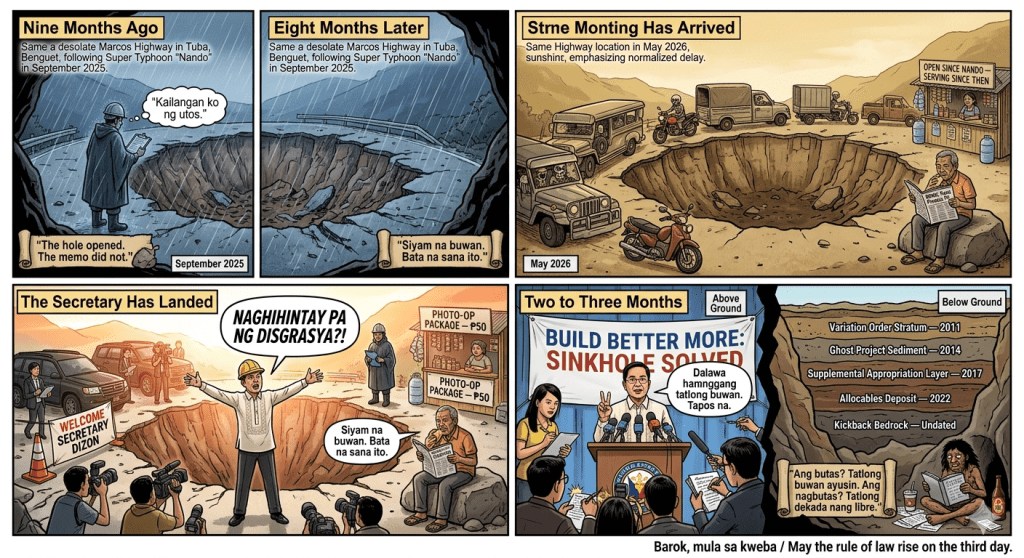
(Nine months of one-way traffic. One morning of outrage. One press release. Problem “solved.)
Dizon’s Double Game: Terrorized Bureaucrats or Grandstanding Savior?
For Dizon: The Argument He Wants You to Swallow
District engineers, he implies, have the authority under the Executive Order No. 292 (Administrative Code of 1987) yet cower behind “walang utos, walang galaw.” Article 365 of the Act No. 3815 (Revised Penal Code) stares them in the face: reckless imprudence resulting in injury or death. A highway cave-in is not a “study in progress”; it is a loaded gun pointed at the motoring public. Emergency procurement under Republic Act No. 9184 (Government Procurement Reform Act) exists precisely for this. Dizon is right that waiting for Manila’s divine fiat is criminal negligence dressed up as procedure.
Against Dizon: The Grandstander in Chief
Eight months in office and the man is still “discovering” a nine-month-old disaster and a fifteen-year-old zombie project? This is not leadership; this is grandstanding with a side of plausible deniability. He decries delays while framing himself as the lone crusader who just noticed the department is a racket. Is this genuine outrage or pre-emptive Arias v. Sandiganbayan insurance? “I empowered them, Your Honors; I cannot supervise everything.” Meanwhile he demands subordinates act without his okay—creating the perfect Kafkaesque trap where they are damned if they do (graft complaints) and damned if they don’t (public shaming by the Secretary himself).
Motivations? Pick your poison. Genuine reformer? Possible, but the timing stinks. Political survivor polishing an anti-corruption brand for 2028? More likely. Or the classic clean-up man: sent to manage optics so the real patrons—those who inserted the “allocables” and protected the favored contractors—remain untouched while the small fish fry. Either way, the theatrics serve one purpose: shift the spotlight from the trillion-peso corpse in the room.
DPWH’s Rotten Empire: Not Mindset, But Racket
Forget “mindset.” That is Dizon’s polite euphemism for systemic malignancy. The DPWH is not broken; it is operating exactly as designed. A fifteen-year bridge delay is not incompetence; it is a protected ecosystem of variation orders, budget realignments, supplemental appropriations, and ghost projects engineered to bleed the Republic dry. A nine-month unrepaired cave-in is not oversight failure; it is the logical outcome of a culture where no one is ever punished because everyone is complicit. The inaction is the feature, not the bug. The “old school” methods Dizon mocks are not archaic—they are profit-maximizing rituals sanctified by decades of impunity.
Patronage Solar System: Sinkholes Born of Trillion-Peso Theft
Zoom out. The small delays Dizon laments are mere moons orbiting the real sun: the flood-control scandal that has allegedly vaporized hundreds of billions—perhaps a trillion—in stolen public funds. Legislative “allocables” sit at the center like a black hole, sucking in budget after budget. DPWH is the orbital mechanism, dutifully spinning the cash into contracts. The Discaya family and their fifteen fellow contractors? The moons, quietly extracting 20% of the entire flood-control pie. The mathematics are impossible without a centralized, protected cartel. Bags of cash in suitcases are the satirical flourish; the analytical truth is a decade-long architecture of rigged bidding, identical project costs, vague specifications, and non-existent structures paid in full. Every sinkhole and half-bridge is born of the same deformed DNA: patronage politics that treats infrastructure as election machinery and public funds as private ATM.
Legal Guillotine: Statutes That Demand Blood
Time to cite chapter and verse.
Republic Act No. 3019 (Anti-Graft and Corrupt Practices Act), Section 3(e) and (g): gross inexcusable negligence causing undue injury, or entering grossly disadvantageous contracts. A fifteen-year bridge and a nine-month death trap fit like a glove. Republic Act No. 6713 (Code of Conduct and Ethical Standards for Public Officials and Employees), Section 4(e): the Code of Conduct’s mandate of “responsiveness to the public” and avoidance of red tape. District engineers who wait for a memo before filling a sinkhole are not cautious—they are in violation of the ethical duty to extend prompt service.
Plunder under Republic Act No. 7080 (An Act Defining and Penalizing the Crime of Plunder): the systematic scale—₱50-million threshold easily met through a pattern of overt acts involving ghost projects, overpricing, and kickbacks—screams syndicate corruption.
Precedent? Let us disembowel the favorite shield. Arias v. Sandiganbayan held that heads may rely on subordinates in good faith—until “obvious irregularities” make reliance inexcusable. Dizon cannot hide behind it if glaring defects were ignored; his subordinates certainly cannot. Richard T. Martel et al. v. People shreds any “good faith / honest intent / efficiency shortcut” defense: a fifteen-year delay obliterates any claim of honest mistake. Gross negligence is not a typo; it is a crime.
Reckoning or Rhetoric? The Prescription for DPWH
The Ombudsman must not “react”—it must act, now. Immediate investigation, full transparency, no more selective probes. Every district engineer, regional director, undersecretary, and legislative patron who enabled this must face the dock. Dizon himself—if he is genuinely “just discovering” this—should tender his resignation alongside them; performative outrage is not leadership. Prosecute under RA 3019, RA 7080, and the Revised Penal Code. No more “reform” theater without criminal convictions. A scorched-earth purge of incompetence, mediocrity, and corruption is the only option; anything less is a PR slogan.
The Verdict: Generational Heist or Functional State?
If this scandal is memory-holed after the 2026 budget cuts, the economic hemorrhage continues: trillions wasted, investor confidence vaporized (already ₱1.7 trillion in market value lost in 2025 alone), lives endangered every rainy season, and public trust in the “Build Better More” slogan reduced to bitter laughter. Normalized corruption is not a cost of doing business; it is the tax that keeps the Philippines poor.
Specific recommendations, surgically precise:
- Reverse the burden of proof for unexplained wealth of all DPWH senior officials and their immediate families—let them explain the sudden mansions and luxury cars.
- Mandate a real-time, open-data portal for every project’s cost, progress, variation orders, and payments—with automatic criminal penalties (RA 3019 level) for non-compliance or falsification.
- Create a permanent special Ombudsman division solely for public works and infrastructure cases, with performance tied to measurable conviction rates and asset recoveries.
- Abolish legislative insertions (“allocables”) in infrastructure budgets—let Congress appropriate by line item or kill the pork forever.
The final verdict? DPWH is not a department; it is a crime scene that has been walking around for decades. Whether Vince Dizon’s autopsy produces a functional state or merely the next, slightly more sophisticated iteration of the grand, generational heist remains to be seen. History, however, is not optimistic. The corpse is still stumbling. The question is not if it will fall again. The question is how many more motorists—and how many more billions—will die with it.
Key Citations
A. Legal & Official Sources
- Philippines. Act No. 3815. An Act Revising the Penal Code and Other Penal Laws. 8 Dec. 1930. LawPhil.
- Philippines. Arias v. Sandiganbayan. G.R. Nos. 81563 & 82512. 19 Dec. 1989. LawPhil.
- Philippines. Executive Order No. 292. The Administrative Code of 1987. 25 July 1987. Official Gazette.
- Philippines. Republic Act No. 3019. Anti-Graft and Corrupt Practices Act. 1960. LawPhil.
- Philippines. Republic Act No. 6713. Code of Conduct and Ethical Standards for Public Officials and Employees. 1989. LawPhil.
- Philippines. Republic Act No. 7080. An Act Defining and Penalizing the Crime of Plunder. 1991. LawPhil.
- Philippines. Republic Act No. 9184. Government Procurement Reform Act. 2003. LawPhil.
- Philippines, Supreme Court. Richard T. Martel et al. v. People. G.R. Nos. 224720-23. 2 Feb. 2021. LawPhil.
B. News Reports

- ₱9 Billion in ‘Savings’? DILG’s Fire Truck Deal Smells Like Smoke

- ₱8B BBM Pork: CCTV for Every Captain’s Kumpare?
- ₱8.9 Billion, 331 Ghost Police Stations: The TIKAS Scandal Explained

- ₱8.4 Billion, 42,000 Barangays, 1 Election: The “Bawat Barangay Makikinabang” Vote-Buying Masterclass

- ₱75 Million Heist: Cops Gone Full Bandit

- ₱63 to the Dollar: The Only Thing Falling Faster Than the Peso Is the Government’s Credibility

- ₱6.77B Ghost Haunts Duterte: RTC Dismisses Mans Carpio’s Desperate Plea
- ₱6.77 Billion and Zero Cash: The Sara Duterte SALN Math That Doesn’t Add Up

- ₱6.7-Trillion Temptation: The Great Pork Zombie Revival and the “Collegial” Vote-Buying Circus

- ₱58.53B, Zero Receipts: The LGSF Pork Barrel Nobody Wants to Name
- ₱53 Million Man Tells ₱695-a-Day Workers to Stop Being ‘Mayabang’: The Audacity of BSP’s Remolona
- ₱4.4 Billion and a Witness Who Can’t Explain It: The Duterte Impeachment’s Most Expensive Non-Answer




Leave a Reply