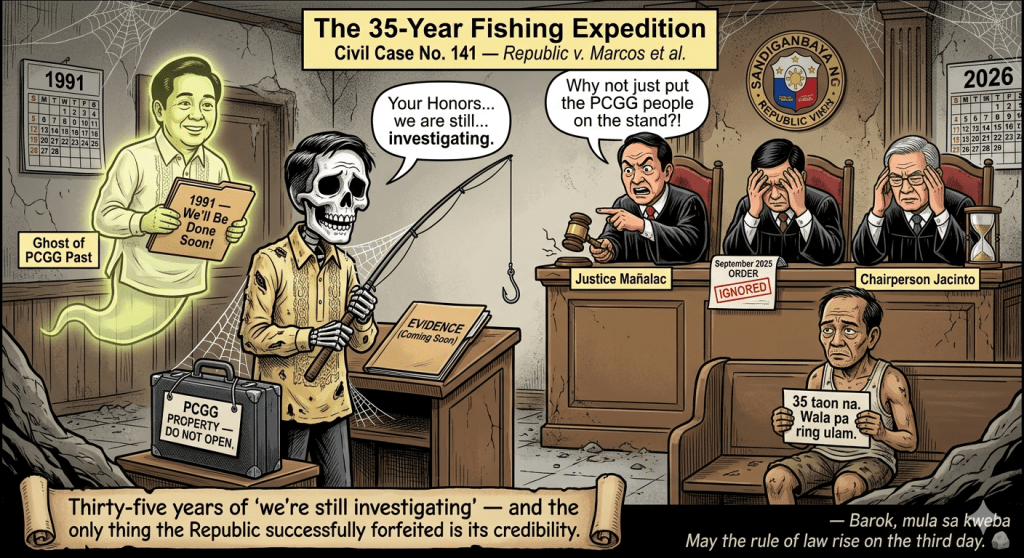
35 Years of “Still Investigating” Ends in Judicial Roast
By Louis ‘Barok‘ C. Biraogo — April 9, 2026
MGA ka-kweba, ladies and gentlemen of the rotting Republic, welcome to the autopsy theater. Civil Case No. 141—Republic v. Ferdinand E. Marcos et al.—is not a lawsuit. It is a mummified corpse propped up in the Sandiganbayan since 1991, still twitching every few years whenever someone remembers the Presidential Commission on Good Government (PCGG) once existed. On that Thursday in May 2026, the justices finally lost their collective shit, and the nation got front-row seats to the greatest prosecutorial face-plant since Cory Aquino’s lawyers first filed this thing while the EDSA dust was still settling.
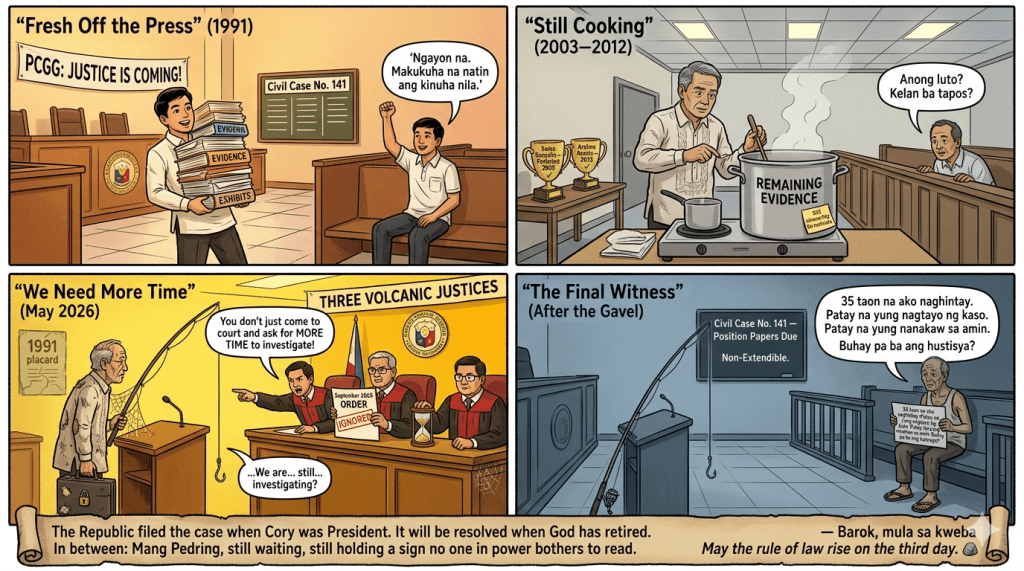
The Witnesses Died. The Lawyers Aged.
The Evidence Never Arrived.
The Marcoses? Still Having Breakfast.”
Rotting Monument: Civil Case No. 141’s Judicial Roast
This isn’t a docket number; it’s a crime scene. Eighteen categories of alleged ill-gotten wealth, and after thirty-five goddamn years, the Office of the Solicitor General (OSG) strolls in and says, essentially, “Your Honors, the PCGG is still investigating.” Justice Maryann Corpus Mañalac, voice dripping with the acid of a woman who has watched empires of paper rot in real time, snapped: “You don’t just come to court and ask for more time to conduct an in-depth investigation.” Justice Juliet San Gaspar drove the knife deeper: the September 30, 2025 order to manifest readiness had been ignored like a parking ticket. Chairperson Bayani Jacinto, presiding over this slow-motion trainwreck, could only order non-extendible five-day position papers before submission for resolution.
The reprimand wasn’t “judicial rage.” It was the primal scream of a court that has been gaslit for three and a half decades. The Swiss deposits? Forfeited in 2003. The Arelma assets? 2012. Paintings and Malacañang bling? Already gone. What’s left? The ghosts of whatever the PCGG might find if only they had another thirty-five years. Civil Case No. 141 isn’t litigation anymore. It’s performance art by the incompetent.
Molotov at the Heart: Delay vs. Due Process Deathmatch
Article III, Section 16 of the 1987 Constitution is not a suggestion: “All persons shall have the right to a speedy disposition of their cases.” The Marcos camp has turned this into a constitutional nuke. Thirty-five years. Witnesses dead. Documents moldering. Memories conveniently fuzzy. The government’s lawyers, meanwhile, clutch Republic Act No. 1379 (RA 1379) like a security blanket—Section 5’s prima facie presumption of ill-gotten wealth when assets dwarf official salaries (the Marcoses’ lawful income from 1965-1986: a pathetic US$304,372). But presumption without evidence is just wishful thinking with a law degree.
The Republic screams “public interest!” and waves Article XI of the 1987 Constitution (Accountability of Public Officers) and Article XVIII, Section 26 of the 1987 Constitution (PCGG mandate). The defense counters with the 1997 Rules of Civil Procedure, Rule 35: partial summary judgment when there is no genuine issue of material fact. The court has already used it to carve out the Swiss billions and the art. Now the OSG wants more time? This isn’t due process. This is due procession—a funeral march for accountability.
Circus of Institutional Rot: The Actors Unmasked
The Sandiganbayan Justices — Mañalac, San Gaspar, and Jacinto
Heroes of judicial efficiency or ventriloquist dummies under political heat? They’re both. Mañalac’s line—“Why not put the PCGG people on the stand?”—was pure poetry. They’re pounding the gavel not because they’re politically pressured, but because they’re tired of babysitting a case older than most of their law clerks. Yet the optics sting: a Marcos in Malacañang, and suddenly the court is “harsh”? No. They’re doing their job under the Code of Judicial Conduct—diligence, prompt disposition. The real question is why it took thirty-five years for the judiciary to lose patience.
The OSG/PCGG Bureaucracy — The Clowns Who Forgot Their Lines
This is the part that should trigger a mass resignation. Lawyers showing up in 2026 begging for time to investigate a case filed when Cory was still in power. Canon IV of the Code of Professional Responsibility and Accountability (CPRA)—Competence and Diligence—has been violated so thoroughly it needs its own forfeiture case. Canon II (Propriety) and Canon III (Fidelity) are in the ICU. Is it terminal incompetence? Chronic underfunding? Or the chilling effect of having the respondent’s son as President? The OSG refused to name properties. Refused to put PCGG witnesses on the stand. Apologized “profusely” and then clammed up. This isn’t lawyering. This is bureaucratic seppuku in open court.
The Marcos Family Defense — Masters of Legal Jiu-Jitsu
Beautiful. They have weaponized the state’s own sloth against it with the elegance of a safecracker filing a noise complaint. Partial summary judgment? It’s not delay—it’s demanding the state finally put up or shut up. They cite Republic v. Sandiganbayan (G.R. No. 152154, 2003) and Marcos Jr. v. Republic (G.R. No. 189434, 2012) back at the Republic like a mirror reflecting thirty years of failure. The defense isn’t denying the past; they’re daring the present government to prove it still cares.
Justice Denied: Filipinos Robbed Twice
The cliché has teeth now. The true victims aren’t the Marcoses—they’ve thrived in the procedural molasses. The victims are 110 million Filipinos who were robbed twice: once by the plunder, once by a justice system that turned recovery into an eternal sitcom. Every dismissed category, every “we’re still investigating” is another peso stolen from public coffers that could have built schools, hospitals, or just paid the electric bill for the PCGG’s crumbling warehouses of seized assets.
Demonic Trinity: One Case, Republic-Wide Rot
This isn’t one case. This is the hologram. The Executive kleptocratizes (or at least used to). The Legislature passes RA 1379 and then starves the PCGG of budget. The Judiciary, exhausted, finally screams. Three branches, one shared DNA of failure. The PCGG recovered billions—Swiss, paintings, jewelry—but the machinery that was supposed to finish the job is now a cautionary tale for every future anti-corruption crusade. When the state itself becomes the biggest obstacle to accountability, kleptocracy doesn’t need to hide. It just waits.
Manifesto: Fix It or Admit the Game Is Rigged
To the three branches: get your act together or burn the pretense.
- Congress: Fund the PCGG properly or abolish it and stop pretending we care about historical accountability.
- OSG/PCGG: Stop treating forfeiture cases like hobbies. Present evidence or concede. No more fishing expeditions.
- Sandiganbayan/Supreme Court: Keep enforcing Rule 35 and Article III, Section 16 without fear or favor.
- The President: If you truly believe the allegations are “untrue,” prove it in open court instead of letting your lawyers play for time.
The Filipino people demand more than position papers in five days. We demand the final act of this never-ending inquest. Not for revenge. Not for revisionism. For the only vaccine against resurgent kleptocracy: a justice system that actually works.
The gavel is cracked. The docket is on fire.
And Barok is still holding the hose—pointed straight at the circus.
The position papers are due. The nation is watching.
Let the final evisceration begin.
Key Citations
A. Legal & Official Sources
- Republic of the Philippines v. Ferdinand E. Marcos et al. Civil Case No. 0141. Sandiganbayan (Special Division), 1991–. – PDF
- Philippines, Supreme Court. Marcos Jr. v. Republic. G.R. No. 189434, 25 Apr. 2012. Lawphil.
- Philippines, Supreme Court. Republic v. Sandiganbayan. G.R. No. 152154, 15 July 2003. Lawphil.
- Republic Act No. 1379: An Act Declaring Forfeiture of the Illegally Acquired Property of Public Officers and Employees. 18 June 1955. Lawphil.
- Supreme Court of the Philippines. 1997 Rules of Civil Procedure. Rule 35, 1 July 1997.
- The 1987 Constitution of the Republic of the Philippines. 1987. Official Gazette of the Republic of the Philippines.
B. News Reports
- ₱9 Billion in ‘Savings’? DILG’s Fire Truck Deal Smells Like Smoke

- ₱8B BBM Pork: CCTV for Every Captain’s Kumpare?

- ₱8.9 Billion, 331 Ghost Police Stations: The TIKAS Scandal Explained

- ₱8.4 Billion, 42,000 Barangays, 1 Election: The “Bawat Barangay Makikinabang” Vote-Buying Masterclass

- ₱75 Million Heist: Cops Gone Full Bandit

- ₱6.77B Ghost Haunts Duterte: RTC Dismisses Mans Carpio’s Desperate Plea
- ₱6.77 Billion and Zero Cash: The Sara Duterte SALN Math That Doesn’t Add Up

- ₱6.7-Trillion Temptation: The Great Pork Zombie Revival and the “Collegial” Vote-Buying Circus

- ₱58.53B, Zero Receipts: The LGSF Pork Barrel Nobody Wants to Name
- ₱53 Million Man Tells ₱695-a-Day Workers to Stop Being ‘Mayabang’: The Audacity of BSP’s Remolona
- ₱4.4 Billion and a Witness Who Can’t Explain It: The Duterte Impeachment’s Most Expensive Non-Answer
- ₱3.06 Billion for Evacuation Centers—But Nobody Knows Where They’ll Stand (Or If They’ll Exist)






Leave a Reply