When a Former Mutineer Tries to Arrest Reality
By Louis ‘Barok‘ C. Biraogo — May 13, 2026
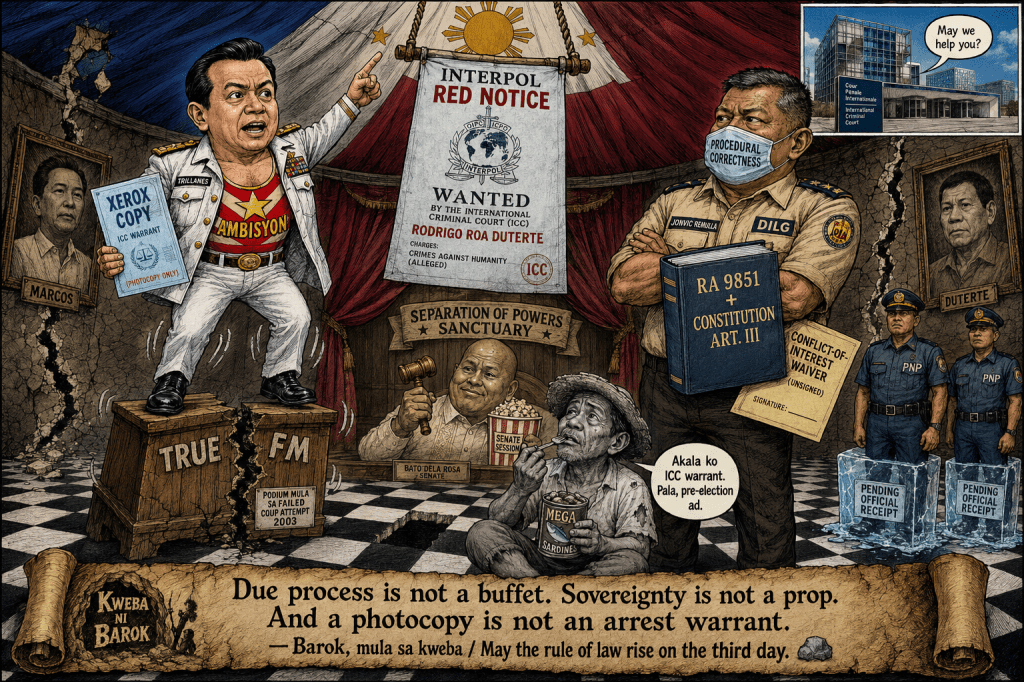
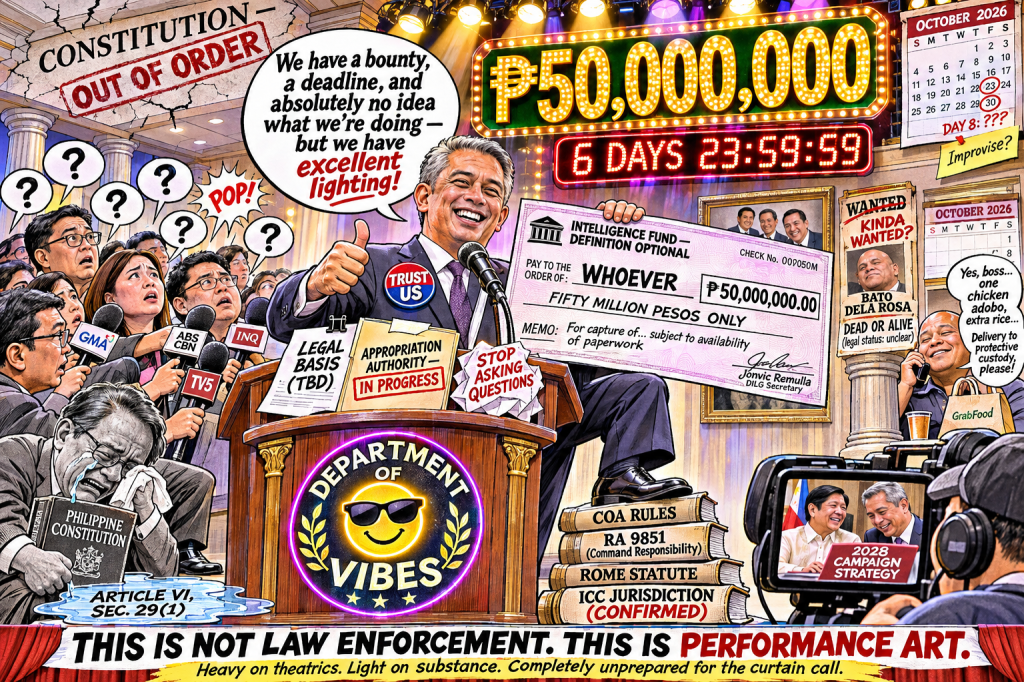
MGA ka-kweba, ladies and gentlemen of the Republic, grab your popcorn and your Constitution. The International Criminal Court (ICC) arrest warrant for Sen. Ronald “Bato” dela Rosa has finally been unsealed, and what do we get? Not a clean takedown of alleged command responsibility, but a slapstick duel between Antonio “Sonny” Trillanes IV—armed with a photocopied warrant and the moral high ground of a man who once tried to mutiny his way into relevance—and Jonvic Remulla, the Department of the Interior and Local Government (DILG) Secretary who insists that Philippine sovereignty is not a buffet where you pick and choose which international pieces to swallow.
Let us be mercilessly clear from the jump: Trillanes’s grandstanding is the procedural equivalent of a drunk uncle trying to serve papers at a family reunion. Remulla’s position, however flawed it looks under the klieg lights, is the only one that actually respects the rule of law instead of treating it like an inconvenient suggestion. The facts scream it; the law backs it; and this political theater only proves it.
Legal Chessboard: RA 9851 Meets Rome Statute Withdrawal
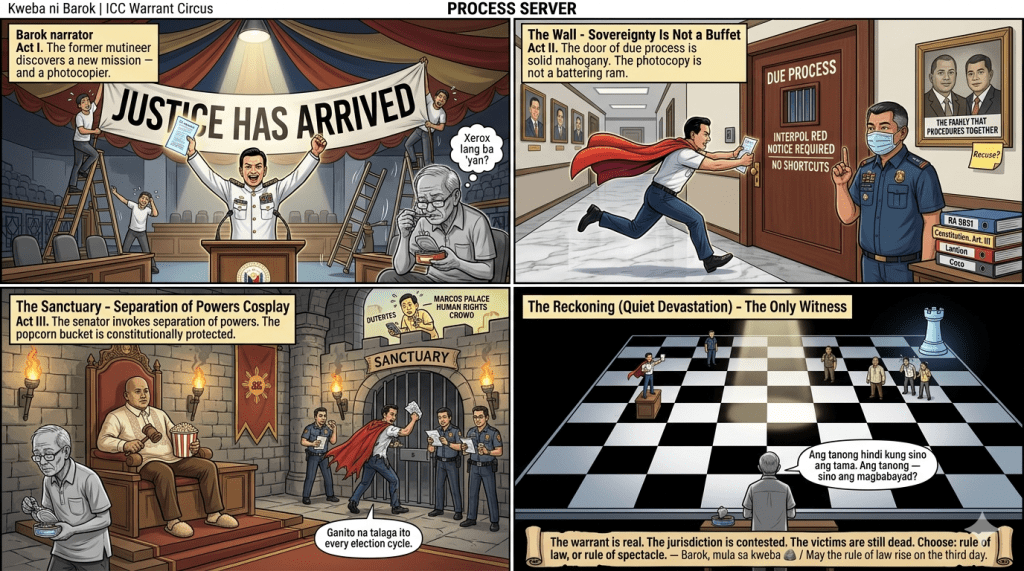
Trillanes waves the ICC warrant like a battle flag, citing Republic Act No. 9851 (Philippine Act on Crimes Against International Humanitarian Law, Genocide, and Other Crimes Against Humanity)’s Section 17 as his golden ticket for instant cooperation. “Surrender or extradite,” he intones, forgetting that the same law says “consistent with the Constitution and applicable laws.” Newsflash, Sonny: the Philippines withdrew from the Rome Statute of the International Criminal Court effective March 17, 2019. Article 127(2) may let the ICC keep its jurisdiction over 2016–2018 crimes on paper, but it does not magically resurrect domestic enforceability. ICC warrants are not self-executing here anymore. They require an Interpol Red Notice through the Philippine NCB/PCTC, followed by a proper domestic review—precisely what Remulla and the Philippine National Police (PNP) are demanding.
Remulla’s “no official warrant in our possession” is not flip-flopping; it is textbook procedural correctness. Secretary of Justice v. Hon. Ralph C. Lantion and People v. Gozo are not suggestions—they are the Supreme Court’s blunt reminder that due process under Article III of the 1987 Constitution of the Republic of the Philippines is non-negotiable. You do not let a private citizen (even an ex-senator with a grudge) and a couple of NBI agents play cowboy with a sitting senator’s liberty. That is not accountability; that is a constitutional shell game.
And oh, the Remulla brothers’ subplot—the Ombudsman (Boying) drops the warrant news in November 2025 like a quiet grenade, then Jonvic suddenly discovers procedural virginity. Republic Act No. 6713 (Code of Conduct and Ethical Standards for Public Officials and Employees)’s prohibition on even the perception of conflict of interest gets a polite golf clap here. It looks bad, yes. But bad optics do not override due process, constitutional protections, and institutional stability. The Constitution’s Article II, Section 2 and Article VII give the executive the steering wheel on foreign relations and treaty implementation. Pangilinan v. Cayetano left the withdrawal question deliciously unresolved; Bayan Muna v. Romulo affirmed that international obligations bow to constitutional supremacy. Remulla is standing on solid legal ground. Trillanes is skating on thin ice.
Hidden Moves: Resurrection, Family Balancing, and 2028 Blood Sport
Trillanes’s motivations are transparent enough to be seen from the Senate gallery. Political resurrection? Check. Cabinet ambitions (the debunked-but-still-whispered DILG rumor)? Check. He lost the Caloocan mayoral race and now needs a national stage. The ICC warrant is his golden ticket back into the anti-Duterte coalition’s inner circle. Every radio interview is a 2028 positioning ad: “I tried to arrest the man while Remulla dithered.”
The Remulla brothers? They are playing 4D institutional chess in a family that straddles the Marcos-Duterte fault line. Boying’s early disclosure looks like transparency; Jonvic’s hesitation looks like prudence. Together they are the only adults in the room trying to keep the Philippine National Police (PNP) from fracturing along dangerous political and loyalty lines and the Marcos administration from lighting the 2028 fuse too early. Dela Rosa’s Senate sanctuary? Classic evasion wrapped in separation-of-powers cosplay. The Marcos people? Divided, terrified of looking weak to the Dutertes or cruel to the human-rights crowd. This entire farce is the opening skirmish of the next presidential election, fought with warrants instead of ballots.
The bloody subtext? The Marcos-Duterte cold war has gone hot, and dela Rosa is the unfortunate pawn. Trillanes wants to accelerate it for relevance. Remulla wants to manage it so the Republic does not implode.
Endgame Scenarios: Interpol Farce, SC Deus Ex Machina, and the Coming Reckoning
- Option 1: Interpol Red Notice route. Legally airtight, politically defensible, and exactly what Remulla is waiting for. Government gets to say “we are cooperating with police, not the ICC.” Elegant.
- Option 2: Supreme Court deus ex machina. Dela Rosa files certiorari, prohibition, the works. The Court will almost certainly affirm procedural safeguards—again. Trillanes loses on technicalities while screaming “impunity.”
- Option 3: Senate sanctuary escalates into a full-blown constitutional crisis. Separation of powers porn for the cameras, zero actual justice.
- Option 4: Political compromise. The quietest, most likely outcome—delayed enforcement, backroom deals, everyone saves face except the drug-war victims.
Impacts? The moral bankruptcy of the drug war remains untouched; PNP morale takes another hit; international accountability becomes a punchline. But the alternative—letting Trillanes turn the ICC into a domestic enforcement tool—would shred sovereignty, destabilize the police, and turn the Philippines into the ICC’s favorite doormat.
Final Verdict and Thunderous Call to Action
Trillanes’s position is emotionally satisfying and legally flimsy. Remulla’s is politically inconvenient and constitutionally ironclad. The rule of law is not the rule of whoever shouts loudest on True FM. It is not the rule of family, faction, or convenient legalism. It is the rule of procedure, sovereignty, and institutional stability.
To every sector—civil society, the bar, the PNP, the Senate, and the Palace—the path forward is clear: stand united. The country must insist that the Interpol route be followed to the letter, that RA 9851 be interpreted strictly through the prism of the Constitution rather than political expediency, and that the Supreme Court finally issue a definitive ruling on post-withdrawal cooperation so this kind of circus never repeats.
And to the Remulla brothers: the perception problem under RA 6713 is real. Recuse, clarify, or step aside if necessary—but do not bend the law to appease the mob.
The ICC warrant is not the first battle of 2028. It is a test of whether the Philippines still believes in its own sovereignty. Remulla is right. The rest is noise.
Rule of law, or rule of spectacle. Choose.
Key Citations
A. Legal & Official Sources
- Republic Act No. 9851. Philippine Act on Crimes Against International Humanitarian Law, Genocide, and Other Crimes Against Humanity. 2009, The LawPhil Project.
- Republic Act No. 6713. An Act Establishing a Code of Conduct and Ethical Standards for Public Officials and Employees. 1989, The LawPhil Project.
- Rome Statute of the International Criminal Court.
- Secretary of Justice v. Hon. Ralph C. Lantion. G.R. No. 139465, Supreme Court of the Philippines, 2000, The LawPhil Project.
- People v. Gozo. G.R. No. L-36409, Supreme Court of the Philippines, 1973, The LawPhil Project.
- Pangilinan v. Cayetano. G.R. No. 238875, Supreme Court of the Philippines, 2021, The LawPhil Project.
- Bayan Muna v. Romulo. G.R. No. 159618, Supreme Court of the Philippines, 2011, The LawPhil Project.
- The 1987 Constitution of the Republic of the Philippines. Official Gazette of the Republic of the Philippines, 1987.
B. News Reports

- “Ang Hirap Maging Mahirap”: The PAO Scandal That Proves Government Contempt Is Nothing New

- “Far-Off” My Axx: Malacañang’s Claire Castro Drowns in Her Own Legal Gaslighting
- “Forthwith” to Farce: How the Senate is Killing Impeachment—And Why Enrile’s Right (Even If You Can’t Trust Him)

- “HINDI AKO NAG-RESIGN!”

- “I Know Nothing”: Baste Duterte’s Amnesia Defense Meets ₱33M in GenCorp Contracts

- “I’m calling you from my new Globe SIM. Send load!”

- “Mahiya Naman Kayo!” Marcos’ Anti-Corruption Vow Faces a Flood of Doubt

- “Manageable” Debt, Unmanageable Lies: DBM’s ₱21 Trillion Fairy Tale

- “Meow, I’m calling you from my new Globe SIM!”

- “Natrabaho”: One Word, One Ombudsman, and a Judiciary on Trial

- “No Special Jail for Crooks!” Boying Remulla Slams VIP Perks for Flood Scammers

- “Philippine-Controlled” or Yankee Gas Station? The Davao Fuel Depot Farce Exposed




Leave a Reply