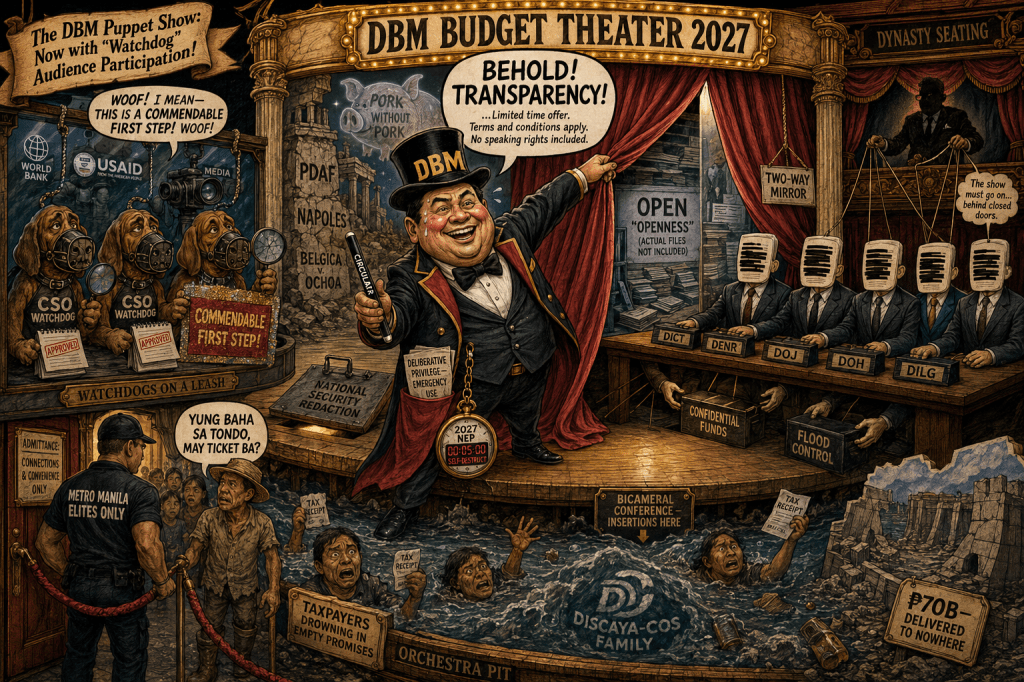
CSO Watchdogs Invited to the Stage — But the Real Script Remains Hidden
By Louis ‘Barok‘ C. Biraogo — May 11, 2026
MGA ka-kweba, ladies and gentlemen, dim the lights. The stage is set in the marble halls of the Department of Budget and Management, where for the first time in Philippine history, the velvet curtain has parted—just a crack—on the most secretive act of the national budgeting drama.
According to the Inquirer’s May 10, 2026 report, DBM Acting Secretary Rolando U. Toledo has decreed that select Technical Budget Hearings (TBHs) for the 2027 National Expenditure Program shall welcome civil society organization (CSO) observers.
DICT and DENR on May 7. DOJ today, May 11. DOH tomorrow. DILG on the 13th.
Social Watch Philippines (SWP), that tireless bloodhound of fiscal malfeasance, has hailed it as “a commendable and necessary first step toward genuine budget transparency,” invoking the Article III, Section 7 of the 1987 Constitution and the ghosts of flood-control billions that still haunt our riverbanks.
Is this the dawn of daylight in the budget’s black box? Or is it merely the latest act in a long-running political theater—staged amid the ruins of public trust, the echo of unbuilt dikes, and the lingering stench of “pork barrel without pork”?
The plot thickens. The machinery of power, long oiled by secrecy, now invites a few chosen watchdogs to peer over the shoulders of technocrats.
Suspense hangs thick: will this pilot program for the 2027 NEP rewrite the rules of the game, or will it dissolve into footnotes and photo-ops? The republic holds its breath.
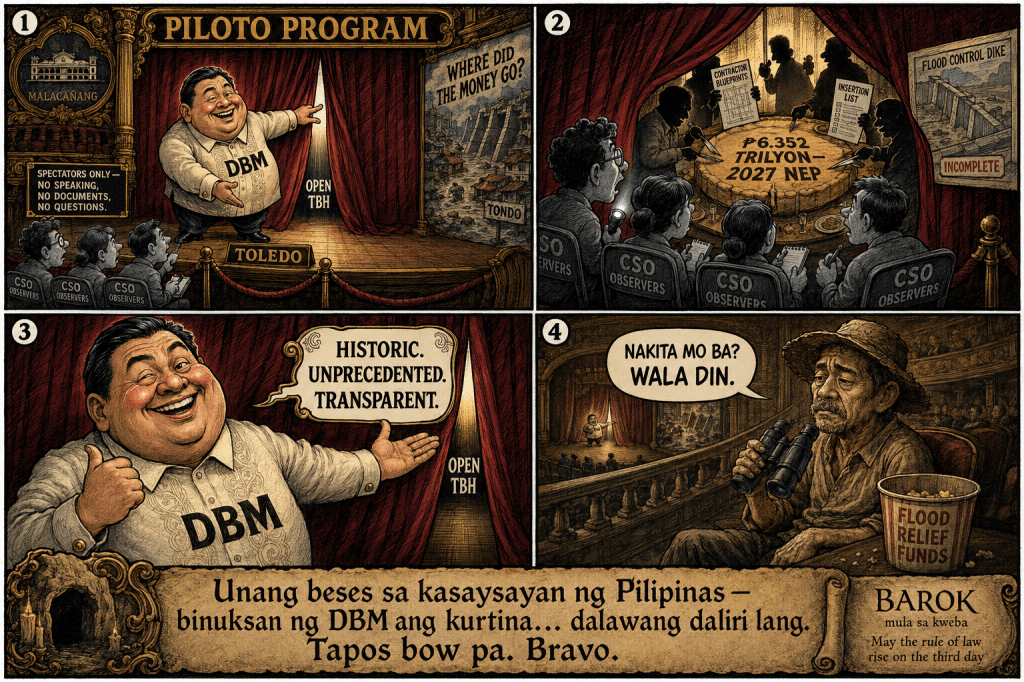
Anatomy of a System: Evisceration of Opaque Governance
Let us cut to the bone. The Philippine budget process has never been a temple of transparency; it has been a fortified cathedral of closed doors, whispered deals, and midnight insertions.
For decades, the executive’s budget preparation—the very first stage—was a sanctum sanctorum where DBM panels, agency heads, and their political patrons haggled over ceilings, confidential funds, capital outlays, and “infrastructure lists” that somehow always fattened the right contractors.
By the time the National Expenditure Program reached Congress, the real decisions had already been carved in stone behind those doors.
Enter the flood control scandals—the grotesque exhibit A of systemic rot.
Billions upon billions poured into DPWH projects that existed only on paper: non-functioning dikes in Malabon and Navotas, duplicate programs, unfinished nightmares costing taxpayers an estimated 70 percent leakage.
The Discaya-Cos family contracting empires didn’t build empires by accident; they thrived on rigged bids, inflated estimates, and “insertions” quietly slipped into bicameral conference reports after the public had stopped watching.
Even after the Supreme Court struck down the old PDAF in Belgica v. Ochoa, the patronage beast simply mutated—into district “priority” projects, unprogrammed appropriations, and flood-control line items that became the new pork.
This was not incompetence. This was design. A captured system where closed-door TBHs shielded the machinery: no public eye on how agency proposals ballooned, how priorities were traded like political favors, how confidential funds slithered into the shadows.
Transparency was never the goal; plausible deniability was. The DBM’s “historic” pilot does not emerge from a vacuum—it is the desperate bandage applied to a hemorrhaging wound inflicted by years of elite capture.
The Great Debate: A Devil’s Advocate Critique
Now, the devil takes the witness stand.
For the DBM’s Initiative:
It restores trust battered by flood-control fiascos. It enables early detection of duplicated projects, inflated costs, and politically motivated insertions. It shields the DBM itself—if scandals erupt later, they can point to the public record and say, “The watchdogs were there.” It aligns with Open Government Partnership commitments and burnishes international credentials when lenders are watching. A political masterstroke, perhaps, or genuine bureaucratic evolution.
Against It:
Technical deliberations are not public spectacles. Candid negotiations over fiscal ceilings and national-security budgets risk grandstanding, leaks, or ideological pressure campaigns. Unelected CSOs—Metro Manila elites funded by foreign donors—suddenly wield influence over public funds without a single vote. Administrative burden mounts. National security whispers that DOJ, DILG, and DICT hearings cannot be fully open. Is this a pilot or a permanent PR stunt designed to placate critics while preserving executive prerogative?
For the CSOs:
They bring expertise, constitutional legitimacy, and the voice of the people. SWP and its peers have monitored budgets across administrations; their scrutiny can sharpen priorities for health, education, and climate adaptation. Participatory budgeting—proven in Brazil, South Korea, Indonesia—deepens democracy.
Against Them:
Who elected these NGOs? Who funds them? Are they genuine watchdogs or aspiring guard dogs for a new technocratic elite? The “professional NGO” syndrome is real: donor-driven, media-savvy, but disconnected from the barangay farmer or the flood victim in Tondo. Will they challenge power or merely seek a seat at the table—and the next grant?
The verdict? The initiative is a bold gamble. But without ironclad safeguards, it risks becoming performative transparency: optics over overhaul.
The Legal Tightrope: A Framework Critique
The Constitution stands as both sword and shield. Article III, Section 7 is ironclad: “The right of the people to information on matters of public concern shall be recognized.”
Legaspi v. Civil Service Commission, and Chavez v. Public Estates Authority, among others, affirm that budgets—lifeblood of the republic—are public concern incarnate. SWP is correct to wave this banner.
Yet the executive’s constitutional domain over budget preparation (Article VII and VI) creates deliberate tension. TBHs are internal executive deliberations. The DBM can lawfully invoke deliberative privilege to protect candid advice and trade-offs.
There is still no Freedom of Information law—only executive policy, EO 31’s Open Government Partnership, and DBM Circular 2026-6. This pilot is discretionary, not statutory. One stroke of the pen, one agency complaint about “sensitive” data, and the curtain can slam shut again.
We walk a legal tightrope. One misstep—excessive redaction, selective access—and the Supreme Court may be asked to decide whether this is constitutional evolution or executive theater. The absence of a FOI statute leaves the entire reform vulnerable to the next administration’s whim.
The Labyrinth of Motives: A Deep-State Analysis
Motives, like shadows in a floodlit hearing room, multiply.
The DBM/Executive:
Damage control, pure and simple. After the flood-control inferno—Senate probes, public outrage, presidential vetoes, zero new DPWH flood funding in 2026—the Marcos administration needs to project reform. International optics matter: lenders demand governance scores; the Open Budget Survey already ranks us top in Asia, but perception is everything. Preemptive strike? By documenting the process, DBM shifts downstream blame to Congress for any later insertions. Or is there genuine internal reformist zeal? Generational shift in the bureaucracy? Possible—but power rarely surrenders secrecy without calculation.
The CSOs:
Genuine passion burns in many—SWP’s decades-long crusade against waste is no charade. Yet cynicism whispers: donor visibility, media leverage, a permanent seat at the policy table. In a patronage republic, influence is currency. Will CSOs remain fierce independents or evolve into convenient validators for the next administration’s narrative?
The labyrinth reveals no saints—only actors in a high-stakes drama where transparency can be weaponized as easily as secrecy.
The Unanswered Questions: Where Substance Falters
Here the suspense tightens. The true test lies in the fractures:
Will CSO observers receive meaningful access—or merely a designated spectator gallery with no speaking rights, no documents, no follow-up? Will the most sensitive files be fully disclosed, or redacted into Swiss cheese under “national security”? Will budget amendments remain traceable, or will phantom insertions still flourish in bicameral darkness? Will public objections ever alter a single peso—or will they be politely noted and ignored?
How will political dynasties and contractor networks react when their fiefdoms are threatened? Will they tolerate sustained scrutiny, or will they quietly kill the experiment after the 2027 NEP is safely passed? Above all: can transparency alone dismantle a patronage system hardened over decades? And who will guard the guardians—ensuring CSOs themselves are not co-opted, captured, or corrupted by the very power they seek to check?
These are not academic questions. They are the fault lines where reform either hardens into steel or crumbles into dust.
The Final Charge: Calls to Action & Recommendations
Enough lamentation. The Filipino people demand more than spectacle.
To the DBM: Institutionalize this pilot immediately. Make open TBHs permanent across all agencies. Publish full transcripts, machine-readable documents, and amendment trackers in real time. Allow limited CSO questions and position papers. Draft the Philippine Budgeting Code with ironclad public participation mandates.
To the CSOs: Reject tokenism. Demand full document access, independent audit powers, and grassroots inclusion—not just Metro Manila voices. Build citizen monitoring platforms. Prepare to go public when fiefdoms push back.
To Congress: Legislate what the executive has begun. Pass a genuine FOI law. Open bicameral conferences. Trace every insertion to its author. Transform “pork without pork” into genuine people’s priorities.
This is no longer about budgets. It is about whether the Republic belongs to its people or to the entrenched few who treat public funds as private fiefdoms. The machinery of power has cracked open a door. Let us not merely peer through it—let us tear it from its hinges.
For the flood victims still waiting for dikes that work. For the taxpayers robbed blind. For every Filipino who has ever asked, “Where did the money go?”
The hour is late, but not lost. Demand permanence. Demand substance. Demand a budget that serves the republic, not its patrons. The people’s vigilance is the only force that can turn this pilot into permanent revolution. Let the next chapter be written not in closed rooms, but in the unforgiving light of day.
Key Citations
A. Legal & Official Sources
- Philippines. 1987 Constitution of the Republic of the Philippines. 1987. Official Gazette.
- Philippines, President (Ferdinand R. Marcos, Jr.). Executive Order No. 31: Institutionalizing the Philippine Open Government Partnership and for Other Purposes. 20 June 2023. Supreme Court E-Library.
- Philippines, Department of Budget and Management. Circular Letter No. 2026-6: Implementing Guidelines on the Adoption of Open Government Partnership Principles in Government Programs, Activities, and Projects Pursuant to Section 54 of the General Provisions of the FY 2026 General Appropriations Act. 15 Apr. 2026. — PDF
- Philippines, Supreme Court. Belgica v. Ochoa. G.R. No. 208566, 19 Nov. 2013. Lawphil.
- Philippines, Supreme Court. Chavez v. Public Estates Authority. G.R. No. 133250, 9 July 2002. Lawphil.
- Philippines, Supreme Court. Legaspi v. Civil Service Commission. G.R. No. L-72119, 29 May 1987. Lawphil.
A. News Articles
- Cabalza, Dexter. “DBM Opens Budget Preparation Hearings to Civil Society Groups.” Inquirer.net, 10 May 2026.
- Baclig, Cristina Eloisa. “Insertions in the Storm: When Flood Control Feeds the Corrupt.” Inquirer.net, 15 Sept. 2025.
C. Official and Organizational Sources
- Social Watch Philippines. Home Page. 2026.
- Wikipedia contributors. “Flood Control Projects Scandal in the Philippines.” Wikipedia, The Free Encyclopedia, 10 May 2026.
- ₱9 Billion in ‘Savings’? DILG’s Fire Truck Deal Smells Like Smoke
- ₱8B BBM Pork: CCTV for Every Captain’s Kumpare?
- ₱8.9 Billion, 331 Ghost Police Stations: The TIKAS Scandal Explained

- ₱8.4 Billion, 42,000 Barangays, 1 Election: The “Bawat Barangay Makikinabang” Vote-Buying Masterclass
- ₱75 Million Heist: Cops Gone Full Bandit

- ₱63 to the Dollar: The Only Thing Falling Faster Than the Peso Is the Government’s Credibility
- ₱6.77B Ghost Haunts Duterte: RTC Dismisses Mans Carpio’s Desperate Plea
- ₱6.77 Billion and Zero Cash: The Sara Duterte SALN Math That Doesn’t Add Up

- ₱6.7-Trillion Temptation: The Great Pork Zombie Revival and the “Collegial” Vote-Buying Circus

- ₱58.53B, Zero Receipts: The LGSF Pork Barrel Nobody Wants to Name
- ₱53 Million Man Tells ₱695-a-Day Workers to Stop Being ‘Mayabang’: The Audacity of BSP’s Remolona
- ₱4.4 Billion and a Witness Who Can’t Explain It: The Duterte Impeachment’s Most Expensive Non-Answer




Leave a Reply