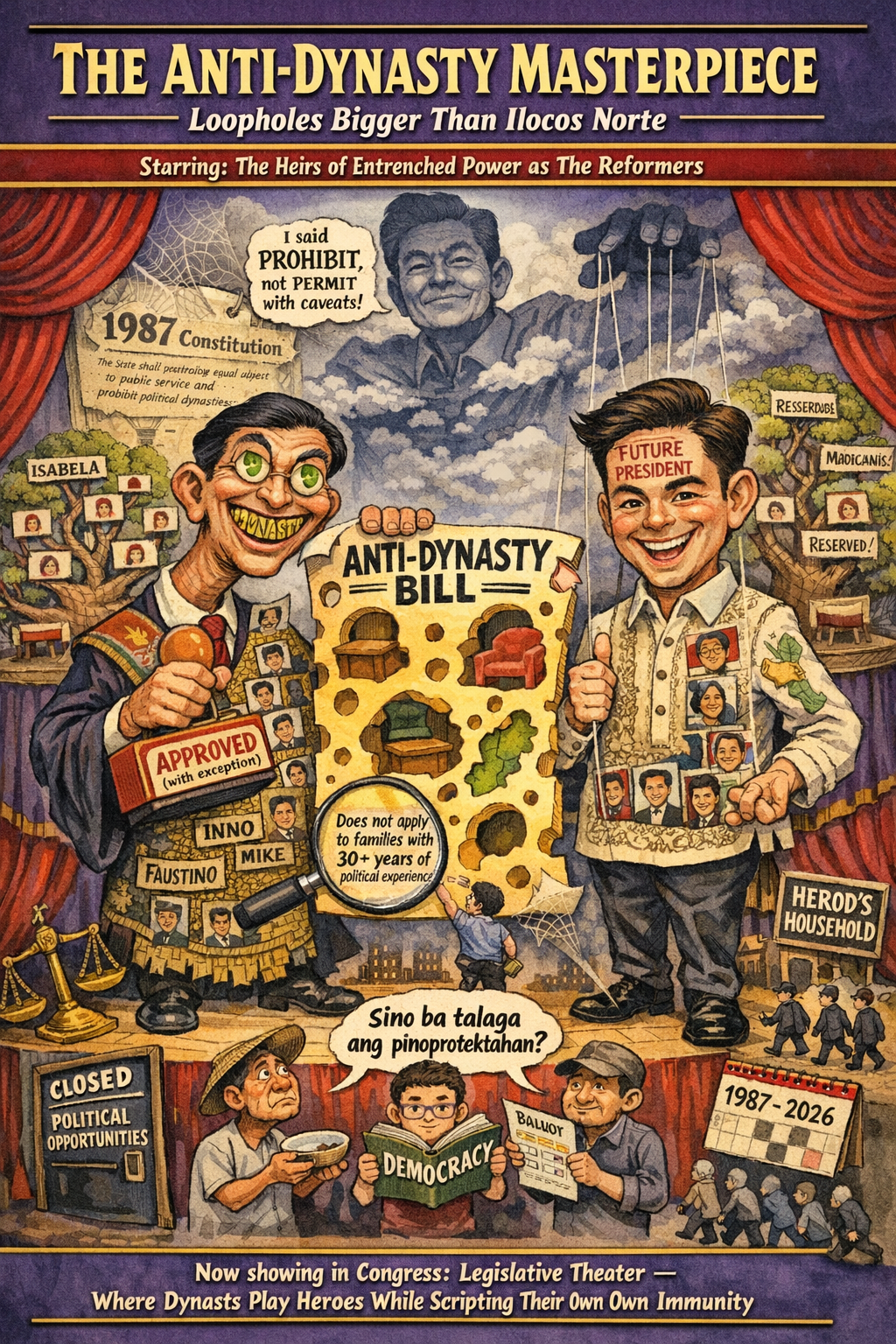
The Only Thing This Bill Bans Is the Possibility of Ever Ending Political Dynasties
By Louis ‘Barok‘ C. Biraogo — March 4, 2026
BEHOLD, the sweet irony of Philippine politics: where the heirs of entrenched dynasties don the mantle of reformers, only to peddle a bill that safeguards their thrones while pretending to dismantle them. On March 3, 2026, the House Committee on Suffrage rubber-stamped an “anti-political dynasty” measure sponsored by Speaker Faustino “Bojie” Dy III and Majority Leader Ferdinand Alexander “Sandro” Marcos – a proposal so watered-down, it makes the 1987 Constitution’s mandate look like a polite suggestion rather than a command. This isn’t legislation; it’s legislative theater, a performance where dynasts play the heroes while scripting loopholes big enough for entire family trees to waltz through. As your resident caveman who’s spent years calling out this balimbing act (that’s political turncoatism for the uninitiated), I’m here to dissect this travesty with the precision of a Supreme Court dissent and the bite of a street satirist. Buckle up, mga ka-kweba – we’re about to expose how this bill isn’t just bad law; it’s constitutional sabotage.
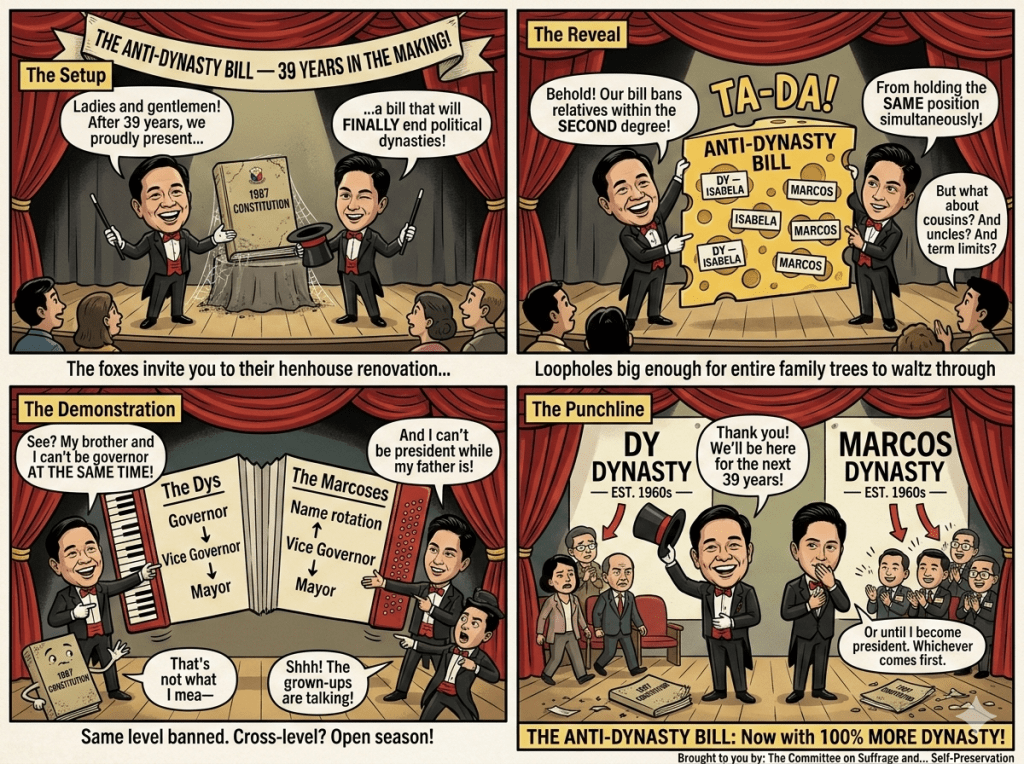
When the Foxes Write the Henhouse Rules: Dynasty Edition
Let’s start with the basics, because even dynasts like Dy and Marcos seem to have forgotten them (or conveniently ignored them). Article II, Section 26 of the 1987 Constitution couldn’t be clearer: “The State shall guarantee equal access to opportunities for public service and prohibit political dynasties as may be defined by law.” This isn’t some vague platitude; it’s a direct response to the oligarchic rot that fueled the Marcos dictatorship and the People Power Revolution. Yet, as the Supreme Court reminded us in Tañada v. Angara (G.R. No. 118295, May 2, 1997), these Article II provisions are declaratory principles – non-self-executing, meaning Congress must breathe life into them with enabling legislation.
Here’s the structural paradox that’s as Philippine as utang na loob: Congress, packed with dynasts (over 80% of its members hail from political families, per empirical studies on governance), is tasked with defining and banning the very system that keeps them in power. In Biraogo v. COMELEC (G.R. No. 203603, November 13, 2012), the Court dismissed a mandamus petition to enforce the ban sans law, emphasizing separation of powers under Angara v. Electoral Commission (63 Phil. 139, 1936). Fair enough – courts can’t legislate. But when Congress finally acts after 39 years of foot-dragging, and produces this? It’s not compliance; it’s nullification. The framers intended a robust prohibition to deconcentrate power, not a fig leaf for the padrino system.
Related statutes scream hypocrisy too. RA 6713 (Code of Conduct and Ethical Standards for Public Officials) demands officials prioritize public interest over family (Section 4), while RA 3019 (Anti-Graft and Corrupt Practices Act) criminalizes self-dealing (Section 3). Even RA 7160 (Local Government Code) promotes accountability but leaves dynasties unchecked. The Sangguniang Kabataan Reform Act (RA 10742) is the only implemented law explicitly barring dynasties at the youth level – why not extend that logic upward? Because, as we’ll see, the adults in the room are the biggest beneficiaries.
The Bill Under the Microscope: Every Clause Screams “Family First”
Now, to the meat – or rather, the gristle – of this unnumbered substitute bill. Approved amid “numerous public consultations” (read: window dressing), it limits the ban to relatives within the second degree of consanguinity or affinity: parents, children, siblings, spouses. Gone is the original fourth-degree scope, which might have snared uncles, cousins, and in-laws. And the prohibition? Strictly territorial: no two relatives in the same national post, same provincial office, same city hall, or same barangay. But cross-level? Open season.
Let’s eviscerate this provision by provision, using the Marcoses as our case study – because Sandro made them relevant, and who better to illustrate absurdity than a family that’s treated Ilocos Norte like a hereditary fiefdom?
- National Elective Officials: Bars relatives from other national posts. So, one Marcos as president (hello, Bongbong), but no simultaneous senator or VP from the clan. Big whoop – they can still stack the deck elsewhere.
- Congressional Districts: Prohibits running for the same district seat at once, but allows multiple Marcoses in different districts. Imagine: Sandro in Ilocos Norte’s 1st, his cousin in the 2nd, and an aunt in a nearby province. Family reunion in the House plenary!
- Provincial Officials: No two in the same provincial government. But a Marcos governor in Ilocos Norte? Fine, as long as the vice governor isn’t kin. And the mayor of Laoag? That’s a different “level” – cue the mother or sibling.
- Municipal/City and Barangay Levels: Same story: one per locality, but multiply across towns. As Anti-Dynasty Network’s Mikee Defensor quipped, “The governor can still be the father, the mayor the mother, the councilor the child.” We’re not decongesting; we’re just spreading the dynasty like a virus.
And successive dynasties? Not touched. Term-limited? Pass the baton to Junior – or, in Marcos terms, from Ferdinand Sr. to Jr., with Sandro waiting in the wings. This fails constitutional muster on equal protection grounds (People v. Cayat, 68 Phil. 12, 1939), where classifications must be germane and not arbitrary. Why exempt cross-level or successive holds? Because it protects fat dynasties, perpetuating inequality under Article III, Section 1.
Hypothetical: In a post-2028 world, Bongbong steps down, Sandro runs for senator, a cousin for governor, and assorted relatives for mayors. The bill? Shrugs. It’s grave abuse of discretion (Article VIII, Section 1), turning “prohibit” into “permit with caveats.”
Bojie & Sandro’s Greatest Trick: Pretending to Ban Their Own Kind
Oh, the hypocrisy! Speaker Faustino “Bojie” Dy III, scion of Isabela’s Dy dynasty (his father was governor, his brother a congressman – the hits keep coming), and Majority Leader Ferdinand Alexander “Sandro” Marcos, grandson of the dictator whose plunder birthed the anti-dynasty clause. These two sponsoring an anti-dynasty bill is like Herod sponsoring child welfare legislation (hat tip to Cardinal Tagle’s “Herod’s household” analogy for dynasties devouring the nation).
Their conflicts scream under RA 6713: Section 4 mandates avoiding family favoritism, yet this bill’s narrow scope shields their legacies. Dy’s Isabela stronghold? Intact. Marcos’s Ilocos empire? Fortified. Motivations? Self-preservation, plain and simple – laundering their dynastic brands as “reformers” while preempting real change. Sandro, denying coup rumors against Dy in February 2026 (as per X chatter and Paolo Duterte’s jabs), affirmed loyalty – but to what? Coalition stability over constitutional fidelity.
Ethical standards? Trampled. RA 3019 bars using office for gain; here, they’re legislating immunity. As Social Justice Society v. Dangerous Drugs Board (G.R. No. 157870, November 3, 2008) struck down discriminatory candidacy restrictions, so too should this be seen as biased toward insiders. Hypocrisy alert: Sandro’s family history includes electoral manipulations (Pamatong v. COMELEC, G.R. No. 161872, April 13, 2004), yet he peddles this as progress? Spare us the performance art.
Pragmatism, Incrementalism, Reality: Three Words for “We’re Keeping the Throne”
Proponents like Committee Chair Zia Alonto Adiong tout pragmatism: “Over 100 co-authors!” Incrementalism! Better than nothing after 39 years! Electoral sovereignty under Article V! Legislative discretion per the “as may be defined by law” clause!
Let’s demolish these one by one, with legal scalpel in hand.
- Pragmatism and Incrementalism: Sure, no law exists – but this isn’t a step; it’s a sidestep. Empirical data links dynasties to higher poverty (studies show dynastic provinces lag in SDG 10 metrics for reduced inequalities) and weak governance. A weak bill entrenches that, violating the constitutional spirit (Tañada v. Angara). Incremental? More like illusory – it “decongests” nothing, as Defensor exposed.
- Electoral Sovereignty: Voters choose, yes, but dynasties distort choice via patronage. Francisco v. House (G.R. No. 160261, November 10, 2003) upheld checks on power; this bill removes them. Overly broad bans? Fine, but this is underbroad, failing rational basis (People v. Cayat).
- Legislative Discretion: Congress defines, but not absurdly. Grave abuse lurks when definition defeats purpose (Article VIII, Section 1). Political reality? That’s code for “we’re dynasts, deal with it.”
Against: Bad faith reigns – conflicts abound, nullifying intent. It’s not reform; it’s sabotage, preserving corruption and inequality.
Motives, Maneuvers, and Epic Face-Plants: Meet the Cast
- Dy: Protecting Isabela fiefdom, stabilizing coalition – could have strengthened in plenary, but nah.
- Sandro: Legacy laundering amid Marcos baggage – option? Add successive bans, but family first.
- Adiong: Leadership favor via “most workable” bill (100+ co-authors as mutual defense pact) – failed to push rigor, opting for incrementalism.
- Makabayan Bloc (Castro, Brosas, Manuel) and Erice: Principled withdrawal – kudos, but could have filed minority reports or mobilized more pressure.
- Opposition: Strategic stance vs. withdrawal – missed mobilizing civil society for amendments.
- Civil Society (Defensor et al.): Genuine advocacy – option? Referendum push under Article XVII, Section 2.
All failed the public trust test (Article XI, Section 1).
Litigation Blueprint: How to Drag This Dynasty Farce to the Supreme Court
Time for justice: File a Petition for Certiorari and Prohibition under Rule 65, invoking grave abuse (Article VIII, Section 1). Standing? Qualified voters, reformists, or groups like Kilosbayan (Kilosbayan v. Guingona, G.R. No. 113375, May 5, 1994) or intergenerational reps (Oposa v. Factoran, G.R. No. 101083, July 30, 1993). Transcendental importance relaxes rules.
Grounds: Violates Article II, Section 26 by illusory prohibition; equal protection fail (People v. Cayat); denies access. Frame as democracy suit: Congress nullified mandate.
Defenses? Political question (Angara v. Electoral Commission) – counter: Expanded review narrows it (Francisco v. House). Discretion? Not to defeat purpose.
Remedies: Declare unconstitutional; TRO pre-COMELEC; fallback: Purposive expansion.
Timeline: File post-enactment; oral arguments on structure.
The Real Legacy: Cementing Dynasties While Burying Philippine Democracy
Passage as-is? Erodes trust, boosts cynicism – dynasties correlate with poverty, violence, corruption (empirical studies abound). Governance suffers; SDG 10 tanks. Future reforms? Stalled, inviting populism.
Amend? Slim chance, but implications: Real competition, better equity.
Stall? Status quo wins.
Broader: Undermines constitutionalism, equality – a far cry from People Power.
Time to Burn the Script: Real Reform or Bust
- Supreme Court: Strike it down – guide Congress.
- Congress: Fix with fourth-degree ban, cross-level/successive prohibitions, disclosures.
- Amend Constitution: Ditch “as may be defined by law” (Article XVII).
- Filipinos: Vote dynasts out; petition, protest. Demand genuine service over family fiefdoms (Article XI, Section 1).
Epilogue: From Cynicism to Hope – The People’s Power Awaits
This bill isn’t the end; it’s a rallying cry. The 1987 spirit lives – not in dynasts’ hands, but in ours. Rise, kababayans: Challenge, reform, reclaim. The dynasties’ farce ends when we say so.
Congress didn’t fail the Constitution. The Constitution failed to anticipate how shameless its custodians could be.
— Barok
Key Citations
A. Legal & Official Sources
- 1987 Constitution of the Republic of the Philippines. Official Gazette of the Republic of the Philippines. Accessed 4 Mar. 2026.
- Republic Act No. 3019. Anti-Graft and Corrupt Practices Act, 17 Aug. 1960, The LawPhil Project. Accessed 4 Mar. 2026.
- Republic Act No. 6713. Code of Conduct and Ethical Standards for Public Officials and Employees, 20 Feb. 1989, The LawPhil Project. Accessed 4 Mar. 2026.
- Republic Act No. 7160. Local Government Code of 1991, 10 Oct. 1991, Official Gazette of the Republic of the Philippines. Accessed 4 Mar. 2026.
- Republic Act No. 10742. Sangguniang Kabataan Reform Act of 2015, 15 Jan. 2016, Official Gazette of the Republic of the Philippines. Accessed 4 Mar. 2026.
- Angara v. Electoral Commission. G.R. No. 45081, Supreme Court of the Philippines, 15 July 1936, The LawPhil Project. Accessed 4 Mar. 2026.
- Francisco v. House of Representatives. G.R. No. 160261, Supreme Court of the Philippines, 10 Nov. 2003, The LawPhil Project. Accessed 4 Mar. 2026.
- Kilosbayan v. Guingona. G.R. No. 113375, Supreme Court of the Philippines, 5 May 1994, The LawPhil Project. Accessed 4 Mar. 2026.
- Oposa v. Factoran. G.R. No. 101083, Supreme Court of the Philippines, 30 July 1993, The LawPhil Project. Accessed 4 Mar. 2026.
- Pamatong v. COMELEC. G.R. No. 161872, Supreme Court of the Philippines, 13 Apr. 2004, The LawPhil Project. Accessed 4 Mar. 2026.
- People v. Cayat. G.R. No. L-45987, Supreme Court of the Philippines, 5 May 1939, The LawPhil Project. Accessed 4 Mar. 2026.
- Social Justice Society v. Dangerous Drugs Board. G.R. No. 157870, Supreme Court of the Philippines, 3 Nov. 2008, The LawPhil Project. Accessed 4 Mar. 2026.
- Tañada v. Angara. G.R. No. 118295, Supreme Court of the Philippines, 2 May 1997, The LawPhil Project. Accessed 4 Mar. 2026.
B. News Reports
- De Leon, Dwight “Bojie Dy, Sandro Marcos’ weak anti-dynasty bill prevails in House committee.” Rappler, 3 Mar. 2026.
- Aning, Jerome. “High Court Dismisses Bid to Ban Political Dynasties.” Inquirer.net, 21 Jan. 2013.
- ₱8B BBM Pork: CCTV for Every Captain’s Kumpare?
- ₱75 Million Heist: Cops Gone Full Bandit

- ₱6.7-Trillion Temptation: The Great Pork Zombie Revival and the “Collegial” Vote-Buying Circus

- ₱1.9 Billion for 382 Units and a Rooftop Pool: Poverty Solved, Next Problem Please

- ₱1.35 Trillion for Education: Bigger Budget, Same Old Thieves’ Banquet

- ₱1 Billion Congressional Seat? Sorry, Sold Out Na Raw — Si Bello Raw Ang Hindi Bumili

- “We Will Take Care of It”: Bersamin’s P52-Billion Love Letter to Corruption

- “Skewed Narrative”? More Like Skewered Taxpayers!

- “Scared to Sign Vouchers” Is Now Official GDP Policy – Welcome to the Philippines’ Permanent Paralysis Economy
- “Robbed by Restitution?” Curlee Discaya’s Tears Over Returning What He Never Earned

- “No Pressure” Luistro? The House Pork Bazaar Exposed
- “My Brother the President Is a Junkie”: A Marcos Family Reunion Special




 KWEBA ni BAROK
Leave a comment