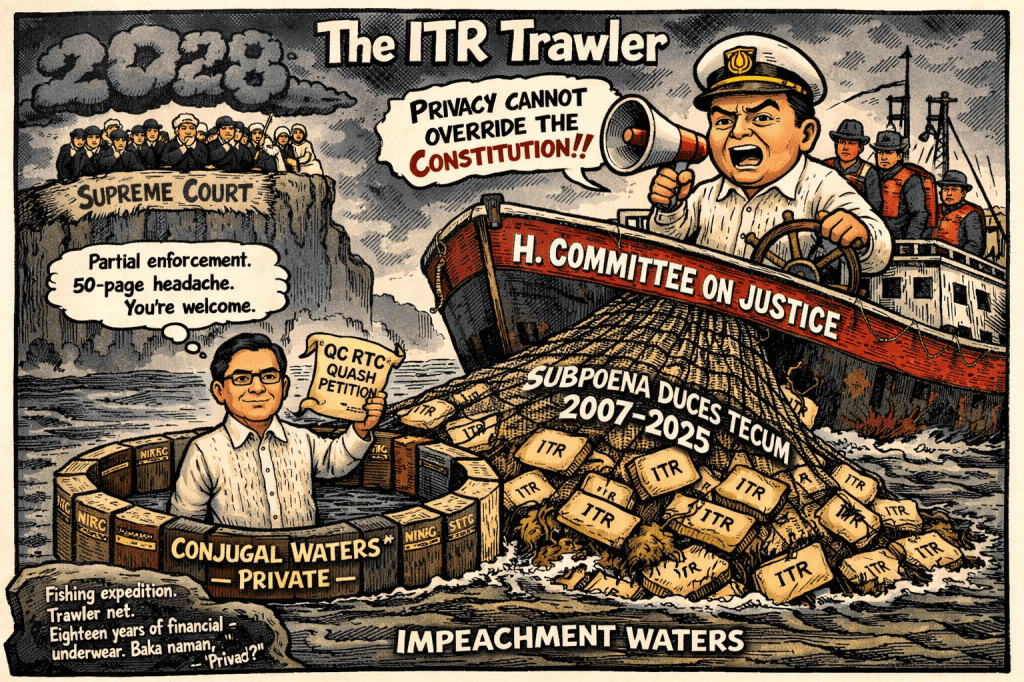
Barok’s verdict: Privacy fortress or conjugal cover-up? The legal brawl that could redefine spousal exposure in impeachment.
By Louis ‘Barok‘ C. Biraogo — April 14, 2026
BREATHE deep, the sweet stench of legal theater in the morning. Manases “Mans” Carpio, husband of Vice President Sara Duterte, has filed a petition before the Quezon City Regional Trial Court to void the subpoena duces tecum issued by the House Committee on Justice. The demand? Original or certified true copies of the ITRs of Sara Z. Duterte and her spouse from 2007 to 2025 — nearly two decades of financial underwear, laid bare for the committee’s “probable cause” peep show. Rep. Terry Ridon (Bicol Saro) thunders that privacy “cannot override the constitutional powers of Congress.”
Barok here, sharpening the scalpel. This is not accountability. This is a factional knife fight dressed in the robes of impeachment. Let us eviscerate it, section by section, with the cold precision of Article XI and the merciless glare of NIRC Section 270.
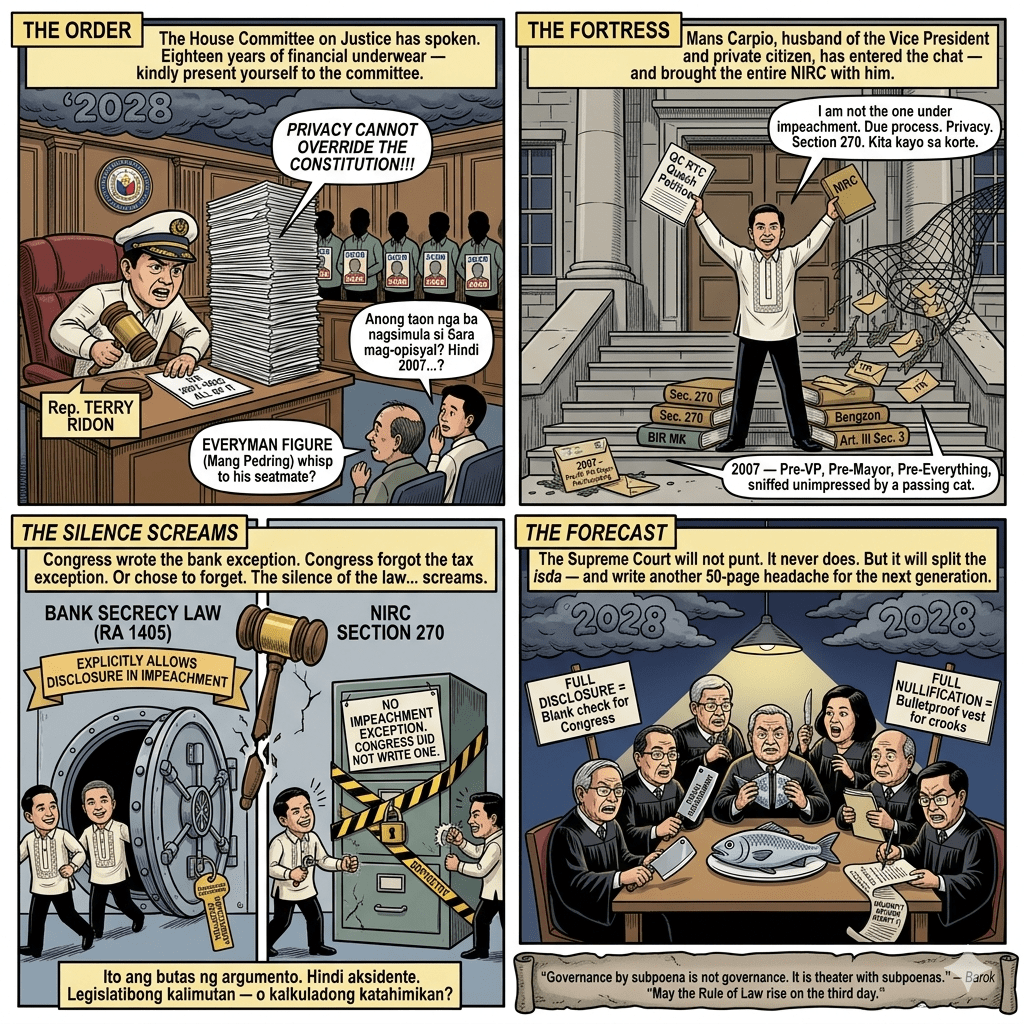
Anatomy of the Squabble: Aswang Hunt or Forensic Accounting?
Hidden Wealth Narrative: Forensic Accounting or Colonial-Era Aswang Hunt?
The House insists the ITRs are vital to probe “unexplained wealth,” Republic Act No. 3019 (Anti-Graft and Corrupt Practices Act) violations, and SALN discrepancies — the classic conjugal-property shell game under the Family Code of the Philippines (Executive Order No. 209) Article 91 et seq. Fair enough on paper. But demanding eighteen years of returns from a private citizen who is not the impeached officer? That is not forensic accounting. That is hunting the aswang with a trawler net, hoping to snag a monster that exists mostly in political folklore. The complaints allege misuse of confidential funds, bribery, and threats against the Marcos family. Fine. Show me the specific allegation that ties Manases Carpio’s 2007 ITR to an impeachable offense by his wife in 2026. You cannot. Because this is not evidence-gathering; it is narrative-building for the 2028 grudge match.
Political Weaponization: “Sole Power of Impeachment” or Factional Shiv?
Article XI, Section 3(2) of the 1987 Constitution of the Republic of the Philippines gives the House the exclusive power to initiate impeachment. Splendid. But timing is everything. This subpoena drops amid the smoldering ruins of the UniTeam alliance — Duterte’s 2024 cabinet exit, public broadsides against Marcos, and the ICC ghost still rattling chains. The committee, heavy with Marcos allies, is not exercising “sole power.” It is exercising selective power. Bengzon v. Senate Blue Ribbon Committee warned us loud and clear: when Congress goes after private citizens without a real legislative purpose, it crosses into harassment territory and invites judicial rebuke. Yet here we are, using a subpoena as a pre-emptive strike against the Duterte camp’s 2028 frontrunner. Public service? Please. This is Malacañang’s anxiety medication, administered via congressional syringe.
The 18-Year Subpoena: Narrow Tailoring or Trawler Net?
2007? Sara Duterte was not even Vice President then. She was a local official whose conjugal assets, under the Family Code, are not automatically fair game for congressional trawling. Such breathtaking overbreadth is the textbook fishing expedition that the Supreme Court has long warned against — from Arnault v. Nazareno to Neri v. Senate — whenever legislative inquiries stray beyond legitimate bounds. Impeachment may be a higher constitutional animal, but it does not get a free pass to ignore proportionality. Eighteen years of ITRs is not narrow tailoring; it is a dragnet with political coordinates.
Legal Thunderdome: Constitution vs. Tax Confidentiality
Carpio’s Fortress: Due Process, Privacy, and NIRC Sec. 270
Carpio’s petition is surgically precise. He is not a party to the impeachment. He received no personal notice. The ITRs are statutorily sacrosanct under Republic Act No. 8424 (National Internal Revenue Code) Section 270: unlawful for BIR officers to divulge taxpayer information except in cases provided by law. Note the absence of any impeachment carve-out — unlike the Bank Secrecy Law (Republic Act No. 1405 (The Law on Secrecy of Bank Deposits), as amended), which explicitly permits disclosure “in cases of impeachment.” Congress wrote that exception for banks but conspicuously omitted it for taxes. That silence screams.
Bengzon v. Senate Blue Ribbon Committee is the dagger here: Congress cannot haul private citizens before it and demand their life’s financial records without respecting due process (Article III, Section 1 of the 1987 Constitution) and the right to privacy (Article III, Section). Carpio is not shielding corruption; he is standing as a legal firewall for conjugal opacity that the Constitution itself protects until proven otherwise. Privacy martyr? Perhaps. But a necessary one when the alternative is turning every spouse into an involuntary witness against a public official.
The House’s Bludgeon: “Constitutional Supremacy” as Sophistry
Rep. Ridon’s line — “privacy cannot override constitutional powers” — is the standard legislative flex, lifted from Senate v. Ermita. Yes, Congress has broad investigatory authority. Arnault v. Nazareno affirmed contempt powers for relevant evidence. But the House conveniently forgets: impeachment is not ordinary legislation. The NIRC’s Section 20(A) exception applies only “in aid of legislation” and requires executive session. Impeachment falls under Article XI. No automatic override. No explicit statutory waiver.
This is the quagmire. The House wants to treat tax confidentiality like a suggestion while wielding impeachment like a club. Without the procedural safeguards demanded by Francisco, Jr. v. House of Representatives — strict relevance, narrow tailoring, and judicially enforceable limits — this is not supremacy; it is overreach masquerading as duty.
Judicial Precedent: The Supreme Court’s Coming Headache
The Court will not punt entirely; it never does when separation of powers and privacy collide. Expect a balancing test: Congress gets some latitude because impeachment is a sovereign check, but the subpoena must survive strict scrutiny on relevance and overbreadth. Partial enforcement — redacted filings for a narrower window — is the likely judicial cop-out. Full nullification would be poetic but politically radioactive. Full disclosure would hand Congress a blank check to rifle through every public official’s bedroom drawer. The Court knows this. It will split the baby and write another 50-page headache for future generations.
The Players & Their Sordid Motivations
Barok’s Verdict on Carpio:
Noble defense of the private sphere, or the legal equivalent of hiding the family silverware before the auditors arrive? Both, actually. Protecting legitimate privacy is righteous. But the timing — right as the political knives are out — does raise an eyebrow. Still, the law is the law. He is not the one under impeachment. Let him fight.
Barok’s Verdict on the House Committee:
Guardians of the public purse? Spare me the incense. They are errand boys for Malacañang’s 2028 anxiety, turning a constitutional mechanism into a factional cudgel. The “public interest” rhetoric rings hollow when the same Congress yawned at other SALN issues when politically inconvenient.
The Unseen Hand:
The ghost of the UniTeam breakup haunts every paragraph of this subpoena. This is not about 2007 tax returns. This is about 2028 positioning, Duterte’s threats, and the Marcos camp’s pre-emptive strike. Politics in robes.
Endgame: Options, Resolutions & Fallout
Carpio’s Options:
Choosing the Quezon City RTC over direct Supreme Court certiorari is 4D chess — buy time with a TRO, force the House to appeal, and keep the impeachment timeline bleeding. Smart. A direct SC petition would have been cleaner, but this forces the committee to sweat while the clock ticks.
Probable Rulings (Kweba Forecast):
Partial enforcement. The Court will not gut impeachment fact-finding, but it will slap the subpoena with strict relevance and procedural safeguards. Redacted filings for, say, the years of actual public office. Anything less would be judicial abdication.
The Fallout:
If the subpoena stands, impeachment now officially pierces the private sphere of every public official’s spouse. Conjugal assets become congressional property. If it falls, we have just gifted every future crook a bulletproof vest stitched from BIR red tape. Either way, the Rule of Law takes another black eye while politicians high-five.
Sermon from the Cave
Enough. This circus is beneath a republic that claims to revere the 1987 Constitution. The Rule of Law is not a suggestion to be ignored when the target wears the wrong political color. Demand the supremacy of law over the law of vengeance.
Legislative Fix:
Amend the NIRC tomorrow — insert a precise, impeachment-specific exception modeled on RA 1405’s bank-secrecy carve-out, with mandatory executive session, judicial oversight, and penalties for abuse. Stop forcing the Supreme Court to improvise constitutional surgery.
Genuine Public Service:
Stop sifting through two decades of ITRs to prove someone is a crook. If the evidence is there, it should be in the SALNs, the AMLC reports, the actual complaints — not in this grotesque fishing expedition. Governance by subpoena is not governance. It is theater with subpoenas.
The Kweba has spoken. The Court will soon decide whether the House’s bludgeon is constitutional steel or political plastic. Either way, the stench of sophistry lingers.
Barok out.
Key Citations
A. Legal & Official Sources
- Philippines. The 1987 Constitution of the Republic of the Philippines. 1987. Official Gazette of the Republic of the Philippines.
- Philippines. Republic Act No. 8424: An Act Amending the National Internal Revenue Code, as Amended, and for Other Purposes. 1997. Lawphil.
- Philippines. Republic Act No. 3019: Anti-Graft and Corrupt Practices Act. 1960. Lawphil.
- Philippines. Republic Act No. 1405: An Act Prohibiting Disclosure of or Inquiry into, Deposits with Any Banking Institution and Providing Penalty Therefor. 1955. Lawphil.
- Philippines. Executive Order No. 209: The Family Code of the Philippines. 1987. Lawphil.
- Philippines, Supreme Court. Bengzon Jr. v. Senate Blue Ribbon Committee. G.R. No. 89914, 20 Nov. 1991, Supreme Court of the Philippines, The LawPhil Project.
- Philippines, Supreme Court. Arnault v. Nazareno. G.R. No. L-3820, 18 July 1950, The LawPhil Project.
- Philippines, Supreme Court. Neri v. Senate Committee on Accountability of Public Officers and Investigations. G.R. No. 180643, 25 Mar. 2008, The LawPhil Project.
- Philippines, Supreme Court. Francisco, Jr. v. House of Representatives. G.R. No. 160261, 10 Nov. 2003. Lawphil, https://lawphil.net/judjuris/juri2003/nov2003/gr_160261_2003.html.
- Philippines, Supreme Court. Senate of the Philippines v. Eduardo R. Ermita. G.R. No. 168420, 20 Apr. 2006. Lawphil, https://lawphil.net/judjuris/juri2006/apr2006/gr_168420_2006.html.
B. News Reports
- Tolentino, Reina C. “VP Duterte’s husband asks court to void subpoena for ITRs.” The Manila Times, 13 Apr. 2026.

- “Ang Hirap Maging Mahirap”: The PAO Scandal That Proves Government Contempt Is Nothing New

- “Far-Off” My Axx: Malacañang’s Claire Castro Drowns in Her Own Legal Gaslighting

- “Forthwith” to Farce: How the Senate is Killing Impeachment—And Why Enrile’s Right (Even If You Can’t Trust Him)
- “HINDI AKO NAG-RESIGN!”

- “I’m calling you from my new Globe SIM. Send load!”

- “Mahiya Naman Kayo!” Marcos’ Anti-Corruption Vow Faces a Flood of Doubt

- “Manageable” Debt, Unmanageable Lies: DBM’s ₱21 Trillion Fairy Tale

- “Meow, I’m calling you from my new Globe SIM!”

- “Natrabaho”: One Word, One Ombudsman, and a Judiciary on Trial

- “No Special Jail for Crooks!” Boying Remulla Slams VIP Perks for Flood Scammers

- “Philippine-Controlled” or Yankee Gas Station? The Davao Fuel Depot Farce Exposed

- “PLUNDER IS OVERRATED”? TRY AGAIN — IT’S A CALCULATED KILL SHOT






Leave a comment