Inherited Excuse Crumbles as Continuing Violation Takes Center Stage
By Louis ‘Barok‘ C. Biraogo — April 24, 2026
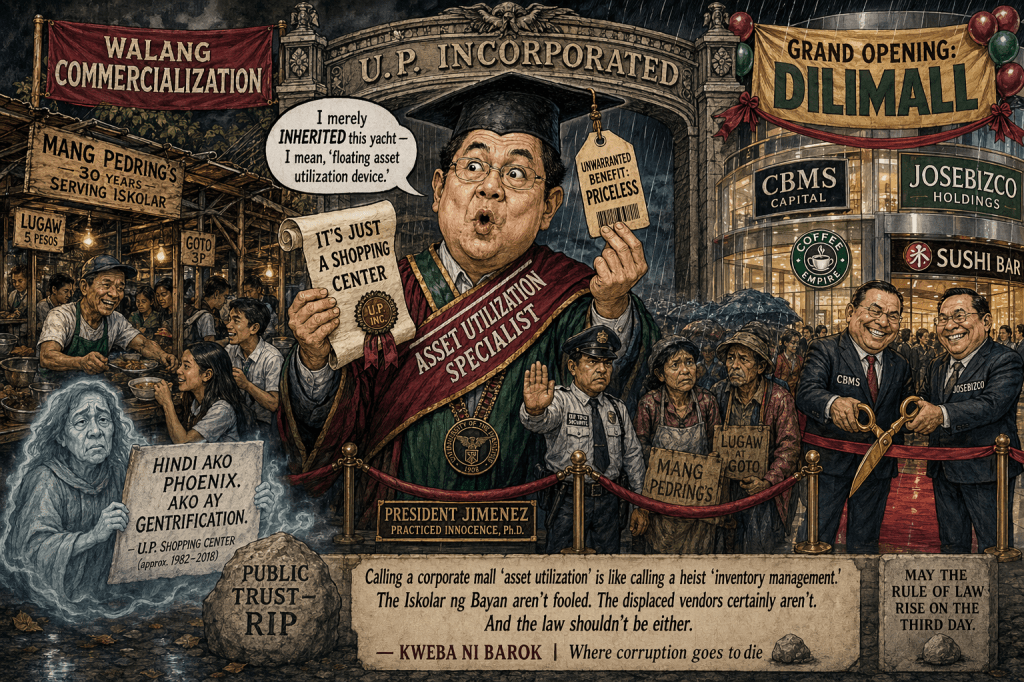
THE University of the Philippines Diliman bills itself as the last fortress of iskolar ng bayan, academic freedom, and that fabled “UP Way” where critical minds allegedly outsmart corporate sleight-of-hand. Yet here we are, watching the ghost of the old UP Shopping Center rise from its 2018 ashes not as a phoenix for small vendors, but as DiliMall (sorry, “shopping center”—mustn’t offend the delicate ears of the administration with the vulgar “m” word) and its culinary cousin GyudFood.
UP President Angelo Jimenez took to the microphones recently to insist there is “no commercialization” on campus. It’s merely “utilization of assets,” he said, the same noble enterprise that blessed us with UP TechnoHub and UP Town Center. Revenues? All funneled “to advance UP’s function.” The projects? Inherited. The complaints before the Ombudsman? A splendid “opportunity” to explain.
Spare us the semantic hair-splitting, Mr. President. Calling a gleaming commercial complex with private lessees a mere “shopping center” is linguistic farce unworthy of the country’s premier university. It’s like calling a yacht a “floating asset utilization device.” The Iskolar ng Bayan aren’t fooled. The displaced vendors certainly aren’t. And the law shouldn’t be either.
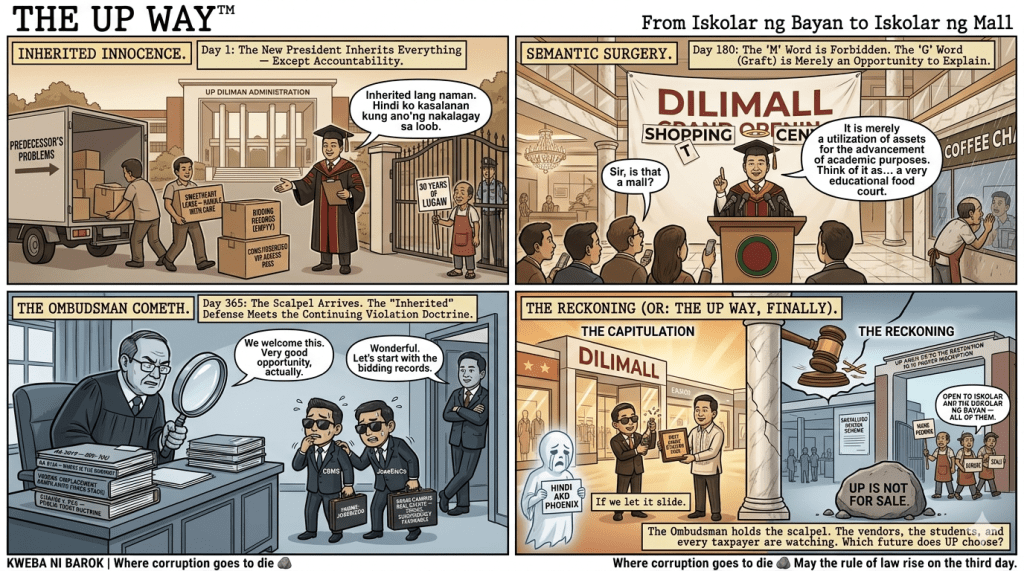
“Tuition rises. Vendors fall. Corporate tenants thrive. Curriculum: Advanced Corruption Studies, 3 units, no prerequisite.”
Eviscerating the “I Just Inherited This Mess” Defense
Jimenez’s favorite shield is continuity: “When you’re UP president, you inherit so many things.” Cute. But public office is a public trust, not a storage unit for predecessor sins. Under the doctrine of continuing violation, a public officer who knowingly implements and benefits from a flawed arrangement does not get a free pass simply because the ink dried before he arrived.
The principle of continuing mandamus under the Rules of Procedure for Environmental Cases (A.M. No. 09-6-8-SC, Rule 8) applies with equal force here. Once red flags wave — displaced vendors screaming about lost livelihoods, questions over bidding, cries of gentrification — the duty to act crystallizes.
Recall Arias v. Sandiganbayan: department heads may rely on subordinates in the ordinary course, absent circumstances that should provoke heightened scrutiny. But when those circumstances scream—complaints from long-time stallholders, the scale of displacement, the optics of corporate tenants occupying prime campus real estate—Arias offers no sanctuary. Jimenez did not merely inherit a contract. He actively executes it daily. Every peso collected, every corporate tenant welcomed, every vendor kept outside is a fresh, deliberate choice. That is not prudence. That is continuing implementation of potential graft.
He ‘welcomes’ the Ombudsman complaints as a ‘very good opportunity’ to explain. How magnanimous. The real opportunity was to pause, audit, and protect the public character of UP land before the concrete set. He chose otherwise.
Prosecuting the Original Sin: Concepcion & Company
Let us turn to the architects: former UP President Danilo Concepcion and his merry band of developers. The Ombudsman Litigation Playbook is clear. Repiblic Act 3019 (Anti-Graft and Corrupt Practices Act) (RA 3019) Section 3(e) requires a public officer, acting with manifest partiality, evident bad faith, or gross inexcusable negligence, to cause undue injury to any party or give unwarranted benefits to a private person. Section 3(g) punishes entering contracts grossly disadvantageous to the government.
The absence of transparent, competitive bidding under Republic Act 9184 (Government Procurement Reform Act) (RA 9184) is damning. Leases of public assets are not immune from procurement rules when they involve substantial public interest. If CBMS Property Company OPC and JoseBizCo Inc. waltzed into these deals without genuine competition, that alone smells like prima facie unwarranted benefit.
This was no innocent “asset utilization.” It was state-backed gentrification: displace the affordable, decades-old vendors who served generations of students, install higher-rent corporate players, and call it modernization. The old Shopping Center may have burned, but the administration’s solution prioritized private profit over public good. Where are the feasibility studies showing these terms were arm’s-length? Where is the independent valuation proving the government wasn’t shortchanged on rentals? The silence is thunderous.
The Philosophical and Legal Heart of the Scandal
This is not a mere contract spat. It is a war for the soul of UP, as defined in its Charter [Repuclic Act 9500, University of the Philippines Charter of 2008 (RA9500) Section 23]: income from resources must be “strictly and exclusively for academic purposes.” Is revenue from DiliMall and GyudFood truly academic, or is it laundering the creeping commercialization of a public trust? When the campus becomes a playground for corporate tenants while small vendors are priced out, the “academic purposes” fig leaf wears thin.
The injury to displaced vendors is not merely economic. It is a constitutional affront to the Social Justice Clause (Article XIII) of the 1987 Constitution of the Republic of the) Philippines. These were not transient squatters; they were part of the campus ecosystem for decades. Their livelihoods—sacrificed on the sanitized altar of “modernization”—embody the clash between elite deals and ordinary Filipinos.
Chavez v. PEA looms large. While that case involved reclaimed lands, its public trust doctrine resonates: long-term leases of inalienable public domain lands cannot function as disguised divestments. UP Diliman land is held in trust for the people, not as a revenue farm for private operators. When leases lock in corporate control for years while marginalizing the very community the university claims to serve, the public trust is breached.
For the Ombudsman, the elements of RA 3019 Sec. 3(e) are straightforward:
- Public officer — Check.
- Act causing undue injury to vendors OR unwarranted benefit to CBMS/JoseBizCo — Displacement plus suspiciously favorable terms.
- Attended by bad faith or gross negligence — Lack of competitive bidding, ignored vendor pleas, and sham consultations.
The evidence will turn on the contracts, bidding records (or their glaring absence), and clear proof of process integrity. If favoritism and procedural sham are evident, the entire defense turns to dust.
A Satirical Rogues’ Gallery
The Private Developers (CBMS and JoseBizCo): Corporate vultures circling prime real estate with a compliant administration. They didn’t create the sweetheart deal, but they feasted on it. Demand the full contracts. Show us the feasibility studies that somehow made these terms a steal for the government. They are classic recipients of unwarranted benefit—prime campus access on terms ordinary businesses could only dream of.
The Displaced Vendors: Not mere victims, but the human collateral damage of UP’s corporate delusion. Decades feeding hungry students on affordable budgets, now exiled in the name of progress. Their economic execution was dressed up as “modernization.” The UP Way, apparently, includes throwing the little guy under the air-conditioned mall.
The UP Community & Mall Rats ng Bayan: Ah, the Iskolar ng Bayan, once forged in the fires of activism and critical inquiry, now being gently rebranded into passive consumers wandering a Ghost Mall. The old Shopping Center had soul—cheap eats, student banter, that chaotic vitality. DiliMall/GyudFood offers sanitized corporate sterility: a monument to ideological surrender where the university trades its public commons for revenue streams. Welcome to UP, Inc., where protest yields to profit and the campus vibe goes full neoliberal.
Call to Arms: Preventive Suspension, Injunction, and a Compromise with Teeth
The Ombudsman must act decisively.
- Issue a preventive suspension order against the implicated officials to immediately halt the continuing injury.
- Courts should grant a legal injunction freezing all operations of DiliMall and GyudFood until a full, independent audit of the leases, bidding process (or lack thereof), and financial terms is completed.
Sunlight is the best disinfectant — let the documents speak.
Beyond punishment, we demand a resolution that truly embodies the “UP Way”: a Compromise with Teeth.
Mandate a socialized rental scheme inside the new structures — dedicated affordable spaces for the original displaced vendors, subsidized by the higher rents from the corporate tenants now occupying their place.
This is not charity.
This is a legal and moral imperative under the Social Justice Clause and the UP Charter itself.
The Case Hinges on Bad Faith and Process Integrity
If the prosecution cannot prove bad faith, the case collapses. If the defense cannot justify process integrity and genuine consultation, their position crumbles. On both fronts — obvious favoritism in partner selection and the evident sham of meaningful stakeholder engagement — the UP administration’s defense is nothing but dust.
UP is not for sale. Its land is not a private profit center. Its officials are not corporate landlords in academic robes. The Ombudsman now holds the scalpel. Use it. The vendors, the students, and every taxpayer who believes a national university should serve the nation—not gentrify it—demand nothing less.
Share this. Debate it. Fear the precedent if we let it slide.
Kweba ni Barok will keep watching. The ghost mall has eyes on it now.
Louis “Barok” C. Biraogo
Legal Gadfly | Merciless Inquisitor | Taxpayer with Receipts
Key Citations
A. News Articles
- Reyes, Dempsey. “UP President: No Commercialization in Diliman Campus.” Inquirer.net, 22 Apr. 2026.
- Bautista, Jane. “UP Officials, 2 Firms Face Raps Over Mall, Food Hub.” Inquirer.net, 16 Dec. 2025.
B. Laws and Charters
- Philippines. Republic Act No. 3019: Anti-Graft and Corrupt Practices Act. 17 Aug. 1960. LawPhil.net.
- —. Republic Act No. 9184: Government Procurement Reform Act. 10 Jan. 2003. LawPhil.net.
- —. Republic Act No. 9500: University of the Philippines Charter of 2008. 29 Apr. 2008. LawPhil.net.
- The Philippines Constitution of 1987. Official Gazette of the Republic of the Philippines.
- Philippines, Supreme Court. Administrative Matter No. 09-6-8-SC: Rules of Procedure for Environmental Cases. 29 Apr. 2010. LawPhil Project, Arellano Law Foundation.
C. Jurisprudence
- Chavez v. Public Estates Authority. G.R. No. 133250, Supreme Court of the Philippines, 9 July 2002. Supreme Court E-Library.
- Arias v. Sandiganbayan. G.R. No. 81563, Supreme Court of the Philippines, 19 Dec. 1989. LawPhil.net.
D. Official Sites

- ₱9 Billion in ‘Savings’? DILG’s Fire Truck Deal Smells Like Smoke

- ₱8B BBM Pork: CCTV for Every Captain’s Kumpare?

- ₱8.9 Billion, 331 Ghost Police Stations: The TIKAS Scandal Explained

- ₱8.4 Billion, 42,000 Barangays, 1 Election: The “Bawat Barangay Makikinabang” Vote-Buying Masterclass

- ₱75 Million Heist: Cops Gone Full Bandit

- ₱63 to the Dollar: The Only Thing Falling Faster Than the Peso Is the Government’s Credibility

- ₱6.77B Ghost Haunts Duterte: RTC Dismisses Mans Carpio’s Desperate Plea
- ₱6.77 Billion and Zero Cash: The Sara Duterte SALN Math That Doesn’t Add Up

- ₱6.7-Trillion Temptation: The Great Pork Zombie Revival and the “Collegial” Vote-Buying Circus

- ₱58.53B, Zero Receipts: The LGSF Pork Barrel Nobody Wants to Name
- ₱53 Million Man Tells ₱695-a-Day Workers to Stop Being ‘Mayabang’: The Audacity of BSP’s Remolona

- ₱4.4 Billion and a Witness Who Can’t Explain It: The Duterte Impeachment’s Most Expensive Non-Answer







Leave a Reply