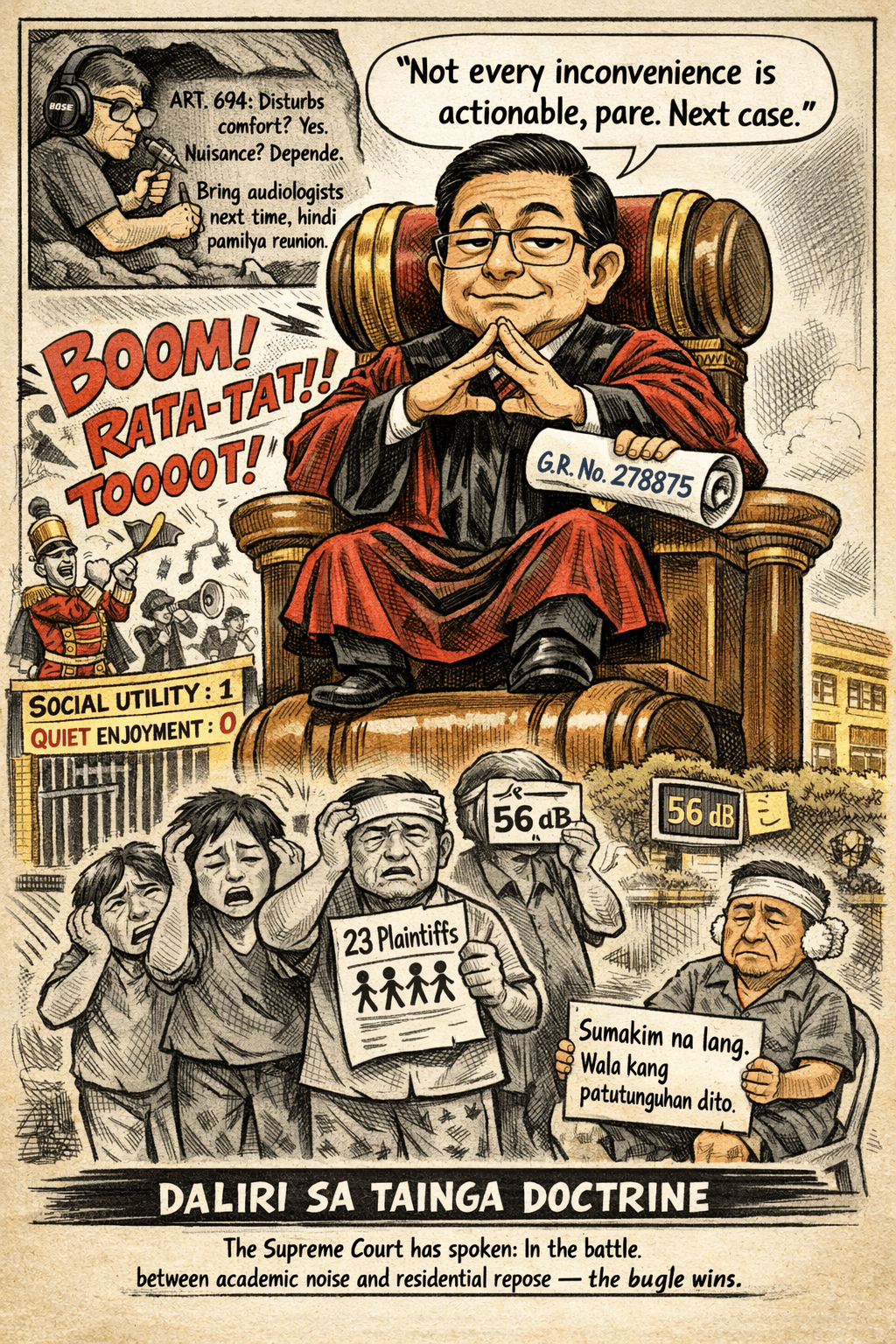
Butuan homeowners lose as Supreme Court rules “academic noise” from drums and bugles is perfectly legal
By Louis ‘Barok‘ C. Biraogo — April 19, 2026
AND so the Supreme Court delivers its trademark brand of judicial restraint — loud and clear. In G.R. No. 278875, the Third Division, per the ever-so-pragmatic Justice Samuel H. Gaerlan, has delivered a 17-page masterclass in telling Butuan’s Saint Joseph Subdivision homeowners exactly where their “quiet enjoyment” ends and a school’s right to bugle practice begins. The Couples for Christ School of the Morning Star (CFC-SMS) can keep drumming, cheering, and megaphoning away. The residents? Their claim for damages and abatement? Dismissed with a polite footnote that essentially reads: “Not every inconvenience is actionable, pare. Next case.”
Welcome to the Gaerlan Gambit: where “tolerance” is the new black, and “preponderance of evidence” is the velvet rope that keeps the rabble out of court.
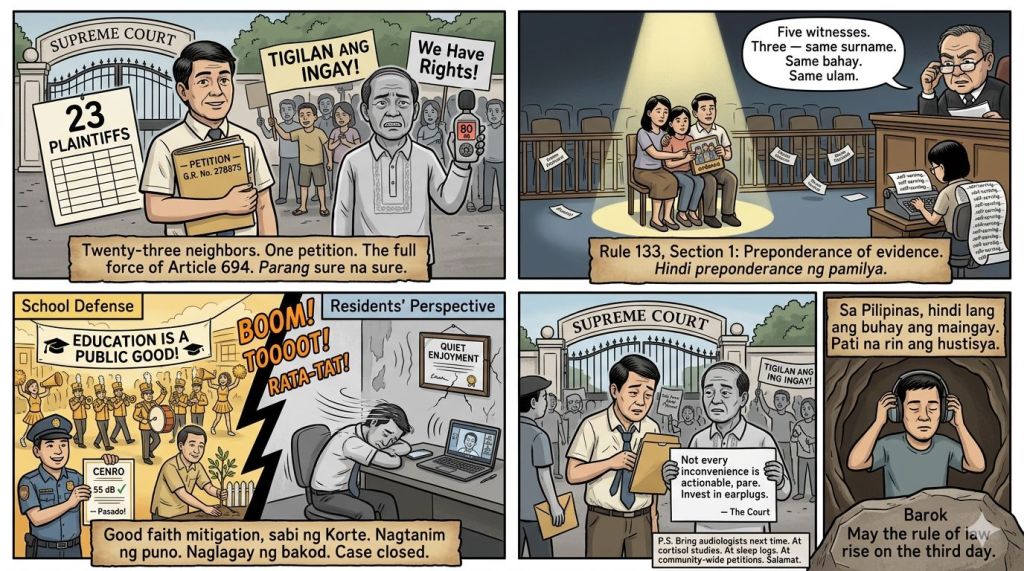
Inchoco Conundrum: Family Reunion Testimony That Flopped as Class-Action Proof
Let’s start with the petitioners’ trial strategy, shall we? Twenty-three plaintiffs sign up to complain about the school’s “boombox” lifestyle—drums, bugles, cheering squads, the works. Yet only five take the witness stand. Three of them? Same surname, same roof, same breakfast table. The other two? Elbert Villanueva and Angeline Rabor-Luta, who, bless their hearts, couldn’t quite prove the noise was turning their lives into a war zone.
Justice Gaerlan called it what it is: “self-serving.” Under Rule 133, Section 1 of the Rules of Court, preponderance isn’t measured by volume of affidavits or the size of the family WhatsApp group—it’s about credible, representative evidence that actually tilts the scales. Here, the Inchoco clan reunion masquerading as community outrage simply didn’t cut it. No expert audiologists. No sleep studies. No cortisol-level bloodwork. Just five people saying, in essence, “It’s loud, Your Honor, and we don’t like it.”
This isn’t a class-action; it’s a family barbecue with delusions of grandeur. The Court smelled it from a kilometer away. And frankly, so did I. When your entire evidentiary arsenal can fit in one household’s living room, don’t be surprised when the Supreme Court treats your petition like a neighbor’s complaint about your karaoke machine—annoying, but not quite worth the taxpayer’s time.
Gaerlan Gambit: “Academic Noise” Gets a Judicial Get-Out-of-Jail-Free Card
Now for the autopsy of the ruling itself. The Court’s shiny new toy is the “academic noise” doctrine—sounds “incident to the operation of an educational institution” that, apparently, get a pass under Article 694 of the Civil Code (Republic Act No. 386) unless you can prove they’re unreasonable, malicious, and personally aimed at your eardrums with a sneer.
Is this a legitimate extension of nuisance law? Or judicial sophistry wrapped in a graduation gown?
Let’s compare this to the AC Enterprises v. Frabelle (2006 & 2020) line. In those cases, the Court applied a multi-factor test: location, social value of the activity, duration, intensity, and—crucially—whether the defendant exercised reasonable care. Blowers from a commercial building? Not automatically a nuisance. Here, the Court takes that framework and stretches it into a blanket deference for schools. The CFC-SMS built fences, planted trees, limited hours, and even passed a 2020 CENRO noise test at or below 55 dB. Good-faith mitigation, the Court says. Case closed.
Tolerance, they call it. I call it capitulation. Article 694 doesn’t distinguish between “annoying the senses” from a factory or from a school drumline. It just asks whether the act “disturbs the comfort or repose of persons” or “impairs the use of property.” Yet the ruling draws a velvet distinction: school noise is special because education is a public good. Fine. But tell that to the resident trying to work from home while the morning assembly megaphone hits 80 dB. Is that “enthusiastic pedagogy” or just noise pollution with a mission statement?
And the Decibel Dodge? The Court concedes the DENR/NPCC 55 dB residential limit but shrugs: exceeding it isn’t automatic nuisance. Other factors matter—health impact, intent, context. So a school can flirt with the line, or even cross it during cheering practice, and it’s not actionable until someone drops dead from a heart attack. Brilliant. The regulatory benchmark becomes a suggestion, not a sword.
Then there’s the Malice Misconception. The Court leans hard on Articles 19, 20, and 21—abuse of rights, good faith, acts contrary to morals. No damages without bad faith or ill motive, they say. But Article 2176 (quasi-delict) only requires fault or negligence. Must the drum major cackle with evil glee for the noise to count? Apparently yes, in Butuan. The school’s legitimate academic purpose and mitigation efforts washed away any whiff of “fault.” Article 26’s protection of “peace of mind” and dignity? Reduced to “minor inconveniences.”
Suck It Up Doctrine: Art. 26 Gets Trumped by “Just Life in the Philippines” Realities
The policy proclamation is the real kicker: “Not every inconvenience gives rise to a cause of action for damages. Otherwise, courts will be inundated with endless litigation over minor and speculative grievances.” Translation: welcome to the Suck It Up Doctrine.
Contrast this with Article 26 of the Civil Code—every person’s right to be “free from… any other similar acts” that “offend the feelings or cause mental anguish.” Velasco v. Meralco (and its progeny) has always demanded concrete proof of harm before moral or actual damages kick in (Articles 2199 and 2217). Fair enough. But the Mendoza line between “actionable nuisance” and “Just Life in the Philippines, Pare” has now been drawn so far toward tolerance that even a morning assembly that sounds like a political rally at 7 a.m. is just Tuesday.
In a country where karaoke bars, tricycles with subwoofers, and roosters at 4 a.m. are national pastimes, the Court is essentially saying: if you can’t beat the noise, join the silent majority with earplugs. Article 697’s abatement remedy? Only if you can prove the harm is real, substantial, and not just “life in a subdivision that let a school in.”
Ripple Effect: The Barok Rule and a Frustrated Call for Real Harm Proof
So what now?
- Residents: Invest in Bose noise-canceling headphones or spend the next decade filing barangay complaints and CENRO letters until the sun burns out. Administrative remedies are your only real play—unless you want to refile with actual evidence next time.
- The School: They built fences and planted trees. Mabuhay. That’s now the gold standard for Article 697 abatement. Social utility 1, quiet enjoyment 0.
- The Legislature: The Civil Code of 1949 is adorable in 2026 subdivision density. Time for statutory clarity on “acoustic zoning.” Congress, do your job before every subdivision becomes a de facto schoolyard.
Here’s the Barok Rule for future litigants: if you want the Court to intervene, bring the real stuff. Expert testimony from audiologists. Medical evidence—cortisol levels, sleep studies, documented hypertension. Community-wide proof—petitions signed by actual neighbors, not just the Inchoco clan reunion. No more self-serving family affidavits. Real, substantial, and proven harm. That’s the new evidentiary gauntlet.
What must a court actually see? Not “it’s loud.” Not “we don’t like it.” But objective proof that the noise unreasonably interferes with the health, safety, or comfort of an ordinary person in that locality—beyond what the social utility of the activity can justify. Until then, the law’s message is clear: in the battle between academic noise and residential repose, the bugle wins.
Every Filipino who has ever lived next to an unplanned karaoke bar, a 24-hour construction site, or—apparently—a faith-based school with a marching band knows this frustration in their bones. The Supreme Court just gave it a 17-page citation.
The noise continues. The residents adapt. And the law? It stays elegantly, infuriatingly, tolerant.
Barok out.
Key Citations
A. Legal & Official Sources
- Philippines. Republic Act No. 386. An Act to Ordain and Institute the Civil Code of the Philippines. 18 June 1949. Official Gazette of the Republic of the Philippines.
- Philippines, Supreme Court. AC Enterprises, Inc. v. Frabelle Properties Corp. Supreme Court E-Library, G.R. No. 166744, 2 Nov. 2005.
- Philippines, Supreme Court. Couples for Christ School of the Morning Star et al. v. Wideline I. Malonda et al.. G.R. No. 278875, 26 Nov. 2025. Supreme Court of the Philippines.
- Philippines, Supreme Court. Frabelle Properties Corp. v. AC Enterprises, Inc. G.R. No. 245438, 3 Nov. 2020. Lawphil.
- Philippines, Supreme Court. Rules of Court. Rule 133, Section 1. Lawphil.
- Philippines, Supreme Court. Velasco v. Manila Electric Co. G.R. No. L-18390, 6 Aug. 1971. Lawphil.
B. News Reports
- “Ang Hirap Maging Mahirap”: The PAO Scandal That Proves Government Contempt Is Nothing New

- “Far-Off” My Axx: Malacañang’s Claire Castro Drowns in Her Own Legal Gaslighting
- “Forthwith” to Farce: How the Senate is Killing Impeachment—And Why Enrile’s Right (Even If You Can’t Trust Him)
- “HINDI AKO NAG-RESIGN!”

- “I Know Nothing”: Baste Duterte’s Amnesia Defense Meets ₱33M in GenCorp Contracts

- “I’m calling you from my new Globe SIM. Send load!”

- “Mahiya Naman Kayo!” Marcos’ Anti-Corruption Vow Faces a Flood of Doubt

- “Manageable” Debt, Unmanageable Lies: DBM’s ₱21 Trillion Fairy Tale
- “Meow, I’m calling you from my new Globe SIM!”

- “Natrabaho”: One Word, One Ombudsman, and a Judiciary on Trial

- “No Special Jail for Crooks!” Boying Remulla Slams VIP Perks for Flood Scammers

- “Philippine-Controlled” or Yankee Gas Station? The Davao Fuel Depot Farce Exposed







Leave a comment