
From Flood Scandal to Fast-Track Frenzy – Same Contractors, Bigger Budget
By Louis ‘Barok‘ C. Biraogo — April 22, 2026
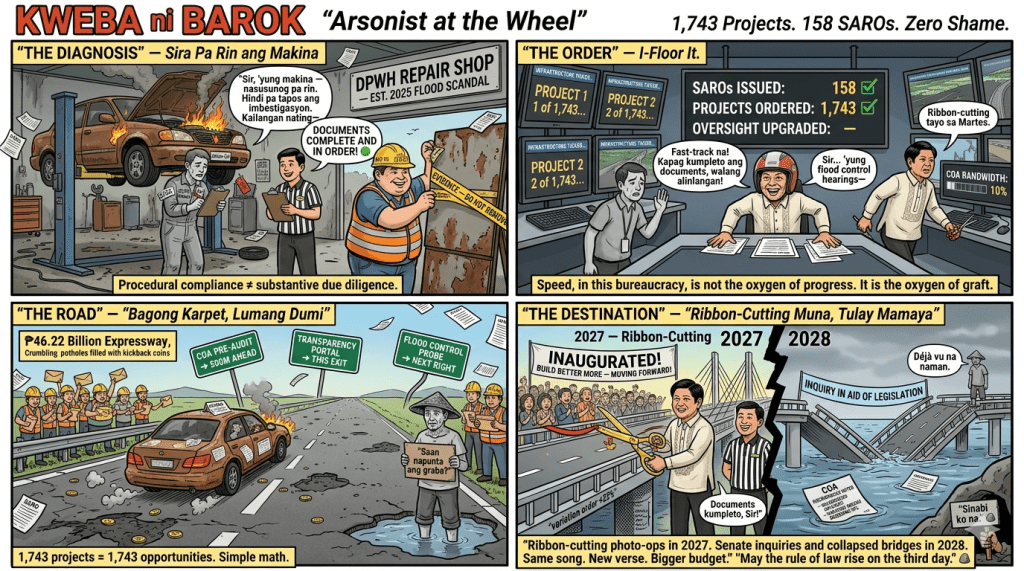
MGA ka-kweba, ladies and gentlemen of the Republic, behold the masterclass in automotive malpractice: President Ferdinand “I’ll Fix It Myself” Marcos Jr. has ordered the fast-tracking of 1,743 infrastructure projects worth ₱46.22 billion, complete with 158 shiny new Special Allotment Release Orders (SAROs) vomited forth by the DBM like so many confetti cannons at a wake. The official line, courtesy of Acting Budget Secretary Rolando Toledo? “When the documents are complete and in order, we will not hesitate.” Translation: the engine is still coughing up oil from the 2025 flood-control ghost-project scandal, the mechanics are still under investigation, and the President has decided the solution is to floor it while the hood is still open and the flames are licking the upholstery.
This is not governance. This is a mechanic swinging a sledgehammer at a carburetor while the car is on fire, then yelling at the smoke inhalation victim for complaining about the smell. Marcos is trying to restart a stalled engine while it is literally still being repaired—and he expects us to applaud the hubris of believing sheer velocity will outrun the consequences.
Legal Facade: SAROs, Paper Compliance, and the Graft Vacuum
The 1987 Constitution of the Republic of the Philippines (Article VII, Section 17) gives the President control over the executive departments. The Executive Order No. 292 (Administrative Code of 1987), the 2026 GAA, and the brand-new Republic Act No. 12289 (Accelerated and Reformed Right-of-Way Act) (the ARROW Act) plus Executive Order No. 59 (2024) provide the statutory scaffolding. The issuance of 158 SAROs issued on April 15? Procedurally compliant, assuming the DBM’s solemn declaration that “documents are complete” is not the bureaucratic equivalent of a barista writing “have a nice day” on a cup of stale coffee.
But procedural compliance is not substantive due diligence, and “complete documents at the DBM” is not a legal standard—it is a punchline. Republic Act No. 9184 (Government Procurement Reform Act) and Republic Act No. 3019 (Anti-Graft and Corrupt Practices Act) do not vanish because the President has declared a speed limit of “as fast as humanly possible.” The ARROW Act may let you seize land faster; it does not magically make the DPWH’s absorptive capacity infinite or turn 15 contractors who cornered 18% of a ₱545-billion flood-control budget into choirboys.
Speed, in this bureaucracy, is not the oxygen of progress. It is the oxygen of graft. Accelerate the process without accelerating oversight—when the Commission on Audit (COA)’s bandwidth is already stretched thinner than a congressman’s alibi—and you do not create efficiency. You create a legal and fiscal vacuum. Corruption, being the opportunistic organism that it is, expands to fill that vacuum with the serene inevitability of mold on week-old adobo.
Arsonist at the Wheel: Rushing Integrity in a Dirty Repair Shop
Here is the delicious contradiction no one in Malacañang wants to say out loud: you cannot simultaneously rush infrastructure and guarantee integrity. It is thermodynamically, fiscally, and politically impossible. The 2025 Flood Control Scandal is Exhibit A, still warm on the evidence table—substandard structures, ghost projects, and a handful of contractors treating the national budget like their personal piggy bank. The DPWH has not been “cleaned.” It has simply been handed a bigger shovel and told to dig faster. The dirt is still under the rug; they are now dropping ₱46.22 billion worth of new carpet on top of it and calling it “asset preservation.”
Patronage math is even more brutal. One thousand seven hundred forty-three projects equal one thousand seven hundred forty-three opportunities for “facilitation fees,” “consultancy retainers,” and “emergency mobilization costs.” On a ₱46.22-billion expressway of government contracts, the unofficial toll fees could fund an entire 2028 Early Withdrawal Program for the administration’s favorite contractors. This is not public works. This is the administration’s quiet privatization of the kickback economy.
High-Stakes Wager: The Palace’s All-In Bet on Speed
This is not policy. This is a calculated political wager—the kind a desperate casino patron makes at 3 a.m. when the chips are low and the cocktail waitress is starting to look sympathetic.
The possible motivations, ranked by plausibility:
- Economic stimulus to mask the anemic 4.4% GDP growth of 2025—because nothing says “we are back, baby” like Keynesian spending on roads that may or may not exist next year.
- Legacy building—echoes of the old man’s infrastructure-heavy governance, now rebranded as “Build Better More” because “Build, Build, Build” already has too many ghosts attached.
- Narrative control—a shiny distraction from the ongoing flood-control hearings and the Senate Blue Ribbon inquiries that are still picking at the scab.
- Political survival, the heaviest dollop of all. A president in the middle of his term who stops building loses the “moving forward” brand faster than a Davao City Bypass contractor can issue a variation order.
The bet is simple: finish the bridge before the rot in the pilings is discovered. Classic gambler’s ruin logic—double down until the house (or the COA) calls your bluff.
Predictable Wreck: Options Ignored, Déjà Vu Guaranteed
The administration has chosen Option 1: Full Speed Ahead. The “Transparency First” path—publish real-time geo-tagged data, wait for COA pre-audits, finish the flood-control probes—is theoretically available. It is also about as likely as Secretary Toledo volunteering to personally audit every dump truck with a flashlight and a guilty conscience.
Worst-case scenario? Child’s play to predict. The 2027 COA report will be a masterpiece of bureaucratic understatement: “discrepancies noted,” “unliquidated advances,” “variation orders exceeding 20%.” The next round of “ghost project” hearings will feature the Davao City Bypass—P288.371 million for fiscal year 2026—as the shiny hood ornament on an otherwise lemon of a vehicle. Ribbon-cutting photo-ops in 2027; Senate inquiries and collapsed bridges in 2028. Same song, new verse, bigger budget.
Venomous Demand: Fix the House Before the Block Party
Enough. A government that just uncovered systemic corruption in its own house should fix the house before throwing another ₱46 billion block party. This is not a call for slowness. This is a call for competent speed—the kind that actually reaches the destination instead of wrapping itself around a lamppost.
Therefore, with the full venomous sarcasm this moment deserves:
- Live Geo-Tagging for every single dump truck funded by these 158 SAROs. Stream it to a public website 24/7. If the gravel ends up at a contractor’s private resort instead of the project site, at least the public will have front-row seats.
- COA Pre-Audit before a single check clears. Make sure the contractor is not the same genius who built the flood wall that dissolved like wet tissue last rainy season.
- Genuine Public Service: remind the Palace that pro-people governance is not measured by the number of ribbon-cuttings but by the absence of potholes filled with kickbacks and the presence of bridges that do not require a life vest to cross.
Gentlemen, start your engines. And keep your lawyers on speed dial. The road to hell, after all, is paved with fast-tracked SAROs.
Key Citations
A. Legal & Official Sources
- The 1987 Constitution of the Republic of the Philippines. Official Gazette of the Republic of the Philippines, 1987.
- Philippines, Executive Secretary. Executive Order No. 292 [Administrative Code of 1987]. Official Gazette of the Republic of the Philippines, 25 July 1987.
- Philippines, Congress. Republic Act No. 12289: An Act Instituting Reforms in the Acquisition of Right-of-Way for Infrastructure Projects by the National Government and by Public Service Providers. Lawphil, 12 Sept. 2025.
- Philippines, President. Executive Order No. 59: Streamlining the Permitting Process for Infrastructure Flagship Projects. Lawphil, 30 Apr. 2024.
- Philippines, Congress. Republic Act No. 9184: An Act Providing for the Modernization, Standardization and Regulation of the Procurement Activities of the Government and for Other Purposes. Lawphil, 10 Jan. 2003.
- Philippines, Congress. Republic Act No. 3019: Anti-Graft and Corrupt Practices Act. Lawphil, 17 Aug. 1960.
- “2025 Flood Control Scandal.” Wikipedia, Wikimedia Foundation, 2026.
B. News Reports

- ₱9 Billion in ‘Savings’? DILG’s Fire Truck Deal Smells Like Smoke

- ₱8B BBM Pork: CCTV for Every Captain’s Kumpare?
- ₱8.9 Billion, 331 Ghost Police Stations: The TIKAS Scandal Explained

- ₱8.4 Billion, 42,000 Barangays, 1 Election: The “Bawat Barangay Makikinabang” Vote-Buying Masterclass

- ₱75 Million Heist: Cops Gone Full Bandit

- ₱63 to the Dollar: The Only Thing Falling Faster Than the Peso Is the Government’s Credibility

- ₱6.77B Ghost Haunts Duterte: RTC Dismisses Mans Carpio’s Desperate Plea
- ₱6.77 Billion and Zero Cash: The Sara Duterte SALN Math That Doesn’t Add Up

- ₱6.7-Trillion Temptation: The Great Pork Zombie Revival and the “Collegial” Vote-Buying Circus

- ₱58.53B, Zero Receipts: The LGSF Pork Barrel Nobody Wants to Name
- ₱53 Million Man Tells ₱695-a-Day Workers to Stop Being ‘Mayabang’: The Audacity of BSP’s Remolona

- ₱4.4 Billion and a Witness Who Can’t Explain It: The Duterte Impeachment’s Most Expensive Non-Answer






Leave a Reply