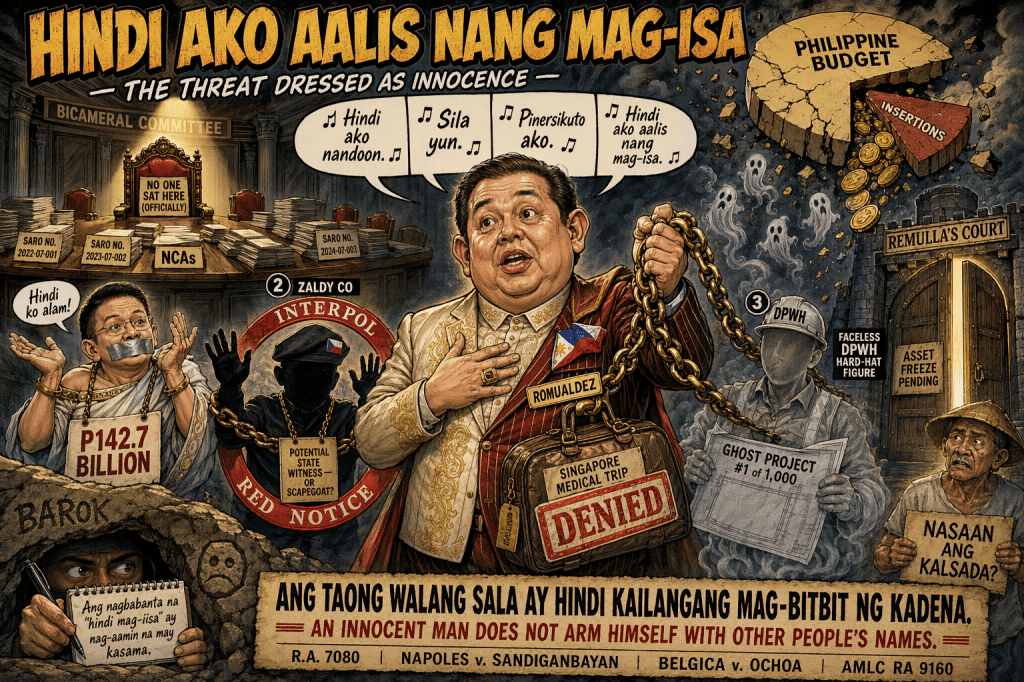
The “Not Go Alone” Threat: How Romualdez Plans to Drag Everyone Down With Him
By Louis “Barok” C. Biraogo — April 22, 2026
Kweba ni Barok | Investigative Commentary
FAIR warning, mga ka-kweba: What follows is not for the faint of heart, the politically squeamish, or those who still believe that budget deliberations in the Philippine Congress resemble anything approaching a deliberative democracy. What we have here is a masterclass in elite panic, a legal thriller unfolding in real-time, and—if we’re being completely honest—a comedy of errors that would be hilarious if it weren’t being funded by your taxes.
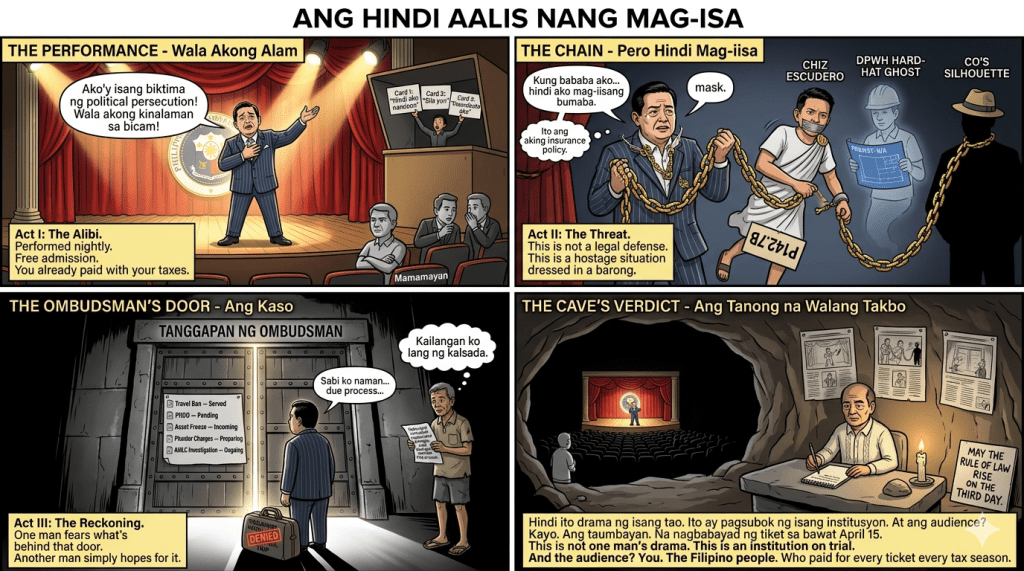
He wears the cross. He swings the shackles. Sometimes simultaneously.
Part I: The Theater of Denial
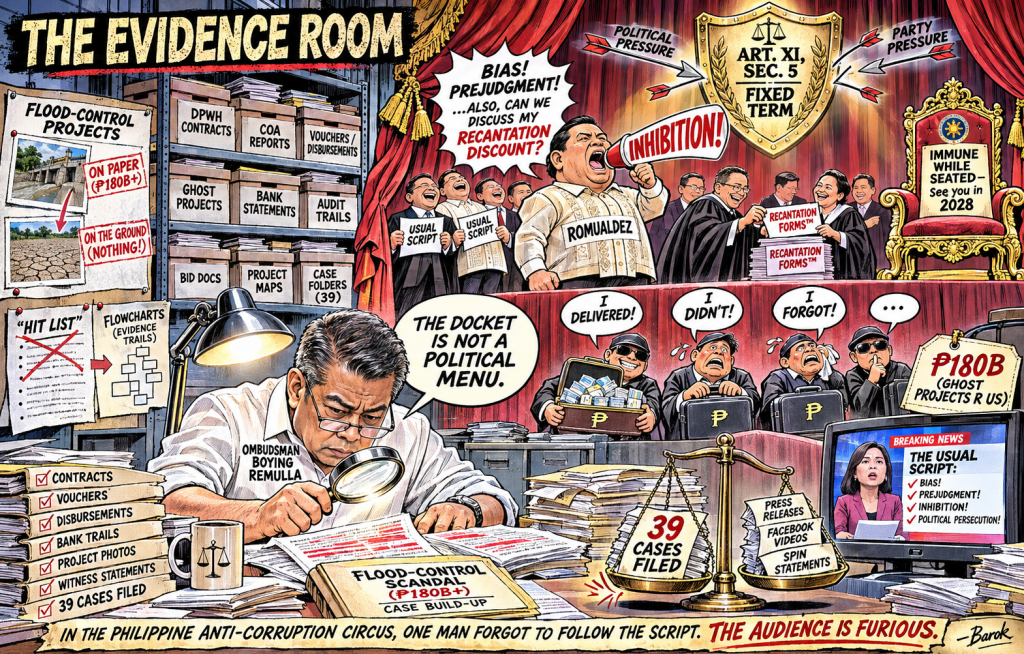
Let us begin with the spectacle itself: Ferdinand Martin Romualdez, cousin to the President, former Speaker of the House, and now self-styled martyr of selective prosecution, has finally broken his silence. And what a silence it was—strategic, calculated, and maintained just long enough for the Office of the Ombudsman to slap him with a travel ban and an impending asset freeze.
His video message, released Tuesday afternoon like a carefully-timed ordinance, contained all the greatest hits of the Philippine politician’s defense playlist:
- “I wasn’t there.” (The bicameral alibi)
- “It was them.” (The Escudero-Co finger-pointing)
- “I’m being targeted.” (The political persecution aria)
- “I will not go quietly.” (The thinly-veiled threat)
Bravo, Congressman. Bravo.
But let us not be distracted by the performance. As any seasoned observer of Philippine politics knows, when a politician starts naming names with the precision of a laser-guided missile, it is not justice they seek—it is leverage.
Part II: The Legal Architecture of Accountability
A. The Plunder Framework: A Tale of P75 Million and a Paper Trail
The Ombudsman, under the newly-minted Jesus Crispin Remulla, is reportedly preparing plunder charges against Romualdez and Escudero. For those who slept through Criminal Law 101, Republic Act No. 7080 (The Plunder Law) requires:
- A public officer
- Amassing ill-gotten wealth of at least ₱75 million (as amended by Republic Act No. 7659)
- Through a combination or series of overt acts (kickbacks, misappropriation, etc.)
The Prosecution’s Challenge:
This is where the rubber meets the road—or, more accurately, where the ghost projects meet the money trail. To secure a plunder conviction, the Ombudsman must produce what I call the “Holy Trinity of Corruption Prosecution” :
- The Paper Trail: Budget insertions → Special Allotment Release Orders (SAROs)/Notice of Cash Allocation (NCA) releases → Project allocations → Ghost projects
- The Financial Trail: Bank records → Shell companies → Kickback patterns → Unexplained wealth
- The Human Link: Insider testimony connecting legislators → Contractors → Implementing agencies
The Romualdez Defense Matrix:
| Argument | Legal Basis | Weakness |
|---|---|---|
| “No direct participation in bicam” | Separation of Powers (Article VI, 1987 Constitution) | Napoles precedent (influence ≠ formal role) |
| “Legislators don’t implement projects” | Executive implementation mandate | Conspiracy doctrine (“act of one is act of all”) |
| “No evidence of personal gain” | Plunder requires proof of enrichment | Anti-Money Laundering Council (AMLC) investigation ongoing; asset freeze pending |
| “Political targeting” | Equal protection, due process | Must prove selective prosecution intent |
B. The Napoles Precedent: The Ghost That Haunts Romualdez
This is the case that should keep Romualdez’s legal team awake at night. In Janet Lim Napoles v. Sandiganbayan (G.R. No. 224162, November 7, 2017), the Supreme Court established principles that fundamentally altered Philippine corruption jurisprudence :
A legislator may be held criminally liable even without direct implementation authority if they:
1. Identify the beneficiaries
2. Exercise control over fund allocation
3. Maintain a pattern of intervention
Application to Romualdez:
While he claims “no visibility” on bicameral details, the prosecution will argue:
- As Speaker, he controlled the legislative agenda
- Co (Ako Bicol) was his appropriations chair
- The “pattern evidence” of ghost projects across multiple districts suggests centralized coordination
The Napoles doctrine essentially says: “You don’t need to hold the knife to be guilty of the murder—you just need to have ordered the hit.”
C. The Belgica Constitutional Framework
The Supreme Court’s landmark decision in Belgica v. Ochoa (G.R. No. 210503, October 8, 2019) declared unconstitutional “all informal practices” that allow legislators to “intervene, assume or participate in any of the various post-enactment stages of the budget execution” .
The 2025 budget insertions, if proven to involve post-enactment legislative intervention, would violate this constitutional prohibition regardless of whether Romualdez “participated” in the bicameral meetings.
Part III: Command Responsibility—The Doctrine Romualdez Fears Most
Why the “Absent from the Room” Alibi Collapses
Romualdez’s primary shield is procedural absence: “I was not part of the bicam and the small committee budget deliberations.”
The Legal Counter-Argument:
Under Philippine jurisprudence, command responsibility has evolved beyond military contexts. In administrative and graft cases, the Supreme Court has consistently held that:
- Supervising officials cannot hide behind procedural technicalities when systemic corruption occurs under their watch
- The “Arias Doctrine” established in Arias v. Sandiganbayan (G.R. No. 81563, December 19, 1989)—heads of office relying on subordinates’ good faith—has limits; it does not apply when there are “red flags” or “badges of fraud”
Romualdez’s Dilemma:
| He Claims | The Reality |
|---|---|
| “I was only updated on general outcomes” | Updates imply oversight authority |
| “I had no visibility on specific details” | Willful blindness is not a defense |
| “Two people made those decisions” | Those people reported to him |
The Killer Question:
- If Romualdez truly had “no role” in budget decisions, why did Co—his own appropriations chair—need to update him on “general outcomes”?
- What was the purpose of those updates if not to secure approval?
The “No Personal Gain” Alibi Meets the AMLC Money Trail
This is perhaps Romualdez’s most vulnerable flank. The timeline of events is suspicious, to say the least:
- October 2025: Independent Commission for Infrastructure (ICI) requests Immigration Lookout Bulletin Order (ILBO) against Romualdez
- Remulla’s Last Day as DOJ Secretary: Signs the ILBO
- Remulla Becomes Ombudsman: Immediately escalates to Precautionary Hold Departure Order (PHDO) and asset freeze
- April 2026: Romualdez requests Singapore medical trip—denied
The AMLC Factor:
The Anti-Money Laundering Council (AMLC) is now involved. Under Republic Act No. 9160 (Anti-Money Laundering Act of 2001), as amended by RA 9194 and RA 10365, the AMLC can:
- Investigate suspicious transactions without prior notice
- Freeze assets upon probable cause showing
- Coordinate with foreign financial intelligence units
What This Means:
The Ombudsman’s confidence in seeking an asset freeze suggests they have preliminary financial intelligence. Romualdez’s sudden urgency to travel—coincidentally right after Co’s arrest in Europe—raises legitimate flight risk concerns.
The Legal Standard:
Under Office of the Court Administrator (OCA) Circular No. 194-2018 (PDF), a PHDO requires only:
- A pending criminal complaint
- Probable cause that the crime was committed
- Reasonable belief that the respondent may flee
Romualdez meets all three criteria.
Part IV: The Proxy War Among Elites
Mapping the Power Struggle
This scandal is not occurring in a vacuum. It is the latest chapter in the eternal Philippine saga of elite fragmentation.
The Factions:
| Faction | Key Players | Interest |
|---|---|---|
| Romualdez-Marcos Bloc | Martin Romualdez, President Marcos | Preserve political dynasty; 2028 positioning |
| Escudero Network | Chiz Escudero, Bicol allies | Distance from Romualdez; self-preservation |
| Remulla-Ombudsman Axis | Jesus Crispin Remulla | Institutional credibility; political independence |
| The Co Wildcard | Zaldy Co (detained in Europe) | Potential state witness; leverage holder |
The Game Theory Analysis:
Romualdez’s statement—“I will not go quietly, and I will not go alone”—is not a legal defense. It is a political threat. He is signaling that if he falls, he will take others with him.
Who might those “others” be?
- Escudero: Already named as a “key decision-maker”
- DPWH Officials: The implementing arm
- Contractors: The private sector beneficiaries
- Potentially Higher: The “budget decisions” Romualdez claims he was “updated” on came from somewhere
The “Quiet Containment” Myth Meets Romualdez’s “Not Go Alone” Threat
The administration’s response to this scandal has been telling. There is a deafening silence from Malacañang, punctuated only by procedural statements about “letting the legal process take its course.”
The Political Calculus:
- Distance the President: Romualdez is a cousin, but family loyalty has limits when plunder charges loom
- Contain the Fallout: Sacrifice one figure to protect the broader coalition
- Control the Narrative: Allow the Ombudsman to appear “independent” while privately managing the scope
The Risk:
Romualdez’s threat to “not go quietly” undermines this strategy. If he produces documents, recordings, or testimony implicating others, the damage control becomes damage amplification.
Part V: Formal Law Versus Political Reality
The Tension That Will Decide This Case
Romualdez’s defense rests on a formalist interpretation of separation of powers:
“Congress appropriates; the Executive implements. I am a legislator; therefore, I cannot be liable for implementation failures.”
The Political Reality:
This is, to put it charitably, legal fiction at its finest. The Philippine budget process has never operated according to constitutional formalism. The reality is:
- Legislators identify projects (through “consultations”)
- Legislators recommend contractors (through “endorsements”)
- Legislators receive updates (through “oversight”)
- Legislators benefit politically (through “constituent service”)
The Belgica Framework Applied:
If the P142.7 billion in alleged insertions functioned similarly to the unconstitutional Priority Development Assistance Fund (PDAF)—with legislators identifying specific projects, amounts, and beneficiaries after bicameral approval—then they violate Belgica regardless of whether Romualdez “participated” in the meetings.
The Legal Question:
Does receiving “updates on general outcomes” constitute post-enactment intervention?
The answer, I suspect, lies in what those “updates” contained. If they included project lists, allocations, and implementing details—and Romualdez had the power to object or modify—then the Napoles precedent applies.
Part VI: The Ombudsman’s Crucial Test
A Call for Independence and the Money Trail
This case will define Jesus Crispin Remulla’s tenure as Ombudsman. The office has historically oscillated between:
- Aggressive independence (Morales-era PDAF prosecutions)
- Political accommodation (various administrations)
What the Ombudsman Must Produce:
- The Money Trail:
- Bank records showing kickback flows
- AMLC suspicious transaction reports
- Foreign account information (if any)
- Insider Testimony:
- Zaldy Co’s potential statement
- Department of Public Works and Highways (DPWH) whistleblowers
- Contractor admissions
- Documentary Evidence:
- Bicameral committee records
- SARO/NCA releases
- Project inspection reports (showing ghost projects)
Without These Elements:
The case collapses. Romualdez walks. And Philippine anti-corruption efforts suffer another devastating blow.
A Call for Transparency:
The Ombudsman must resist the temptation to:
- Selectively prosecute based on political convenience
- Leak information to favored media outlets
- Use the investigation as a bargaining chip
The Public Deserves:
- Full disclosure of the investigation’s scope
- Equal treatment of all implicated officials
- A clear timeline for filing charges
- Protection for whistleblowers
Part VII: Systemic Corruption—The Elephant in the Room
Why Systemic Corruption Is Baked Into the Philippine Budget
Let us be honest: This scandal is not an aberration. It is the logical outcome of a budget system designed for opacity.
The Bicameral Black Hole:
The Bicameral Conference Committee is where:
- Transparency dies
- Insertions materialize
- Accountability evaporates
Why It Persists:
| Stakeholder | Interest |
|---|---|
| Legislators | Discretionary funds for reelection |
| Executive | Legislative support for priority projects |
| Contractors | Guaranteed government contracts |
| Bureaucracy | Implementation “fees” and commissions |
The Reform Imperative:
Until we address the structural incentives for corruption, we will continue cycling through scandals:
- PDAF (abolished 2013)
- Disbursement Acceleration Program (DAP) (partially invalidated 2014)
- Budget Insertions (ongoing)
- Next scandal (inevitable)
Constitutional Violations:
The current budget process violates:
- Article VI, Section 24: Appropriations must originate from House, but bicameral insertions bypass this
- Article VI, Section 25: Prohibition on “riders” and unrelated provisions
- Article XI, Section 1: Public office as public trust
Part VIII: The Co Factor—State Witness or Scapegoat?
The Man in European Detention
Elizaldy “Zaldy” Co’s arrest in the Czech Republic is the wildcard that could determine this case’s trajectory.
Scenario A: Co as State Witness
Under Rule 119, Section 17 of the Rules of Court, Co could be discharged as a state witness if:
- His testimony is absolutely necessary
- There is no other direct evidence available
- His testimony can be corroborated
- He does not appear to be the “most guilty”
What Co Could Reveal:
- The mechanics of budget insertions
- Who gave instructions for specific projects
- The kickback percentages and distribution
- Contractor relationships
Scenario B: Co as Scapegoat
Romualdez’s statement about “weaponizing individuals, including Zaldy Co” suggests a counter-narrative: Co will be pressured to implicate Romualdez falsely in exchange for leniency.
The Problem with the Scapegoat Theory:
If Co is truly a scapegoat, Romualdez should welcome his testimony—assuming Romualdez is innocent. An innocent man does not fear the truth from a co-accused.
Unless, of course, the “truth” is the problem.
Part IX: Escudero’s Strategic Silence
The Art of Saying Nothing
Francis “Chiz” Escudero has been notably quiet throughout this controversy. This is not accidental; it is strategic.
The Escudero Calculus:
| Option | Risk | Reward |
|---|---|---|
| Defend Romualdez | Guilt by association | Political alliance preservation |
| Attack Romualdez | Escalation of elite war | Distance from scandal |
| Remain Silent | Appears complicit (short-term) | Flexibility to pivot later |
The Legal Exposure:
Documents allegedly show Escudero responsible for P142.7 billion in insertions. If true, his liability may exceed Romualdez’s.
His Likely Defense:
- Bicameral amendments are “parliamentary practice”
- Insertions were for legitimate projects
- No personal benefit derived
The Weakness:
Under Belgica, the practice itself is constitutionally suspect, regardless of personal gain.
Part X: Possible Resolutions and Their Implications
A Spectrum of Outcomes
1. Full Prosecution → Trial → Conviction
- Likelihood: Moderate (depends on evidence)
- Impact: Landmark anti-corruption precedent; elite accountability
- Required: Money trail + insider testimony + political will
2. Full Prosecution → Trial → Acquittal
- Likelihood: Moderate-High (evidentiary challenges)
- Impact: Reinforcement of impunity; Ombudsman credibility damage
- Required: Weak evidence + effective defense + judicial deference
3. Political Settlement
- Likelihood: High (historically most common)
- Impact: Cynicism; continued systemic corruption
- Required: Behind-the-scenes negotiation + face-saving exit
4. Selective Conviction of Mid-Level Actors
- Likelihood: Moderate
- Impact: Illusion of accountability; elite protection
- Required: Scapegoats + controlled investigation scope
5. Case Collapse
- Likelihood: Low-Moderate
- Impact: Ombudsman embarrassment; Romualdez political resurrection
- Required: Procedural fatal error + lack of evidence
Part XI: Impacts, Implications, and Consequences
A Multi-Dimensional Analysis
Legal System Impacts:
| Area | Positive Potential | Negative Risk |
|---|---|---|
| Plunder Jurisprudence | Expansion of Napoles doctrine | Narrowing of prosecutorial scope |
| AMLC Powers | Strengthened financial investigation | Chilling effect on legitimate transactions |
| Ombudsman Independence | Institutional credibility boost | Perception of political weaponization |
Political Impacts:
- 2028 Presidential Race: Romualdez’s viability severely damaged regardless of outcome
- Congressional Dynamics: Speaker Dy’s leadership tested; potential realignment
- Executive-Legislative Relations: Strained if President perceived as abandoning Romualdez
Economic Impacts:
- Infrastructure Spending: Scrutiny may delay projects (legitimate and otherwise)
- Investor Confidence: Corruption perception affects foreign direct investment
- Budget Process: Pressure for transparency reforms
Institutional Impacts:
- Congress: Bicameral process under unprecedented scrutiny
- DPWH: Implementation practices exposed
- Ombudsman: Defining moment for Remulla’s tenure
Public Trust:
The most significant casualty may be whatever remains of public faith in:
- The budget process
- Congressional integrity
- Anti-corruption institutions
Part XII: Recommendations
For the Ombudsman
- Produce the Money Trail Immediately:
- Coordinate with AMLC for expedited financial intelligence
- Engage international counterparts for foreign account information
- File asset freeze petitions with comprehensive supporting evidence
- Secure Insider Testimony:
- Formalize Zaldy Co’s status (witness or respondent)
- Offer whistleblower protections to DPWH personnel
- Engage contractors for cooperative testimony
- Expand Investigation Equitably:
- Apply equal scrutiny to Escudero and other implicated officials
- Investigate DPWH implementation chain
- Trace funds to ultimate beneficiaries
- Maintain Transparency:
- Regular public updates on investigation progress
- Clear timeline for filing decisions
- Protection of due process rights while ensuring accountability
For Congress
- Reform the Bicameral Process:
- Mandate public hearings for all bicameral deliberations
- Require itemized disclosure of all amendments
- Establish independent budget oversight office
- Strengthen Accountability Mechanisms:
- Enhanced conflict of interest rules
- Mandatory disclosure of project endorsements
- Independent audit of all infrastructure projects
For Civil Society
- Demand Transparency:
- Monitor Ombudsman proceedings
- Track budget implementation
- Document ghost projects through citizen audits
- Support Institutional Reform:
- Advocate for constitutional amendments on budget process
- Push for Freedom of Information strengthening
- Build coalitions for anti-corruption initiatives
For the Public
- Stay Informed:
- Follow case developments
- Understand legal framework
- Recognize political narratives versus legal facts
- Demand Accountability:
- Contact representatives
- Support investigative journalism
- Participate in governance processes
Part XIII: The Supremacy of the Rule of Law
A Concluding Call
This case represents more than the fate of Ferdinand Martin Romualdez. It is a referendum on whether the Philippines can:
- Prosecute powerful elites
- Follow evidence regardless of political implications
- Build institutions that transcend personalities
The Rule of Law Requires:
- Equal Application: No immunity for political connections
- Due Process: Fair proceedings for all respondents
- Evidence-Based Decisions: Prosecution and judgment on facts, not politics
- Transparency: Public access to proceedings and reasoning
Genuine Public Service Demands:
- People-Centered Governance: Budgets that serve communities, not politicians
- Institutional Integrity: Systems that prevent rather than punish corruption
- Accountability Culture: Consequences for betraying public trust
Epilogue: The Kweba’s Verdict
And so, mga ka-kweba, we find ourselves at a familiar crossroads. The powerful scramble to protect their interests. Institutions strain under political pressure. The public watches, weary and cynical, wondering if this time will be different.
Romualdez says he is “no scapegoat.” Perhaps he is right. Perhaps he is a mastermind. Perhaps he is something in between—a cog in a machine so vast and so corrupt that individual culpability becomes almost meaningless.
But here is what I know: The Filipino people deserve better. They deserve a budget process where “insertions” are not a euphemism for theft. They deserve infrastructure that actually exists. They deserve leaders who serve the public interest rather than their private ambitions.
The Ombudsman has a choice: Pursue this case with the rigor and independence it demands, or become yet another chapter in the long, sad history of Philippine anti-corruption theater.
The courts have a choice: Apply the law without fear or favor, or provide yet another escape hatch for the powerful.
And Romualdez has a choice: Cooperate fully with the investigation, or continue playing the martyr in a drama of his own creation.
As for me, I will be watching. Taking notes. Asking questions. And reporting back to you from this cave of truth-telling.
Because in the end, the only thing that can break the cycle of corruption is the relentless, uncompromising demand for accountability.
And that, mga ka-kweba, is a demand that must come from all of us.
Louis “Barok” C. Biraogo is the author of the Kweba ni Barok blog, where he dispenses sharp legal analysis, biting political commentary, and unapologetic satirical observations with equal measures of outrage and irreverence. He studied law but did not finish his degree, though he insists that his real education came from “watching the circus of Philippine politics for far too long.” He can be reached through his blog — or not at all, depending on how explosive his latest exposé turns out to be.
This analysis is based on publicly available information as of April 2026. The views expressed are those of the author and do not constitute legal advice. If you need legal advice, hire a lawyer who hasn’t been mentioned in this article.
Key Citations
A. Legal & Official Sources
- The 1987 Constitution of the Republic of the Philippines. Official Gazette of the Republic of the Philippines, 1987.
- Republic Act No. 7080. An Act Defining and Penalizing the Crime of Plunder. 12 July 1991.
- Republic Act No. 3019. Anti-Graft and Corrupt Practices Act. 17 August 1960.
- Republic Act No. 9160. Anti-Money Laundering Act of 2001. 29 September 2001.
- Philippines. Republic Act No. 9194: An Act Amending Republic Act No. 9160, Otherwise Known as the “Anti-Money Laundering Act of 2001.” The Lawphil Project, 7 Mar. 2003.
- Republic Act No. 10365. An Act Further Strengthening the Anti-Money Laundering Law, Amending for the Purpose Republic Act No. 9160, Otherwise Known as the “Anti-Money Laundering Act of 2001,” as Amended. 15 Feb. 2013.
- Supreme Court of the Philippines. OCA Circular No. 194-2018: Rule on Precautionary Hold Departure Order. Office of the Court Administrator, 10 Sept. 2018. — PDF
- Belgica v. Ochoa, G.R. No. 210503, 8 October 2019. Supreme Court of the Philippines.
- Janet Lim Napoles v. Sandiganbayan, G.R. No. 224162, 7 November 2017. Supreme Court of the Philippines.
- Arias v. Sandiganbayan, G.R. No. 81563, 19 December 1989. Supreme Court of the Philippines.
- Estrada v. Sandiganbayan, G.R. No. 148965, 26 February 2002. Supreme Court of the Philippines.
B. News Reports
- Lalu, Gabriel Pabico and Gabriel, Kenneth Christiane. “Romualdez on corruption probe: ‘I’m no scapegoat’.” Inquirer.net, 22 April 2026.
- Panti, Llanesca T. “Ombudsman Blocks Romualdez Departure.” Philstar.com, 22 Apr. 2026.

- “Ang Hirap Maging Mahirap”: The PAO Scandal That Proves Government Contempt Is Nothing New
- “Far-Off” My Axx: Malacañang’s Claire Castro Drowns in Her Own Legal Gaslighting
- “Forthwith” to Farce: How the Senate is Killing Impeachment—And Why Enrile’s Right (Even If You Can’t Trust Him)
- “HINDI AKO NAG-RESIGN!”

- “I Know Nothing”: Baste Duterte’s Amnesia Defense Meets ₱33M in GenCorp Contracts
- “I’m calling you from my new Globe SIM. Send load!”

- “Mahiya Naman Kayo!” Marcos’ Anti-Corruption Vow Faces a Flood of Doubt

- “Manageable” Debt, Unmanageable Lies: DBM’s ₱21 Trillion Fairy Tale
- “Meow, I’m calling you from my new Globe SIM!”

- “Natrabaho”: One Word, One Ombudsman, and a Judiciary on Trial
- “No Special Jail for Crooks!” Boying Remulla Slams VIP Perks for Flood Scammers

- “Philippine-Controlled” or Yankee Gas Station? The Davao Fuel Depot Farce Exposed



Leave a Reply