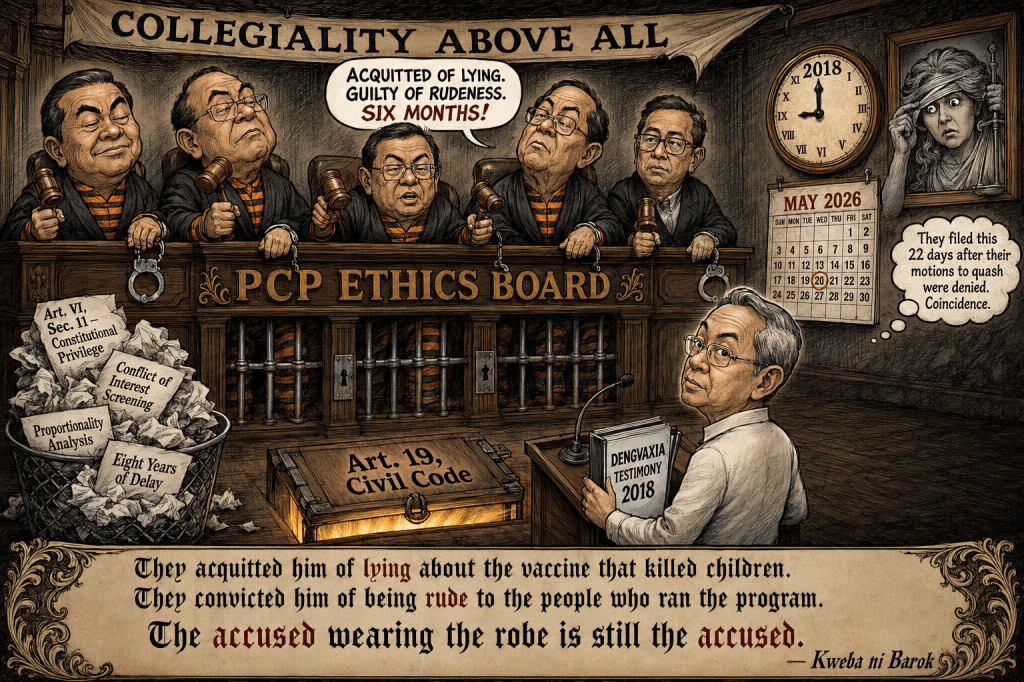
Four Criminal Defendants Walk Into the PCP… They Leave With Leachon’s Suspension
By Louis “Barok” C. Biraogo — June 6, 2026
I. PCP’s Ethics Board Serves Up a Six-Month Timeout — For Rudeness, Not Lies
The Philippine College of Physicians (PCP) just proved that in Philippine medicine, the real malpractice isn’t killing patients with a botched vaccine rollout. It’s suggesting, in a congressional hearing, that the people who rolled it out might have had conflicts. On 20 May 2026, the 13-member Board of Regents issued its 26-page Decision suspending Dr. Anthony “Tony” Leachon from PCP membership for six months. They nailed him for defamation and violation of ethical standards over his 29 November 2018 congressional testimony. They acquitted him on the juicier charges of expert-witness misrepresentation and peddling false Dengvaxia information.
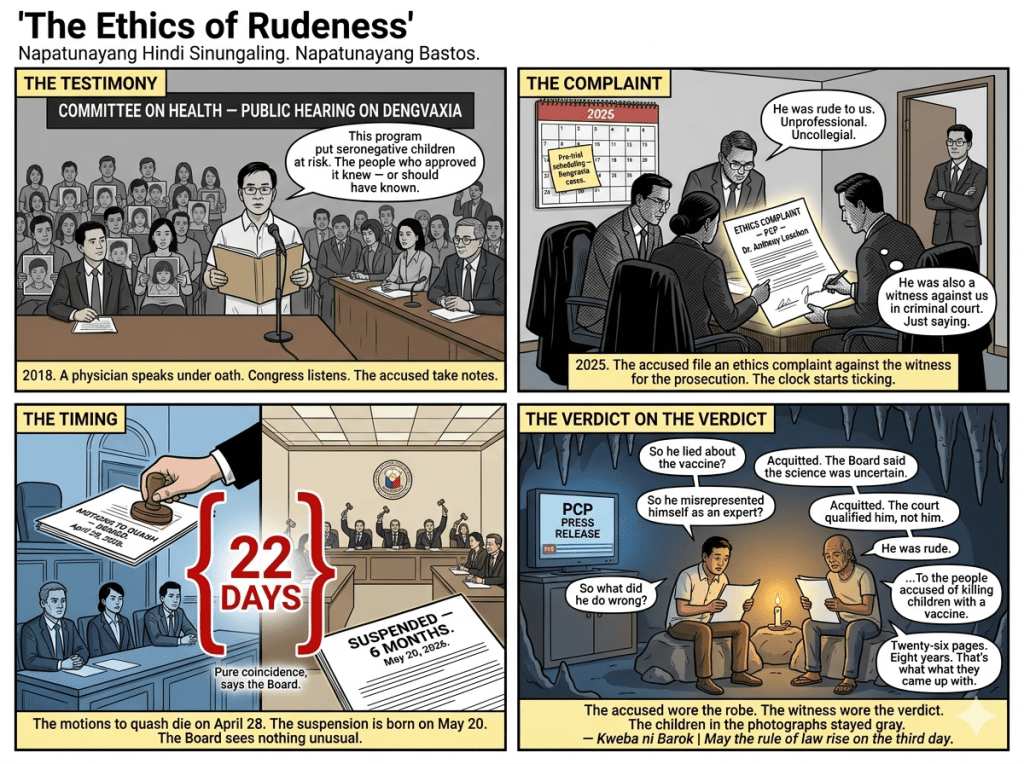
The GMA News report dutifully parroted the Board’s self-congratulatory framing: formal process, substantial evidence, measured penalty. It quoted Leachon’s defiant Facebook post about studying remedies and protecting victims’ families’ right to justice. It let the PCP claim it wasn’t acting lightly. What the report soft-pedaled — like most mainstream coverage — was the grotesque structural conflict: four of the five complainants are the very accused in the Dengvaxia criminal cases where Leachon is a key prosecution witness. Timing? Complaint filed February 2025 as pre-trial heated up; Decision dropped 22 days after Judge de Jesus denied motions to quash on 28 April 2026. Pure coincidence, the Board insists.
The Board’s Self-Contradictions on Full Display
The Decision is a masterclass in selective rigor. It correctly refused to brand Leachon a liar on Dengvaxia science — implicitly conceding “widespread scientific uncertainty” at the time and that complainants failed to prove falsity by substantial evidence. It correctly held that it was the prosecution, not Leachon, who offered him as an expert; courts qualify experts under Rule 130, Section 39 of the Revised Rules of Evidence, and rejection isn’t proof of fraud.
Yet on defamation, the same Board suddenly forgot that congressional testimony carries privileges and that motive of the complaining parties matters. It cherry-picked PCP Code of Ethics provisions on collegiality (“an internist must not speak ill of a colleague”) while ignoring the constitutional elephant and the fact that the “colleagues” were public officials whose program Leachon believed was killing children.
Complainants’ Conflict of Interest Table
| Complainant | Role in Dengvaxia Cases | Status in Criminal Proceedings | Obvious Interest in Silencing Leachon |
|---|---|---|---|
| Dr. Janette L. Garin | Former DOH Secretary | Principal accused | High — star witness against her |
| Dr. Kenneth Y. Hartigan-Go | Former PCP President, ex-FDA DG | Co-accused | High — Leachon named him in 2018 |
| Dr. Julius A. Lecciones | Former PCMC Executive Director | Co-accused | High |
| Dr. Raymundo W. Lo | Pathologist | Co-complainant only | Medium |
| Maria Lourdes Santiago, RPh | Former FDA Deputy DG | Co-accused | High |
Four out of five. This isn’t subtle. Under Article 19 of Republic Act No. 386 (Civil Code of the Philippines), every person must act with justice, give everyone his due, and observe honesty and good faith. Filing an ethics complaint to kneecap your own criminal accuser’s witness is textbook abuse of rights (Arts. 19, 20, 21). The Board never even addressed it.
The Congressional Privilege Time Bomb They Pretended Didn’t Exist
This is one of the Decision’s most serious analytical failures. The 26-page ruling never once cites, quotes, or engages Article VI, Section 11 of the 1987 Constitution of the Republic of the Philippines (1987 Constitution) or Section 21.
Philippine law and long-standing policy afford strong protection to testimony given in official congressional hearings. While the clearest and most absolute form of the privilege belongs to Members of Congress themselves, witnesses and experts who appear and testify on matters of urgent public concern enjoy robust protection against subsequent civil or professional liability for pertinent statements. The purpose is obvious: Congress cannot perform its oversight function if witnesses fear that powerful complainants will later use private ethics machinery to punish them.
The Board instead treated Leachon’s 29 November 2018 testimony as ordinary professional conduct governed solely by the PCP Code of Ethics. It acknowledged that constructive criticism of public officials is generally allowed but ruled that this principle “does not and should not operate as an unbridled license or blanket authority to defame, discredit, disparage or dishonor persons.” It never asked the threshold constitutional question: whether statements made as sworn testimony in a legislative hearing on a national public health controversy are protected activity that a private professional organization may punish without colliding with the constitutional framework that authorizes such hearings in the first place.
By skipping this analysis entirely, the Board failed to consider a controlling legal principle directly on point. Under Ang Tibay v. Court of Industrial Relations, 69 Phil. 635 (1940), one of the cardinal requirements of due process in administrative proceedings is that the tribunal must act on its own independent consideration of the law and facts of the controversy, and not simply accept the views of a subordinate. A decision that pretends the constitutional architecture protecting legislative testimony does not exist cannot credibly claim to have satisfied that standard.
This is not academic hair-splitting. It goes to the heart of whether the PCP can discipline a physician for what he said under oath before Congress without first explaining why the Constitution’s protections for such testimony do not apply. The Board’s silence on this point is the single biggest reason the defamation finding is vulnerable on appeal or review.
SEO Tags: #DrTonyLeachon #Dengvaxia #PCP #HealthPH #SatirePH
II. Dramatis Personae: The Accused Trying to Muzzle Their Own Witness
The complainants are not neutral guardians of medical ethics. They are the accused in People v. Garin et al. (the 35+ remaining reckless imprudence resulting in homicide cases now moving before QC RTC Branch 102). Leachon was the physician who, since 2016, hammered the Dengvaxia program’s risks for seronegative children — precisely the theory the prosecution needs.
Dr. Leachon, former PCP President turned public dissident, built his brand on this fight. The PCP suspension doesn’t touch his PRC license or his right to testify. It only taxes his social capital inside the very organization he once led. The Board calls this “serious offense.” Eight years after the hearing. With the criminal trial finally lurching forward.
III. Legal Framework: Hits and Misses at the PCP Kangaroo Court
What Little They Got Right
- Partial acquittals on misrepresentation and misinformation charges show the Board wasn’t a total rubber stamp. It applied substantial evidence correctly on those points and refused to let complainants rewrite scientific debate as ethics violation.
- Facial due process was observed: notice, Answer, extensions, Verified Rejoinder, 13-member deliberation.
- The collegial duty in the PCP Code is real. Physicians shouldn’t lightly accuse colleagues of corruption.
The Fatal Legal Errors the Board Pretended Didn’t Exist
The Board’s Decision is riddled with serious legal omissions that go far beyond mere disagreement. These are not technical quibbles. They strike at the foundation of the ruling.
Grievous Error #1: Constitutional Privilege Ignored.
The Board treated Leachon’s 2018 congressional testimony as ordinary professional speech. It was not. Article VI, Section 11 of the 1987 Constitution of the Republic of the Philippines (1987 Constitution) grants absolute privilege to Members of Congress for speech made in the course of legislative proceedings. Witnesses who testify in official congressional inquiries also receive robust protection under Article VI, Section 21. The Board’s complete silence on this constitutional dimension — despite Leachon testifying under oath in a formal hearing — is a serious omission that materially weakens the Decision.
Grievous Error #2: Complainants’ Conflict Never Screened.
Four of the five complainants are themselves accused in the very Dengvaxia criminal cases in which Leachon is a key witness. Under established jurisprudence, the motive and good faith of the party initiating a quasi-judicial proceeding are relevant considerations. The Board’s failure to even acknowledge this obvious conflict of interest — much less scrutinize it — is a glaring omission. This directly implicates Article 19 of Republic Act No. 386 (Civil Code of the Philippines), which requires every person to act with justice and good faith.
Grievous Error #3: Eight-Year Delay + Six-Month Suspension = Disproportionate.
The conduct complained of occurred in November 2018. The Decision was issued in May 2026. The penalty lands precisely when the criminal cases against the complainants are moving forward. While Ang Tibay v. Court of Industrial Relations, G.R. No. 46496 (69 Phil. 635, 1940) requires administrative bodies to act on their own independent consideration of the law and facts, the Board offered no meaningful explanation for the extreme delay or why a six-month suspension remains proportionate after nearly eight years.
Grievous Error #4: No Engagement with Whistleblower and Public Interest Defense.
The Board acknowledged that constructive criticism of public officials is generally allowed but refused to seriously engage the fact that Leachon spoke as a witness in a congressional inquiry on a matter of urgent public health. Under Rule 133, Section 5 of the Revised Rules of Court, decisions must be supported by substantial evidence on the whole record. The Board’s refusal to weigh the constitutional and public interest context of Leachon’s testimony leaves the Decision vulnerable to the charge that it applied the PCP Code of Ethics in a vacuum.
IV. Political Timing in the Dengvaxia Eternal War
Timeline That Speaks Louder Than the Decision
| Date | Event | Inference |
|---|---|---|
| 29 Nov 2018 | Leachon testifies at congressional hearing, names Hartigan-Go/PCP | Original sin |
| 21 Feb 2025 | Ethics complaint filed | Coincides with criminal case pre-trial scheduling |
| 28 Apr 2026 | Judge de Jesus denies all motions to quash | Cases about to go full blast |
| 20 May 2026 | PCP Board issues 6-month suspension | 22 days later — surgical timing |
| Jun 2026 | Decision published; Leachon signals appeal | Martyr narrative locked and loaded |
This doesn’t prove conspiracy. It creates an inference of retaliatory motive so powerful that any appellate body must scrutinize it. The combination of the complainants’ obvious conflict of interest and the telling timeline should have been treated as a major red flag. The Board chose to look the other way.
V. The Ethical Collision: Collegiality vs. Public Health Whistleblowing
The core collision is ancient: the physician’s duty of primum non nocere — first, do no harm — and the duty to warn the public versus the collegial duty not to “speak ill” of colleagues. The World Medical Association Declaration of Helsinki and Geneva emphasize protecting patients over protecting colleagues’ reputations when public health is at stake.
The Board correctly said free speech isn’t a blank check to defame. But it wrongly assumed that naming a former PCP president in congressional testimony on a program the speaker believed was lethal automatically equals baseless defamation. When the “baseless” part was never proven (they acquitted on the misinformation charge), the defamation finding collapses under its own weight.
The chilling effect is obvious. Future physicians watching this will think twice before testifying against powerful colleagues in public health scandals. That is not ethical progress. That is institutional self-preservation dressed as professionalism.
VI. When the Defendants Become the Ethics Police
To the PCP Board of Regents:
You acquitted Leachon of lying about Dengvaxia but convicted him of being rude to the people who rolled it out. You spent eight years deliberating and still missed the constitutional privilege that has protected legislative testimony since the First Congress. You saw the conflict of interest (four accused complainants) and looked the other way. That’s not ethics enforcement. That’s the old boys’ club with better stationery.
To Dr. Janette Garin and Co-Complainants:
You are the accused in reckless imprudence cases involving children’s deaths. You filed an ethics complaint against the physician whose testimony supports the prosecution theory. Then you watched the Board suspend him 22 days after your motions to quash were denied. Under Article 19 of Republic Act No. 386 (Civil Code of the Philippines), this isn’t justice. This is using a professional organization as litigation strategy. The victims’ families deserve better than this theater.
To Dr. Kenneth Hartigan-Go:
You were PCP President when Leachon testified. You are now a co-complainant seeking to discipline him for what he said about you in Congress. The optics are not collegial. They are self-serving. The Code you helped enforce now looks like a shield for the powerful rather than a standard for all.
VII. Actionable Recommendations for All Sides
To Dr. Leachon and counsel:
Exhaust any internal PCP appeal immediately, if available under the organization’s By-Laws. File an ordinary civil action before the Regional Trial Court for reinstatement, damages, and declaration of nullity, on the grounds of violation of due process and abuse of rights under Articles 19, 20, and 21 of the Civil Code. Publicly frame the suspension as retaliatory by highlighting the precise timeline of events. Additionally, evaluate whether the elements of malicious prosecution under Article 2219(8) of Republic Act No. 386 (Civil Code of the Philippines) can support a counter-suit once the criminal cases are further clarified.
To the Philippine College of Physicians:
Vacate or substantially modify the Decision on reconsideration. Adopt a bright-line rule: no ethics complaint may proceed against a potential witness in ongoing litigation where the complainant is an accused party in that same controversy without independent screening by a disinterested panel. Publicly acknowledge the constitutional privilege issue. Stop pretending collegiality trumps public health whistleblowing when children’s deaths are involved.
To the Medical Profession at Large:
Depoliticize. Now. Ethics codes must protect patients and the public first, colleagues second. Insert explicit whistleblower safe harbors for good-faith testimony in legislative or judicial proceedings on public health matters. The alternative is a profession that polices speech more aggressively than it polices actual harm.
To Congress:
Pass legislation or issue a resolution clarifying absolute privilege for expert and fact witnesses in congressional inquiries on matters of urgent public concern, including public health disasters. Make it explicit that professional organizations cannot discipline members for privileged legislative testimony.
To the Department of Justice and the Courts (especially QC RTC Branch 102):
In the Dengvaxia cases, give zero or minimal weight to the PCP suspension as impeachment material against Leachon. Under the People v. Yabut doctrine and related precedents, the motive and conflict taint its probative value. Consider sua sponte scrutiny of whether the ethics complaint itself constitutes abuse of process or witness intimidation. The rule of law does not bend to professional guild score-settling.
VIII. The Barok Verdict: Pyrrhic Win for the College, Scar for Leachon
The PCP Board won the battle on paper and lost the war in reality. By convicting Leachon only on the collegiality charge while acquitting him on the substance of his Dengvaxia claims, they inadvertently validated his core factual posture. By ignoring privilege, conflict, timing, and proportionality, they exposed their own process as politically convenient rather than ethically pure.
Leachon loses six months of PCP privileges and some internal standing. He gains martyr capital, a stronger public narrative, and — crucially — no finding that he lied about the vaccine. The complainants gain short-term tactical breathing room in their criminal defense but cement the perception that they are using every institution available to silence a witness.
The real losers are the medical profession’s credibility and the public’s trust that ethics enforcement is blind to politics and litigation advantage. Dengvaxia already shredded that trust once. This spectacle shreds it again.
IX. One Last Echo from the Cave
When the accused in a mass-vaccination death case weaponize their own professional college to discipline the witness against them — and the college plays along while pretending it didn’t notice the conflict or the Constitution — the cave doesn’t just echo. It laughs bitterly at the gavel.
— Barok
Disclaimer: This is public-interest commentary and legal analysis, not legal advice. I am not your lawyer. The PCP Decision speaks for itself; so does the 1987 Constitution of the Republic of the Philippines. Victims’ families deserve real justice in court, not guild theater.
Key Citations
A. Legal & Official Sources
- “The 1987 Constitution of the Republic of the Philippines.” Official Gazette of the Republic of the Philippines, 1987, http://www.officialgazette.gov.ph/constitutions/1987-constitution/.
- Republic Act No. 386. An Act to Ordain and Institute the Civil Code of the Philippines, 1949, lawphil.net/statutes/repacts/ra1949/ra_386_1949.html.
- “Rules 128-134: Evidence.” Revised Rules of Court, LawPhil Project, Arellano Law Foundation, lawphil.net/courts/rules/rc_128-134_evidence.html. Accessed 6 June 2026.
- Ang Tibay v. Court of Industrial Relations, G.R. No. 46496, 69 Phil. 635, 1940, https://lawphil.net/judjuris/juri1940/feb1940/gr_46496_1940.html.
- People of the Philippines v. Yabut. Supreme Court of the Philippines, 29 Apr. 1977, G.R. No. L-42847, The Lawphil Project, Arellano Law Foundation, https://lawphil.net/judjuris/juri1977/apr1977/gr_42847_1997.html.
- World Medical Association. “Declaration of Helsinki: Ethical Principles for Medical Research Involving Human Subjects.” WMA, 2013, http://www.wma.net/policies-post/wma-declaration-of-helsinki-ethical-principles-for-medical-research-involving-human-subjects/.
- World Medical Association. “Declaration of Geneva.” 1948 (amended 2017), http://www.wma.net/policies-post/wma-declaration-of-geneva/.
- Philippine College of Physicians. “Code of Ethics.” Philippine College of Physicians, 16 June 2025, pcp.org.ph/2025/06/16/code-of-ethics/. Accessed 6 June 2026.
- Philippine College of Physicians Board of Regents. Decision in Ethics Case No. 2025-001 (Dr. Janette L. Garin, et al. v. Dr. Anthony C. Leachon). 20 May 2026, kuwebanibarok.wordpress.com/wp-content/uploads/2026/06/wp-1780724708839.pdf.
B. News Reports
- GMA News. “Philippine College of Physicians Suspends Dr. Tony Leachon for Six Months.” GMA Network, 5-6 June 2026, http://www.gmanetwork.com/news/topstories/nation/990406/philippine-college-physicians-dr-tony-leachon/story/.
- “Ang Hirap Maging Mahirap”: The PAO Scandal That Proves Government Contempt Is Nothing New
- “Far-Off” My Axx: Malacañang’s Claire Castro Drowns in Her Own Legal Gaslighting
- “Forthwith” to Farce: How the Senate is Killing Impeachment—And Why Enrile’s Right (Even If You Can’t Trust Him)

- “HINDI AKO NAG-RESIGN!”

- “I Know Nothing”: Baste Duterte’s Amnesia Defense Meets ₱33M in GenCorp Contracts
- “I’m calling you from my new Globe SIM. Send load!”

- “Mahiya Naman Kayo!” Marcos’ Anti-Corruption Vow Faces a Flood of Doubt

- “Manageable” Debt, Unmanageable Lies: DBM’s ₱21 Trillion Fairy Tale
- “Meow, I’m calling you from my new Globe SIM!”

- “Natrabaho”: One Word, One Ombudsman, and a Judiciary on Trial
- “No Special Jail for Crooks!” Boying Remulla Slams VIP Perks for Flood Scammers

- “Philippine-Controlled” or Yankee Gas Station? The Davao Fuel Depot Farce Exposed



Leave a comment