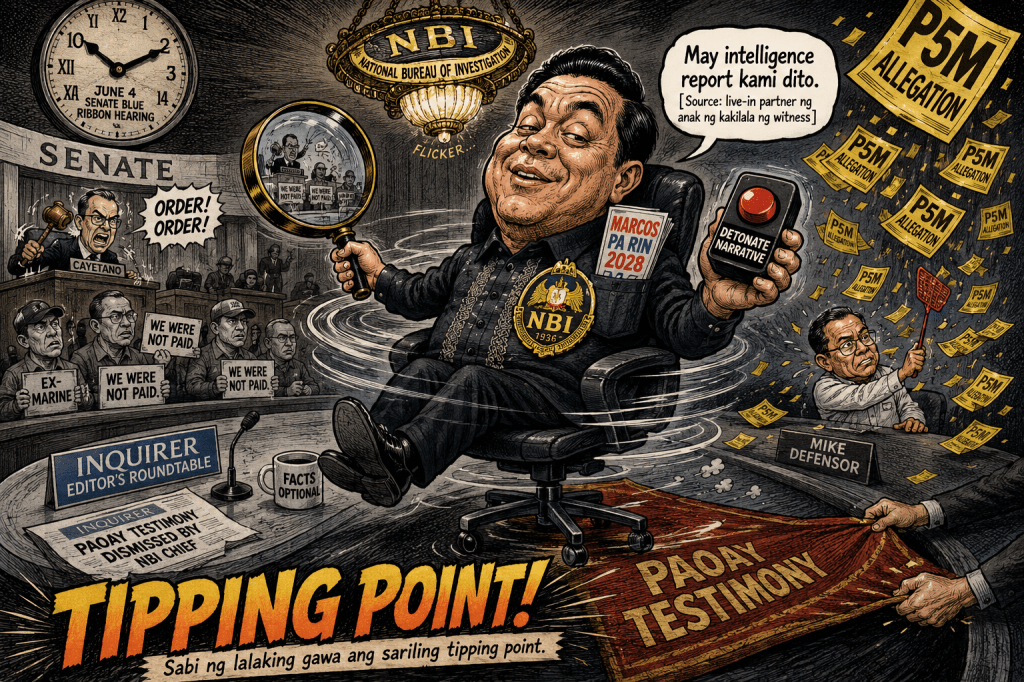
When the NBI Chief Becomes a Spin Doctor: Matibag’s Timed P5M Narrative Bomb
Louis ‘Barok’ C. Biraogo — June 7, 2026
IT began, as these things often do in Manila’s fevered political season, not with tanks in the streets but with a casual remark over editors’ notebooks.
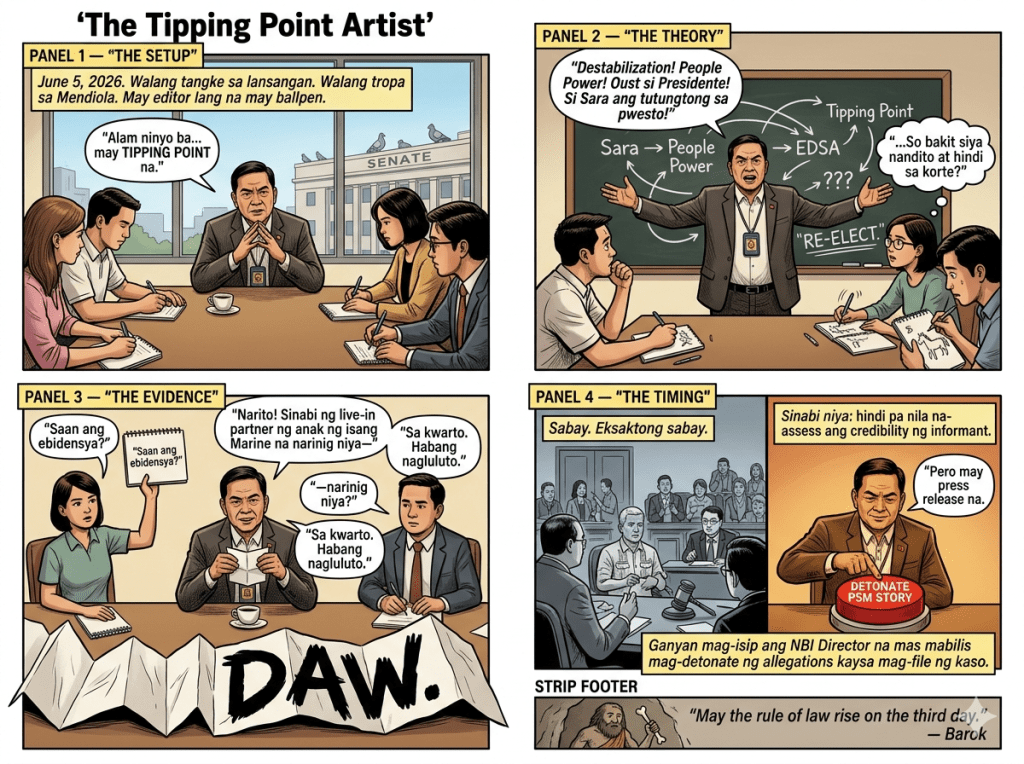
On June 5, 2026, NBI Director Melvin Matibag sat across from Inquirer editors and delivered a claim that should have made every constitutional lawyer reach for the 1987 Charter.
The Senate’s cascading chaos—the May 13 Senate shootout, Senator Ronald “Bato” dela Rosa’s cinematic escape the following day with Robin Padilla, the June 4 spectacle of 18 alleged ex-Marines testifying before Alan Peter Cayetano’s Blue Ribbon Committee—was not messy institutional dysfunction. It was, Matibag declared, the engineered “tipping point” of a destabilization plot designed to oust President Ferdinand Marcos Jr. and install Vice President Sara Duterte through a modern People Power uprising.
“Destabilization trying to amass support from the people to oust the President, so Sara can be in power,” he said. “That’s what happens naturally. When the president is gone, it’s always the vice president who will take over.” He even claimed an intelligence report existed to support the assessment.
One waited for the clarifying wink. It never came. This was the Director of the National Bureau of Investigation speaking on the record, not under oath, in a roundtable that doubled as political theater.
The theory is as bold as it is brittle. It rests on three propositions that wither under even modest scrutiny.
The Logical Fallacy
Sara Duterte does not need a revolution. She is already the prohibitive frontrunner for 2028 in every survey that matters. She holds the second-highest office in the land, commands a national platform, and enjoys the structural luxury of being the automatic constitutional successor should anything happen to Marcos.
To risk—or to permit her allies to risk—a destabilization campaign that could be credibly labeled seditious would be an act of political self-immolation. A failed or even merely messy uprising would hand the Marcos camp the moral high ground, trigger loyalty tests across the uniformed services, invite international isolation, and likely end her viability long before the first 2028 campaign rally.
The rational strategy, and the one the evidence of the past months actually documents, is attrition. Keep the flood-control hearings alive. Keep the Senate in controlled turmoil just long enough to complicate Sara’s impeachment trial. Bleed the Marcos coalition’s credibility month after month until the electorate, not the mob, renders judgment at the ballot box. Matibag’s tipping-point theory requires us to believe that a camp sophisticated enough to execute a Senate coup would simultaneously be reckless enough to choose the single path guaranteed to maximize downside risk. That is not intelligence assessment. That is fan fiction dressed in the language of national security.
The Sociological and Geographic Contradictions
Even if one grants the existence of coordinated pressure against Marcos, the notion that it will culminate in a People Power-style transfer of power collides with stubborn structural realities. Sara’s strongest support remains concentrated in the D and E socioeconomic classes—the very voters least likely to sustain the prolonged, organizationally complex street mobilizations that defined EDSA 1986 and EDSA II.
Those voters prioritize rice prices, daily wages, and local patronage networks over constitutional controversies. When they are angry, history shows they express it at the polls or through localized, short-duration protests—not by camping on EDSA while forgoing income.
People Power has always been a Metro Manila phenomenon powered by the Church hierarchy, business elites, professionals, students, and—indispensably—military and police defectors. None of these pillars are visible in Sara Duterte’s current coalition. Mindanao can deliver passionate rhetoric, electoral margins, and perhaps a handful of retired officers with old scores to settle. It cannot, however, deliver tens of thousands of bodies to the gates of Malacañang or Camp Aguinaldo on short notice. Geography and class are not minor footnotes; they are structural vetoes on the classic EDSA model. Matibag’s scenario ignores them because they are inconvenient to the narrative he has chosen to advance.
The Political Weaponization
The most revealing element is not what Matibag said but when and how he said it. On June 4, as the ex-Marines took the stand and one testified to a 2022 cash delivery in Paoay, Ilocos Norte, that allegedly placed President Marcos, First Lady Liza Araneta-Marcos, Representative Sandro Marcos, and former House Speaker Martin Romualdez at the scene of flood-control anomalies, Matibag chose that exact moment to announce that former Congressman Mike Defensor had bribed each of the 18 witnesses with P5 million.
The source? The live-in partner of a child of one of the Marines—a second-degree hearsay witness who supposedly overheard household conversations. The NBI had possessed the sworn statement since April 28 and a supplemental affidavit in early May. Subpoenas were issued on June 2. Yet the public detonation was synchronized with the live Senate hearing for maximum preemptive damage.
This is not how a professional investigative agency safeguards the integrity of an ongoing probe. This is how a political actor poisons a witness pool before damaging testimony can take root in public consciousness. By labeling the most explosive allegations against the First Family as potentially purchased perjury, Matibag achieved what Palace lawyers could not: he shifted the burden from disproving the Paoay claim on the merits to forcing the witnesses to prove they were not bought. It was narrative warfare executed with campaign-level timing, not law-enforcement discipline. Defensor has dismissed the claim as “nonsense,” and the ex-Marines vehemently denied it under oath during the hearing. The NBI itself acknowledged it still needed to assess the informant’s credibility. None of this stopped the Director from weaponizing the allegation at the moment of maximum political utility.
The Institutional Peril
When the head of the country’s premier civilian investigative body uses his platform to peddle a conspiracy theory whose evidentiary foundation would not survive a first-year law student’s moot-court exercise, the damage extends beyond any single political skirmish. Absent military defections, absent Cardinal-level Church mobilization, absent Supreme Court signals, and absent any credible foreign endorsement—the classic pillars of a People Power tipping point—Matibag’s scenario is not an intelligence assessment. It is a political hypothesis dressed in the borrowed authority of the NBI seal.
Matibag is not entirely wrong that the Senate turmoil, the witness wars, and the flood-control allegations form part of a coordinated factional struggle. He is correct that these are not spontaneous institutional hiccups; they are moves in a high-stakes contest over who will control Malacañang after 2028. But that is ordinary, if ugly, democratic politics—not the precursor to an imminent regime-changing uprising. By inflating a factional siege into a seditious coup plot, Matibag has supplied the Marcos camp with a ready-made rhetorical shield: any further scrutiny can now be framed as part of the “destabilization” script he himself authored.
The NBI now faces a stark choice. It can reclaim its mandate as the impartial gatherer of evidence for prosecution and public accountability. Or it can continue functioning as the rapid-response messaging unit of whichever administration holds the power of appointment. It cannot credibly do both without completing the erosion of whatever public trust remains in institutions already battered by years of weaponization.
What Must Be Done
If Director Matibag possesses credible, actionable evidence of a seditious conspiracy, he should refer it to the Department of Justice for the filing of appropriate charges—complete with affidavits, not soundbites delivered in editor roundtables. He should welcome the opportunity to have his informants cross-examined under oath in a forum where perjury carries real consequences. The public, for its part, should treat any future “intelligence assessment” from law-enforcement officials on live political controversies with the skepticism normally reserved for campaign advertisements—until and unless that assessment arrives accompanied by testable evidence rather than timed talking points.
Matibag may yet prove correct that someone is searching for a tipping point. The real tragedy is that his own intervention may have done more to raise the temperature of the conflict than to lower it. When the guardians of facts become the authors of convenient fictions, the only tipping point that truly matters is the moment citizens conclude that the law no longer applies equally to the powerful and the powerless.
May the next tipping point belong to the public that finally stops believing official fairy tales.
— Barok
Key Citations
A. News Articles
- Salcedo, Mary Joy. “Matibag: Senate Turmoil Aims to Unseat Marcos, Put Sara Duterte in Power.” Inquirer.net, 5 June 2026, https://newsinfo.inquirer.net/2241052/matibag-senate-turmoil-aims-to-unseat-marcos-put-sara-duterte-in-power.
B. Reference Works
- “People Power Revolution.” Encyclopædia Britannica, Encyclopædia Britannica, Inc., https://www.britannica.com/event/People-Power-Revolution. Accessed 7 June 2026.
- “Second EDSA Revolution.” Wikipedia, Wikimedia Foundation, https://en.wikipedia.org/wiki/Second_EDSA_Revolution. Accessed 7 June 2026.
C. Official Documents
- “The 1987 Constitution of the Republic of the Philippines.” Official Gazette of the Republic of the Philippines, https://www.officialgazette.gov.ph/constitutions/1987-constitution/.
- “Department of Justice.” Official Website of the Department of Justice, Republic of the Philippines, https://www.doj.gov.ph/.

- “Ang Hirap Maging Mahirap”: The PAO Scandal That Proves Government Contempt Is Nothing New

- “Far-Off” My Axx: Malacañang’s Claire Castro Drowns in Her Own Legal Gaslighting
- “Forthwith” to Farce: How the Senate is Killing Impeachment—And Why Enrile’s Right (Even If You Can’t Trust Him)
- “HINDI AKO NAG-RESIGN!”

- “I Know Nothing”: Baste Duterte’s Amnesia Defense Meets ₱33M in GenCorp Contracts

- “I’m calling you from my new Globe SIM. Send load!”

- “Mahiya Naman Kayo!” Marcos’ Anti-Corruption Vow Faces a Flood of Doubt

- “Manageable” Debt, Unmanageable Lies: DBM’s ₱21 Trillion Fairy Tale
- “Meow, I’m calling you from my new Globe SIM!”

- “Natrabaho”: One Word, One Ombudsman, and a Judiciary on Trial
- “No Special Jail for Crooks!” Boying Remulla Slams VIP Perks for Flood Scammers

- “Philippine-Controlled” or Yankee Gas Station? The Davao Fuel Depot Farce Exposed







Leave a comment