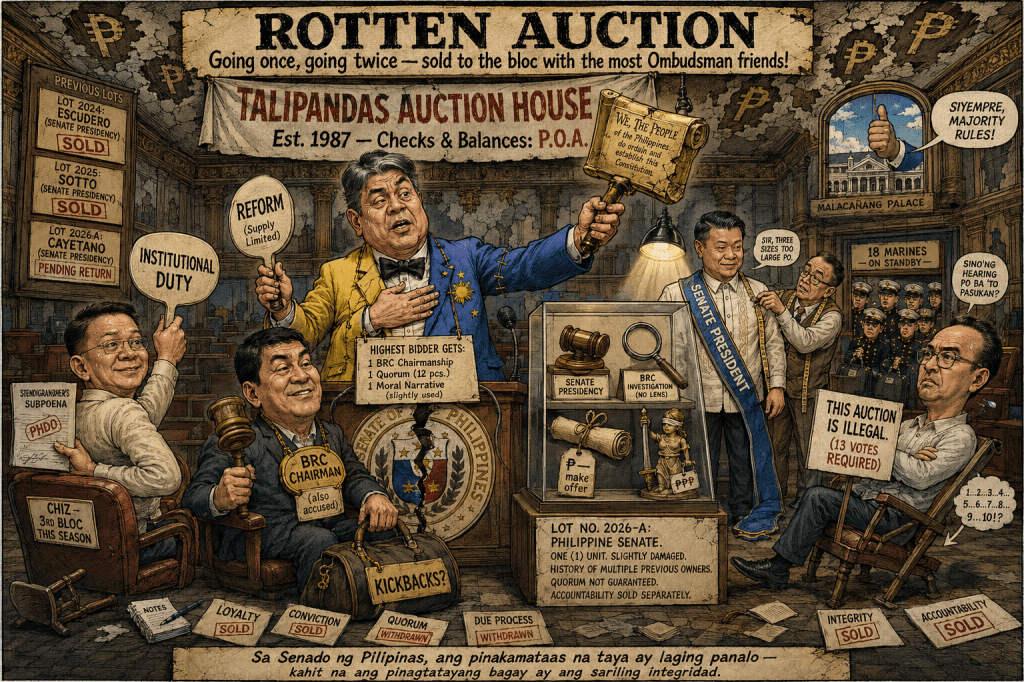
Pangilinan’s Paradox, Escudero’s Defection, and the Marketplace Where Philippine Democracy Goes to Die
By Louis ‘Barok’ C. Biraogo — June 7, 2026
“May the rule of law rise on the third day—and when it does, may it find a Senate that has remembered what it was built for.”
In the chamber where the 1987 Constitution vests the power to check the executive and conduct the nation’s most consequential investigations, what we witness today is not deliberation but a continuous political auction. Senators do not weigh evidence or principle; they calculate which bloc offers the best package of committee chairmanships, staff allocations, media visibility, legal protection, and positioning for 2028.
Kiko Pangilinan’s appeal to his colleagues to “follow Chiz Escudero” and support Sherwin Gatchalian is merely the most recent, and most elegantly phrased, sales pitch in this tawdry bazaar.
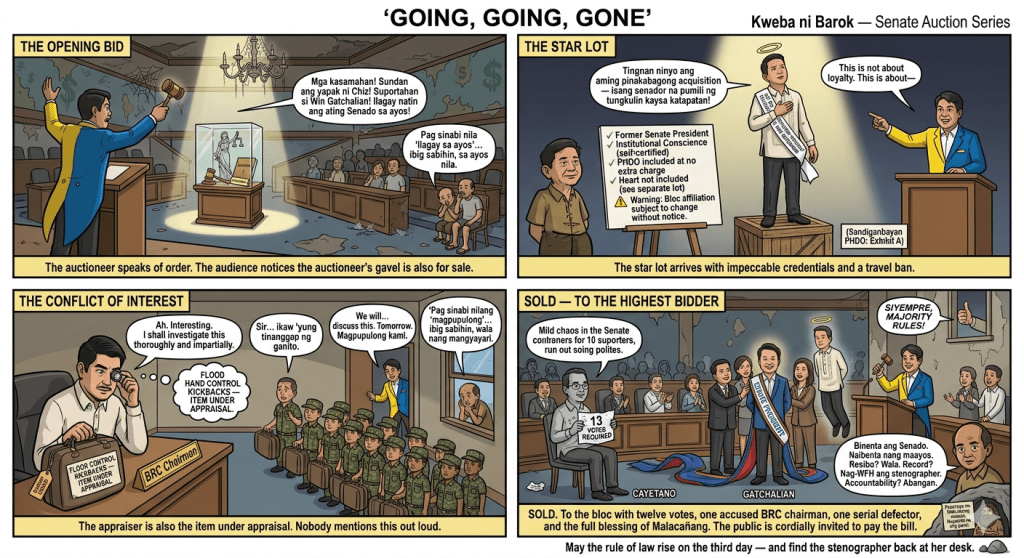
The Pangilinan Paradox
Pangilinan’s paradox cuts to the heart of the hypocrisy on display. He presents himself as the voice of institutional stability and reformist conscience. He argues, correctly, that the Senate cannot remain paralyzed, that Gatchalian possesses technocratic experience from his electricity market days, and that the public deserves a functioning legislature.
He levels a devastating charge against the Cayetano bloc’s Blue Ribbon hearing: without stenographers or secretariat, it produced no official record and thus no legally cognizable legislative act—no contempt power, no enforceable subpoenas, nothing but political theater dressed in senatorial robes.
Yet it was Pangilinan’s own bloc that created the very deficiency it now condemns. The authorization of work-from-home arrangements for Senate staff on June 4 ensured that the Cayetano hearing would lack institutional support, after which the new majority promptly declared it “bogus.”
This is not the defense of due process; it is the engineering of a procedural crisis to delegitimize political opponents while one’s own investigations proceed under the shadow of glaring conflicts. Pangilinan’s coalition installed Erwin Tulfo—accused by eighteen former Marines of receiving kickbacks in the flood control projects now under scrutiny—as chairman of the very committee investigating those projects.
The same voice that questions why Cayetano’s vice-chairs face plunder cases now belongs to a majority whose lead investigator stands accused. The glass house has never been more transparent.
The Defector’s Calculus
Francis Escudero’s defection supplies the moral narrative Pangilinan needs. Escudero speaks of taking “a stand for the Senate,” of allegiance to institution rather than faction, of duty over loyalty or betrayal. It is an elegant formulation, and for two days he honored the Cayetano boycott before breaking ranks.
But this is the same Francis Escudero who was ousted as Senate president in a prior coup amid the flood control scandal, who then aligned with Cayetano to remove the man who replaced him, and who now aligns with a bloc that includes the very senator he once helped sideline.
More damningly, this defection occurs while Escudero labors under a Sandiganbayan precautionary hold departure order and while the Office of the Ombudsman investigates him for plunder, graft, and bribery connected to the national budget and flood control.
When columnists openly speculate that charges were rushed to pressure defections, and when rumors circulate that even his celebrity wife Heart Evangelista was mentioned as potential leverage, the “institutional duty” narrative collapses into something far more human and far more dangerous: the self-preservation instinct of a politician who has calculated that the winning side controls the prosecutors.
The Toxic Proxy War
The Gatchalian and Cayetano blocs are not rival visions of governance. They are rival factions in the toxic Marcos-Duterte political war that has paralyzed national politics since the 2022 alliance fractured.
The Cayetano remnant—Bong Go, Imee Marcos, Rodante Marcoleta, Robinhood Padilla, the Villars—carries the Duterte-aligned standard into minority status. The Gatchalian majority—Pangilinan, Risa Hontiveros, Panfilo Lacson, Bam Aquino, Tito Sotto, the Tulfos, Migz Zubiri—operates with the explicit blessing of Malacañang, whose spokesperson declared the proceedings lawful with the telling observation, “Siyempre, majority rules!”
The incentives are brutally transactional. Join the majority and receive committee chairmanships, larger budgets, subpoena power, and a measure of protection from the Ombudsman daggers that have already found Escudero and others. Remain in minority and watch investigations you care about buried or weaponized against you.
The 2028 horizon looms over every calculation: Gatchalian gains national executive exposure; Escudero seeks rehabilitation; Pangilinan burnishes his conscience credentials within a coalition that includes the accused.
This is the Senate reduced to auction house. The flood control investigation, potentially the most significant corruption probe in a generation, has been captured by factional warfare. The 18 ex-Marines’ allegations against President Marcos, Martin Romualdez, Tito Sotto, Erwin Tulfo, and Sandro Marcos now serve as ammunition in a leadership contest rather than as evidence in a search for accountability.
One bloc’s hearing lacks official memory because the other bloc helped strip it away. The other bloc’s hearing is chaired by a senator accused of the very kickbacks under investigation. Genuine consequences, if they come, will arrive from the Sandiganbayan or international pressure, not from a chamber whose every move is dictated by who holds the gavel and who controls the subpoenas.
The Ombudsman as Weapon
The rot reaches deeper than personalities. When the timing of Ombudsman graft charges against Escudero and Estrada appears to track Malacañang’s requirements for Senate realignment, the anti-corruption architecture itself becomes suspect.
The perception that prosecutorial power serves political ends corrodes institutional credibility long after the current actors depart. The 12-senator quorum maneuver, while arguably defensible under Avelino v. Cuenco, establishes a precedent that future minorities will inevitably exploit by engineering absences or worse.
The Blue Ribbon Committee, once an instrument of fear for the corrupt, has become a revolving door of politically installed chairpersons whose tenures last only until the next coup. Legislative continuity suffers. Public trust erodes.
The ICC process triggered by Ronald dela Rosa’s dramatic appearance—the original spark of this conflagration—receives neither legislative attention nor meaningful oversight because the Senate is too busy fighting over its own internal power structure.
The Price of the Auction
The consequences are already visible and will compound. The flood control investigation’s credibility is structurally compromised, its findings forever tainted by the conflict-of-interest question on one side or the procedural-deficiency charge on the other.
Any impeachment trial of Vice President Sara Duterte will unfold before a Senate whose presiding officer and majority composition were determined by the latest auction rather than by constitutional process or electoral mandate. The quorum precedent invites future constitutional hardball that makes today’s crisis look tame.
Most insidiously, the public is taught once again that Philippine politics is not about ideas or accountability but about which faction can assemble the largest coalition of the transactional and the terrified.
The Cave-Dweller’s Verdict
Both sides speak truth about the other’s corruption while remaining silent about their own. Pangilinan correctly identifies the damage of paralysis and the relative qualifications of Gatchalian. Cayetano correctly identifies the traditional 13-vote requirement and the self-inflicted procedural wound his opponents now exploit.
But neither offers the public a path to genuine accountability or pro-people governance. One side delivers a hearing without institutional record. The other delivers a hearing chaired by an accused kickback recipient. The citizen is left to choose between a process deliberately stripped of memory and a process chaired by conflict of interest—both presented as victories for the rule of law.
What Must Be Done
The solution does not lie in recruiting one more defector or in persuading the Supreme Court to bless one bloc over the other. It lies in structural reforms that make such auctions less profitable and less necessary: Senate rules that treat engineered quorums as the constitutional violations they are; an Ombudsman whose funding, leadership, and charging decisions are insulated from executive political cycles; mandatory recusal or term limits for committee chairs whose coalitions touch the matters under investigation; robust public financing of campaigns to diminish the patronage economy that fuels perpetual realignment; and, above all, a citizenry that refuses to legitimize either bloc until it sees evidence that accountability is not merely a weapon deployed against the other side.
Watch both hearings. Read the affidavits the ex-Marines have already submitted to the Ombudsman, which do not depend on Senate procedural validity. Insist that the Sandiganbayan pursue the evidence without regard to which faction currently controls the gavel.
The cave echoes not with the triumph of reformers over reactionaries or of one coup over another. It echoes with the sound of a deliberative institution that has forgotten its purpose and become, instead, a marketplace where the gavel goes to the highest bidder and the public is left to pay the bill.
🪨 Let the cave echo the truth.
— Barok
Key Citations
A. Legal and Official Sources
- Avelino v. Cuenco, G.R. No. L-2821, 83 Phil. 17 (1949). Supreme Court of the Philippines. https://lawphil.net/judjuris/juri1949/mar1949/gr_l-2821_1949.html.
- Republic of the Philippines. The 1987 Constitution of the Republic of the Philippines. Official Gazette, 1987. https://www.officialgazette.gov.ph/constitutions/1987-constitution/.
- Sandiganbayan. Official Website. https://sb.judiciary.gov.ph/.
- Office of the Ombudsman. Official Website. https://www.ombudsman.gov.ph/.
B. News and Contemporary Reporting
- GMA Network. “Pangilinan to Cayetano bloc: Follow Escudero, support Gatchalian.” GMA News, 2026. https://www.gmanetwork.com/news/topstories/nation/990331/pangilinan-cayetano-bloc-escudero-gatchalian/story/.
- Castro, Claire. “LIVE: Malacañang Holds Press Briefing with PCO Usec. Claire Castro | June 4.” YouTube, uploaded by ABS-CBN News, 4 June 2026, http://www.youtube.com/watch?v=dpD5SEsAXY8.
- “Court Issues Precautionary Hold Departure Order vs Escudero, Ngu.” Inquirer.net, 27 Apr. 2026, https://newsinfo.inquirer.net/2219162/court-issues-precautionary-hold-departure-order-vs-escudero-ngu.
- Tiglao, Rigoberto. “Marcos’ Senate Bloc Thinks Filipinos Are Stupid.” The Manila Times, 5 June 2026, https://www.manilatimes.net/2026/06/05/opinion/columns/marcos-senate-bloc-thinks-filipinos-are-stupid/2358950.
- ₱8B BBM Pork: CCTV for Every Captain’s Kumpare?
- ₱8.9 Billion, 331 Ghost Police Stations: The TIKAS Scandal Explained

- ₱8.4 Billion, 42,000 Barangays, 1 Election: The “Bawat Barangay Makikinabang” Vote-Buying Masterclass

- ₱75 Million Heist: Cops Gone Full Bandit

- ₱6.77B Ghost Haunts Duterte: RTC Dismisses Mans Carpio’s Desperate Plea
- ₱6.77 Billion and Zero Cash: The Sara Duterte SALN Math That Doesn’t Add Up

- ₱6.7-Trillion Temptation: The Great Pork Zombie Revival and the “Collegial” Vote-Buying Circus

- ₱58.53B, Zero Receipts: The LGSF Pork Barrel Nobody Wants to Name
- ₱53 Million Man Tells ₱695-a-Day Workers to Stop Being ‘Mayabang’: The Audacity of BSP’s Remolona

- ₱4.4 Billion and a Witness Who Can’t Explain It: The Duterte Impeachment’s Most Expensive Non-Answer
- ₱3.06 Billion for Evacuation Centers—But Nobody Knows Where They’ll Stand (Or If They’ll Exist)
- ₱16 Billion, 280 Accounts, 8 Helicopters: Boying Remulla’s Case Against the Yaps Is Not a Drill





Leave a comment