When Your Recantation Needs a Recantation: Inception for Corruption Cases
By Louis ‘Barok’ C. Biraogo — August 24, 2026
PART I: THE NON-CASE THAT’S SOMEHOW A VERY BIG CASE
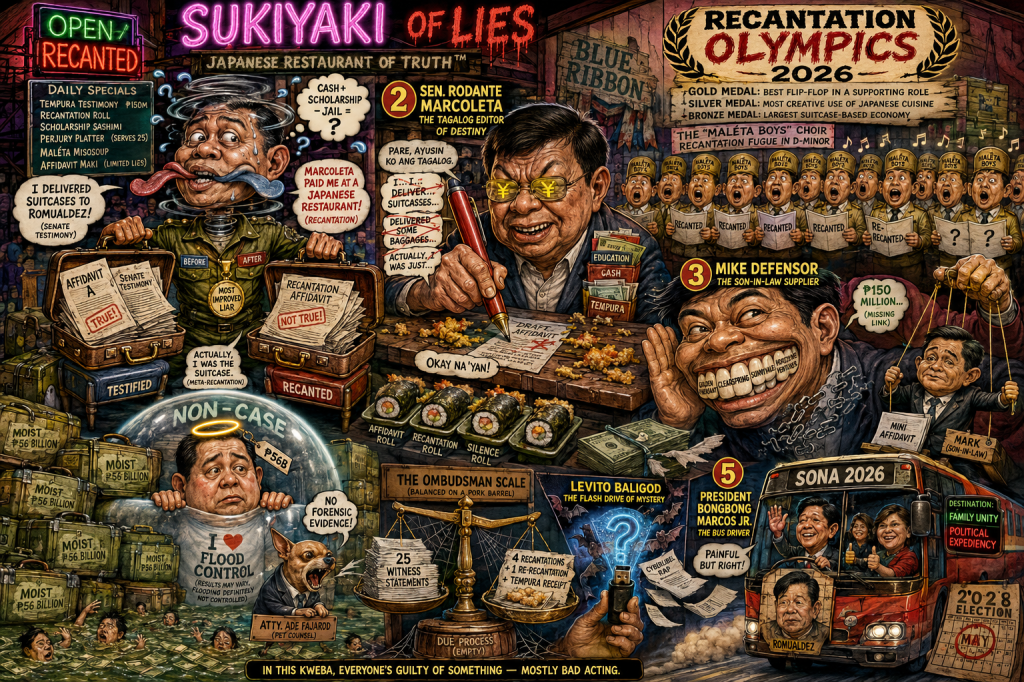
Mga ka-kweba, gather ’round the flickering screen of justice, because today we’re dissecting what might be the most expensive work of fiction since Fifty Shades of Grey — except this one involves ₱56 billion in flood control projects, 18 “Maleta Boys” who apparently moonlighted as human ATMs, and a former House Speaker who insists he’s just a humble public servant who happened to be in the wrong room at the wrong time. For several years. With ₱56 billion passing through.
Atty. Ade Fajardo — Romualdez’s counsel, spokesperson, and apparently his emotional support lawyer — has declared this a “non-case.” Which is legal terminology for “please make this go away.” His argument? No forensic evidence. No documentary proof. Just “kuwento” — stories. Narratives. Tales told by idiots, full of sound and fury, signifying ₱56 billion.
But here’s the thing about “non-cases,” mga ka-kweba. They don’t usually involve the Office of the Ombudsman‘s “special panel of investigators.” They don’t typically generate counter-affidavits with 25 former aides. And they absolutely do not feature star witnesses who recant their recantations while accusing senators of buying them Japanese food. (More on the tempura of justice later.)
Fajardo says the Ombudsman shouldn’t have “pre-ordained” results. Which is rich coming from a defense team that seems to have pre-ordained their own conclusion: innocent, your Honor, because we say so. The Ombudsman, for its part, has been admirably patient — months of investigation, witness summons, record requests. If this is a rush to judgment, it’s the slowest rush since EDSA Traffic on a Friday payday.
PART II: THE MALETA BOYS CHOIR — NOW WITH MORE RECANTATIONS!
Let’s talk about the “Maleta Boys.” Eighteen former security and administrative aides who allegedly delivered suitcases of cash to Romualdez. That’s not a corruption scheme; that’s a baggage handling service. I’ve seen less coordinated logistics at Ninoy Aquino International Airport Terminal 1 during a typhoon.
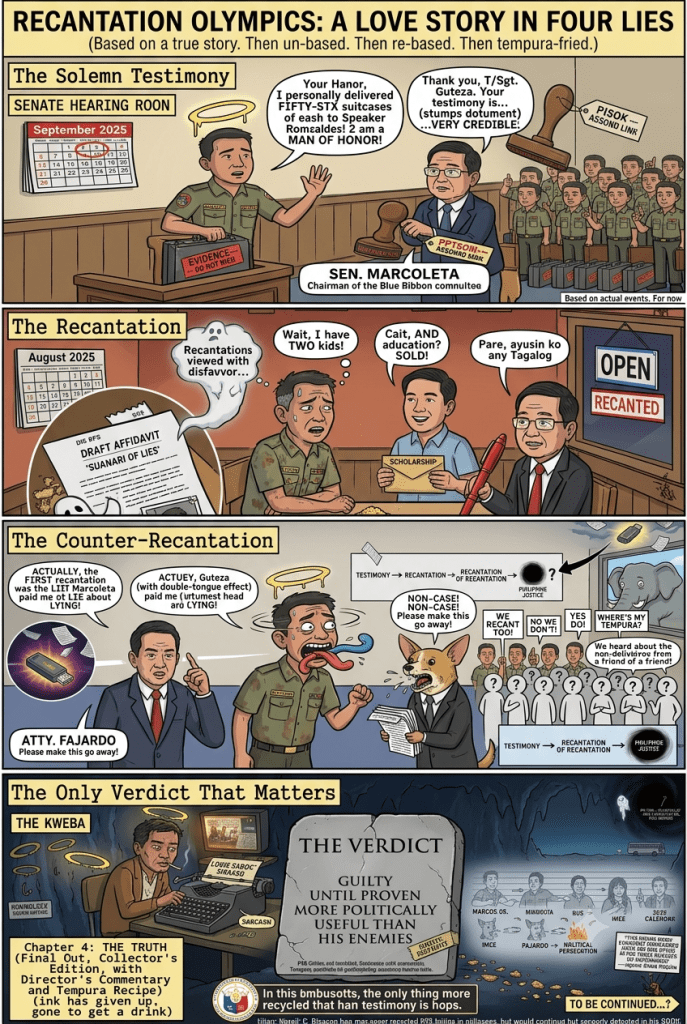
Four recanted. Then Guteza recanted. Then everyone accused everyone else of paying for recantations — at this point, they’re like a Boy Band with too many comeback tours. The star witness, retired Marine T/Sgt. Orly Guteza, testified before the Senate of the Philippines in September 2025 that he delivered suitcases to Romualdez. Then in August 2026, he recanted that, claiming Sen. Rodante Marcoleta and former Rep. Mike Defensor paid him and drafted his affidavit. Meanwhile, 25 new witnesses appeared who were never “Maleta Boys” but somehow knew all about the non-deliveries.
Guteza’s story now involves:
- A Japanese restaurant (unidentified, but presumably with excellent witness tampering ambiance)
- Cash payments
- Education scholarships for his children
- A mysterious “Mark” who is Defensor’s son-in-law
- ₱150 million as “the missing link to tag Romualdez”
Mga ka-Kweba, I’ve heard more coherent narratives from my tita after three glasses of Emperador. But let’s assume Guteza’s recantation is telling the truth. That means his Senate testimony was the lie — bought, paid for, and tempura-fried by political operatives. Here’s the Supreme Court doctrine on recantations, from People v. Bensurto, Jr. (G.R. No. 216061): original testimony in open court gets greater weight because — follow me here — it was given in open court. Under oath. With penalties. Recantations are viewed with “disfavour” because they might be motivated by “intimidation or monetary considerations.” Unless the original testimony was the one cooked up at a Japanese restaurant, in which case the recantation is the truth, and the doctrine just choked on its own logic. Like, say, cash and scholarships from a senator’s son-in-law in exchange for false allegations — allegations that somehow became the “solemn” testimony the Court wants us to trust. Pass the wasabi.
The defense’s response? File cyberlibel and perjury cases against everyone. (Okay, technically former NSA Año and ex-Senator Trillanes filed them, but Romualdez’s lawyer sure loved citing them.) Because nothing says “we have nothing to hide” like suing all the witnesses — or at least enthusiastically pointing to the lawsuits.
PART III: THE ₱56 BILLION QUESTION
Let’s address the elephant in the room. Or rather, the ₱56 billion elephant that apparently walked through flood control projects without leaving footprints.
The prosecution’s theory: Romualdez, as Speaker, and Zaldy Co, as Appropriations Chair, inserted anomalous flood control budgets. Contractors kicked back percentages. Cash was delivered in suitcases. The money was laundered through corporate networks — Golden Pheasant, Clearspring, Brightnews, Braavos, Valiant. (I’ve seen less elaborate shell companies in a John Grisham novel, and those are fiction. Allegedly.)
Fajardo’s counter: congressional budgeting is “collective.” The Speaker alone cannot control appropriations. This is technically true. It’s also technically true that the Capo alone doesn’t rob every bank — he has people for that. Republic Act No. 7080 (The Plunder Law) specifically criminalizes “combination or series of overt or criminal acts” — you don’t need to press every button yourself if you’re orchestrating the symphony.
The Supreme Court in Estrada v. Sandiganbayan upheld plunder’s constitutionality, noting it’s a “single composite offense.” The prosecution doesn’t need to prove every predicate act — just enough to show a pattern. ₱56 billion, if proven, isn’t a pattern. It’s a tapestry. A very expensive, very wet tapestry, given all the flood control.
And here’s where Fajardo’s “no direct evidence” argument gets… soggy. The Ombudsman panel has identified:
- Department of Public Works and Highways (DPWH) Undersecretary Roberto Bernardo’s testimony confirming a “flood control scheme” with Co
- Property acquisition in South Forbes Park
- Surge in lawyer Jose Raulito Paras’s financial activity (2022–2025)
- The corporate network allegedly used for laundering
That’s not “no evidence.” That’s circumstantial evidence. Which, under Philippine law, is perfectly admissible and can sustain conviction if there’s more than one piece and they converge on a conclusion. Like, say, ₱56 billion converging on a Speaker’s office.
PART IV: THE MARCOS FAMILY MELTDrama
Now we enter the telenovela portion of our program. President Bongbong Marcos Jr. — Romualdez’s first cousin — publicly supported the investigation in his State of the Nation Address (SONA). Called it “painful but right.” Which is presidential for “I’m throwing my cousin under the bus because ₱56 billion is too big to ignore — though between us, the real crime is he never cut me in — and also Imee is watching, so smile for the cameras.”
Because here’s the other subplot: Sen. Imee Marcos, the President’s sister, has allied with VP Sara Duterte and is positioning for 2028. The Romualdez scandal conveniently eliminates a potential Marcos-backed contender. It’s almost like… no, couldn’t be… political timing?
Meanwhile, the alleged architects of Guteza’s recantation — Sen. Marcoleta and Mike Defensor — are Duterte camp figures. Marcoleta chaired the Senate Blue Ribbon Committee hearing where Guteza originally testified. Now Guteza claims Marcoleta edited his Tagalog over tempura. If true, this isn’t witness tampering; it’s witness catering. Fine dining for false testimony.
The irony? Everyone claims to be fighting corruption while allegedly practicing it. Marcos distances himself from his cousin to appear clean. Marcoleta allegedly buys witnesses to expose corruption. Romualdez claims political persecution while his aides carry suitcases. It’s corruption accusations all the way down, and at the bottom, there’s just a Japanese restaurant bill.
PART V: THE OMBUDSMAN’S DILEMMA
Republic Act No. 6770 (The Ombudsman Act of 1989) establishes the Ombudsman’s mandate. Fajardo wants the Ombudsman to not be “pre-ordained.” Fair enough. But he also wants them to dismiss the case immediately. Which is itself a pre-ordained result, just in his favor. The Ombudsman’s actual mandate under the Ombudsman Act is to “act promptly on complaints.” Months of investigation, witness interviews, and evidence gathering is acting promptly. It’s not “pre-ordained” to conclude that ₱56 billion in allegations with multiple witnesses and documentary traces deserves a formal charge.
The Ombudsman’s options:
- File in Sandiganbayan — high risk, high reward, potential political explosion
- Dismiss — vindicates Romualdez, damages credibility, invites accusations of cover-up
- Continue investigating — delay criticized, witnesses may further mutate their stories
My prediction? They file. Because ₱56 billion is not a “non-case.” It’s a career-defining case. And prosecutors, like bloggers, enjoy career-defining moments.
PART VI: THE BALIGOD FLASH DRIVE AND OTHER TECHNO-MYSTERIES
Atty. Levito Baligod — yes, that Baligod, of Napoles Luy fame — has submitted a flash drive allegedly relevant to the recantation reversals. The contents? Unknown. Could be:
- Recordings of witness tampering
- Financial transaction records
- 47 minutes of Marcoleta explaining Tagalog grammar
- A virus that crashes the Ombudsman’s computers
The defense has filed cyberlibel charges against Baligod. Because in the Philippines, the response to inconvenient evidence is always: sue the messenger, question the medium, ignore the message.
PART VII: CONCLUSIONS FOR THE CONFUSED
So where does this leave us, mga ka-Kweba?
We have a former Speaker accused of ₱56 billion in plunder. A defense claiming “non-case” while filing 25 witness statements. Witnesses who have testified, recanted, un-recanted, and possibly re-recanted again. A president who threw his cousin under the bus while his sister plots from the wings. Senators allegedly buying witnesses Japanese food. A flash drive of mysteries. And flood control projects that apparently controlled nothing except the flow of cash.
The legal framework is clear: plunder requires ₱50 million and a pattern. ₱56 billion and a network of shell companies, if proven, meets that standard. The procedural framework is clear: preliminary investigation determines probable cause, not guilt. The political framework is clear as mud: everyone is using corruption accusations to fight corruption, while being accused of corruption.
Romualdez’s best hope? That the Ombudsman finds the remaining evidence insufficient after the recantations. Or that the Sandiganbayan — if it reaches that far — finds reasonable doubt in the witness chaos.
His worst fear? That the Ombudsman has more than he’s admitting. That the “no forensic evidence” claim is, itself, forensic evidence of a cover-up. That ₱56 billion leaves traces even the most sophisticated “Maleta Boys” can’t carry away.
Because here’s the final truth, mga ka-kweba: in Philippine politics, the “non-case” is often the case that matters most. And the man who claims innocence while surrounded by vaults of cash, recanting witnesses, and a president who won’t save him — that man is not innocent until proven guilty. He’s just guilty of being in the wrong room, with the wrong people, at the wrong dynasty.
He’s just guilty until proven more politically useful than his enemies.
And in this kweba, that’s the only verdict that ever matters.
— Barok out.
Key Citations
A. Legal & Official Sources
- The 1987 Constitution of the Republic of the Philippines. Official Gazette of the Republic of the Philippines, 1987, http://www.officialgazette.gov.ph/constitutions/1987-constitution/.
- Republic Act No. 7080. An Act Defining and Penalizing the Crime of Plunder. 1991, http://www.officialgazette.gov.ph/1991/07/12/republic-act-no-7080/.
- Republic Act No. 6770. An Act Providing for the Functional and Structural Organization of the Office of the Ombudsman, and For Other Purposes. 1989, lawphil.net/statutes/repacts/ra1989/ra_6770_1989.html.
- Republic Act No. 3019. Anti-Graft and Corrupt Practices Act. 1960, http://www.officialgazette.gov.ph/1960/08/17/republic-act-no-3019/.
- Republic Act No. 9160. Anti-Money Laundering Act of 2001. 2001, http://www.officialgazette.gov.ph/2001/09/29/republic-act-no-9160/.
- Estrada v. Sandiganbayan, G.R. No. 148560, Supreme Court of the Philippines, 19 Nov. 2001, lawphil.net/judjuris/juri2001/nov2001/gr_148560_2001.html.
- People v. Bensurto, Jr., G.R. No. 216061, Supreme Court of the Philippines, 2016, lawphil.net/judjuris/juri2016/dec2016/gr_216061_2016.html.
B. News Reports
- “No evidence directly linking Romualdez to ‘cash deliveries’.” Philippine News Agency, 20 Aug. 2026, http://www.pna.gov.ph/articles/1282331.
- Mangaluz, Jean. “Orly Guteza Recants Statement on Delivering Cash to Martin Romualdez.” GMA News Online, GMA Network, 19 Aug. 2026, http://www.gmanetwork.com/news/topstories/nation/999155/orly-guteza-recants-statement-on-delivering-cash-to-martin-romualdez/story/.
- Mendoza, John Eric. “Probe of Romualdez, Co Tags Firms, ‘Maleta’ Use.” Inquirer.net, 25 July 2026, newsinfo.inquirer.net/2270157/probe-of-romualdez-co-tags-firms.
- “Romualdez Questions Use of Witnesses Facing Cyberlibel, Perjury Raps.” Philippine News Agency , 31 July 2026, http://www.pna.gov.ph/articles/1280831.
- Ramirez, Renalyn. “Romualdez on Cases Cited at SONA: Painful, but Right Thing Must Be Done.” Philstar.com, 27 July 2026. https://www.philstar.com/headlines/2026/07/27/2545127/romualdez-cases-cited-sona-painful-right-thing-must-be-done?hl=en-US. Accessed 24 Aug. 2026.
- “Ombudsman panel finds probable cause vs Romualdez, Co, others in ₱56B plunder case.” Rappler, 15 Aug. 2026, http://www.rappler.com/nation/elections/ombudsman-panel-probable-cause-romualdez-co-56b-plunder-case.
- “Imee Marcos Breaks Silence on Romualdez Scandal, Calls for ‘Impartial Justice’.” Manila Bulletin, 27 July 2026, https://mb.com.ph/2026/07/27/budol-imee-marcos-says-charges-being-filed-vs-romualdez-just-a-bluff. Accessed 24 Aug. 2026.
- Maricel, Rex Espiritu,. “4 ‘Maleta Boys’ Recant Flood Control Allegations.” Manila Standard, 7 Aug. 2026, https://manilastandard.net/news/314775614/4-maleta-boys-recant-flood-control-allegations.html. Accessed 24 Aug. 2026.
- “Baligod Submits Flash Drive on Witness Recantations; Faces Cyberlibel Raps.” ABS-CBN News, 18 Aug. 2026. https://www.abs-cbn.com/news/nation/2026/8/18/ombudsman-four-ex-co-bodyguards-who-recanted-may-face-plunder-raps-1510?hl=en-US. Accessed 24 Aug. 2026
- “Zaldy Co remains at large; faces separate graft charges before Sandiganbayan.” CNN Philippines, 14 Aug. 2026, http://www.cnnphilippines.com/news/zaldy-co-at-large-graft-charges-sandiganbayan.
- “DPWH Undersec. Bernardo confirms ‘flood control scheme’ with Co in Senate probe.” Senate of the Philippines, 10 Sept. 2025, http://www.senate.gov.ph/press_release/bernardofloodcontrol.pdf.
- “Romualdez files counter-affidavit, seeks dismissal of ‘non-case’.” BusinessWorld, 7 Aug. 2026, bworldonline.com/romualdez-files-counter-affidavit-seeks-dismissal-non-case.




 KWEBA ni BAROK
Leave a comment