
One heartbeat from the presidency. Zero grounds for immunity
By Louis ‘Barok‘ C Biraogo — September 11, 2026
LET me get this straight.
The Vice President of the Philippines—a woman who allegedly looked into a camera and said she had arranged for someone to kill the President, the First Lady, and the Speaker of the House if she were killed—is now asking the Supreme Court to protect her from… paperwork.
Not from the allegations. Not from the evidence. From the indignity of showing up in court and entering a plea like every other Filipino accused of a crime.
And her legal theory? She’s too important to be prosecuted.
Spoiler alert: It doesn’t exist.
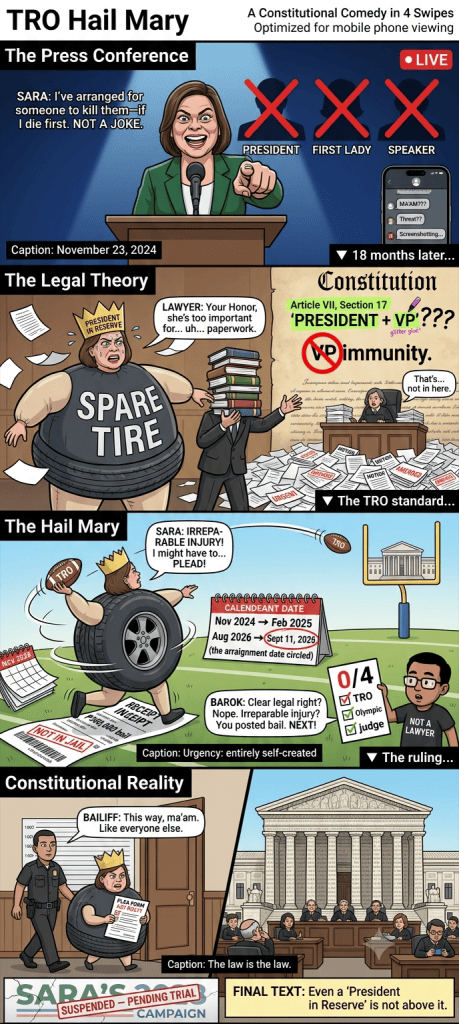
The Actual Stakes: A Timeline of Convenience
- November 23, 2024: Duterte holds her infamous press conference and allegedly threatens to have Marcos, Araneta-Marcos, and Romualdez killed.
- December 2024: Her lawyers file a declaratory relief case before the San Juan Regional Trial Court (RTC) claiming immunity. Notice: They didn’t wait for charges. They preemptively sought protection.
- February 2025: The National Bureau of Investigation (NBI) files complaints for grave threats and inciting to sedition.
- August 7, 2026: The Department of Justice (DOJ) recommends indictment.
- August 11, 2026: Three criminal informations filed before the Quezon City (QC) RTC.
- August 21, 2026: Duterte files a certiorari and prohibition petition with the Supreme Court.
- September 4, 2026: Arrest warrant issued. Duterte posts ₱360,000 bail the next day.
- September 7, 2026: Urgent motion for Temporary Restraining Order (TRO) filed.
- September 10, 2026: Amended petition filed.
- September 11, 2026: Arraignment.
The alleged threats were made in November 2024. The DOJ sat on this for eighteen months before recommending indictment in August 2026—right as the impeachment trial was heating up and Duterte was positioning herself for 2028.
If you believe the DOJ’s timeline is pure administrative happenstance, I have a bridge in Marawi to sell you.
But here’s the uncomfortable truth: The delay cuts both ways. The NBI complaint filed in February 2025 shows the investigation predated the impeachment drama. So the “political persecution” narrative isn’t as clean as Duterte’s camp would like. It’s suspicious. It’s convenient. But it’s not smoking-gun proof of weaponization.
The Constitutional Illiteracy of “Limited Procedural Immunity”
Duterte’s petition argues that as an “impeachable official,” she enjoys “limited procedural immunity” from criminal prosecution while in office. Her lawyers claim allowing the case to proceed would “violate the constitutional framework governing impeachable officials” and “undermine the separation of powers.”
They’ve even invoked the “President in Reserve” doctrine—arguing the Vice President must remain unencumbered because she might be called upon to assume the presidency.
Let me translate: “I’m one heartbeat away from the presidency, so you can’t prosecute me for anything.”
This is not constitutional law. This is constitutional fan fiction.
Article VII, Section 17 states: “The President shall be immune from suit during his tenure.”
The President.
Not the Vice President. Not “impeachable officials.” The President.
The framers knew how to grant immunity when they wanted to. They explicitly chose not to extend it to the Vice President. The deletion of the 1973 Constitution‘s broader immunity provision wasn’t an oversight—it was deliberate.
DOJ Secretary Fredderick Vida has been clear: “Under existing laws and the Philippine legal system, only the President has immunity from suit while serving in office. The Vice President, in this particular matter, does not enjoy immunity from suit.”
This isn’t partisan hackery. This is basic constitutional text.
Duterte’s lawyers conflate two separate constitutional mechanisms.
Impeachment is a political process for removing officials from office.
Criminal prosecution is a judicial process for determining guilt under penal laws.
These are not mutually exclusive. They operate on “separate tracks,” as Prosecutor General Richard Fadullon correctly noted.
Article XI, Section 3(7) states that “judgment in cases of impeachment shall not extend further than removal from office and disqualification… but the party convicted shall nevertheless be liable and subject to prosecution, trial, and punishment according to law.”
The sequencing is clear: Impeachment first, criminal prosecution after.
Not “criminal prosecution never while in office.”
The “Spare Tire” Problem
University of the Philippines (UP) College of Law Assistant Dean Paolo Emmanuel Tamase has articulated the fatal flaw: “Unlike the President, who enjoys immunity from suit while in office, the Vice President does not have the same protection.”
Presidential immunity is based on the need to allow the President to function as “the country’s sole executive without facing multiple legal challenges.” This rationale simply doesn’t apply to the Vice President, who is “constitutionally a spare tire.”
The “President in Reserve” argument is particularly laughable. The Vice President’s constitutional role is largely ceremonial. She doesn’t exercise executive power. She doesn’t command the military. She waits.
And apparently, while waiting, she believes she should be immune from the ordinary operation of criminal law.
The irony is stunning: Duterte’s lawyers argue that the mere possibility of assuming the presidency somehow elevates her above the law. But if that’s the standard, then every impeachable official—Supreme Court justices, Constitutional Commission members, the Ombudsman—should also enjoy criminal immunity while in office.
The logical endpoint of Duterte’s argument is a constitutional caste system where certain officials can commit crimes with impunity until they’re removed through impeachment. That’s not a constitutional democracy. That’s an oligarchy with procedural formalities.
The TRO Standard: A Hail Mary by Any Other Name
A Temporary Restraining Order under Rule 58 requires:
- A clear legal right to be protected
- Material and substantial invasion of that right
- Urgent need to prevent irreparable injury
- No other ordinary, speedy, and adequate remedy
Duterte’s “clear legal right” is… what exactly?
The right to not be prosecuted while in office? A right that exists nowhere in the constitutional text? A right that contradicts Article VII, Section 17?
Her “irreparable injury” is that she might have to attend her own arraignment.
Let me repeat that: The Vice President of the Philippines is asking the Supreme Court to halt criminal proceedings because showing up in court is too burdensome.
The irreparable injury argument is particularly weak because Duterte has already posted bail. She’s not in detention. She’s not being prevented from performing her duties. She’s facing trial. Which is what happens when you’re accused of a crime.
The urgency argument is even weaker. The case has been pending since November 2024. The “urgency” is entirely of Duterte’s own making—she could have filed earlier but chose to wait until the eve of arraignment.
This is not a constitutional emergency. This is litigation strategy.
The Political Theater Masquerading as Legal Argument
Duterte’s TRO petition isn’t primarily about legal principle. It’s about political survival.
A criminal conviction would disqualify her from running for president in 2028. It would end her political career. It would potentially send her to prison.
So her legal team is throwing everything at the wall, hoping something sticks.
Every day the case is delayed is another day Duterte remains politically viable. Another day she can fundraise. Another day she can build her narrative as a victim of political persecution.
The timing of the amended petition—filed just one day before arraignment—is telling. This isn’t a good-faith effort to resolve a constitutional question. This is a last-minute attempt to avoid an embarrassing court appearance.
Meanwhile, Judge Maria Angelica de Ramos, who issued the arrest warrant, has faced online trolling and harassment from Duterte loyalists.
This is the context in which the Supreme Court must decide. Not in a vacuum of legal principle, but in a maelstrom of political pressure, threats against judicial officers, and a defendant who has publicly demonstrated her willingness to use violent rhetoric.
What the Supreme Court Should Do
If the Court grants the TRO, it effectively recognizes a constitutional immunity that doesn’t exist in the text. It would set a precedent that impeachable officials can delay criminal proceedings indefinitely by claiming “limited procedural immunity.”
If the Court denies the TRO, it risks being accused of political bias. Duterte’s supporters will claim the Court is doing Marcos’s bidding.
But the Court’s duty is to the Constitution, not to political convenience.
The Constitution is clear: Only the President enjoys immunity from suit while in office. The Vice President does not. Criminal prosecution and impeachment are separate processes that can proceed simultaneously.
The Court should deny the TRO and allow the case to proceed.
But it should also act swiftly on the merits. If the Court ultimately rules that the Vice President does enjoy some form of immunity, it should say so clearly—not through a procedural TRO that leaves the question unresolved.
What the Court should not do is allow the case to drag on for years while Duterte exploits every procedural delay. Justice delayed is justice denied—both for the victims of the alleged threats and for the public’s right to know whether their Vice President committed a crime.
The Bigger Picture: A Test of Institutional Integrity
This case is about more than Sara Duterte. It’s about whether the Philippines is a country where the law applies equally to everyone, or whether certain officials can claim special privileges based on political status.
The Duterte family has long operated as if they were above the law. Rodrigo Duterte’s drug war killed thousands with impunity. His daughter now claims immunity from prosecution for alleged death threats.
The pattern is clear: The Dutertes believe they are a law unto themselves.
The Supreme Court has an opportunity to reject this dangerous doctrine. It can affirm that in the Philippines, no one—not even the Vice President—is above the law.
Or it can grant the TRO and signal that powerful officials can escape accountability through creative legal arguments and political pressure.
The choice is theirs.
But history will judge them.
And so will the Filipino people, who deserve a government where the rule of law means something more than a slogan on a campaign poster.
Epilogue: What Happens Next?
If the TRO is denied, Duterte will be arraigned. She will enter a plea (almost certainly “not guilty”). The case will proceed to trial.
That’s how the system is supposed to work.
But Duterte’s legal team will continue to fight. They’ll file more motions. They’ll appeal every adverse ruling. They’ll do everything possible to delay the inevitable.
And if the Supreme Court ultimately rules against them, they’ll take their case to the court of public opinion. They’ll claim political persecution. They’ll rally their supporters. They’ll threaten chaos.
But the law is the law.
And the law says that even a Vice President who claims to be a “President in Reserve” is not above it.
Louis ‘Barok’ C Biraogo is not a lawyer, which means he has no ethical obligation to be polite about any of this. He blogs at Kweba ni Barok, documenting the Philippine political circus with equal parts horror and amusement
Disclaimer: The views expressed in this article are those of the author and do not necessarily reflect the views of anyone with actual legal authority. If you’re Vice President Sara Duterte, please don’t threaten to have me killed.
Key Citations
A. Legal and Official Sources
- The 1987 Constitution of the Republic of the Philippines. Art. VII, Official Gazette of the Republic of the Philippines, https://www.officialgazette.gov.ph/constitutions/the-1987-constitution-of-the-republic-of-the-philippines/the-1987-constitution-of-the-republic-of-the-philippines-article-vii/.
- The 1987 Constitution of the Republic of the Philippines. Art. XI, Official Gazette of the Republic of the Philippines, https://www.officialgazette.gov.ph/constitutions/the-1987-constitution-of-the-republic-of-the-philippines/the-1987-constitution-of-the-republic-of-the-philippines-article-xi/.
- The 1973 Constitution of the Republic of the Philippines. Official Gazette of the Republic of the Philippines, https://www.officialgazette.gov.ph/constitutions/1973-constitution-of-the-republic-of-the-philippines-2/.
- Rules of Court. Rule 58, Supreme Court of the Philippines E-Library, https://elibrary.judiciary.gov.ph/thebookshelf/showdocsfriendly/1/64903.
- Duterte, Sara Z. Petition for Certiorari and Prohibition under Rule 65. Supreme Court of the Philippines, Aug. 2026, https://sc.judiciary.gov.ph/wp-content/uploads/2026/09/Petition-for-Certiorari-and-Prohibition-under-Rule-65.pdf.
- Duterte, Sara Z. Amended Petition for Certiorari and Prohibition under Rule 65 with TRO and/or WPMI. G.R. No. E-08160, Supreme Court of the Philippines, 10 Sept. 2026, https://sc.judiciary.gov.ph/wp-content/uploads/2026/09/Amended-Petition-for-Certiorari-and-Prohibition-under-Rule-65-with-TRO-and-or-WPMI-GR-No-E-08160.pdf.
B. News Articles
- “Philippines Boosts Security after VP’s Assassination Threat against President.” Reuters, 23 Nov. 2024, https://www.reuters.com/world/asia-pacific/philippine-vp-says-she-would-have-marcos-assassinated-if-she-is-killed-2024-11-23/.
- Buan, Lian. “NBI Files Inciting to Sedition, Grave Threat Complaints vs Sara Duterte.” Rappler, 12 Feb. 2025, https://www.rappler.com/philippines/nbi-inciting-sedition-grave-threat-complaints-sara-duterte/.
- “DOJ Files Grave Threats vs. Sara Duterte.” GMA News Online, 11 Aug. 2026, https://www.gmanetwork.com/news/topstories/nation/998144/doj-grave-threats-sara-duterte/story/.
- Pulta, Benjamin. “QC Court Issues Arrest Warrant vs VP Sara over Grave Threats Case.” Philippine News Agency, 4 Sept. 2026, https://www.pna.gov.ph/articles/1283368.
- Hernando-Malipot, Merlina. “VP Duterte Posts Bail; Arrest Warrant Lifted in QC Grave Threats Case.” Manila Bulletin, 5 Sept. 2026, https://mb.com.ph/2026/09/05/duterte-posts-bail-arrest-warrant-lifted-in-qc-grave-threats-case.
- “Justice Dep’t Says VP Sara Has No Immunity from Suit.” BusinessWorld, 10 Sept. 2026, https://bworldonline.com/the-nation/2026/09/10/776110/justice-dept-says-vp-sara-has-no-immunity-from-suit/.
- “LIVE UPDATES: Sara Duterte Arraignment for Grave Threats (Sept. 11, 2026).” GMA News Online, 11 Sept. 2026, https://www.gmanetwork.com/news/topstories/nation/1001987/live-updates-sara-duterte-arraignment-for-grave-threats-sept-11-2026/story/.
C. Official Websites
- Office of the Vice President. Republic of the Philippines, https://www.ovp.gov.ph/.
- Supreme Court of the Philippines. https://sc.judiciary.gov.ph/.
- “Duterte Case.” International Criminal Court, https://www.icc-cpi.int/victims/duterte-case.
- Tamase, Paolo Emmanuel S. Faculty profile. UP College of Law, https://law.upd.edu.ph/profile/faculty-tamasepaolos/.
- Biraogo, Louis C. “About Me.” Kweba ni Barok, https://kwebanibarok.com/about/.





Leave a Reply