₱2.5M Under the Table, ₱500K on Paper: The Only ‘Audit’ the BIR Never Fails
By Louis ‘Barok’ C. Biraogo — September 13, 2026
I’VE watched this movie before. Scandal erupts. Senate investigates. Agency announces ‘reforms.’ Cameras roll. Everyone claps. And six months later, the same crooks are back—except now they have nicer PowerPoint slides and a fresh acronym. The BIR calls it ‘D.A.R.E.S.’ I call it a sequel nobody asked for.
But the Bureau of Internal Revenue (BIR)’s current Letter of Authority (LOA) extortion scandal deserves special recognition. It’s not just corruption. It’s performance art.
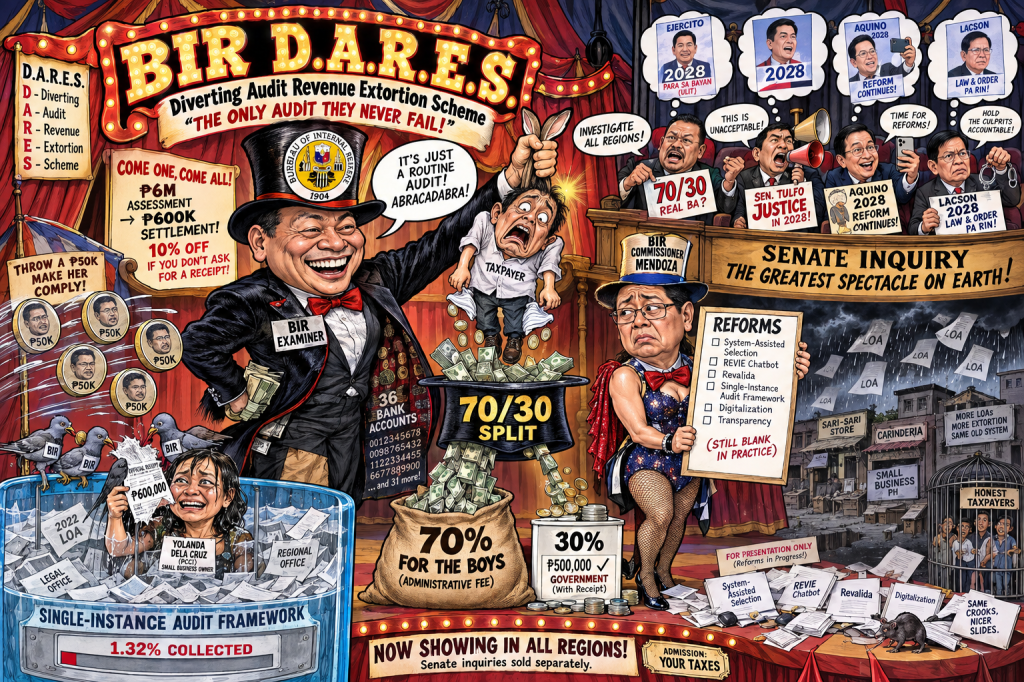
On September 10, 2026, Yolanda dela Cruz, Philippine Chamber of Commerce and Industry (PCCI) Vice President for National Capital Region (NCR), walked into a Senate hearing and dropped a bomb so spectacularly mundane that it should have been boring. BIR examiners, she said, are still extorting businessmen. The kickbacks they demand are bigger than the taxes actually paid to the government.
She described receiving a ₱6 million LOA demand, negotiating it down to ₱600,000 (a suspiciously round “10%”), and then watching subsequent examiners demand payments that never made it to official receipts. Her 2022 LOA remains unresolved because BIR wants ₱3 million, but only ₱500,000 would be receipted. Documents bounced between offices five times, each round trip costing ₱50,000.
Let me translate: ₱2.5 million of a ₱3 million demand was allegedly designated for “the boys.”
And here’s the part that makes me want to throw my laptop: this is exactly what the Senate investigated in 2025.
The “Reform” That Wasn’t
Let’s do a quick timeline, because apparently nobody in Malacañang bothered to.
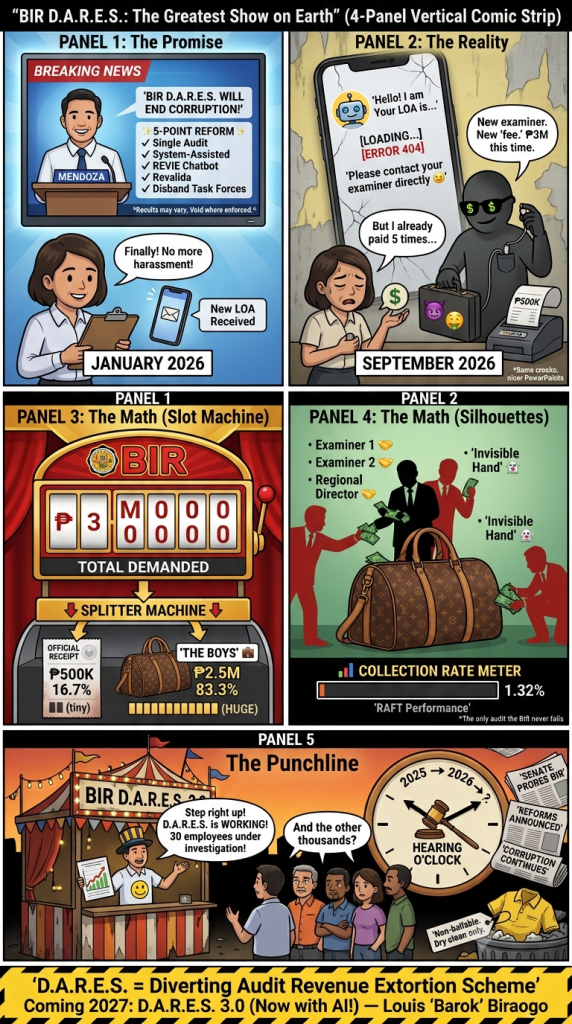
November 2025: BIR Commissioner Charlito Mendoza—newly appointed, presumably to clean house—suspends all field audits and LOA issuances following corruption allegations. Senators JV Ejercito and Erwin Tulfo had already flagged an alleged “70/30 scheme” where BIR personnel supposedly pocket 70% of LOA-driven collections.
January 2026: BIR lifts the suspension and unveils “BIR DARES”—a five-point reform agenda with a name so aggressively acronymed it sounds like a student council campaign. The reforms include:
- A Single-Instance Audit Framework limiting one LOA per taxpayer per year
- System-assisted, risk-based audit selection to remove human discretion
- A public LOA verification tool via chatbot “REVIE”
- The Revalida system, or “audit-the-auditor”
- Disbanding overlapping audit task forces and Value-Added Tax (VAT) audit units
February 2026: The Senate Blue Ribbon Committee lauds these reforms. Commissioner Mendoza tells senators that 30 employees are under investigation, 25 face formal charges. Senate President Pro Tempore Panfilo Lacson warns corrupt BIR personnel that corruption can be non-bailable and they might end up “wearing a yellow shirt”.
September 2026: A PCCI executive testifies that nothing has changed.
The Math That Should Haunt Mendoza’s Dreams
Dela Cruz’s testimony contains a mathematical structure so damning it should be framed and hung in the BIR Commissioner’s office as a daily reminder of his failure.
- Total allegedly demanded: ₱3,000,000
- Officially receipted: ₱500,000
- Unreceipted balance: ₱2,500,000
That’s 83.33% of the alleged demand unaccounted for—if you believe the government’s own receipts. The phrase “under the table” is doing a lot of heavy lifting here, but even by the standards of Philippine bureaucratic corruption, this is impressively brazen.
And then there’s the earlier ₱6 million → ₱600,000 negotiation. A perfect 10% ratio. Dela Cruz herself frames it as “I am willing to pay but only 10 percent as a help to the government”. I’m no forensic accountant, but when a taxpayer and an examiner converge on a nice round percentage, that’s not tax compliance. That’s haggling.
The uncomfortable legal question—which nobody in the Senate seems eager to ask—is whether Dela Cruz’s own conduct creates liability. Under Article 212 of the Revised Penal Code, a person who offers or gives a bribe can be prosecuted alongside the official who receives it. The difference between “victim of extortion” and “co-conspirator in corruption” often hinges on whether the taxpayer initiated the offer or was coerced into it.
Dela Cruz’s own testimony suggests she proposed the 10% arrangement. That’s not a legal judgment—it’s just a fact worth noting while we’re all busy pretending business owners are pure victims.
The “70/30” Elephant in the Room
Senator Ejercito’s “70/30 scheme” allegation deserves its own section because it reframes the entire scandal. If BIR personnel are allegedly pocketing 70% of LOA-driven collections, then this isn’t a few rogue examiners. It’s an institutional revenue-sharing arrangement.
The numbers, if true, are staggering:
- Target revenue from LOA misuse: ₱6–8 billion
- Actual government collections: ₱2–3 billion
- Allegedly pocketed: ₱1.4–2.1 billion
That’s not corruption. That’s a parallel tax system.
And here’s the thing: the BIR’s own data supports the pattern. Lacson noted that 3,520 LOAs were issued by the Run After Fake Transactions (RAFT) task force from 2023 to 2025, with assessed payables of ₱601.01 billion but only ₱7.95 billion actually paid—a collection rate of 1.32%.
I’ll say that again: 98.68% of assessed liabilities went uncollected.
Either the BIR is spectacularly incompetent at collection, or something else is happening to those assessments. Something that involves “settlements” that never make it to the Treasury.
The LOA as a Weapon
Here’s what frustrates me most about this scandal: the LOA is supposed to be a legal safeguard.
Under Supreme Court jurisprudence—particularly CIR v. McDonald’s Philippines Realty Corp.—an LOA is a jurisdictional requirement. Without a valid LOA, the BIR has no authority to examine a taxpayer. Transferring an audit to an officer not named in the LOA violates due process and usurps the Commissioner’s statutory authority.
The LOA exists to protect taxpayers from arbitrary examination. It tells you who is authorized to audit you, what they can examine, and when the authority expires.
So what happens when the instrument designed to protect taxpayers becomes the primary tool of extortion?
You get a system where examiners brandish LOAs like search warrants, demand “settlements,” and then circulate documents through multiple offices to extract payments at each stage. Dela Cruz described five rounds of document circulation, each costing ₱50,000. That’s ₱250,000 in “processing fees” for documents that, under the new Single-Instance Audit Framework, should have been consolidated into one proceeding.
The Reforms That Weren’t
I want to be fair to Commissioner Mendoza. He inherited a mess. The BIR’s audit system was, by all accounts, a machine for converting tax assessments into personal income. The “drop box” extortion network—payments retrieved by “invisible hands” with no CCTV coverage—suggests organized criminality, not isolated misconduct.
His reforms sound good on paper:
- Single-Instance Audit Framework: One LOA per taxpayer per year. In theory, this prevents the document-circulation scheme Dela Cruz described.
- System-assisted selection: Removes examiners’ ability to target specific taxpayers.
- REVIE verification tool: Lets taxpayers check if an LOA is legitimate.
- Revalida: Internal “audit-the-auditor” review.
But here’s the problem: paper reforms don’t change behavior if nobody enforces them.
Dela Cruz’s testimony—delivered eight months after these reforms were announced—describes the exact same practices that triggered the 2025 investigation. The “single-instance” framework didn’t stop documents from circulating. The “system-assisted” selection didn’t prevent examiners from demanding kickbacks. The verification tool didn’t stop ₱50,000 payments at each stage.
Either the reforms aren’t being implemented, or they’re being systematically circumvented.
The Enforcement Deficit
Commissioner Mendoza told senators in February that 30 employees were under investigation, 25 facing formal charges. That sounds impressive until you realize:
30 employees out of how many?
The BIR employs thousands. The “70/30 scheme” allegedly involved networks of examiners across multiple regions. If only 30 are under investigation, either the scheme is much smaller than alleged—or investigators are only scratching the surface.
And what happens to those 30? Mendoza said “dismissal from service remains an option where evidence warrants”. That’s bureaucratic language for “we’ll see.”
Meanwhile, Lacson’s warning about “non-bailable” corruption charges and yellow shirts is politically satisfying but legally meaningless unless someone actually gets charged and convicted.
The uncomfortable truth: Philippine anti-corruption enforcement is a joke. Cases take years. Convictions are rare. The powerful are protected. The small fry get sacrificed. And the system continues.
The Political Theater
I’d be lying if I said the Senate hearings weren’t partly about politics.
Senator Bam Aquino chairs the trade committee that heard Dela Cruz’s testimony. He’s also a potential 2028 presidential candidate. His closing statement—“As long as we’re the committee chairman on trade… we will really want to get to the bottom here”—is oversight. It’s also branding.
Senator JV Ejercito has been banging the “70/30” drum since 2025. Senator Erwin Tulfo filed a resolution demanding investigation. Senator Panfilo Lacson, the Blue Ribbon chair, gets to play the tough cop.
None of this means their concerns are insincere. But it does mean that institutional reform competes with individual political advancement. Every senator investigating BIR corruption is also building a platform for the next election.
And the BIR? Commissioner Mendoza is defending his reforms while simultaneously acknowledging that corruption “remains” a problem. That’s not a great position for a reformer.
What Would Actually Work
If the government were serious about ending LOA extortion—and I’m increasingly convinced it’s not—here’s what would happen:
- Full forensic audit of every LOA issued since 2020. Not a sample. Not a “statistically significant subset.” Every single one. Match each LOA to its assessment, its resolution, and its payment records. Find the discrepancies.
- Criminal prosecution of everyone involved—including taxpayers who knowingly participated in unreceipted payments. Corruption requires two parties. If business owners are paying “under the table” to reduce assessments, they’re not victims. They’re participants.
- Asset forfeiture. If examiners are collecting ₱50,000 per document circulation, where’s the money going? Bank accounts? Real estate? Relatives? The Department of Justice (DOJ)’s Zamboanga conviction of a BIR officer with 36 bank accounts and deposits “substantially exceeding” his salary shows this can be done.
- Real-time payment tracking. Every peso paid to the BIR should be electronically traceable from taxpayer to Treasury. No cash. No “drop boxes.” No “invisible hands.” If the government can track my GCash transactions, it can track tax payments.
- Whistleblower protection with teeth. Dela Cruz spoke at a Senate hearing. That’s not whistleblowing—that’s performance. Real whistleblowers need legal protection, financial support, and guaranteed immunity if they self-report participation in corruption.
The Bottom Line
The BIR LOA scandal isn’t complicated. It’s a simple equation:
Audit authority + unchecked discretion + collection pressure + minimal oversight = extortion machine.
The 2025 investigation exposed the machine. The 2026 “reforms” were supposed to dismantle it. The September 2026 testimony proves the machine is still running.
Commissioner Mendoza has two choices: admit that his reforms have failed to change anything meaningful, or double down on the fiction that “BIR DARES” is working. The Senate has two choices: keep holding hearings that produce headlines but no accountability, or actually refer cases for prosecution and follow through.
And taxpayers—the honest ones, the ones who actually pay what they owe without negotiating “10% arrangements”—have one choice: keep watching the circus, or demand real change.
The PCCI’s dela Cruz said it best: “If the government will remove all these scrupulous and corrupt BIR examiners, kikita ang ating gobyerno.”
Remove the corrupt examiners. Then we’ll talk about reform.
Until then, the BIR’s “D.A.R.E.S.” agenda might as well be renamed:
Diverting
Audit
Revenue
Extortion
Scheme
Louis ‘Barok’ C Biraogo is the author of the Kweba ni Barok blog. He has worked for 37 years in Philippine governance and anti-corruption advocacy. The views expressed are his own, though he suspects many taxpayers share them.
Key Citations
A. Reports & Studies
- Bureau of Internal Revenue. BIR Launches DARES Reform Agenda at Directors’ Conference, Sets Audit Reform as First Priority Ahead of Relaunch. 21 Jan. 2026, https://bir-cdn.bir.gov.ph/BIR/pdf/PR04JAN2126.pdf.
- Bureau of Internal Revenue. BIR Lifts Audit Suspension, Reformed Audit Program Launched. 27 Jan. 2026, https://bir-cdn.bir.gov.ph/BIR/pdf/PR07JAN2726.pdf.
- Bureau of Internal Revenue. BIR Presents Key Audit Reforms to Senate Blue Ribbon Committee. 10 Feb. 2026, https://bir-cdn.bir.gov.ph/BIR/pdf/PR11FEB1026.pdf.
- Bureau of Internal Revenue. Revenue Memorandum Circular No. 107-2025. 24 Nov. 2025, https://bir-cdn.bir.gov.ph/BIR/pdf/RMC%20No.%20107-2025%20Digest%20FINAL.pdf.
B. News Articles
- Abarca, Charie. “JV Ejercito: 70% of LOA Collections Pocketed by Some BIR Officials.” Philippine Daily Inquirer, 25 Nov. 2025, https://newsinfo.inquirer.net/2146000/fwd-bir-corruption-explained-70-of-loa-collections-pocketed-only-30-remitted-to-govt-says-ejercito.
- Bacelonia, Wilnard. “Senator Seeks Probe into Alleged ‘Weaponization’ of BIR Audits.” Philippine News Agency, 24 Nov. 2025, https://www.pna.gov.ph/articles/1263824.
- Hilotin, Jay. “Philippines: Senate Uncovers Multi-Billion Money Machine at BIR via So-Called ‘Letter of Authority’ and Mission Orders.” Gulf News, 3 Feb. 2026, https://gulfnews.com/world/asia/philippines/philippines-multi-billion-money-machine-at-bir-via-so-called-letter-of-authority-and-mission-orders-mos-uncovered-corruption-runs-deep-as-senate-probe-kicks-off-1.500429539.
- Lalu, Gabriel Pabico. “BIR Examiners Still into Extortion, Senate Told.” Philippine Daily Inquirer, 12 Sept. 2026, https://newsinfo.inquirer.net/2303972/bir-examiners-still-into-extortion-senate-told.
- Lalu, Gabriel Pabico. “PCCI Exec: BIR Corruption Stays; Examiners’ Kickbacks Bigger than Taxes.” Philippine Daily Inquirer, 11 Sept. 2026, https://newsinfo.inquirer.net/2303641/pcci-exec-bir-corruption-stays-examiners-kickbacks-bigger-than-taxes.
- Nazario, Dhel. “JV Ejercito: BIR Officials Pocket 70% of LOA Collections.” Manila Bulletin, 25 Nov. 2025, https://mb.com.ph/2025/11/25/jv-ejercito-bir-officials-pocket-70-of-loa-collections.
- Ong, Ghio. “BIR Employee in Zamboanga Guilty of Money Laundering.” The Philippine Star, 29 Apr. 2026, https://www.philstar.com/headlines/2026/04/29/2524312/bir-employee-zamboanga-guilty-money-laundering.
C. Official Websites
- Bureau of Internal Revenue. Official Website. https://www.bir.gov.ph/.
- Department of Finance. “Statement on the Immediate and Temporary Suspension of All Bureau of Internal Revenue Field Audits and Related Operations.” 24 Nov. 2025, https://www.dof.gov.ph/statement-of-finance-secretary-frederick-d-go-and-bureau-of-internal-revenue-commissioner-charlito-martin-r-mendozaon-the-immediate-and-temporary-suspension-of-all-field-audits-and-related-operation/.
- Department of Justice. Official Website. https://www.doj.gov.ph/.
- GCash. Official Website. https://www.gcash.com/.
- Philippine Chamber of Commerce and Industry. Official Website. https://www.philippinechamber.com/.
- Senate of the Philippines. “Senate Resolution No. 180.” 20th Congress, 24 Nov. 2025, https://legacy.senate.gov.ph/lis/bill_res.aspx?congress=20&q=SRN-180.
D. Laws & Jurisprudence
- Commissioner of Internal Revenue v. McDonald’s Philippines Realty Corp. G.R. No. 242670. Supreme Court of the Philippines, 10 May 2021. https://lawphil.net/judjuris/juri2021/may2021/gr_242670_2021.html.
- Revised Penal Code of the Philippines. Act No. 3815, 8 Dec. 1930. Official Gazette of the Republic of the Philippines, https://www.officialgazette.gov.ph/1930/12/08/act-no-3815-s-1930/.



Leave a Reply