
Supreme Court dismissed. The justices walked. Here’s what “judicial in nature” really means.
By Louis ‘Barok‘ C Biraogo — September 13, 2026
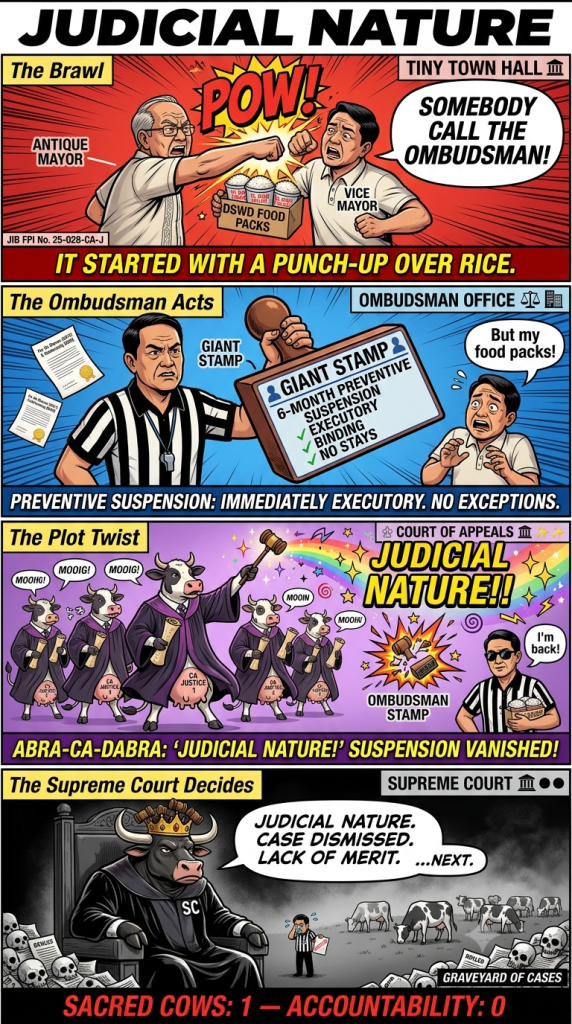
IN THE Philippine judiciary, “judicial in nature” is not a legal classification. It is a magic spell. Utter it, and seven Court of Appeals justices who defied binding Supreme Court precedent walk away clean, the Ombudsman’s complaint vanishes, and the December 3, 2025 resolution—dismissing the case “for lack of merit”—becomes yet another masterpiece of institutional self-preservation dressed up as constitutional principle.
The case, Judicial Integrity Board (JIB) FPI No. 25-028-CA-J, has all the ingredients of a legal thriller: a physical brawl between Antique officials over Department of Social Welfare and Development (DSWD) food packs, a six-month preventive suspension order, a CA temporary restraining order (TRO) that neutered the Ombudsman, and a Supreme Court that—surprise, surprise—found the CA justices’ actions “judicial in nature” and therefore immune from administrative discipline.
Let’s be clear about what just happened. Seven CA justices reversed the Ombudsman’s preventive suspension orders against Antique Mayor Ernesto Tanjanlangit III and eight provincial board members. The Ombudsman cried foul, citing a mountain of Supreme Court precedent holding that its decisions are “immediately executory” and cannot be stayed by CA injunctions. The Supreme Court’s response? “Judicial nature. Case dismissed. Next.”
This is the legal equivalent of a referee ejecting a player for a flagrant foul, only for the league commissioner to overturn the ejection on the grounds that the referee’s whistle was “administrative in nature.” The logic is airtight if your only goal is to ensure no one ever holds a judge accountable for anything short of accepting a briefcase full of cash on live television.
The Precedent Problem: When the Supreme Court Contradicts Itself
Here’s where it gets deliciously absurd. In Office of the Ombudsman v. De Chavez (G.R. No. 172206, July 3, 2013), the Court held that the CA’s issuance of a preliminary injunction to stay an Ombudsman penalty “encroach[es] on the rule-making powers of the Office of the Ombudsman under the Constitution and Republic Act No. 6770 (The Ombudsman Act of 1989).” The Court invoked specialis derogat generali—special rules prevail over general rules—to explain why the Ombudsman’s Rule III, Section 7 supersedes the CA’s authority under Rule 43, Section 12 of the Rules of Court.
In Gobenciong v. Court of Appeals (G.R. No. 159883, March 31, 2008), the Court doubled down, ruling that preventive suspension orders are “immediately effective and executory” and that filing a motion for reconsideration does not stay implementation.
So the CA justices in the Antique case, by issuing a TRO against an Ombudsman preventive suspension order, were not merely exercising judicial discretion. They were directly contradicting binding Supreme Court precedent. If that doesn’t constitute “gross ignorance of the law”—a serious charge under Rule 140—then the phrase has no meaning.
Yet the Supreme Court dismissed the complaint “for lack of merit.” This is the same Court that, in Reyes v. Paderanga, found a judge guilty of gross ignorance of the law for a single erroneous order, fining him P20,000. The standard articulated there was that “good faith in situations of fallible discretion inheres only within the parameters of tolerable misjudgment” and does not apply “where the issues are so simple and the applicable legal principle evident and basic as to be beyond permissible margins of error.”
Was the De Chavez doctrine—repeatedly affirmed, unambiguous, and directly on point—somehow not “evident and basic”? Or does the standard magically become more forgiving when the respondents wear robes and sit on the appellate court?
The “Judicial Nature” Dodge: A Doctrine With No Limits
The Supreme Court’s primary ground for dismissal—that the CA justices’ actions were “judicial in nature”—is doing an enormous amount of work here. It is, in essence, a categorical immunity shield that prevents any administrative inquiry into judicial conduct, no matter how flagrantly it violates established law.
The judicial acts doctrine exists for good reason. Judges should not be disciplined for every erroneous ruling, or the judiciary would be paralyzed by constant administrative complaints from losing litigants. But the doctrine has always had exceptions: bad faith, malice, corruption, or gross ignorance. The Supreme Court’s dismissal doesn’t address whether those exceptions apply. It simply says the acts were judicial, therefore case closed.
This is circular reasoning elevated to constitutional doctrine. The question isn’t whether the acts were judicial—of course they were; CA justices issue TROs as part of their judicial function. The question is whether judicial acts performed in gross violation of binding precedent, in a manner that systematically undermines another constitutional body’s mandate, can be subject to administrative discipline. The Supreme Court’s answer is effectively “no, and don’t ask again.”
The Institutional Dance: Remulla’s Refile and the SC’s “Invitation”
Ombudsman Jesus Crispin Remulla, who inherited this mess from predecessor Samuel Martires, has announced he will refile the complaint. The Supreme Court, in a statement from spokesperson Camille Ting, has “invited” Remulla to file a “proper complaint” with “supporting evidence.”
This is political theater of the highest order. The Supreme Court knows any refiled complaint will face the same “judicial nature” dismissal unless it alleges bad faith or corruption with smoking-gun evidence—virtually impossible to obtain against judges who don’t leave paper trails. The “invitation” is a public relations move designed to make the Court appear open to accountability while maintaining a procedural framework that guarantees no accountability will ever occur.
Remulla, for his part, is playing his role perfectly. He has threatened to publish a “graveyard” of Ombudsman cases reversed by the CA. He has called for “soul-searching” in the judiciary. He has positioned himself as the lone institutional warrior against judicial impunity. Whether this is genuine conviction or strategic positioning—Remulla is, after all, a former congressman who knows how to command a microphone—is almost beside the point. The spectacle is what matters.
The Antique Backstory: Politics, Punch-Ups, and Food Packs
Lest we forget, this entire legal conflagration began with a physical altercation between Mayor Tanjanlangit and Vice Mayor Jose Maria “Jojo” Fornier over the distribution of DSWD food packs intended for El Niño-affected residents. The Ombudsman issued a six-month preventive suspension against Tanjanlangit in September 2024. The CA 14th Division issued a TRO in October 2024, effectively nullifying the suspension.
Tanjanlangit himself has alleged a “pattern” of Ombudsman actions against Antique officials, suggesting political motivation. The Ombudsman, meanwhile, has pointed to a broader pattern of CA reversals that undermine its institutional authority. Both narratives may be true simultaneously—the Ombudsman may be politically motivated in Antique and the CA may be systematically overstepping its authority in reversing Ombudsman decisions. Philippine politics is rarely so tidy as to allow only one villain.
The Real Stakes: Accountability for the Powerful
Strip away the legal jargon and institutional posturing, and what remains is a fundamental question: can the Ombudsman, a constitutionally created body tasked with being the “protector of the people”, effectively discipline erring public officials when the judiciary can and will nullify its actions without consequence?
The answer, as the Supreme Court has just demonstrated, is no. The CA can issue TROs against Ombudsman preventive suspension orders, contradicting binding precedent. The Ombudsman can file administrative complaints. The Supreme Court can dismiss them as “judicial in nature.” And the public officials who were supposed to be suspended? They remain in office, governing, potentially influencing witnesses, potentially tampering with records.
The Supreme Court’s dismissal is not just a legal ruling. It is a statement of institutional hierarchy: the judiciary is above the Ombudsman’s disciplinary reach, and any attempt to impose accountability on judges will be rebuffed. The “sacred cows” that Remulla warned about are real, and they are grazing comfortably on the pasture of judicial immunity.
What Comes Next: Evidence Over Theater
If Remulla is to succeed where his predecessor fell short, he needs to do more than refile the same complaint with slightly different phrasing. He needs to build a record—documenting specific instances of CA reversals that violate De Chavez and Gobenciong, showing not just legal error but a pattern of disregard for binding precedent. He needs to press the Supreme Court to either explicitly overrule its own precedents or explicitly exempt judges from their application. And he needs to make the “judicial nature” dodge politically costly enough that the Court cannot simply wave it away.
That’s a tall order. But the alternative—accepting that judges are immune from accountability for grossly erroneous rulings that undermine other constitutional institutions—is worse. It means the Ombudsman’s constitutional mandate is a dead letter whenever the CA decides to nullify it. It means preventive suspension, a key anti-corruption tool, is available only until a well-connected respondent finds a sympathetic appellate justice.
The Supreme Court’s dismissal is a victory for judicial independence. It is also a defeat for accountability. Whether it is also a defeat for the rule of law depends on whether the Court’s “judicial nature” doctrine has any limiting principle at all. Based on this resolution, the answer appears to be no.
And that should worry everyone—except, perhaps, the seven CA justices and the Antique officials they protected.
Key Citations
A. Legal & Official Sources
- The 1987 Constitution of the Republic of the Philippines. Official Gazette of the Republic of the Philippines, 1987, http://www.officialgazette.gov.ph/constitutions/1987-constitution/.
- The 1987 Constitution of the Republic of the Philippines, art. XI, sec. 12. Official Gazette of the Republic of the Philippines, http://www.officialgazette.gov.ph/constitutions/the-1987-constitution-of-the-republic-of-the-philippines/the-1987-constitution-of-the-republic-of-the-philippines-article-xi/.
- Republic Act No. 6770. An Act Providing for the Functional and Structural Organization of the Office of the Ombudsman, and for Other Purposes (The Ombudsman Act of 1989). 17 Nov. 1989, lawphil.net/statutes/repacts/ra1989/ra_6770_1989.html.
- Administrative Order No. 07. Rules of Procedure of the Office of the Ombudsman. 10 Apr. 1990, lawphil.net/courts/supreme/ao/ao_07_1990.html.
- Rules of Court, Rule 140. Charges Against Judges of First Instance / Discipline of Judges and Justices. lawphil.net/courts/rules/rc_140_judicial.html.
- Office of the Ombudsman v. De Chavez, G.R. No. 172206. Supreme Court of the Philippines, 3 July 2013, lawphil.net/judjuris/juri2013/jul2013/gr_172206_2013.html.
- Gobenciong v. Court of Appeals, G.R. No. 159883. Supreme Court of the Philippines, 31 Mar. 2008, lawphil.net/judjuris/juri2008/mar2008/gr_159883_2008.html.
- Reyes v. Paderanga, A.M. No. RTJ-06-1973. Supreme Court of the Philippines, 14 Mar. 2008, elibrary.judiciary.gov.ph/thebookshelf/showdocs/1/44797.
B. News Reports
- Casilao, Joahna Lei. “SC Dismisses Admin Complaint vs. 7 CA Justices.” GMA News Online, GMA Network, 11 Sept. 2026, http://www.gmanetwork.com/news/topstories/nation/1002040/sc-dismisses-admin-complaint-vs-7-ca-justices/story/.
- De Villa, Kathleen. “SC Junks Admin Raps vs CA Justices over Suspension of Antique Officials.” Philippine Daily Inquirer, 11 Sept. 2026, newsinfo.inquirer.net/2303594/sc-junks-admin-raps-vs-ca-justices-over-suspension-of-antique-officials.
- “SC Invites Ombudsman to File ‘Proper Complaint’ over CA Rulings.” Philippine Daily Inquirer, 4 Sept. 2026, newsinfo.inquirer.net/2298665/sc-invites-ombudsman-to-file-proper-complaint-over-ca-rulings.
- “Ombudsman Urges Examination of Judiciary; SC Says File Proper Complaints.” GMA News Online, GMA Network, 3 Sept. 2026, http://www.gmanetwork.com/news/topstories/nation/1001075/ombudsman-urges-examination-of-judiciary-sc-says-file-proper-complaints/story/.
- Ong, Ghio. “Ombudsman to SC: Act on Complaint vs CA Justices.” Philstar.com, The Philippine Star, 7 Sept. 2026, http://www.philstar.com/headlines/2026/09/07/2554504/ombudsman-sc-act-complaint-vs-ca-justices.

- ₱9 Billion in ‘Savings’? DILG’s Fire Truck Deal Smells Like Smoke

- ₱8B BBM Pork: CCTV for Every Captain’s Kumpare?

- ₱8.9 Billion, 331 Ghost Police Stations: The TIKAS Scandal Explained

- ₱8.4 Billion, 42,000 Barangays, 1 Election: The “Bawat Barangay Makikinabang” Vote-Buying Masterclass

- ₱75 Million Heist: Cops Gone Full Bandit

- ₱63 to the Dollar: The Only Thing Falling Faster Than the Peso Is the Government’s Credibility

- ₱6.77B Ghost Haunts Duterte: RTC Dismisses Mans Carpio’s Desperate Plea

- ₱6.77 Billion and Zero Cash: The Sara Duterte SALN Math That Doesn’t Add Up

- ₱6.7-Trillion Temptation: The Great Pork Zombie Revival and the “Collegial” Vote-Buying Circus

- ₱58.53B, Zero Receipts: The LGSF Pork Barrel Nobody Wants to Name

- ₱53 Million Man Tells ₱695-a-Day Workers to Stop Being ‘Mayabang’: The Audacity of BSP’s Remolona

- ₱4.4 Billion and a Witness Who Can’t Explain It: The Duterte Impeachment’s Most Expensive Non-Answer









Leave a Reply