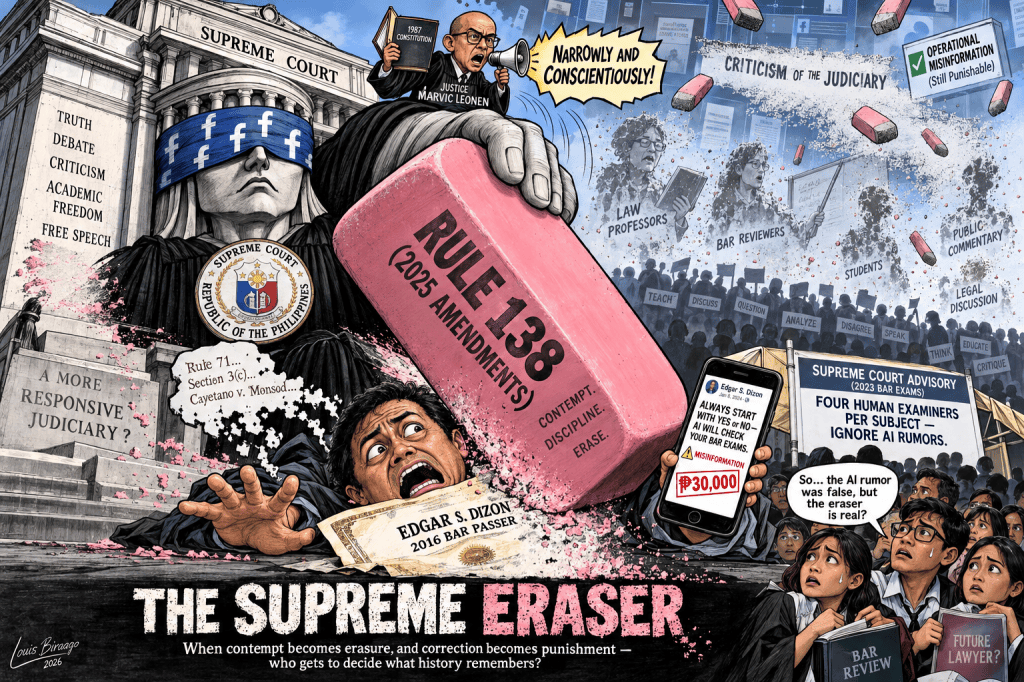
Edgar Dizon Was Never a Lawyer. So the Court Did Something Worse Than Disbarment — It Erased the One Thing He Had Left.
B.M. No. 4734 (In re: Social Media Posts of Edgar S. Dizon) — A Kweba ni Barok Investigation
Let me tell you something about the Philippine Supreme Court that you won’t read in the sanitized press releases. When the Court decides it’s mad — truly, deeply, institutionally mad — it doesn’t just fine you. It reaches back seven years into your personal history, finds the one thing you thought was untouchable, and erases it from the record. Not because you’re a lawyer who committed misconduct. Not because you’re a member of the Bar who violated A.M. No. 22-09-01-SC (Code of Professional Responsibility and Accountability or CPRA). But because you posted something on Facebook that made the Justices feel bad.
And yes, before the trolls come for me: I read the decision. I read the concurrence. I read Rule 71 of the Rules of Court, Rule 138 of the Rules of Court, the A.M. No. 24-10-05-SC (2025 amendments), G.R. No. 100113 (Cayetano v. Monsod), G.R. No. 190980 (Stradcom Corporation v. Failon Etong), the whole legal buffet. So put down your pitchforks and let’s actually talk about what happened here.
The Facts, Stripped of the Theatrics
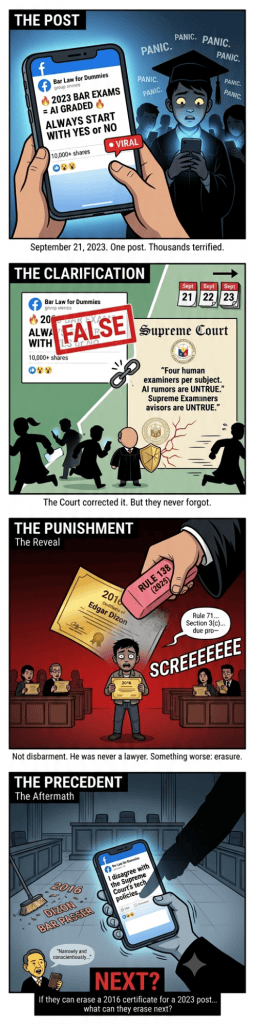
On September 21, 2023, Edgar Dizon — administrator of a Facebook group called “Bar Law for Dummies,” a Bar passer from 2016 who never took the oath because of pending murder cases — posted that the 2023 Bar Examinations would be “sorted, checked, and corrected by means of artificial intelligence” . He told examinees to “ALWAYS START WITH YES or NO” because that’s what the AI would look for.
The post went viral. The Office of the 2023 Bar Chair, under Justice Ramon Paul Hernando, scrambled to trace the source, issued an advisory clarifying that four human examiners per subject would check the answers, and coordinated with government agencies . The Court says this caused “panic and anxiety” among examinees and forced officials to divert “limited time and resources”.
Then Dizon did something that, in hindsight, was legally suicidal: he doubled down. Instead of deleting the post, he gave media interviews, threatened to sue the Supreme Court, and demanded a public apology “within 24 hours” . He sent emails to the Judiciary Public Assistance Section claiming the advisory had a “chilling effect” on him . He asked the Court to “rectify” its own clarification.
The Court’s response was, to put it mildly, not amused.
The Contempt Finding: Legally Solid, Institutionally Terrifying
Let’s be fair to the Court on the core contempt issue. Rule 71, Section 3(c) covers “unlawful interference with the processes or proceedings of a court”. Section 3(d) covers “improper conduct tending, directly or indirectly, to impede, obstruct, or degrade the administration of justice” . If you tell thousands of Bar examinees — people in the most psychologically vulnerable moment of their professional lives — that an AI system will check their answers and they should format their responses a certain way, that is not the same as saying “I disagree with the Supreme Court’s technological policies.”
It’s operational misinformation about an ongoing court proceeding. The Court has a legitimate institutional interest in correcting that. The ₱30,000 fine under Rule 71, Section 7 is the statutory maximum for indirect contempt. On these facts, it’s defensible.
But here’s where I start getting suspicious.
The Delisting: When Punishment Becomes Erasure
The Court didn’t just fine Dizon. It ordered the Office of the Bar Confidant to remove his name from the list of 2016 Bar passers. Let that sink in for a moment.
Edgar Dizon passed the Bar in 2016. That examination result is a historical fact. He was never admitted to the Bar — he never took the oath due to pending murder cases . He was never a lawyer. The Court cannot “disbar” him because he was never in the Bar. So instead, it erased his passing status.
The Court justified this under the 2025 amendments to Rule 138, which allow delisting for “false or inaccurate information, concealment or failure to disclose, or misrepresentation” . But here’s the temporal problem that any first-year law student should spot: Dizon’s alleged misconduct occurred in 2023. The Rule 138 amendments took effect in 2025. The decision came in 2026 .
The Court could argue it’s not retroactively applying the amendments but exercising its pre-existing constitutional authority over Bar admission under Article VIII, Section 5(5) of the 1987 Constitution. And that’s a coherent institutional position. But let’s be honest about what’s happening: the Court is using a 2025 procedural rule to justify a 2026 punishment for 2023 conduct that had nothing to do with his 2016 Bar application. The delisting isn’t correcting a fraudulent application. It’s a retroactive sanction dressed in administrative clothing.
And the most troubling part? The Court is simultaneously the alleged victim of the misinformation, the investigator of the misinformation, the prosecutor of the contempt charge, and the final adjudicator of both the contempt and the delisting. That’s not a due process violation per se — courts have inherent contempt power — but it’s an appearance of institutional self-dealing that should make any constitutionalist uncomfortable.
The Unauthorized Practice Ruling: The Precedent That Should Scare Every Bar Reviewer
The Court also found that Dizon engaged in unauthorized practice of law by authoring 22 categories of Bar review materials and conducting coaching sessions . It cited Cayetano v. Monsod for the proposition that practice of law includes “any activity… which requires the application of law, legal procedure, knowledge, training and experience” .
Here’s the problem: that definition is dangerously overbroad.
Under this reasoning, every law professor who teaches Torts without being an active practitioner is “practicing law.” Every legal researcher who drafts memoranda. Every accountant who teaches taxation. Every political scientist who explains constitutional theory. The CPRA‘s current definition of practice of law — which refers to legal services pursuant to a lawyer-client relationship or other CPRA-governed engagement — is significantly narrower than the Cayetano formulation the Court relied on .
If the Court is saying that only admitted lawyers can author Bar review materials and teach Bar review, that would upend the entire legal education industry. Many law professors are not active practitioners. Many Bar reviewers are retired academics. The Court’s broad language could sweep them all into “unauthorized practice” — a chilling prospect for legal education in the Philippines.
Leonen’s Concurrence: The Warning Shot
Senior Associate Justice Marvic Leonen’s separate concurrence is the most intellectually honest part of this entire ruling. He agreed Dizon should be punished but emphasized that the contempt power “must be exercised narrowly and conscientiously so that it can coexist with the freedom of expression that sustains deliberative democracy”.
Leonen is essentially saying what every First Amendment scholar would say: the Court cannot punish speech merely because it damages the Court’s reputation. The constitutional justification has to rest on actual interference with the administration of justice, not institutional hurt feelings.
And that’s exactly the line the majority opinion walks — sometimes successfully, sometimes not.
The “Clear and Present Danger” Problem
The Court invoked the “clear and present danger” test to justify punishing Dizon’s speech . But here’s what that test actually requires in Philippine jurisprudence: the danger must be extremely serious, highly imminent, and sufficiently connected to harm the administration of justice.
Was Dizon’s post “extremely serious”? It caused confusion and required the Bar Chair’s Office to issue a clarification. Annoying? Yes. Resource-diverting? Yes. But “extremely serious”? That’s a stretch.
Was it “highly imminent”? The examinations were days away. But the Court successfully corrected the misinformation through its advisory . Examinees were informed. The examinations proceeded. The imminent danger was mitigated by the Court’s own actions.
Did it actually obstruct justice? The Court says it “distracted examinees” and “diverted resources” . But “distraction” and “resource diversion” are not the same as obstruction. If every viral Facebook post that causes administrative inconvenience is contempt, we’ve effectively criminalized online speech about judicial processes.
The Procedural Theater
The Court gave Dizon a show-cause order, received his explanation, and issued a reasoned decision . Procedurally, that satisfies Rule 71. But let’s not pretend this was a fair fight. Dizon was a non-lawyer — a Bar passer who never took the oath, with pending murder cases . He was navigating a Supreme Court contempt proceeding without counsel (or at least without any indication of representation in the reported facts). The Court had the full institutional machinery of the Judiciary at its disposal.
This isn’t to say Dizon is a sympathetic figure. His post-publication conduct — threatening to sue the Court, demanding a 24-hour apology, asking for a photo with the Bar Chair — was bizarre and self-defeating . But the power imbalance here is staggering.
What This Case Actually Means
Let me be clear about my assessment:
- The contempt finding: Defensible on the facts. The post was operational misinformation about an imminent court-administered proceeding. That’s different from criticism.
- The ₱30,000 fine: Procedurally authorized. Substantively proportional? Arguable. The Court should have explained why it imposed the maximum rather than a lesser amount.
- The delisting: The most legally vulnerable part of the ruling. The temporal gap between the 2023 conduct and the 2025 Rule 138 amendments creates a serious retroactivity question. And the Court’s reasoning conflates contempt punishment with admission fitness regulation — two distinct legal theories that should be analyzed separately.
- The unauthorized practice finding: Potentially catastrophic precedent if read broadly. The Court needs to clarify that teaching law and practicing law are not the same thing, and that Bar review instruction by non-admitted persons is not automatically unauthorized practice.
The Bottom Line
The Supreme Court has a legitimate institutional interest in protecting the integrity of the Bar Examinations. False information about grading procedures, disseminated to vulnerable examinees days before the exam, is not the same as political criticism. Dizon’s conduct was reckless, his post-publication behavior was indefensible, and some sanction was warranted.
But the Court’s decision is a Rorschach test for institutional power. Read narrowly, it says: “Don’t spread operational misinformation about court proceedings.” Read broadly, it says: “The Supreme Court can punish anyone who embarrasses it, can reach back years to erase your achievements, and can define ‘practice of law’ so expansively that every legal educator is at risk.”
The narrow reading is constitutionally sustainable. The broad reading is a censorship regime waiting to happen.
And here’s the thing that should scare every lawyer, every law professor, and every Bar reviewer in the Philippines: the Court hasn’t told us which reading it intends.
Justice Leonen’s concurrence suggests he understands the danger. But a concurrence is not a majority opinion. The Court needs to clarify — sooner rather than later — that criticism of the Judiciary is protected, that operational misinformation is not, and that teaching law is not practicing law. Otherwise, this decision will chill far more speech than it corrects.
Dizon may have been wrong. But the Court’s remedy may end up being more dangerous than his post.
Key Citations
A. Legal & Official Sources
- In re: Social Media Posts of Edgar S. Dizon. B.M. No. 4734. Supreme Court of the Philippines, 15 July 2026, sc.judiciary.gov.ph/4734-in-re-social-media-posts-of-edgar-s-dizon/.
- Leonen, Marvic M.V.F. Separate Concurring Opinion. In re: Social Media Posts of Edgar S. Dizon, B.M. No. 4734, Supreme Court of the Philippines, 15 July 2026, sc.judiciary.gov.ph/4734-separate-concurring-opinion-senior-associate-justice-marvic-m-v-f-leonen/.
- The 1987 Constitution of the Republic of the Philippines. Official Gazette of the Republic of the Philippines, 1987, http://www.officialgazette.gov.ph/constitutions/1987-constitution/.
- “Rule 71 of the Rules of Court. Contempt.” Supreme Court E-Library, elibrary.judiciary.gov.ph/thebookshelf/showdocs/11/374.
- “Rule 138: Attorneys and Admission to Bar.” The Lawphil Project, Arellano Law Foundation, https://lawphil.net/courts/rules/rc_138_bar.html. Accessed 14 Sept. 2026.
- Re: 2025 Proposed Amendments to Rule 138 of the Rules of Court. A.M. No. 24-10-05-SC. Supreme Court of the Philippines, 12 Aug. 2025, sc.judiciary.gov.ph/24-10-05-sc-re-2025-proposed-amendments-to-rule-138-of-the-rules-of-court/.
- Code of Professional Responsibility and Accountability. A.M. No. 22-09-01-SC. Supreme Court of the Philippines, 11 Apr. 2023, sc.judiciary.gov.ph/wp-content/uploads/2023/05/22-09-01-SC.pdf.
- “Code of Professional Responsibility and Accountability.” Supreme Court of the Philippines, 15 May 2023, sc.judiciary.gov.ph/22-09-01-sc-code-of-professional-responsibility-and-accountability/. Accessed 14 Sept. 2026.
- Cayetano v. Monsod. G.R. No. 100113. Supreme Court of the Philippines, 3 Sept. 1991, http://www.lawphil.net/judjuris/juri1991/sep1991/gr_100113_1991.html.
- Stradcom Corporation v. Mario Teodoro Failon Etong a.k.a. Ted Failon. G.R. No. 190980. Supreme Court of the Philippines, 10 Oct. 2022, elibrary.judiciary.gov.ph/assets/pdf/philrep/2022/G.R.%20No.%20190980.pdf.
B. News Reports
- Supreme Court of the Philippines, Office of the Spokesperson. “SC Holds Bar Review Coach in Contempt for Spreading False Information on Bar Exams.” Supreme Court of the Philippines, 11 Sept. 2026, sc.judiciary.gov.ph/sc-holds-bar-review-coach-in-contempt-for-spreading-false-information-on-bar-exams/.
- Ranara, John Patrick Magno. “SC Finds Review Coach Guilty over False Claims That AI Will Be Used to Check Bar Exams.” PhilSTAR Life, 11 Sept. 2026, philstarlife.com/news-and-views/545813-bar-review-coach-guilty-false-claims-ai-2023-bar-exams.
- “SC Sanctions Bar Coach over Claim That AI Would Check Exams.” Newsbytes.PH, 12 Sept. 2026, newsbytes.ph/2026/09/12/sc-sanctions-bar-coach-over-claim-that-ai-would-check-exams/.
- “Ang Hirap Maging Mahirap”: The PAO Scandal That Proves Government Contempt Is Nothing New
- “Far-Off” My Axx: Malacañang’s Claire Castro Drowns in Her Own Legal Gaslighting
- “Forthwith” to Farce: How the Senate is Killing Impeachment—And Why Enrile’s Right (Even If You Can’t Trust Him)
- “HINDI AKO NAG-RESIGN!”

- “I Know Nothing”: Baste Duterte’s Amnesia Defense Meets ₱33M in GenCorp Contracts

- “I’m calling you from my new Globe SIM. Send load!”

- “Mahiya Naman Kayo!” Marcos’ Anti-Corruption Vow Faces a Flood of Doubt

- “Manageable” Debt, Unmanageable Lies: DBM’s ₱21 Trillion Fairy Tale
- “Meow, I’m calling you from my new Globe SIM!”

- “Natrabaho”: One Word, One Ombudsman, and a Judiciary on Trial
- “No Special Jail for Crooks!” Boying Remulla Slams VIP Perks for Flood Scammers

- “Philippine-Controlled” or Yankee Gas Station? The Davao Fuel Depot Farce Exposed





Leave a Reply