The Philippine Government Can’t Prove Its TUPAD Beneficiaries Are Real—That’s the Scandal
By Louis ‘Barok’ C. Biraogo — September 14, 2026
MGA ka-kweba, gather ’round. We need to talk about the Philippine government’s favorite magic trick: making millions of pesos disappear and calling it a “database lapse.”
The Commission on Audit (COA) has dropped its 2025 findings on the Department of Labor and Employment’s (DOLE) Tulong Panghanapbuhay sa Ating Disadvantaged/Displaced Workers (TUPAD) program—the flagship emergency employment initiative supposed to help disadvantaged workers earn a few thousand pesos doing community work. What did our intrepid auditors find?
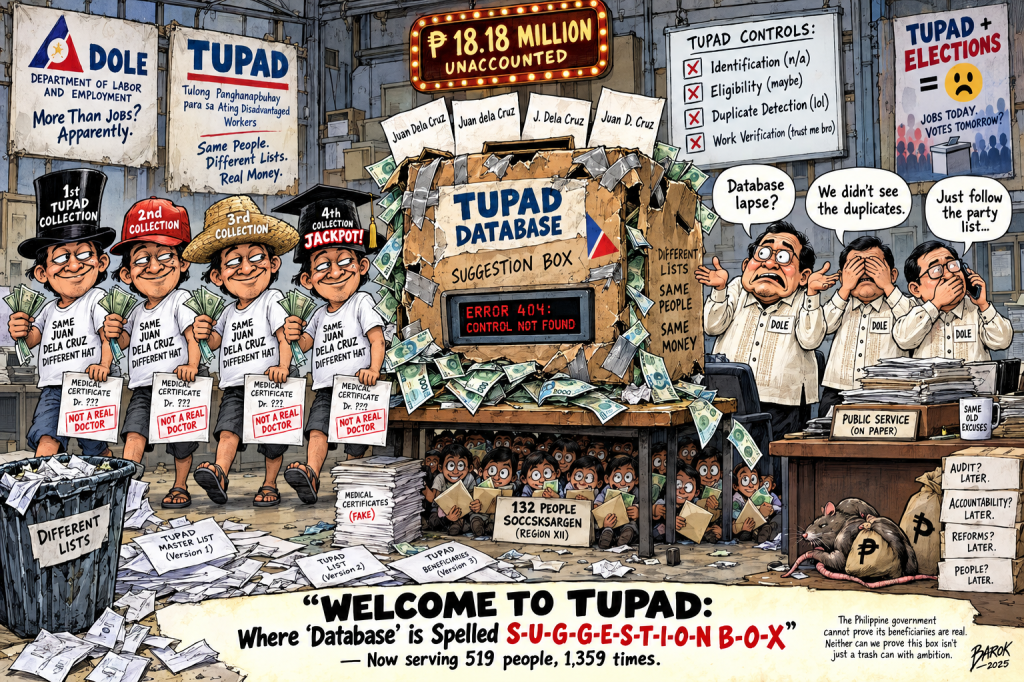
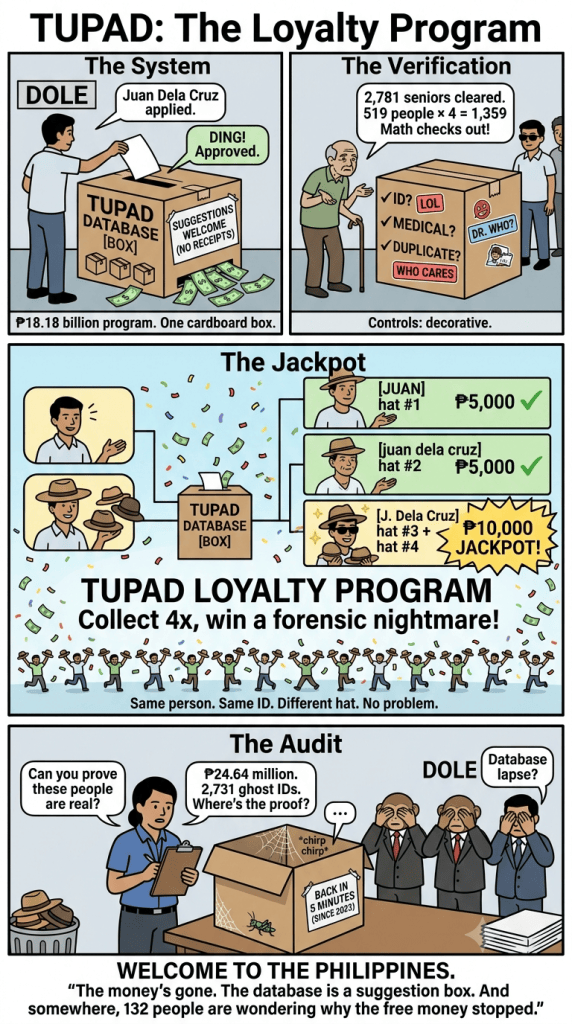
₱18.18 million in questionable payouts. 2,731 beneficiaries without valid IDs. 2,781 senior citizens with medical certificates from doctors who apparently don’t exist. ₱6.46 million in excess payments in Zamboanga. And in SOCCSKSARGEN, 519 people who somehow collected TUPAD assistance multiple times—330 twice, 57 three times, and a truly impressive 132 individuals who hit the jackpot four times.
That’s not a database error. That’s a loyalty program.
COA is careful: “inadvertent” inclusion, “lapses in the maintenance of the database.” The kindest reading is that DOLE’s verification system is held together with duct tape and the prayer that no one checks.
But here’s what I want to know: How many controls have to fail simultaneously before we stop calling it incompetence and start calling it something else?
The Anatomy of a Perfectly Useless Control System
A cash assistance program should have layers of protection: identification verification, eligibility screening, duplicate detection, work verification, payment authorization, post-audit reconciliation. DOLE had all of these on paper. In practice, they functioned about as well as a screen door on a submarine.
Take the senior citizens. DOLE Department Order No. 239, Series of 2023 requires senior citizens to submit a medical certificate from a licensed physician confirming they’re “fit to work.” This isn’t nitpicking—it’s basic safety. You’re sending elderly people to do manual labor. If they keel over, who’s liable?
COA found 2,781 senior citizens whose medical certificates “did not come from a licensed physician.” Not “the doctor was out of town.” The certificates weren’t from licensed physicians. Period.
Maybe every senior was actually healthy. Maybe the certificates were written by barangay health workers who forgot to stamp a Professional Regulation Commission (PRC) license number. Maybe.
But here’s the thing: When the government cannot prove a beneficiary was medically cleared to work, it cannot prove it wasn’t paying someone to do a job they were physically incapable of doing. That’s the difference between a social program and a slush fund.
The Zamboanga Excess: When “Database Lapse” Means “We Have No Idea What Happened”
₱6,463,150 in excessive payments to 1,275 beneficiaries in Zamboanga Peninsula. COA attributes this to “lapses in the maintenance of the database.”
Translation: The system supposed to track who got paid, how much, and whether they were entitled to it was broken. And nobody noticed until the auditors showed up.
The average excess is roughly ₱5,069 per beneficiary. That’s not a rounding error. That’s a systematic failure. And here’s what COA doesn’t answer: Did anyone check the database before the money went out? Because a database exists to be checked. If it fails 1,275 times, you either have a catastrophic Information Technology (IT) problem or a catastrophic oversight problem.
Or—just spitballing—you have people who realized a broken database is a convenient place to hide irregularities.
SOCCSKSARGEN: The Loyalty Program Nobody Authorized
In SOCCSKSARGEN, 330 people collected TUPAD twice, 57 three times, and 132 four times. That’s 1,359 payment instances for 519 people who should have received one each.
That’s 840 extra payments. At roughly ₱5,000 per beneficiary, potentially ₱4.2 million in duplicate payments in one region alone.
COA’s explanation? “Inadvertent” inclusion traced to “submission of different lists or inconsistencies in the identification details.”
Translation: Someone submitted Juan Dela Cruz on List A. Someone else submitted Juan dela Cruz on List B. A third submitted J. Dela Cruz on List C. The system—bless its heart—treated them as three different people.
This is the database equivalent of a bouncer who lets the same person in four times because he wore a different hat.
I’m not saying all 519 were master fraudsters. Some genuinely didn’t know they’d been enrolled multiple times. But someone submitted those lists. Someone approved those payments. And someone didn’t notice the same names showing up like a recurring nightmare.
This Isn’t New, and That’s the Problem
This is not a new problem.
In January 2025, COA flagged DOLE for the exact same issues in its 2023 audit. 887 beneficiaries received excessive payments totaling ₱4.9 million due to “lapses in the system.” Beneficiaries in the National Capital Region (NCR) used maiden names and married surnames to collect twice. In Ilocos, the system couldn’t detect duplicates due to “deficiencies in the control features of the TUPAD Online System.” In Davao, a worker tried to claim a payout in a different location before anyone caught on.
COA’s recommendation then? “Adopt an automated check/detection function to detect and flag possible duplication.”
That was two years ago. Since then, the problems have gotten worse. The 2025 findings show more beneficiaries, more money, and the same broken controls.
At this point, “we’re working on it” isn’t a response. It’s a confession.
The “Different Lists” Defense: A Forensic Nightmare
DOLE cites “submission of different lists” from intermediary organizations. Fine. That explains the mechanism. It does not explain the failure.
If your program relies on multiple external organizations submitting beneficiary lists, you need a master registry that cross-references all of them before payment. Otherwise, you’re not running a social protection program. You’re running a lottery where the same ticket can win multiple times.
The forensic questions write themselves:
- Did the same person appear with the same government ID across multiple lists? That’s not a glitch. That’s someone ignoring a match.
- Did the same bank account receive multiple payments for the same person? That’s money flowing to the same destination.
- Did any DOLE personnel manually override duplicate warnings? Who, and why?
COA’s report doesn’t answer these. But someone should.
The ₱18.18 Million Elephant in the Room
COA’s language is careful: “The audit team could not sufficiently determine whether the beneficiaries were indeed medically fit to perform the assigned work or whether the contracted services were actually rendered.”
Audit-speak for: We have no idea if these people actually worked, and the government has no evidence to prove they did.
Two possible explanations. Explanation A: Pure documentation failure—beneficiaries were genuine, worked, were qualified; field personnel just failed to collect paperwork. Administrative negligence, not fraud. Explanation B: Something worse—beneficiaries weren’t qualified, didn’t work, or don’t exist. The missing documents aren’t missing because of sloppy filing. They’re missing because they never existed.
I don’t know which is correct. Neither does COA—that’s the point. A government that cannot prove its beneficiaries were qualified cannot prove its beneficiaries were real. In a program disbursing billions in cash assistance, that’s a fundamental accountability failure.
The Political Dimension: TUPAD and the Patronage Machine
TUPAD is a massive program—₱18 billion in 2024, over 4 million beneficiaries. It’s highly visible, directly beneficial to individuals, and implemented through local intermediaries. That combination is a patronage politician’s dream.
The Commission on Elections (Comelec) has specifically flagged TUPAD as a potential vehicle for vote-buying and abuse of state resources. In 2025, Comelec reported cases of vote-buying and Abuse of State Resources (ASR) violations, with TUPAD named as a potential concern. Some DOLE regional offices voluntarily suspended payouts during the election period—a tacit acknowledgment that the program’s political neutrality was, at minimum, a perception problem.
I’m not saying the irregularities are evidence of systematic political manipulation. That would require evidence I don’t have. But: If you wanted to design a program vulnerable to patronage, you’d design something exactly like TUPAD. Decentralized implementation. Discretionary beneficiary selection. Large volumes. Cash payments. Weak central oversight.
COA found irregularities in Eastern Visayas, Davao, SOCCSKSARGEN, Caraga, and Zamboanga Peninsula. Are these regions with particular political dynamics? Are beneficiary lists concentrated in specific barangays or associated with specific local officials? COA doesn’t say. But those are exactly the questions a forensic investigation should answer.
What Comes Next: The Investigation DOLE Doesn’t Want
COA has recommended recovery. DOLE’s regional offices have “agreed to strictly enforce beneficiary validation and verification procedures.” Everyone is saying the right things.
But recovery alone doesn’t fix the problem. If DOLE recovers ₱6.46 million from Zamboanga but keeps the same broken database, the next audit will find the same issues with different zeros.
Here’s what a real investigation looks like:
Step 1: Beneficiary-level forensic audit. Not a sample. Every flagged beneficiary. Who are they? Are they real? Did they work? Did they receive money directly, or did someone else collect it?
Step 2: Payment trail analysis. Follow the money. Bank accounts. E-wallets. Cash withdrawals. Identify common recipients, common intermediaries, common patterns.
Step 3: Identity cross-referencing. Same name with different spellings? Same address? Same phone? Same government ID? Same bank account? Every match is a red flag.
Step 4: Accountability mapping. Who approved each questionable payment? Who certified the lists? Who entered the data? Who had authority to override controls, and did they?
Step 5: Database forensics. Was the TUPAD Online System capable of detecting duplicates? If so, why didn’t it? If not, why was it deployed for a program of this scale? Who designed it, who tested it, and who signed off on its adequacy?
The Bottom Line
COA’s findings do not prove ₱24.64 million was stolen. They do not prove DOLE officials committed graft. They do not prove beneficiaries were ghosts.
What they prove is this: The Philippine government cannot reliably track who receives TUPAD assistance, how much they receive, or whether they’re entitled to it.
That’s a scandal regardless of whether anyone goes to jail.
Because whether through incompetence, negligence, or design, public money that cannot be accounted for is public money that has been lost. And when the program is supposed to help the poorest and most vulnerable workers—people who genuinely need emergency employment to survive—the cost isn’t just financial.
It’s moral.
DOLE now has a choice. Treat this as a paperwork problem, issue some memos, recover some money, and wait for the next audit to find the same issues. Or treat this as what it is: a systemic failure that requires forensic investigation, accountability, and fundamental reform.
I know which choice I’d bet on.
But then again, I’ve been watching Philippine governance for a while now. And I’ve learned that the safest bet is always on the government finding new and creative ways to disappoint.
Mga ka-kweba, the cave is open. The money is gone. The database is a suggestion box. And somewhere, 132 people in SOCCSKSARGEN are wondering why the government stopped sending them free money.
Welcome to the Philippines.
Key Citations
A. Reports & Studies
- Commission on Audit. Annual Audit Reports. Commission on Audit, https://www.coa.gov.ph/reports/annual-audit-reports/.
- Department of Labor and Employment. “Department Order No. 239-23 Guideline in the Implementation of the Department of Labor and Employment Integrated Livelihood and Emergency Employment Program (DILEEP).” Bureau of Working Conditions, 2023, https://bwc.dole.gov.ph/issuances/department-orders/.
B. News Articles
- “COA Finds Irregularities in TUPAD Payouts in 2025.” Rappler, 11 Sept. 2026, https://www.rappler.com/philippines/national-news/coa-finds-irregularities-department-labor-tupad-payouts-2025/.
- “CoA Questions P19-M DoLE Receipts.” BusinessWorld, 10 Sept. 2026, https://bworldonline.com/the-nation/2026/09/10/776106/coa-questions-p19-m-dole-receipts/.
- Mangaluz, Jean. “COA Flags DOLE’s TUPAD Program for Unqualified, Two-Time Recipients.” Philstar.com, 26 Dec. 2024, https://www.philstar.com/headlines/2024/12/26/2409945/coa-flags-dole-program-unqualified-beneficiaries-two-time-recipients.
- Santos, Tina. “Gatchalian: 1M Fewer Tupad Beneficiaries Due to Budget Cut.” Inquirer.net, 22 Oct. 2025, https://newsinfo.inquirer.net/2128507/gatchalian-1m-fewer-tupad-beneficiaries-due-to-budget-cut.
- Bermudez, Patricia Mae, and Mae Muñoz. “Cash Aid Distribution 10 Days Before Elections Is Vote Buying — Comelec.” Philippine Information Agency, 6 Mar. 2025, https://pia.gov.ph/news/luzon/calabarzon/cash-aid-distribution-10-days-before-elections-is-vote-buying-comelec/.
- Patinio, Ferdinand. “Abusing State Resources During Elections More Insidious – Poll Exec.” Philippine News Agency, 6 June 2025, https://www.pna.gov.ph/articles/1251657.
- Ladiao, Ma. Theresa. “Use of TUPAD Beneficiaries for Campaign Violates Election Rules, Says Comelec.” Panay News, 27 Mar. 2025, https://www.panaynews.net/use-of-tupad-beneficiaries-for-campaign-violates-election-rules-says-comelec/.
C. Official Websites
- Commission on Audit. Commission on Audit, https://www.coa.gov.ph/.
- Department of Labor and Employment. Department of Labor and Employment, https://www.dole.gov.ph/.
- Commission on Elections. Commission on Elections, https://comelec.gov.ph/.
- Professional Regulation Commission. Professional Regulation Commission, https://www.prc.gov.ph/.

- “Ang Hirap Maging Mahirap”: The PAO Scandal That Proves Government Contempt Is Nothing New
- “Far-Off” My Axx: Malacañang’s Claire Castro Drowns in Her Own Legal Gaslighting
- “Forthwith” to Farce: How the Senate is Killing Impeachment—And Why Enrile’s Right (Even If You Can’t Trust Him)
- “HINDI AKO NAG-RESIGN!”

- “I Know Nothing”: Baste Duterte’s Amnesia Defense Meets ₱33M in GenCorp Contracts

- “I’m calling you from my new Globe SIM. Send load!”

- “Mahiya Naman Kayo!” Marcos’ Anti-Corruption Vow Faces a Flood of Doubt

- “Manageable” Debt, Unmanageable Lies: DBM’s ₱21 Trillion Fairy Tale
- “Meow, I’m calling you from my new Globe SIM!”

- “Natrabaho”: One Word, One Ombudsman, and a Judiciary on Trial
- “No Special Jail for Crooks!” Boying Remulla Slams VIP Perks for Flood Scammers
- “Philippine-Controlled” or Yankee Gas Station? The Davao Fuel Depot Farce Exposed



Leave a Reply