No More Safe Haven Rhetoric – Remulla’s Flood Scandal Billions Chase Goes Global
By Louis “Barok” C. Biraogo — June 29, 2026
The Same Old Song—Or Has the Band Finally Shown Up?
So here we are again.
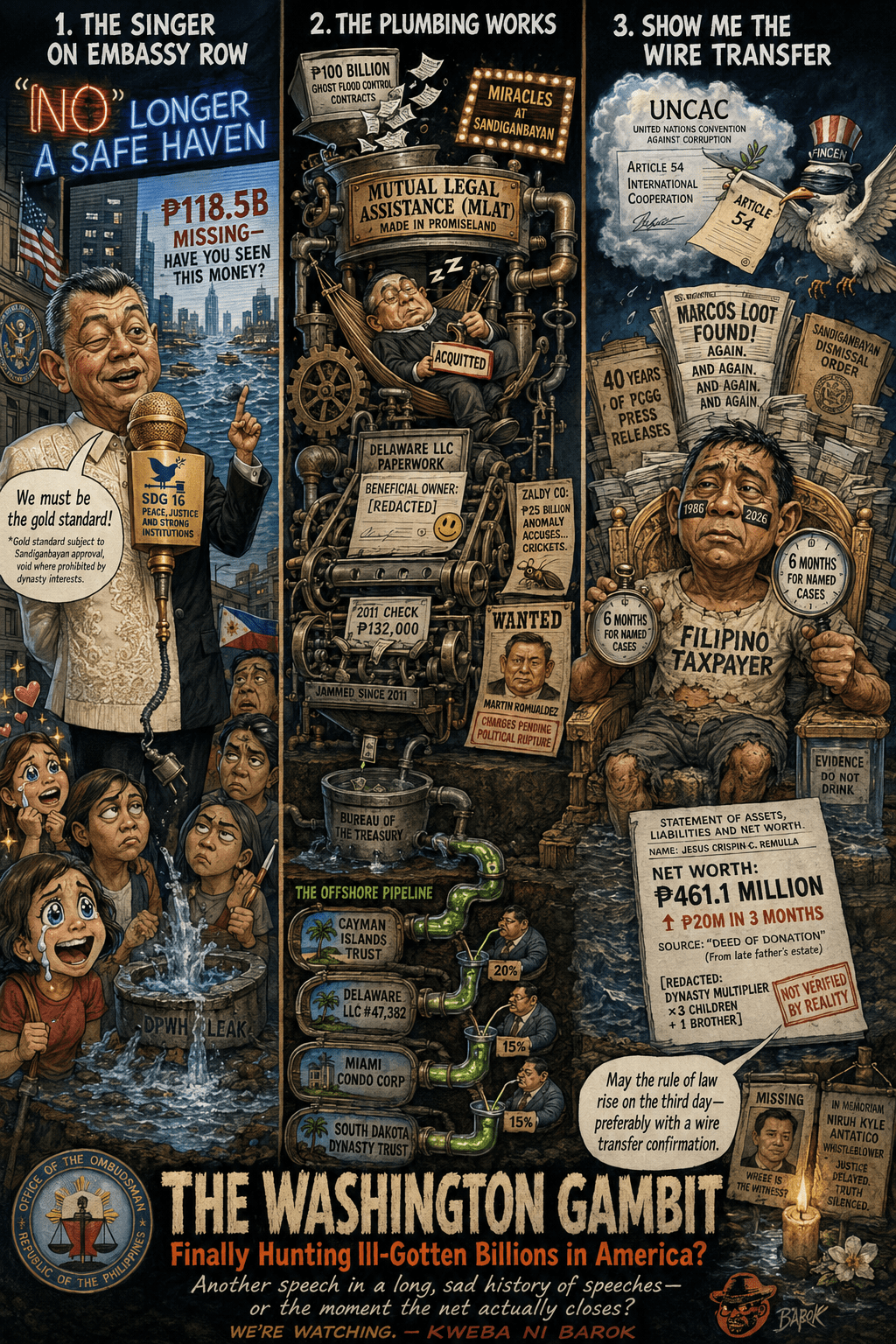
Another Philippine official, standing on foreign soil, promising to bring back the stolen billions. The Filipino community in Washington, D.C. nodded politely on June 22 as Ombudsman Jesus Crispin “Boying” Remulla declared the United States “no longer a safe haven for ill-gotten wealth from the Philippines.” Cue the patriotic stirrings. Cue the skeptical eye-rolls. Cue the collective national memory of every single time we’ve heard this song before—a greatest hits album spanning four decades, from the Presidential Commission on Good Government (PCGG)‘s 1986 mandate to every Ombudsman who ever held a press conference.
The difference this time? There might actually be a band behind the singer.
Let’s get one thing straight before the cynics sharpen their knives: Remulla’s Washington vow is not the empty-calorie rhetoric we’ve been force-fed since the Marcos era. The man didn’t just parachute into Embassy Row for a photo op. He arrived fresh from the 7th Global Conference on Sustainable Development Goal 16 (SDG 16) at the United Nations, where he discussed the multi-billion-peso flood control scandal that has already produced actual consequences—asset freezes, travel bans, Sandiganbayan indictments, and the glorious spectacle of sitting senators and a former House Speaker scrambling for legal cover. This is not a fishing expedition. This is a man holding a net already heavy with catch, looking for the ones that slipped offshore.

Discretion Is Not Evasion—But the Skeptics Have Receipts
The critics—and oh, they are legion—will point to the obvious. Remulla named no names. He cited no case numbers. He waved at no frozen Manhattan penthouse. “Where’s the beef?” they’ll demand, conveniently ignoring that announcing your targets before you’ve transmitted a formal Mutual Legal Assistance Treaty request is the prosecutorial equivalent of texting the burglars to let them know you’ve called the cops. Discretion isn’t evasion. It’s the difference between recovering assets and watching them vanish into a Cayman Islands trust while your press release is still trending.
But let’s not pretend the skepticism comes from nowhere. This is the Philippines, after all—a country where the PCGG has spent forty years chasing an estimated $5-10 billion in Marcos-era loot and recovered a fraction so small you’d need a microscope to find it on the national balance sheet. This is a jurisdiction where the Sandiganbayan’s conviction rate in pork-barrel and fertilizer-fund cases has been so abysmal that Remulla himself has publicly called the judiciary “one package” with the corruption it’s supposed to cure. When your own Ombudsman is trash-talking the courts, you know the accountability pipeline has more leaks than a DPWH flood control project.
The Flood Control Black Hole: Billions Vanished While Cities Drowned
Speaking of which: let’s talk about those flood control projects. Finance Secretary Ralph Recto told the Senate that the economy lost between ₱42.3 billion and ₱118.5 billion to ghost infrastructure from 2023 to 2025. That’s not a typo. That’s enough money to build actual flood control systems that might have prevented the seasonal drowning of Metro Manila, except the funds apparently went to politicians’ pockets, contractors’ shell companies, and—if Remulla’s instincts are correct—American real estate, bank accounts, and the occasional LLC registered in Delaware, which asks fewer questions about beneficial ownership than a Tinder date asks about your marital status.
Here’s how the grift works, for those who haven’t been paying attention. Corrupt official awards inflated contract to crony contractor. Crony contractor kicks back percentage to official. Official, not being an idiot, doesn’t deposit cash at BDO under “ILL-GOTTEN WEALTH—DO NOT AUDIT.” Instead, the money flows through a daisy chain of shell corporations, often registered in secrecy-friendly US states like Delaware, Nevada, or South Dakota, where you can form an LLC with less identification than it takes to get a library card. That LLC buys a condo in Miami, a house in Los Angeles, or just parks cash in an American bank account where the IRS and FinCEN are theoretically watching but practically overwhelmed. The official’s name appears nowhere. The paper trail dead-ends at a nominee director who may or may not exist. And unless someone with subpoena power connects the Philippine corruption case to the American asset, that money is as good as gone.

Treaties with Teeth: The MLAT and UNCAC Arsenal
This is the system Remulla has vowed to dismantle. And unlike his predecessors, he actually has the legal architecture to try.
The Treaty Between the Government of the United States of America and the Government of the Republic of the Philippines on Mutual Legal Assistance in Criminal Matters (MLAT), signed at Manila on November 13, 1994 isn’t decorative diplomacy. Article 1(g) explicitly covers “proceedings related to forfeiture of assets, restitution, and collection of fines.” Article 16 obligates both parties to assist in immobilizing proceeds and contemplates the actual transfer of recovered assets back to the requesting state. This isn’t theoretical—in 2011, the US Embassy handed a $132,000 check to then-Justice Secretary Leila de Lima, representing the first successful forfeiture-proceeds return under the treaty. It was small, yes. But it proved the plumbing works.
Layered atop the MLAT is the United Nations Convention against Corruption (UNCAC), whose Chapter V makes asset recovery a “fundamental principle” of international anti-corruption law. Article 51 demands the “widest measure of cooperation.” Article 54 pushes states toward non-conviction-based confiscation—a godsend when your domestic prosecution is crawling through the Sandiganbayan at the speed of a Manila traffic jam. Article 57 generally requires return of embezzled public funds to the requesting state. Remulla’s SDG 16 framing wasn’t diplomatic theater; it was anchoring a bilateral ask in a multilateral framework that makes it harder for Washington to treat the request as a favor rather than an obligation.
The Supreme Court Has Already Built the Predicate
And on the US side, the tools are real. The Department of Justice’s Kleptocracy Asset Recovery Initiative has taken down assets linked to Equatorial Guinea’s Teodoro Nguema Obiang, Malaysia’s 1MDB scandal, and Nigeria’s Sani Abacha. US civil forfeiture under 18 U.S.C. § 981 operates in rem—against the asset itself, not the owner—and requires only a preponderance of evidence, not a criminal conviction. The Corporate Transparency Act, flawed as its implementation has been, at least theoretically requires beneficial ownership disclosure to FinCEN. The AMLC, through its Egmont Group membership, can share financial intelligence with US counterparts without waiting for diplomatic niceties.
The Supreme Court has done its part too. In Republic v. Sandiganbayan (G.R. No. 152154, July 15, 2003), the Court affirmed that wealth “manifestly and patently disproportionate” to lawful income creates a presumption of ill-gotten acquisition under Republic Act No. 1379 (An Act Declaring Forfeiture in Favor of the State Any Property Found to Have Been Unlawfully Acquired by Any Public Officer or Employee and Providing for the Proceedings Therefor)—the same statute Remulla can use to go after assets parked in relatives’ names. In Heirs of Ligot v. Republic (G.R. Nos. 257827 et al., March 5, 2025), the Court just this year reinforced that registration under third-party names doesn’t defeat the forfeiture presumption. These precedents matter because they’re the domestic predicate that any US forfeiture action will scrutinize. A strong Philippine judgment makes an American seizure exponentially easier.
The Messenger Problem and the Credibility Gap
Now, the counterarguments. Let’s air them fairly, because the cynics aren’t entirely wrong.
First, the messenger problem. Remulla’s own SALN declared a net worth of ₱461.1 million as of April 2026—up ₱20 million in three months. The increase is documented: a Deed of Donation from his late father’s estate, stock and property sales. No one has alleged illegality. But when the man tasked with auditing everyone else’s wealth is himself a near-half-billion-peso man, the optics are about as subtle as a cockfight in a cathedral. Add the family dynasty factor—brother Jonvic as DILG Secretary, three children holding Cavite elective posts—and you have a credibility vulnerability that defense lawyers and political opponents will exploit until the cows come home. The Remullas aren’t corrupt because they’re a dynasty, but dynasties sure do make it hard to convince the public you’re an impartial corruption fighter.
Second, the historical base rate. The PCGG had a dedicated commission, a presidential mandate, and forty years. It recovered perhaps 10-15% of the Marcos fortune. What makes Remulla think his general-jurisdiction Ombudsman’s office, juggling 209 flood-control complaints and countless other cases, will outperform that record? The honest answer: nothing guarantees it. Asset recovery is hard, slow, and expensive. The US will demand evidence. Defense lawyers will litigate every step. Assets will move. Witnesses will disappear—Orly Guteza, the retired Marine who testified about cash-filled suitcases, has been missing since September 2025. Niruh Kyle Antatico, who exposed NIA corruption, is dead. This is not a business for the faint-hearted.
Third, the political selectivity specter. Martin Romualdez—the President’s cousin—is among the accused, but charges came only after a visible political rupture. Senator Jinggoy Estrada and Senator Chiz Escudero face PHDOs, but other administration allies appear untouched. Zaldy Co, who accused Marcos himself of receiving ₱25 billion in kickbacks, fled abroad and his case hasn’t exactly been the Ombudsman’s top priority. Critics smell selective prosecution. They might not be wrong.
Partial Success Beats Cynical Resignation—If We Actually Push
So where does that leave us?
The most likely outcome is partial success: some MLAT requests honored, some accounts frozen, some assets eventually repatriated—but nowhere near the full extent of what was stolen. The comprehensive kleptocracy takedown that SDG 16 imagines remains aspirational. The full-cycle success story—named cases, US forfeiture actions, billions returned—is a low-probability event given historical precedent and institutional constraints.
But here’s the thing: partial success is still success. The 2011 check was only $132,000, but it established a precedent. Every asset frozen abroad is an asset not funding a politician’s next campaign. Every US forfeiture action is a warning to the next corrupt official that Delaware LLCs aren’t invisibility cloaks. Every MLAT request that survives US judicial scrutiny strengthens the bilateral norm that the Philippines isn’t just asking for favors—it’s asserting legal rights under a treaty its partner signed in good faith.
The Remulla family’s dynastic entanglements are real, and this platform has never shied from calling them out. The SALN optics are real. The Sandiganbayan’s conviction problem is real. But perfect should not be the enemy of progress, and the flood-control scandal’s victims—the Filipino taxpayers who lost up to ₱118.5 billion while their cities drowned—deserve more than cynical resignation dressed up as sophistication.
Ombudsman Remulla is right about one thing that matters more than his net worth or his family tree: moments of exposed weakness can become moments of reform. The flood-control scandal has exposed the putrid innards of Philippine infrastructure corruption. The question is whether the accountability pipeline—from Ombudsman investigation to Sandiganbayan conviction to MLAT request to US forfeiture to peso repatriation—can actually deliver consequences this time.
The legal architecture exists. The domestic cases are filed. The international framework is operational. What remains is the political will to pursue the powerful without fear or favor, and the institutional competence to convert 209 complaints into airtight convictions that American courts will respect.
I’m not holding my breath. But for the first time in a long time, I’m not dismissing the vow either.
Marching Orders: From Press Release to Wire Transfer
Recommendations:
- The Ombudsman must immediately formalize specific MLAT requests with the US Department of Justice, targeting identifiable assets with evidence packages robust enough to survive US judicial scrutiny. General vows don’t freeze bank accounts—particularized requests do.
- Congress must pass automatic bank secrecy waiver legislation (like the stalled HB 7861) for all public officials. It is obscene that in 2026, Philippine anti-corruption investigators still need to fight through Republic Act No. 1405 (Law on Secrecy of Bank Deposits) and Republic Act No. 6426 (Foreign Currency Deposit Act) protections that corrupt officials wield as shields.
- The AMLC should establish a dedicated international asset recovery unit with FinCEN liaison capacity, funded adequately and insulated from political pressure.
- The Supreme Court should issue rules expediting Sandiganbayan corruption cases, because every year of delay is a year defense lawyers use to move assets, intimidate witnesses, and wait out the political calendar.
- The Filipino diaspora—whom Remulla rightly called “partners”—should organize monitoring mechanisms with concrete benchmarks: named cases within six months, formal MLAT requests within a year, and publicly reported outcomes. Trust but verify, because four decades of disappointment have earned us the right to demand receipts.
The United States must decide whether it is genuinely committed to SDG 16.4’s mandate to “significantly reduce illicit financial flows” or whether its financial secrecy architecture—Delaware LLCs, real estate opacity, overworked FinCEN analysts—will continue to shelter the world’s kleptocrats. The Philippines is offering Washington an opportunity to match its rhetoric with action. Whether the State Department and DOJ seize it will tell us more about American commitment to the rule of law than a hundred UN speeches.
As for Remulla: you’ve made your vow, Ombudsman. Now deliver the goods. The Filipino people have been patient. They have been hopeful. They have been disappointed. They will not be fooled again by a press release dressed in the language of sustainable development. Show us the frozen accounts. Show us the forfeiture complaints. Show us the checks being deposited in the Bureau of Treasury. Because until the money comes home, your Washington gambit is just another speech in a long, sad history of speeches.
We’re watching.
May the rule of law rise on the third day—preferably with a wire transfer confirmation.
Louis “Barok” C. Biraogo is the publisher of Kweba ni Barok, a blog devoted to the proposition that Philippine governance can be improved through merciless scrutiny, relentless mockery, and the occasional citation of actual laws. He has been disappointed by every Ombudsman since 1989 and would love to be surprised.
Key Citations
A. Legal & Official Sources
- Executive Order No. 1, s. 1986. Creating the Presidential Commission on Good Government. Official Gazette of the Republic of the Philippines, 28 Feb. 1986, http://www.officialgazette.gov.ph/1986/02/28/executive-order-no-1-s-1986/.
- Heirs of Ligot v. Republic, G.R. Nos. 257827, 257940, 258109, 259593. Supreme Court of the Philippines, 5 Mar. 2025. Lawphil, lawphil.net/judjuris/juri2025/mar2025/gr_257827_2025.html.
- Republic Act No. 1379. An Act Declaring Forfeiture in Favor of the State Any Property Found to Have Been Unlawfully Acquired by Any Public Officer or Employee and Providing for the Proceedings Therefor. 18 June 1955. Lawphil, lawphil.net/statutes/repacts/ra1955/ra_1379_1955.html.
- Republic Act No. 1405. An Act Prohibiting Disclosure or Inquiry into, or Examination of, Deposits with Banking Institutions and Providing Penalty Therefor (Law on Secrecy of Bank Deposits). 9 Sept. 1955. Lawphil, lawphil.net/statutes/repacts/ra1955/ra_1405_1955.html.
- Republic Act No. 6426. An Act Amending Certain Provisions of Republic Act Numbered One Thousand Four Hundred Five, as Amended, Otherwise Known as the Law on Secrecy of Bank Deposits (Foreign Currency Deposit Act). 4 Apr. 1974. Lawphil, lawphil.net/statutes/repacts/ra1974/ra_6426_1974.html.
- Republic v. Sandiganbayan, G.R. No. 152154. Supreme Court of the Philippines, 15 July 2003. Lawphil, lawphil.net/judjuris/juri2003/jul2003/gr_152154_2003.html.
- Treaty Between the Government of the United States of America and the Government of the Republic of the Philippines on Mutual Legal Assistance in Criminal Matters, signed at Manila on 13 Nov. 1994. 104th Congress, Treaty Doc. 104-18, http://www.congress.gov/treaty-document/104th-congress/18.
- United Nations Convention against Corruption, adopted 31 Oct. 2003, entered into force 14 Dec. 2005. UNCAC Coalition, uncaccoalition.org/the-uncac/united-nations-convention-against-corruption/.
B. News Reports
- Ombudsman of the Philippines. “OMB Remulla Meets Filipinos in Washington, DC; Highlights Institutional Reforms and Accountable Governance.” Press Release, 26 June 2026, http://www.ombudsman.gov.ph/?p=133767.
- Cruz, RG. “PH Economy Lost Over P100-B to ‘Ghost’ Flood Control Projects from 2023-2025: Recto.” ABS-CBN, 2 Sept. 2025, http://www.abs-cbn.com/news/business/2025/9/2/ph-economy-lost-over-p100-b-to-ghost-flood-control-projects-from-2023-2025-recto-1859.
- Carreon, Jire. “Ombudsman Remulla: Corruption in Judiciary Also ‘Severe’.” Rappler, 3 Jan. 2026, http://www.rappler.com/philippines/ombudsman-boying-remulla-corruption-judiciary-severe/.
- United States Department of Justice. “Justice Department Recovers an Additional $20M in Misappropriated 1MDB Funds.” Office of Public Affairs, 17 Jan. 2025, http://www.justice.gov/archives/opa/pr/justice-department-recovers-additional-20m-misappropriated-1mdb-funds.
- “Ang Hirap Maging Mahirap”: The PAO Scandal That Proves Government Contempt Is Nothing New

- “Far-Off” My Axx: Malacañang’s Claire Castro Drowns in Her Own Legal Gaslighting
- “Forthwith” to Farce: How the Senate is Killing Impeachment—And Why Enrile’s Right (Even If You Can’t Trust Him)

- “HINDI AKO NAG-RESIGN!”

- “I Know Nothing”: Baste Duterte’s Amnesia Defense Meets ₱33M in GenCorp Contracts

- “I’m calling you from my new Globe SIM. Send load!”

- “Mahiya Naman Kayo!” Marcos’ Anti-Corruption Vow Faces a Flood of Doubt

- “Manageable” Debt, Unmanageable Lies: DBM’s ₱21 Trillion Fairy Tale
- “Meow, I’m calling you from my new Globe SIM!”

- “Natrabaho”: One Word, One Ombudsman, and a Judiciary on Trial
- “No Special Jail for Crooks!” Boying Remulla Slams VIP Perks for Flood Scammers

- “Philippine-Controlled” or Yankee Gas Station? The Davao Fuel Depot Farce Exposed




Leave a Reply