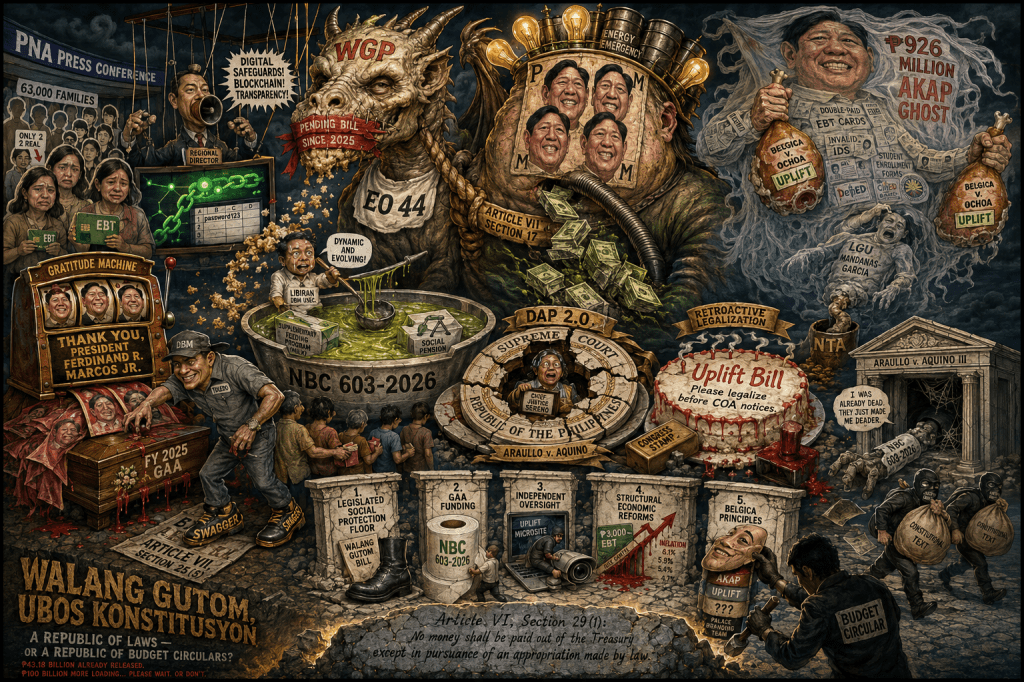
A ₱155-billion buffet of budget circulars, executive orders, and the legislative corpse left on the plate.
By Louis ‘Barok‘ C. Biraogo — July 25, 2026
THE PNA report from Legazpi City is a masterpiece of bureaucratic stagecraft. Sixty-three thousand Bicol families clutching Electronic Benefit Transfer (EBT) cards, two tearful mothers thanking “President Ferdinand R. Marcos Jr.” by name, and a regional director rattling off digital safeguards as if blockchain had descended upon the Department of Social Welfare and Development (DSWD). It is the kind of feel‑good copy that makes editors yawn and copy‑desks hit “publish” without asking the only question that matters: Who wrote the check, and under what authority?
The answer, buried under a mountain of press releases and one deceptively bland budget circular, is that the ₱155‑billion UPLIFT architecture — the vast cash‑spigot behind those grateful faces — is a constitutional train wreck waiting for a Supreme Court petition. Let us conduct the autopsy.
The Two-Headed Beast
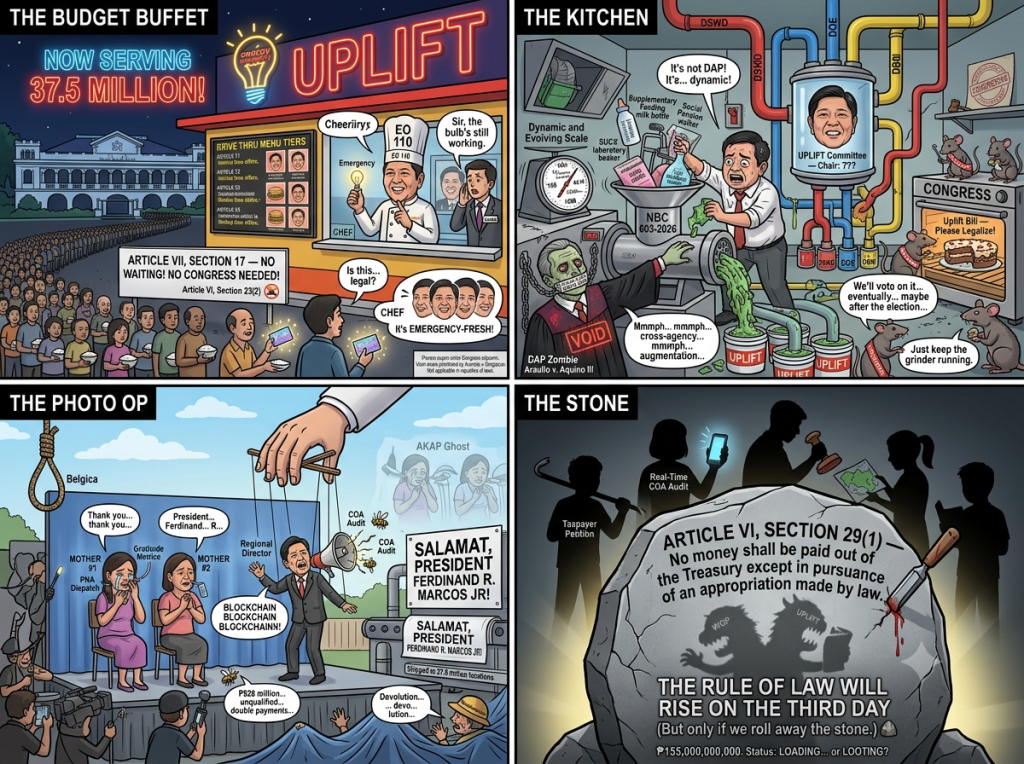
The Walang Gutom Program (WGP) is the older, narrower scheme: ₱3,000 a month in restricted food credits under Executive Order No. 44 (Walang Gutom 2027: Food Stamp Program). It has no permanent statute, hobbling along on annual appropriations and a pending institutionalization bill that has languished since 2025. UPLIFT, by contrast, is the new monster. Hatched in March 2026 via Executive Order No. 110 (UPLIFT), it declares a national energy emergency and “adopts” a whole‑of‑government relief framework that scoops WGP’s beneficiary list into a three‑tiered cash‑transfer machine aiming at 37.5 million people. The legal glue? Article VII, Section 17 of the Constitution and Section 25 of the Department of Energy Act (Republic Act No. 7638) — a flimsy statutory hook the administration chose precisely because it avoids the automatic‑sunset discipline of Article VI, Section 23(2). That provision exists for a reason: when the President exercises extraordinary powers in a national emergency, Congress must authorize them by law, and those powers die the moment Congress adjourns unless renewed. The Supreme Court enforced this with razor clarity in Araneta v. Dinglasan and Rodriguez v. Gella. Yet EO 110 mentions none of it. Instead, the Palace gave itself a year‑long, self‑extendable blank check dressed up as an energy‑crisis response — a clever bit of executive lawyering that transforms a constitutional safeguard into an inconvenient formality.
The Funding Mechanism: DAP 2.0, with a Bow
Now the real fun begins. On May 4, 2026, Acting Budget Secretary Rolando Toledo issued National Budget Circular No. 603-2026, ordering all agencies, Government-Owned and Controlled Corporations (GOCCs), and State Universities and Colleges (SUCs) to identify “unobligated allotments” from the expiring FY 2025 General Appropriations Act (GAA), declare them savings, and surrender them for UPLIFT. No supplemental appropriation. No specific line item. Just a circular. Department of Budget and Management (DBM) Undersecretary Goddes Hope Libiran called the ₱155‑billion target “dynamic and evolving.” In plain English: We’ll sweep whatever we find, repurpose it, and hope Congress retroactively approves the mess later.
If this sounds familiar, it is because the Supreme Court gutted precisely this mechanism in Araullo v. Aquino III (the DAP case). The Court held that (1) unobligated allotments cannot be declared “savings” mid‑year unless the activity is genuinely completed or abandoned, and (2) cross‑agency transfers of savings violate Article VI, Section 25(5), which confines the President’s augmentation power to his own office’s appropriations. NBC 603‑2026 violates both prongs with the swagger of a pickpocket at a funeral. It raids FY 2025 allotments — including the Supplementary Feeding Program and the Social Pension for Indigent Senior Citizens — before the fiscal year is even closed, and pools them across multiple departments under a centrally commanded UPLIFT Committee chaired by the President himself. The DBM has already released ₱43.18 billion this way, bypassing Congress, the GAA, and the constitutional command that “no money shall be paid out of the Treasury except in pursuance of an appropriation made by law” (Article VI, Section 29(1)).
Worse, Malacañang has submitted an “Uplift bill” to Congress specifically to “ensure the legality” of the savings‑tapping. Translation: We are spending the money now; please legalize it retroactively before Commission on Audit (COA) or the Court notices. This is not governance; it is a legislative alibi bought on credit.
The Arguments — For and Against — Rendered Moot by the Smell of Pork
Proponents will tell you the emergency is real (true, oil prices spiked), the EBT system reduces leakage (true, WGP’s closed-loop design is an improvement), and beneficiaries genuinely need the relief (true, rice prices are devouring household budgets). They will even note that an Uplift microsite provides transparency, which is like a thief installing a security camera after the heist.
But the same proponents conveniently ignore the constitutional arson at the program’s core. They also ignore the cold reality that UPLIFT is less a social‑protection framework than an incumbent‑branding operation on steroids. The PNA dispatch is a case study: a DSWD press release that names the President four times in gratitude, as if the aid were a personal gift from Malacañang rather than a taxpayer‑funded entitlement. This is the Ayuda sa Kapos ang Kita Program (AKAP) pattern on a national scale — legislator “endorsements,” tarpaulin politics, and the systematic blurring of institutional aid into personal political capital, precisely what the Belgica ruling outlawed when it declared the Priority Development Assistance Fund unconstitutional. The COA already found that AKAP’s ₱926 million in 2024 went to unqualified recipients and ghost beneficiaries, yet here we are, scaling the same model to 37 million people with even weaker legal footing.
UPLIFT’s design also centralizes credit at the expense of local governments, thumbing its nose at the Mandanas‑Garcia ruling that devolved social‑welfare delivery to Local Government Units (LGUs) precisely so that aid would be less politicized. Instead, the national government siphons National Tax Allotment (NTA)‑augmented local budgets upward, then sends the cash back down wrapped in the President’s face. Devolution, meet recentralization by EO.
The Non‑Negotiable Framework — Because Band-Aids on Bullet Wounds Are Still Band-Aids
Any relief architecture that aspires to be more than an election‑cycle slush fund must rest on five pillars.
- First, a legislated, permanent social protection floor. The Walang Gutom bill has to pass, and it must enshrine the right to food as a justiciable entitlement, not a flagship subject to the next president’s whims.
- Second, adequate, predictable funding through the General Appropriations Act — no more mid‑year circular alchemy that treats “savings” as an executive slush fund.
- Third, independent oversight with genuine civil‑society participation; the Uplift microsite is a start, but nothing replaces a multi‑sectoral audit body empowered to subpoena DBM’s savings ledgers in real time.
- Fourth, structural economic reforms — a living wage, agricultural productivity investments, and employment pathways — because a ₱3,000 EBT card does not cure hunger when the rice it buys is priced out of reach by the same government’s failure to dismantle cartels.
- Fifth, strict enforcement of Belgica principles to block any revival of the pork barrel, whether it wears the mask of AKAP, UPLIFT, or the next acronym the Palace’s branding team dreams up.
Demands, Not Prayers
Let the Commission on Audit open an immediate real‑time audit of every agency’s savings declaration under NBC 603‑2026. Let the Supreme Court, when a taxpayer inevitably petitions, treat this as Araullo reincarnate and issue a temporary restraining order before another ₱100 billion vanishes into the maw of pre‑election patronage. Let Congress exercise its power of the purse by amending the Uplift bill to close the cross‑agency transfer loophole permanently, not rubber‑stamp a retroactive legalization that makes a mockery of Article VI. Let local governments reclaim their devolved mandate and demand that aid flow through their accountable structures, not through Malacañang’s photo‑op machinery. And let civil society track every peso — because the only thing more obscene than a hungry child in a middle‑income country is a hungry child whose government spent the rice money on a campaign jingle.
Above all, let the youth see this moment for what it is: a choice between a republic of laws and a republic of budget circulars. The 1987 Constitution did not emerge from EDSA so that a President could fund a ₱155‑billion political machine with a memo. We demand genuine public service, pro‑people governance, and a social protection system that feeds the hungry without fattening dynasties.
The rule of law will rise on the third day — but only if we roll away the stone. 🪨
Key Citations
A. Legal & Official Sources
- The 1987 Constitution of the Republic of the Philippines. Official Gazette of the Republic of the Philippines, 1987, http://www.officialgazette.gov.ph/constitutions/1987-constitution/.
- Executive Order No. 44. Establishing the “Walang Gutom 2027: Food Stamp Program” as a Flagship Program of the National Government. 12 Oct. 2023, lawphil.net/executive/execord/eo2023/eo_44_2023.html.
- Executive Order No. 110. Declaring a State of National Energy Emergency and Authorizing the Unified Package for Livelihoods, Industry, Food, and Transport. 24 Mar. 2026, lawphil.net/executive/execord/eo2026/eo_110_2026.html.
- National Budget Circular No. 603. Adoption of Economy Measures in View of the Declaration of a State of National Energy Emergency under Executive Order No. 110, s. 2026. Department of Budget and Management, 4 May 2026, http://www.dbm.gov.ph/wp-content/uploads/Issuances/2026/National-Budget-Circular/NATIONAL-BUDGET-CIRCULAR-NO.-603.pdf.
- Republic Act No. 7638. An Act Creating the Department of Energy, Rationalizing the Organization and Functions of Government Agencies Related to Energy, and for Other Purposes. 9 Dec. 1992, lawphil.net/statutes/repacts/ra1992/ra_7638_1992.html.
- Araneta v. Dinglasan. G.R. No. L-2044, 26 Aug. 1949, lawphil.net/judjuris/juri1949/aug1949/gr_l-2044_1949.html.
- Rodriguez v. Gella. G.R. No. L-6266, 28 Feb. 1953, lawphil.net/judjuris/juri1953/feb1953/gr_l-6266_1953.html.
- Araullo v. Aquino III. G.R. No. 209287, 1 July 2014, lawphil.net/judjuris/juri2014/jul2014/gr_209287_2014.html.
- Belgica v. Ochoa. G.R. No. 208566, 19 Nov. 2013, lawphil.net/judjuris/juri2013/nov2013/gr_208566_2013.html.
- Mandanas v. Ochoa (Mandanas-Garcia ruling). G.R. No. 199802, 10 Apr. 2019, lawphil.net/judjuris/juri2019/apr2019/gr_199802_2019.html.
B. News Reports
- Calipay, Connie. “Walang Gutom, UPLIFT programs ease burden for 63K Bicol families.” Philippine News Agency, 24 July 2026, http://www.pna.gov.ph/articles/1280258.
- “P926 million in AKAP funds go to unqualified recipients, double payments — COA.” Rappler, 22 Dec. 2025, http://www.rappler.com/philippines/audit-dswd-akap-program-2024-unqualified-recipients-double-payments/.




Leave a Reply