One Year After Marcos Lit the Fuse, the Only Thing That Exploded Was Public Patience
By Louis ‘Barok’ C Biraogo — July 25, 2026
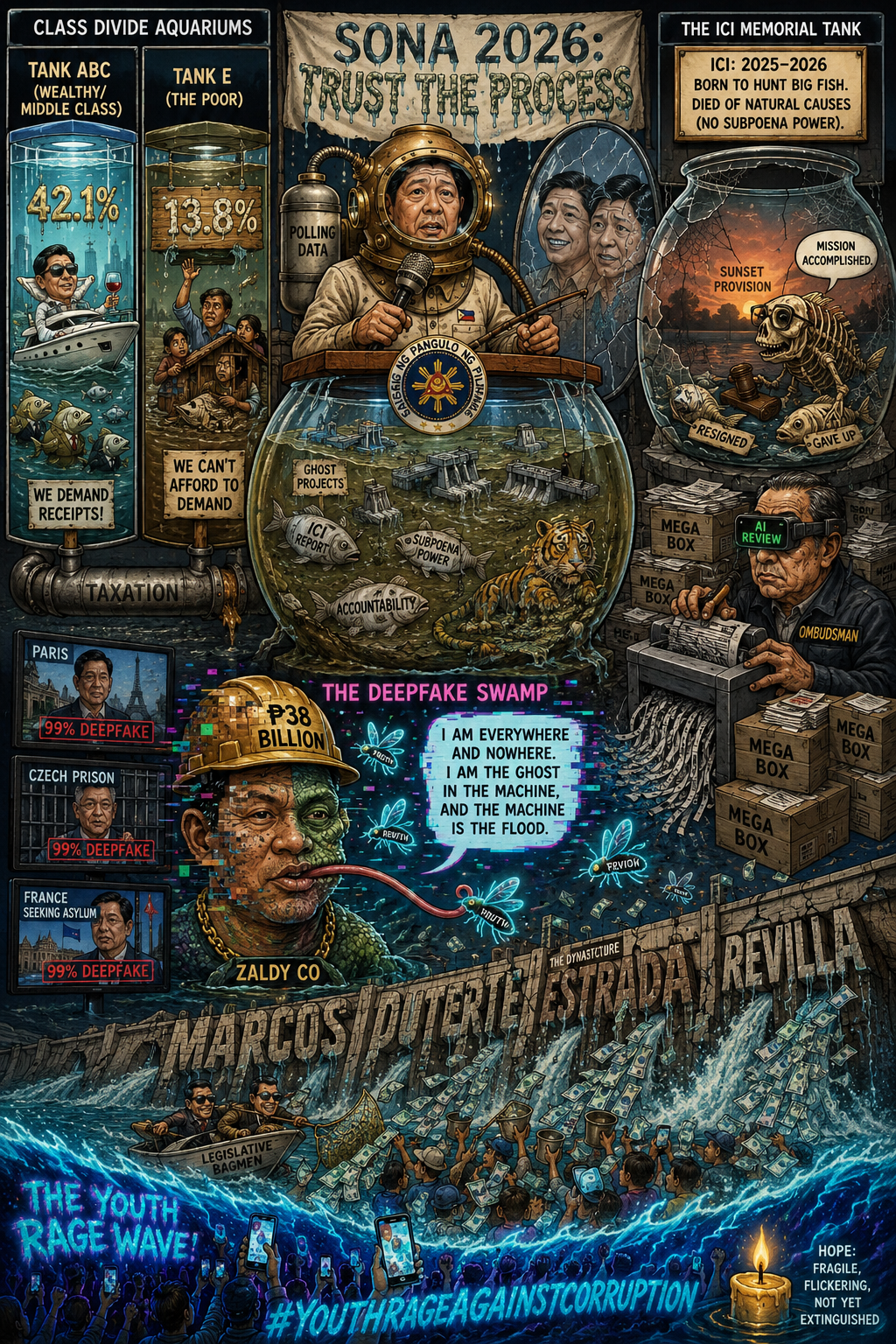
IN A just nation, a president’s annual address would be a reckoning. In the Philippines, it’s a ritual. On Monday, July 27, 2026, Ferdinand Marcos Jr. will stand before Congress, surveyors having already measured the nation’s fever, and the diagnosis is scathing: corruption is what Filipinos most want him to address.
Not inflation, which devours wages. Not jobs, which remain scarce. Corruption. Specifically, the breathtaking, multi-billion-peso flood-control scandal that Marcos himself detonated from this very podium one year ago.
The ghosts have returned to haunt him, and they are wet, hungry, and furious.

The Pulse of Public Outrage
The Pulse Asia numbers are devastating because they represent a primal scream that cuts across the usual political loyalties. Nearly 30% of Filipinos spontaneously named corruption—specifically the flood-control racket—as their top State of the Nation Address (SONA) priority.
That 18.9% didn’t mention some abstract platitude about good governance; they demanded to know who will be held accountable for the “figments of imagination” Marcos exposed in 2025. This is not a prompted, sanitized multiple-choice response. This is an open-ended cry from the gut, a rare moment in opinion polling where a nation’s trauma finds a number.
The methodology is sound, but the political weight is heavier. The President’s own words from last year have been litigated in the court of public opinion, and the verdict is a resounding “we remember, and we see nothing has changed.”
Institutional Dysfunction and the ICI Failure
We see nothing because the institutions meant to deliver justice were, by design or dysfunction, unplugged. There is a special circle of performative hell reserved for the Independent Commission for Infrastructure (ICI).
Born from Marcos’s vow to run after the crooks, it was a body without subpoena power, holding hearings in secret. It promptly hemorrhaged two of its three commissioners before dissolving entirely.
It was a containment mechanism, not an accountability tool—a pressure-release valve that hissed loudly for a few months before being carted off, leaving behind a damp stain of unfulfilled promise. Leila de Lima, once silenced, now speaks with clear-eyed fury, labeling the ICI precisely what it was: a “public ride.”
Marcos’s 2025 “shame on you” rebuke, which sent a shiver of possibility through the body politic, curdled into the administration’s own shameful silence on reaching the scandal’s masterminds.
The Impeachment Paradox
This institutional rot finds its apotheosis in the impeachment paradox. While Senator Jinggoy Estrada, a man whose name is practically a synonym for plunder, sits in detention over kickbacks, his alleged partner-in-political-dynasty, Vice President Sara Duterte, faces an impeachment trial that a mere 1.2% of Filipinos care to hear about in the SONA.
Let that sink in. A constitutional crisis of historic proportions is unfolding, and the public treats it as political background noise, a noisy, partisan telenovela disconnected from the rising price of rice. They intuit what the political elite cannot process: that the Duterte impeachment and the Estrada arrest are symptoms of the same disease—a power struggle between feudal houses masquerading as a justice campaign.
The public isn’t stupid; it’s exhausted.
The Class Schism in Survival
But to weaponize this survey without reading its fine print is its own form of elite myopia, for a national average is a tyrannical lie. The survey’s most profound truth is a class schism.
- For wealthy and middle-class Filipinos (Classes ABC), corruption roars as the top concern at 42.1%, a post-materialist luxury of those who can afford to worry about abstractions.
- For the poorest, Class E, the number plummets to 13.8%, replaced by a desperate obsession with affordable goods.
This is not apathy; it is a hierarchy of survival. The same flood waters that expose ghost projects also drown the market stalls and trash the daily wages of those too poor to demand a receipt. The media narrative of a unified national outrage is a fiction.
In reality, we have one nation demanding that its taxes not be stolen, and another—larger, hungrier, more desperate—just trying to afford the next meal, knowing full well both crises are connected by the sticky fingers of the same politicians.
Dismantling the Architecture of Corruption
This is the structural vulnerability of a democracy left to rot for decades. We are banging our heads against a wall built by dynasties, cemented with patronage. The flood-control complex was never an anomaly; it was the system working as designed—a vast, hydraulic network for siphoning public wealth into private pockets, from contractor-kingpins to the legislative bagmen who lubricate the budgets.
The fugitive Zaldy Co’s videos, a carnival of shocking claims now further polluted by Artificial Intelligence (AI)-generated deepfakes, are the perfect, chaotic artifact of a degraded information environment where truth and tactical smear are indistinguishable.
Marcos’s challenge, therefore, is not merely to catch a few thieves. It is to dismantle the architecture that guarantees their successors. That is the hard truth the survey whispers: fixing this requires a structural overhaul that the people who must vote for that overhaul will never, ever sanction. Dynasties do not vote to abolish themselves.
A Demand for Structural Overhaul
So, what must the President say? He must do more than scold. He must demand that Congress immediately pass a permanent, truly independent accountability commission with real subpoena power and prosecutorial teeth—not another ICI-shaped paper tiger.
He must direct his Ombudsman and Justice Department to climb the case ladder not just to a disc jockey or an aging senator, but to the summit, wherever the evidence leads, including toward his own political allies.
And he must champion a parallel, relentless focus on economic dignity—taming prices and boosting wages—not as a distraction from corruption, but as the very shield that protects the most vulnerable from its fallout.
A generation of young Filipinos is watching, already taking to the streets in a “Youth Rage Against Corruption” movement, their hope a fragile, flickering thing. They do not need another performance. They need proof that in a republic finally choosing justice over power, the floods that come will be of accountability—and those waters, for the first time, will cleanse rather than kill.
Key Citations
A. Reports & Studies
- Pulse Asia. “Fight vs Corruption Top Issue for Marcos’ 5th SONA.” Pulse Asia Research Inc., 2026, https://www.abs-cbn.com/news/nation/2026/7/24/sona-2026-corruption-leads-issues-filipinos-want-to-hear-pulse-asia-0847.
B. News Articles
- Inquirer News. “ICI’s Work on Flood Mess Ends March 31.” Philippine Daily Inquirer, 2026, https://newsinfo.inquirer.net/2195448/icis-work-on-flood-mess-ends-march-31.
- Tribune. “ICI Failure to Net ‘Big Fish’ Slammed: De Lima Says Marcos Flood Control Probe a Mere ‘Public Ride’.” Daily Tribune, 2026, https://tribune.net.ph/2026/03/15/ici-failure-to-net-big-fish-slammed-de-lima-says-marcos-flood-control-probe-a-mere-public-ride.
- SunStar. “Jinggoy Estrada: From ‘Juetengate’ to Flood Control.” SunStar Cebu, 2026, https://www.sunstar.com.ph/cebu/jinggoy-estrada-from-juetengate-to-flood-control.
- Rappler. “FACT CHECK: Video of Zaldy Co Claiming Marcos Gov’t is Harassing Critics is AI-Generated.” Rappler, 2026, https://www.rappler.com/newsbreak/fact-check/zaldy-co-video-marcos-admin-harassing-critics-ai-generated/.
C. Official Websites & Organizations
- Office of the Ombudsman. Republic of the Philippines. https://www.ombudsman.gov.ph/.
- Youth Rage Against Corruption. Official Facebook Page, https://www.facebook.com/YouthRageAgainstCorruption/.
- “Ang Hirap Maging Mahirap”: The PAO Scandal That Proves Government Contempt Is Nothing New

- “Far-Off” My Axx: Malacañang’s Claire Castro Drowns in Her Own Legal Gaslighting
- “Forthwith” to Farce: How the Senate is Killing Impeachment—And Why Enrile’s Right (Even If You Can’t Trust Him)

- “HINDI AKO NAG-RESIGN!”

- “I Know Nothing”: Baste Duterte’s Amnesia Defense Meets ₱33M in GenCorp Contracts

- “I’m calling you from my new Globe SIM. Send load!”

- “Mahiya Naman Kayo!” Marcos’ Anti-Corruption Vow Faces a Flood of Doubt

- “Manageable” Debt, Unmanageable Lies: DBM’s ₱21 Trillion Fairy Tale
- “Meow, I’m calling you from my new Globe SIM!”

- “Natrabaho”: One Word, One Ombudsman, and a Judiciary on Trial
- “No Special Jail for Crooks!” Boying Remulla Slams VIP Perks for Flood Scammers

- “Philippine-Controlled” or Yankee Gas Station? The Davao Fuel Depot Farce Exposed








Leave a Reply