When 52% of Filipinos Say They’re Poor, But the State Says 9.7%—Who’s Gaslighting Whom?
By Louis ‘Barok‘ C. Biraogo — August 22, 2026
THE body isn’t even cold yet, and already they’re throwing confetti on it.
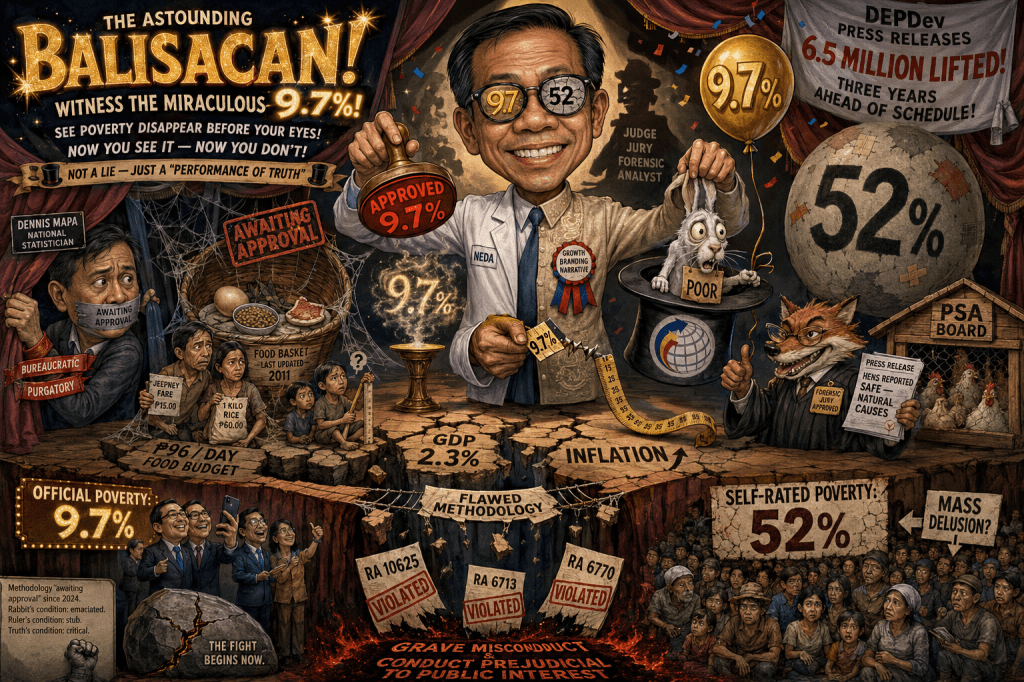
On August 21, 2026, the Philippine Statistics Authority—that august temple of numerical truth—declared that poverty in this archipelago of 110 million souls has fallen to a historic, miraculous, single-digit 9.7%. The Department of Economy, Planning, and Development, in a press release that read more like a campaign ad than a technical bulletin, proclaimed that 6.5 million Filipinos had been “lifted out of poverty.” Secretary Arsenio Balisacan, who simultaneously serves as Chair of the PSA Board—a detail so deliciously corrupt in its architecture that it deserves its own wing in a museum of institutional failures—declared victory three years ahead of schedule.
Let me be clear, because the fanatics on both sides will miss the point: the PSA didn’t lie. The numbers are real. The math checks out. The survey was conducted. The data was tabulated. And yet, what was presented to the Filipino people last week was not truth. It was a carefully staged performance of truth—a statistical sleight-of-hand so brazen that David Copperfield should be taking notes.
The question isn’t whether 9.7% is technically accurate under the current methodology. The question is whether that methodology is an honest measure of Filipino poverty—or whether it’s a ruler deliberately shortened so that the child appears taller.
Spoiler alert: the ruler is a stub.
THE CRIME SCENE: A THRESHOLD BUILT ON FANTASY
Let us examine the weapon used to commit this statistical assault on reality.
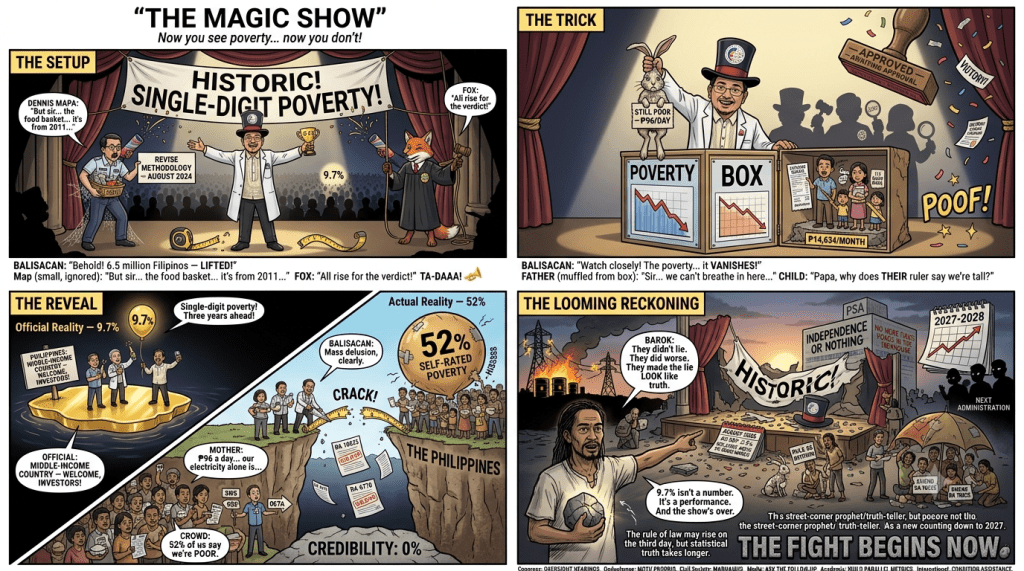
The PSA’s poverty threshold for 2025 was set at ₱35,121 per person per year. That’s approximately ₱96 per day. For a family of five, that’s about ₱14,634 per month. In a country where a single jeepney ride now costs more than a day’s worth of the official food budget, where a kilo of rice can consume a third of a minimum-wage worker’s daily earnings, and where electricity bills routinely exceed the entire non-food allowance built into this threshold.
But the real scandal isn’t just the threshold—it’s the food basket underneath it. The one that prices out scrambled eggs for breakfast, monggo with malunggay and dilis for lunch, and boiled pork for dinner. The one that National Statistician Dennis Mapa himself admitted in August 2024 was “insufficient” to meet basic nutritional requirements. The one that was last meaningfully updated in 2011—fifteen years ago, when a sari-sari store could still sell you a tingi of shampoo for a peso.
Mapa promised a fix. The PSA would revise the menu. The methodology would be updated. The threshold would finally reflect reality.
That was August 2024. It is now August 2026. The fix is still “awaiting approval.”
Two years. Two years to update a food basket. In that same period, the government managed to pass how many laws? Approve how many budgets? The PSA managed to conduct a nationwide survey, tabulate millions of data points, and release a press-ready report. But the supposedly simple task of updating a meal plan—a task that nutritionists and statisticians had already flagged as urgent—remains in bureaucratic purgatory.
This is not administrative delay. This is administrative murder—the deliberate, systematic killing of statistical truth.
THE ARCHITECTURE OF DECEPTION: CONFLICT OF INTEREST BY DESIGN
Republic Act No. 10625, the Philippine Statistical Act of 2013, created the PSA and placed it under the policy coordination of the National Economic and Development Authority—now the Department of Economy, Planning, and Development. The DEPDev Secretary chairs the PSA Board, the highest policy-making body on statistical matters.
Read that again, slowly. Let the absurdity marinate.
The Cabinet official whose entire political legacy depends on favorable poverty numbers is simultaneously the chairman of the body that controls how those numbers are calculated. It’s as if the accused in a murder trial were also the judge, the jury, and the forensic analyst—and then held a press conference to announce the victim had died of natural causes.
This isn’t a bug in the system. It’s a feature.
The architects of RA 10625 may have had noble intentions—”policy coordination” sounds so professional, so technocratic. But the result is a statistical system where the political arm of government has structural veto power over the evidentiary arm. The fox doesn’t just guard the henhouse; the fox owns the henhouse, sets the security protocols, and issues press releases about how safe the hens are.
Compare this to central bank independence—a principle so sacred that even this administration wouldn’t dare violate it openly. The Bangko Sentral ng Pilipinas operates with genuine autonomy because markets demand it. But poverty statistics? Who demands those be independent? The poor? They don’t have lobbyists.
The constitutional mandate for an “independent economic and planning agency” has been reduced to a punchline. And Balisacan’s dual role—measuring poverty as PSA Board Chair while celebrating its reduction as DEPDev Secretary—is the institutional equivalent of grading your own homework and then demanding a medal for it.
THE CREDIBILITY CHASM: 9.7% VS. 52%
Here’s where the statistical theater becomes statistical tragedy.
The PSA says 9.7% of Filipinos are poor. But the Social Weather Stations—the most respected independent pollster in the country—found that 52% of Filipino families consider themselves poor. That’s a 42.3-percentage-point divergence. It’s not a gap; it’s a continental divide.
The administration’s defenders will argue that these measure different things: official poverty measures income against a threshold; self-rated poverty measures subjective experience. But that’s precisely the point. When half of Filipino families feel poor while the government claims fewer than one in ten are poor, something has broken in the machinery of statistical governance.
One of two things is true. Either:
- The official threshold is so catastrophically disconnected from lived reality that it has become a work of fiction, measuring not poverty but a fantasy world where ₱96 per day constitutes a dignified existence; or
- Half of Filipino families are suffering from mass delusion, unable to recognize their own prosperity while the data insists they’re doing fine.
I’ll let you guess which interpretation requires more faith.
The administration loves to cite the SWS finding when it suits them—noting that self-rated poverty declined in Q2 2026 as “corroborating evidence” for their narrative. But they conveniently ignore that the same SWS survey still shows nearly half the country considers itself poor. It’s like celebrating that your fever dropped from 104°F to 103°F while ignoring that normal body temperature is 98.6°F.
And let’s not forget that OCTA Research—the administration’s other favorite pollster when the numbers flatter—found self-rated poverty rising during the same period, from 35% to 39%, with hunger incidence climbing from 17% to 21%. Two reputable pollsters, surveying nearly the same window, producing opposite trendlines. And the government picked the one that matched its press release.
This is what corruption looks like when it wears a lab coat and carries a clipboard.
THE LEGAL EXPOSURE: WHERE TECHNICAL FLAWS BECOME CRIMINAL ACTS
Here’s where we move from methodological critique to legal accountability. Because the question isn’t just whether the methodology is flawed—it’s whether the delay in fixing a known flaw constitutes a violation of public trust.
The Revised Penal Code, Article 171, penalizes falsification by public officers. Republic Act 6713, the Code of Conduct and Ethical Standards for Public Officials, requires “professionalism, justness, and sincerity” in the performance of official duties. Republic Act 6770 empowers the Ombudsman to investigate “inefficiency, neglect of duty, and improper conduct” by public officials.
The factual record is damning:
- August 2024: The National Statistician admits the poverty threshold’s food component is inadequate and promises a methodology revision.
- August 2026: The revision remains “awaiting approval.” No timeline is given. No explanation is offered. No accountability is assigned.
- In the interim: The PSA releases poverty statistics based on the admittedly flawed methodology, and the administration builds a political narrative—”single-digit poverty,” “three years ahead of schedule”—on top of a foundation its own chief statistician has declared unsound.
If a private corporation’s auditor admitted that its financial statements were based on an outdated accounting method that materially misrepresented the company’s condition—and then the company released those statements anyway, trumpeting record profits to investors—the SEC would be on them like locusts on a rice field. Criminal charges would follow. Careers would end.
But when the Philippine government does the same thing with poverty data, we’re told it’s just “technical disagreement” among economists. Just “methodological debate.” Just “academic discourse.”
The legal question isn’t whether the PSA committed fraud. It’s whether the knowing use of an admittedly inadequate methodology, without disclosure, for political advantage constitutes the kind of “grave misconduct” or “conduct prejudicial to the best interest of the service” that our anti-corruption laws were designed to address.
I submit that it does.
THE LOOMING RECKONING: A STATISTICAL TIME BOMB
The single most damning detail in this entire saga isn’t the threshold, the conflict of interest, or even the legal exposure. It’s the timing.
The PSA released its poverty statistics on August 21-22, 2026—within days of its own report that Q2 GDP growth had slowed to a pandemic-level 2.3%. The energy shock from the Middle East conflict has kept inflation above the Bangko Sentral’s 3% ceiling since March. The Philippine Institute for Development Studies warns that up to 3.1 million Filipinos could slip back below the poverty line under severe shock scenarios. The World Bank projects poverty could rise back to 12.3% by 2028.
The “single-digit poverty” milestone, in other words, is a backward-looking photograph of an economy that is actively deteriorating. It’s a snapshot of 2023-2025 conditions, taken with a lens that was already warped, and presented as evidence of present-day success even as the ground shifts beneath it.
The administration knows this. Balisacan’s own statement acknowledged that “current developments may slow the pace of poverty reduction”—the bureaucratic equivalent of a CEO saying “future losses may occur” in an earnings call before the stock crashes. It’s the kind of forward-looking disclaimer that defense lawyers love: we told you it might not last, so you can’t blame us when it doesn’t.
But here’s what happens next. The 2026 energy shock will continue to bite. Inflation will keep eroding purchasing power. The 2.3% growth figure will be revised downward. And sometime in 2027 or 2028, when the next poverty survey is released—perhaps under a new administration, perhaps under a different statistical leadership—the numbers will tell a different story. Poverty will rise. The “single-digit” milestone will evaporate.
And the Filipino people will be left asking: Was the 9.7% ever real? Or was it just a political performance, staged for an election cycle, designed to be abandoned once the cameras stopped rolling?
The credibility of Philippine statistics—already battered by years of survey controversies, contested numbers, and political cherry-picking—will have been so thoroughly destroyed that not even a full PSA leadership purge will restore it. And the poor, whose lives the statistics are supposed to illuminate, will be the ones who suffer from the policy errors that inevitably follow from bad data.
WHAT MUST HAPPEN: A CALL TO ARMS
The time for polite suggestions is over. The time for “constructive dialogue” with an institution that has demonstrated contempt for its own technical standards is past. What is needed now is action—legal, political, and institutional.
Congress must conduct immediate joint oversight hearings. The Senate and House Committees on Economic Affairs should summon PSA officials, not for the usual Kabuki theater of political grandstanding, but for sustained, technical interrogation. Why was the methodology fix delayed? Who approved the delay? What correspondence exists between the PSA, DEPDev, and Malacañang regarding the timing of the poverty release? And most critically: Congress must amend RA 10625 to strip the DEPDev Secretary of the PSA Board chairmanship. The statistical authority must be truly independent—insulated from the political messaging function that DEPDev performs.
The Ombudsman should open a motu proprio investigation under RA 6770, Section 15. The question is simple: did public officials engage in “inefficiency, neglect of duty, or improper conduct” by failing to implement an admittedly necessary methodology update for two years, thereby producing poverty statistics that materially misrepresented the condition of the Filipino people? The Ombudsman’s constitutional mandate exists precisely for moments like this—moments when the system’s own checks have failed and independent scrutiny is required.
Civil society must file a mandamus petition under Rule 65 to compel the PSA to immediately implement the corrected methodology and release recalculated poverty statistics. The Supreme Court’s jurisprudence in Legaspi v. Civil Service Commission and Chavez v. PCGG establishes the right of citizens to demand transparency and accountability from government. This is not a political act; it is a constitutional one.
The media must stop serving as a transmission belt for government press releases. Every report on poverty statistics should include not just the official number but the self-rated poverty figure, the MPI data, and the threshold controversy. Journalists should ask the hard follow-up questions: What would the poverty rate be under the revised methodology? When will the revision be implemented? Who specifically is responsible for the delay?
Academia must build parallel statistical infrastructure. Philippine universities have the technical capacity to develop independent poverty metrics based on realistic living costs. The international academic community, through organizations like the International Association for Official Statistics, should conduct an independent peer review of PSA methodology. If the government won’t produce honest statistics, scholars must.
The international community—the World Bank, Asian Development Bank, and UN agencies—must condition development assistance on statistical integrity. The UN Principles of Official Statistics, to which the Philippines is a signatory, require that official statistics be “compiled on an impartial basis” and “presented in a clear and understandable manner.” A government that uses an admittedly flawed methodology to claim political victory is in violation of those principles.
BAROK’S VERDICT
The 9.7% poverty rate is not a lie. It’s something more insidious: a truth packaged in a lie.
Real people did experience income growth between 2023 and 2025. Real families did cross whatever line was drawn, however inadequate that line may be. The economic gains of those years—the remittances, the employment growth, the social protection programs—were not fictional. The administration deserves some credit for presiding over a period of measurable improvement.
But that’s precisely what makes this scandal so infuriating. They had a real story to tell, and they chose to wrap it in a deception. They had genuine progress to report, and they chose to measure it with a ruler they knew was too short, then demand credit for the measurement as if it reflected reality.
The 9.7% figure will be cited in SONAs, in campaign speeches, in international investment pitches. It will be used to argue that poverty is “no longer a major problem,” that the administration’s economic strategy “works,” that the Philippines has “arrived” as a middle-income country ready for the world stage. And each time it’s cited, it will be a small act of violence against the 11.08 million Filipinos still officially poor—and the tens of millions more who know, in their bodies and their bank accounts, that the official statistics have nothing to do with their lives.
This is what corruption looks like when it isn’t stealing money. It’s stealing truth. And in a democracy, truth is the one thing the poor can’t afford to lose.
The fight for honest statistics is not a technical dispute among economists. It is the front line of the fight for accountable governance. Because if the government can lie about poverty—if it can dress up a flawed number in the language of scientific authority and demand that we all bow before it—then it can lie about anything. And if we accept the lie, if we nod along and say “well, the methodology is complicated, who really knows,” then we have surrendered the very ground on which democratic accountability stands.
The PSA says 9.7% of Filipinos are poor. The Filipino people say 52% of them are. I know which number I believe. And I know which number the government fears.
The rule of law may rise on the third day, but statistical truth takes longer. The fight begins now. 🪨
Key Citations
A. Reports & Studies
- Philippine Statistics Authority. 2025 Full-Year Official Poverty Statistics. 21 Aug. 2026, psa.gov.ph.
- Social Weather Stations. “Self-Rated Poverty fell by 3%, while Self-Rated Food Poverty fell by 6%, between March and June 2026.” 14 Aug. 2026, sws.org.ph.
- World Bank. Building the Filipino Middle Class: Towards Resilient Futures and Poverty Eradication. 2026, worldbank.org.
- Philippine Institute for Development Studies. Policy note on energy shock and poverty. Apr. 2026, rappler.com.
B. News Articles
- Arceo, Niña Myka Pauline. “Poverty rate hits record low of 9.7%.” The Manila Times, 22 Aug. 2026, manilatimes.net.
- Desiderio, Louella. “6.5 million Filipinos lifted out of poverty – PSA.” Philstar.com, 22 Aug. 2026, philstar.com.
- Cordero, Ted. “PSA admits P64 per person/day food threshold ‘insufficient’.” GMA News Online, 15 Aug. 2024, gmanetwork.com.
- Social Weather Stations. “Self-Rated Poverty (SRP) at 52% on March 2026; Borderline at 13%, Not Poor at 35%.” Social Weather Stations, 8 May 2026, sws org ph.
- Baroña, Franco Jose C. “Poverty, hunger rise in Q2 – OCTA.” The Manila Times, 21 Aug. 2026, manilatimes.net.
C. Official Websites & Legal Texts
- Republic Act No. 10625. Philippine Statistical Act of 2013. 12 Sept. 2013, chanrobles.com.
- Republic Act No. 6713. Code of Conduct and Ethical Standards for Public Officials and Employees. 20 Feb. 1989, adb.org.
- Republic Act No. 6770. Ombudsman Act of 1989. 17 Nov. 1989, dti.gov.ph.
- United Nations. Fundamental Principles of Official Statistics. 2014, unstats.un.org.
- Supreme Court of the Philippines. “1997 Rules of Civil Procedure.” Chan Robles Virtual Law Library, chanrobles.com.
- Legaspi v. Civil Service Commission. G.R. No. 72119, 29 May 1987, jur.ph.
- Chavez v. Presidential Commission on Good Government. G.R. No. 130716, 9 Dec. 1998, jur.ph.



Leave a Reply