
One Gets Impeached, the Other Gets a Rubber Stamp
By Louis “Barok” C. Biraogo | August 22, 2026
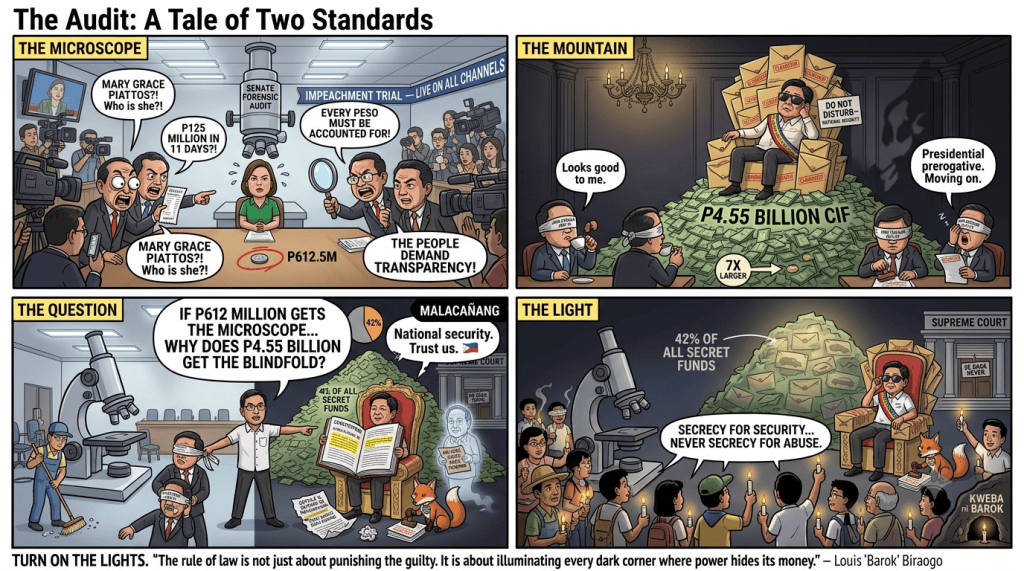
WHILE the nation sits riveted to the Senate’s forensic dissection of Sara Duterte’s P125 million “special disbursements”—complete with fictitious-sounding recipients like “Mary Grace Piattos” and the now-infamous 11-day spending spree—a far more spectacular heist is unfolding in plain sight.
It involves no aliases, no forged receipts, no theatrical testimonies. It requires no such theatrics because it is, quite simply, legal. It is the P4.55 billion in Confidential and Intelligence Funds (CIF) quietly nestled inside the Office of the President’s proposed 2027 budget. And unlike the Vice President’s pocket change, this one comes with a presidential seal.
ACT Teachers Rep. Antonio Tinio, God bless his persistent soul, has once again thrust his finger into the wound. The numbers are staggering: P2.25 billion in confidential funds, P2.30 billion in intelligence funds—44.9 percent of the OP’s entire budget, and a jaw-dropping 42 percent of the entire government’s P10.773 billion CIF pool.
While the Senate pores over Duterte’s P612.5 million with electron microscopes, Malacañang sits atop a secret mountain nearly seven times larger, and the guardians of our fiscal integrity yawn.
The question, as Tinio so elegantly poses it, is simple: Would the Office of the President survive the same scrutiny it has helped unleash upon its former ally?
I. THE CONSTITUTIONAL SHELL GAME
Let us be clear about what the Palace will tell you. It will invoke the Constitution. It will speak in hushed, reverent tones about the President’s role as Commander-in-Chief under Article VII, Section 18. It will whisper about national security, about intelligence sources whose lives would be endangered, about the shadowy threats that lurk beyond our shores and within our borders. It will wrap itself in the flag and dare you to question its patriotism.
This is, of course, a magnificent magic trick. The Constitution, in Article II, Section 28, commands the State to “adopt and implement a policy of full public disclosure of all its transactions involving public interest.” This is not a suggestion. It is a mandate.
And yet, the Malacañang argument rests on a sleight of hand: that the phrase “subject to reasonable conditions prescribed by law” somehow transforms a joint circular—an administrative issuance signed by five agency heads in 2015—into a “law” that can override constitutional transparency.
Let us be precise. Joint Circular No. 2015-01 is not a statute. It was not debated in Congress. It was not subjected to bicameral deliberation. It was not signed by the President as an act of legislation. It is an internal memorandum dressed up in legal clothing.
And yet, the Malacañang argument rests on a sleight of hand: that the phrase “subject to reasonable conditions prescribed by law”—the Constitution’s command—somehow transforms a joint circular—the government’s actual implementation, an administrative issuance signed by five agency heads in 2015—into a “law” that can override constitutional transparency.
The pending Supreme Court petition filed by former Senior Associate Justice Antonio Carpio—now gathering dust for nearly three years—calls this exactly what it is: a “usurpation of legislative power by the Executive Branch.” Under the Constitution, any limitation on the right to information must be “prescribed by law.” A joint circular is not law. It is an internal rule. And an internal rule cannot constitutionally shield public money from public scrutiny.
The Court’s own jurisprudence is damning. In Belgica v. Ochoa, the Supreme Court struck down the Priority Development Assistance Fund as an unconstitutional lump-sum appropriation that violated separation of powers. In Araullo v. Aquino III, it dismantled the Disbursement Acceleration Program for its cross-border fund transfers.
The lesson from both cases is unmistakable: the Constitution abhors discretionary money that flows without congressional oversight. And yet, the CIF system has somehow escaped this constitutional guillotine, surviving on a technicality and a deferential Court that has so far refused to act.
But the legal time bomb is ticking. And when it detonates, it will not be a controlled explosion.
II. THE FISCAL OBSCENITY AND THE DOUBLE STANDARD DANCE
Let us now turn to the numbers, because numbers, unlike politicians, do not lie—though they can certainly be buried.
The Office of the President’s P4.55 billion CIF allocation is not an anomaly. It is a tradition. In 2022, the OP spent approximately P4.5 billion. In 2023, P4.56 billion. In 2024, it achieved the remarkable feat of a 100 percent quarterly obligation rate on its CIF—every single peso, every single quarter, fully spent—while its regular, transparent budget languished at a mere 78 percent obligation rate.
Let that sink in. The office responsible for the nation’s highest public trust spent its secret money with perfect efficiency while failing to fully utilize its transparent funds for public programs.
This is not governance. This is a pathology.
The contrast with the Duterte impeachment is almost too perfect to be accidental. The Vice President’s CIF—P612.5 million across the OVP and DepEd—has been the centerpiece of the nation’s most consequential political trial since the fall of Estrada. Senators have demanded documents. COA auditors have testified about acknowledgment receipts with fictitious names. The prosecution has spent months constructing a narrative of abuse, waste, and corruption. And what is the sum total of all this prosecutorial fury? Six hundred twelve million pesos.
Meanwhile, Malacañang sits on P4.55 billion—an amount that dwarfs the Duterte funds by a factor of seven—and the same senators who demand accountability from the Vice President suddenly develop a convenient case of selective amnesia when it comes to the President.
Tinio’s point is not that Duterte should escape accountability. It is that accountability should not be a one-way street. The rule of law is not a weapon to be wielded against political enemies while being sheathed for political allies. It is either a universal standard or a partisan cudgel. And right now, it looks very much like the latter.
The Department of Budget and Management’s defense is almost comical in its inadequacy. “These funds are subject to existing budgeting, utilization, liquidation, and auditing rules,” they intone, as if reciting a mantra. But what are these rules? A sealed envelope sent to a special COA unit called the ICFAU. A unit that checks for completeness of documentation, not accuracy. A unit that verifies that the forms are filled out correctly, not that the underlying activity actually occurred. A unit whose findings are themselves classified.
In other words, the audit is a secret. The auditor’s report is a secret. The auditor’s methodology is a secret. The auditor’s disallowances—if any—are a secret. The system is not designed to catch fraud; it is designed to certify that fraud, if it occurs, will never see the light of day.
III. THE ETHICAL VACUUM AND THE NATIONAL SECURITY CHIMERA
The ethical dimension of this controversy is perhaps the most damning. Public office is a public trust. This is not a slogan; it is the opening line of Article XI, Section 1 of the Constitution. The Code of Conduct and Ethical Standards for Public Officials—Republic Act No. 6713—commands public servants to “serve the people with utmost responsibility, integrity, loyalty, and efficiency.” It demands “simple living.” It demands “commitment to public interest.”
How, precisely, does a P4.55 billion secret slush fund comport with “simple living”? How does the systematic shielding of expenditures from public view demonstrate “commitment to public interest”? The answer, of course, is that it doesn’t. What it demonstrates is a commitment to power—the power to spend without questions, to allocate without justification, to distribute without accountability.
The “national security” defense is the final refuge of every scoundrel who wants to hide public money. Yes, some intelligence operations require confidentiality. Yes, informants must be protected. Yes, operational details must sometimes remain classified. No reasonable person disputes this.
But here is the question that the national security high priests never answer: Who decides what counts as national security? In the absence of a law defining the boundaries, in the absence of a statute specifying which activities may be funded confidentially, in the absence of independent oversight that can verify the classification—the decision rests entirely with the very officials who benefit from the secrecy. The fox is not just guarding the henhouse; the fox has been given a P4.55 billion budget and told to audit itself.
The inevitable result is not national security. It is institutionalized impunity.
IV. THE WAY FORWARD: DEMANDS AND RECOMMENDATIONS
Let us not end this jeremiad without offering a path forward. The demand is simple, and it is one that every Filipino should make their own: Secrecy for security, never secrecy for abuse.
What does this mean in practice?
First, Congress must act. The power of the purse belongs to the legislature, not the executive. Congress has the constitutional authority—indeed, the constitutional duty—to scrutinize every peso of the proposed CIF. It must demand justifications. It must demand line-item explanations. It must demand to know what activities require P2.25 billion in confidential funds—funds that, under the Joint Circular’s own definitions, are meant for civilian surveillance—and P2.30 billion in intelligence funds for the OP. It must reject the idea that a single office should control 42 percent of the nation’s entire secret budget.
The pending bills in the 20th Congress—House Bills No. 1417 and 1467—offer a foundation. They propose a 10 percent cap on CIF allocations for any single agency. They propose a public disclosure section. They propose a “loss of confidentiality status” trigger when COA issues a disallowance. These are not radical proposals. They are the minimum safeguards any functioning democracy should demand. Congress must pass them.
Second, the President must lead. Ferdinand Marcos Jr. has a choice. He can continue to hide behind the tired rhetoric of “national security” and “presidential prerogative,” or he can do something no recent predecessor has done: voluntarily submit the OP’s CIF to independent, verifiable scrutiny. He can invite COA to conduct a substantive audit, not a paperwork check. He can publish aggregate figures—total allocation, total utilization, broad spending categories, audit findings—without compromising operational details. He can demonstrate that his commitment to anti-corruption extends to his own office.
If he does not, the message is clear: The anti-corruption crusade is a selective weapon, not a principled cause.
Third, COA must reclaim its constitutional mandate. The Commission on Audit is the guardian of public funds. It has the power, under Article IX-D, Section 2, to “define the scope and technique of its audit” and to “prevent and disallow irregular, unnecessary, excessive, extravagant, or unconscionable expenditures.” The ICFAU, as currently structured, is not an auditor; it is a rubber stamp. COA must ask itself: How many OP CIF transactions have been substantively verified? How many recipients have been interviewed? How many expenditures have been disallowed? If the answer to these questions is “we cannot say,” then the system is broken.
Fourth, the Supreme Court must decide. The Carpio petition has been pending since November 2023. Nearly three years of silence is not judicial prudence; it is judicial abdication. The Court cannot continue to dodge the fundamental constitutional question at the heart of the CIF system: Can an administrative circular, not a law, authorize the expenditure of billions in secret public funds? The answer, under any honest reading of the Constitution, is no. The Court must say so.
CONCLUSION: LIGHT THE DARKNESS
The Filipino people are told, year after year, that these funds are necessary. That they protect us from enemies foreign and domestic. That they keep us safe in a dangerous world. And perhaps, in some measure, they do. But let us be honest about what else they do. They shield the powerful from accountability. They transform public money into private discretion. They perpetuate a system in which the most privileged office in the land is also the least transparent.
The P4.55 billion question is not about money. It is about power. It is about whether the people have a right to know how their resources are spent. It is about whether the Constitution’s promise of “full public disclosure” means anything at all. It is about whether the rule of law applies to the ruler.
While the Senate dissects Sara Duterte’s P125 million, the larger question remains unanswered: Who will audit the President?
The nation watches. The nation waits. And the nation deserves an answer.
The rule of law is not just about punishing the guilty. It is about illuminating every dark corner where power hides its money.
Turn on the lights.
May the rule of law rise on the third day. 🪨
Key Citations
A. Reports & Studies
- Commission on Audit, Department of Budget and Management, Department of the Interior and Local Government, Governance Commission for GOCCs, and Department of National Defense. Joint Circular No. 2015-01: Guidelines on the Entitlement, Release, Use, Reporting and Audit of Confidential and/or Intelligence Funds. 8 Jan. 2015, https://www.coa.gov.ph/wpfd_file/coa-dbm-dilg-gcg-for-goccs-dnd-joint-circular-no-2015-01-january-8-2015/.
B. News Articles
- Cruz, James Patrick. “Marcos gov’t seeks P10.773 billion in confidential, intel funds for 2027.” Rappler, 17 Aug. 2026, https://www.rappler.com/philippines/confidential-intelligence-funds-budget-proposal-2027/.
- Maralit, Kristina. “How did VP spend P125M in 11 days?” The Manila Times, 4 Aug. 2026, https://www.manilatimes.net/2026/08/04/news/how-did-vp-spend-p125m-in-11-days/2397306.
- Quismorio, Ellson. “House prosecutors to go all in on Mary Grace Piattos to prove VP Sara confidential funds misuse.” Manila Bulletin, 29 June 2026, https://mb.com.ph/2026/06/29/house-prosecutors-to-go-all-in-on-mary-grace-piattos-to-prove-vp-sara-confidential-funds-misuse.
- “Lawmaker: OP spent all P4.5-B secret funds in 2024, but . . .” Inquirer.net, 2 Oct. 2025, https://newsinfo.inquirer.net/2118364/lawmaker-op-spent-all-p4-5-b-secret-funds-in-2024-but.
C. Official Websites & Jurisprudence
- Belgica v. Ochoa. G.R. No. 208566, 19 Nov. 2013, Supreme Court of the Philippines, https://lawphil.net/judjuris/juri2013/nov2013/gr_208566_2013.html.
- Araullo v. Aquino III. G.R. No. 209287, 1 July 2014, Supreme Court of the Philippines, https://lawphil.net/judjuris/juri2014/jul2014/gr_209287_2014.html.
- The 1987 Constitution of the Republic of the Philippines. Official Gazette, https://www.officialgazette.gov.ph/constitutions/1987-constitution/.
- Republic Act No. 6713. Code of Conduct and Ethical Standards for Public Officials and Employees. Official Gazette, 20 Feb. 1989, https://www.officialgazette.gov.ph/1989/02/20/republic-act-no-06713/.
- “Ang Hirap Maging Mahirap”: The PAO Scandal That Proves Government Contempt Is Nothing New
- “Far-Off” My Axx: Malacañang’s Claire Castro Drowns in Her Own Legal Gaslighting
- “Forthwith” to Farce: How the Senate is Killing Impeachment—And Why Enrile’s Right (Even If You Can’t Trust Him)
- “HINDI AKO NAG-RESIGN!”

- “I Know Nothing”: Baste Duterte’s Amnesia Defense Meets ₱33M in GenCorp Contracts

- “I’m calling you from my new Globe SIM. Send load!”

- “Mahiya Naman Kayo!” Marcos’ Anti-Corruption Vow Faces a Flood of Doubt

- “Manageable” Debt, Unmanageable Lies: DBM’s ₱21 Trillion Fairy Tale
- “Meow, I’m calling you from my new Globe SIM!”

- “Natrabaho”: One Word, One Ombudsman, and a Judiciary on Trial
- “No Special Jail for Crooks!” Boying Remulla Slams VIP Perks for Flood Scammers

- “Philippine-Controlled” or Yankee Gas Station? The Davao Fuel Depot Farce Exposed





Leave a Reply