Forensic Engineering vs. the Pork Barrel: Can Science Beat the Syndicate?
By Louis ‘Barok‘ C. Biraogo — August 21, 2026
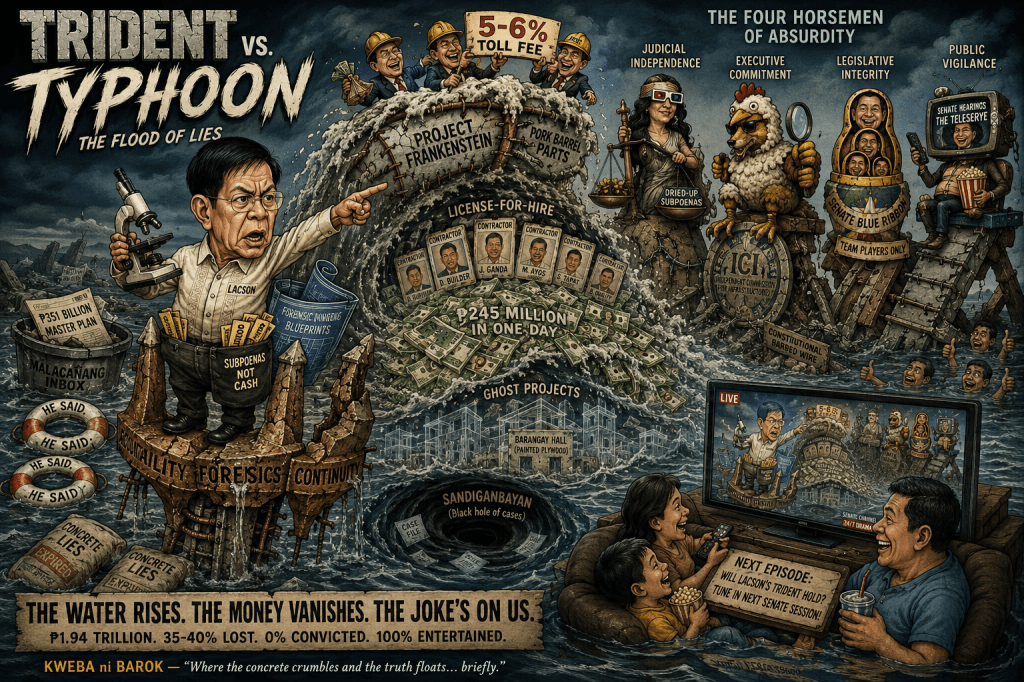
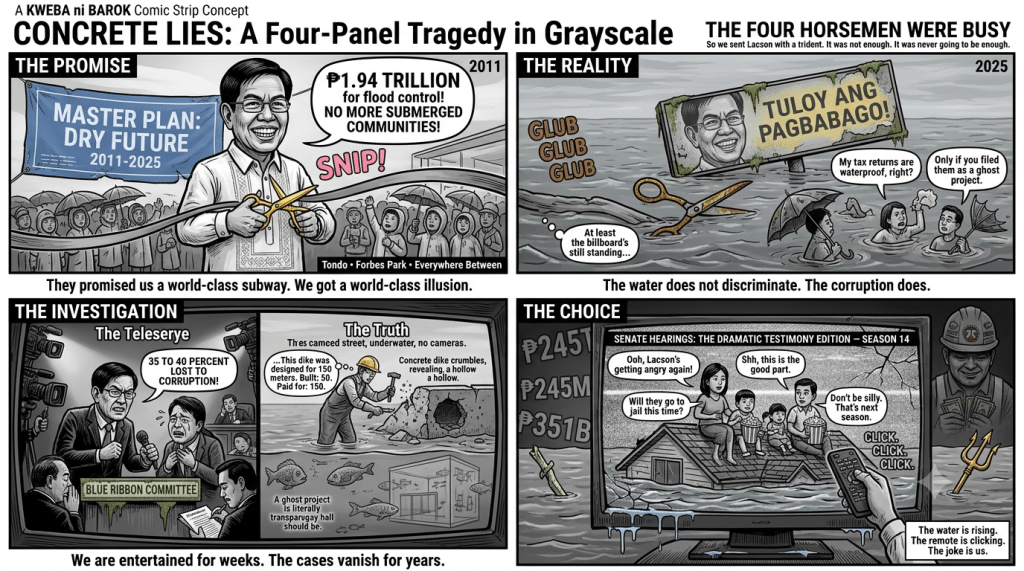
LET us begin with a number so absurd, so astronomical, that it should haunt the dreams of every Filipino taxpayer: ₱1.94 trillion.
That is the sum the Philippine government has poured into flood control from 2011 to 2025. For context, that is enough money to build a world-class subway system in Manila, modernize every public hospital in the country, and still have enough left over to buy every senator a lifetime supply of conscience—assuming such a product existed.
And yet, when the rains come, what happens? Communities are submerged. Homes are destroyed. Lives are lost. The floodwaters do not discriminate between the shanties of Tondo and the gated villages of Forbes Park. The water rises, indifferent to the billions spent to stop it.
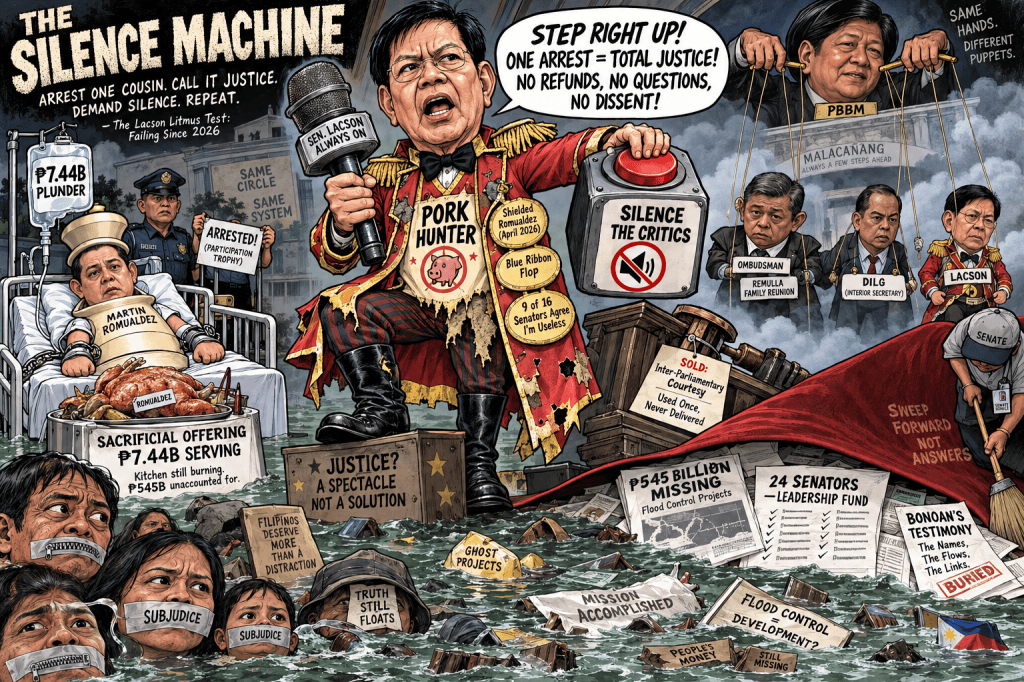
Now, Senator Panfilo “Ping” Lacson—a man who has made a career out of being the Senate’s resident scold—has emerged from the rubble with a three-pronged approach to fix this mess: accountability, forensic engineering, and master plan continuity. It is a sensible, almost radical, proposal. And in its very existence, it is a damning indictment of how profoundly broken the system has become.
Because the real story here is not that Lacson has a plan. The real story is that we need one at all.
The Ghost in the Machine
Let us talk about the first prong: accountability. It sounds simple, doesn’t it? If you steal money, you go to jail. If you build a bridge that collapses, you answer for it. This is the logic we teach our children. It is not, apparently, the logic that governs the Department of Public Works and Highways (DPWH).
The numbers are staggering. Lacson, citing testimony from former DPWH officials, estimates that 35 to 40 percent of that ₱1.94 trillion was lost to corruption. Let that sink in for a moment. We are not talking about a few million pesos slipped into a congressman’s pocket. We are talking about a potential loss of ₱680 to ₱775 billion—a scale of larceny that would make a drug lord blush.
But here is where the narrative takes a turn into the surreal, the kind of thing you’d expect from a badly written political thriller. The Senate investigation has uncovered a system of “ghost projects”—infrastructure that exists only on paper. Contractors paid in full for structures that were never built. Licenses rented out “sapilitan” (forcibly) to create a phantom army of builders. A whistleblower admits to delivering ₱245 million in cash in a single day. A single day! It’s as if the DPWH had become a parallel universe where the laws of physics—and accounting—no longer apply.
This is not mere corruption. This is institutionalized, weaponized, industrial-scale theft. It is a “License-for-Hire” scheme that turns public works into a private ATM for the connected and the craven. The question Lacson’s call for accountability raises is simple: Will anyone, anyone, with real power face a judge? Or will this be another season of our national reality show, “Senate Hearings: The Dramatic Testimony Edition,” where we are entertained for weeks, only for the cases to vanish into the black hole of the Sandiganbayan?
The Forensic Imperative
This is where Lacson’s second prong, forensic engineering, becomes crucial. It is the missing link between failure and fraud. When a dike collapses, is it because of an extraordinary typhoon, or because the contractor used substandard materials and the DPWH engineer signed off on it? When a flood-control project fails, is it a design flaw, or is it because the project was a “ghost” from the very beginning—a phantom meant to launder money, not to hold back water?
As the research materials rightly point out, a failed project is evidence requiring investigation, not automatic proof of corruption. But in the Philippine context, where “Project Frankenstein” is stitched together from pork-barrel parts and a 5-6% “toll fee” is paid to lawmakers who are themselves contractors or have contractor relatives, the stench of corruption is overwhelming.
Forensic engineering is the scalpel that can cut through the tissue of lies. It can distinguish between criminal negligence and bad luck. It can provide the smoking gun—the test results showing inferior cement, the surveys proving a 50-meter dike was built where a 150-meter one was paid for. Lacson’s call to tap civil engineers’ groups is not just an administrative suggestion; it is a declaration of war against the culture of impunity that hides behind technical jargon and bureaucratic buck-passing.
The Amnesia of Power
And then there is the third prong: master plan continuity. This, perhaps, is the most damning of all. It exposes the petty, destructive politics at the heart of our governance.
The Aquino administration spent ₱351 billion to craft a comprehensive flood-control master plan under then-Secretary Rogelio Singson. It was a document born of science, designed to span decades. And what happened to it? According to Lacson, it was simply discontinued. Malacañang claims it was never received. A classic case of “he said, he said,” where the only certainty is that a multi-billion-peso, scientifically-designed plan ended up in the dustbin of history.
This is the “amnesia of power.” Every new administration comes in, declares its predecessors incompetent (or worse), and starts from scratch. Why? Because starting from scratch is where the money is. New projects mean new contracts. New contracts mean new kickbacks. A master plan that spans administrations is a threat to the entire corrupt ecosystem because it eliminates the chaos in which graft thrives. It is the difference between a well-planned city and a chaotic night market where everything is for sale.
The Four Horsemen of the Anti-Corruption Apocalypse
Lacson’s plan, sound as it may be, is not a magic spell. It requires a conjuring of forces that have been conspicuously absent. It requires the Four Horsemen. Without them, his three-pronged approach is little more than a well-intentioned speech, destined to be filed away alongside the ₱351 billion master plan it seeks to revive.
Horseman #1: Judicial Independence
Will the Ombudsman and Sandiganbayan act on evidence, or will they be swayed by the subtle whisper of power?
The subpoenas to the DPWH, Philippine Reclamation Authority (PRA), and Registry of Deeds are a promising start. But a subpoena is not a conviction. The ₱21.7 billion in frozen assets is a welcome development. But it is a drop in the ocean of ₱1.94 trillion spent.
The question is whether the scales of justice can truly balance when weighed down by political gold. If the courts become another arena for political theater—where the powerful are protected by their connections and only the small fry are served up for public consumption—then the entire edifice of accountability collapses into farce.
Horseman #2: Executive Commitment
Will the investigation be a surgical strike, carefully calibrated to eliminate political rivals while protecting allies?
The administration’s attempt to create a controlled narrative through the Independent Commission for Infrastructure (ICI) is itself now a case study in executive overreach. Born of Executive Order No. 94 (Creating the Independent Commission for Infrastructure), this body was meant to be the palace’s all-seeing eye. Instead, it has become a constitutional punching bag, challenged before the Supreme Court for violating the separation of powers.
Even its own mandate limits it to recommending prosecutions, not pursuing them. It is the fox offering to guard the henhouse—except now the fox finds itself entangled in a legal fence, its authority questioned and its recommendations subject to the very institutional weaknesses it was designed to bypass.
The real test will be whether the administration pursues all implicated officials equally—including those who share its political bed—or whether the sword of justice is selectively sharpened.
Horseman #3: Legislative Integrity
Will Congress resist the impulse to shield its own?
This is perhaps the most absurd of all the horsemen. The Senate is tasked with investigating a system that some of its own members may be complicit in. It is a club investigating itself, with all the awkwardness that entails.
The evidence is damning. The Senate Blue Ribbon Committee’s own report “went stale and became spoiled” due to a lack of signatures. Senators were told to be “team players.” One can only imagine the pressure applied behind closed doors—the whispered reminders of political debts, the unspoken threats of electoral retaliation.
The irony is staggering: a body designed to provide oversight has become a sanctuary for the overseen. When senators refuse to sign a report implicating their colleagues, they are not just failing their constitutional duty. They are complicit in the very corruption they were elected to expose.
Horseman #4: Public Vigilance
Will the Filipino people sustain pressure for real results, or will they be placated by spectacle?
This is the wild card. The most powerful force in any democracy is an informed, angry, and persistent public. But the Filipino people have a remarkable—and deeply troubling—tolerance for political theater.
We are entertained by the drama, the shouting matches, the tearful confessions. We watch Senate hearings like teleseryes, complete with heroes, villains, and plot twists. But have we been so conditioned by this spectacle that we now confuse it with justice?
The question is not whether we will watch. The question is whether we will act. Will we accept a new committee report as a substitute for a conviction? Will we be satisfied with symbolic gestures, empty promises, and performative accountability? Or will we, for once, demand that the concrete be real, the money accounted for, and the guilty punished—regardless of their last name?
The Bottom Line
This is not about flood control. It is about whether the Philippines is a nation of laws or a nation of deals. It is about whether public infrastructure is meant to serve the people or to enrich the powerful. It is about whether we will bequeath to our youth a future of dry homes and safer communities, or a legacy of scandal and submerged dreams.
Lacson’s three-pronged approach is a necessary start. It is a blueprint for a system where science dictates, transparency governs, and accountability is automatic. But it is only a blueprint. The question is whether we have the political will to build it, or if we will simply watch it wash away in the next flood—along with our taxes, our trust, and our future.
The water is rising. It always does. The only question is whether we will finally learn to swim against the current of corruption, or simply drown in the sea of our own complacency.
Key Citations
A. Legal & Official Sources
- The 1987 Constitution of the Republic of the Philippines. Official Gazette of the Republic of the Philippines, 1987, http://www.officialgazette.gov.ph/constitutions/1987-constitution/.
- Executive Order No. 94. Creating the Independent Commission for Infrastructure. Office of the President of the Philippines, 11 Sept. 2025, lawphil.net/executive/execord/eo2025/eo_94_2025.html.
- Sandiganbayan. Official Website of the Sandiganbayan, sb.judiciary.gov.ph/.
- Office of the Ombudsman. Official Website of the Office of the Ombudsman, http://www.ombudsman.gov.ph/.
- Supreme Court of the Philippines. Official Website of the Supreme Court of the Philippines, sc.judiciary.gov.ph/.
- Philippine Reclamation Authority. Official Website of the Philippine Reclamation Authority, http://www.pea.gov.ph/.
- Department of Public Works and Highways. Official Website of the Department of Public Works and Highways, http://www.dpwh.gov.ph/.
B. News Reports
- Bacelonia, Wilnard. “Lacson Outlines 3-Pronged Approach to Strengthen Flood Control.” Philippine News Agency, 19 Aug. 2026, http://www.pna.gov.ph/articles/1282218.
- Bacelonia, Wilnard. “Senate Probe on Flood Control Bares Ghost Projects, Favoritism.” Philippine News Agency, http://www.pna.gov.ph/articles/1256868.
- Valente, Catherine S. “Lacson: P1.9T Spent for Flood Control.” The Manila Times, 19 Aug. 2026, http://www.manilatimes.net/2026/08/19/news/national/lacson-p19t-spent-for-flood-control/2407841.
- Cabato, Luisa. “Palace: Bonoan Did Not Receive Aquino Flood Control Master Plan.” Inquirer.net, 20 Aug. 2025, newsinfo.inquirer.net/2098314/palace-on-flood-control-materplan-from-aquino-admin.
- “Far-Off” My Axx: Malacañang’s Claire Castro Drowns in Her Own Legal Gaslighting
- “Forthwith” to Farce: How the Senate is Killing Impeachment—And Why Enrile’s Right (Even If You Can’t Trust Him)
- “HINDI AKO NAG-RESIGN!”

- “I’m calling you from my new Globe SIM. Send load!”

- “Mahiya Naman Kayo!” Marcos’ Anti-Corruption Vow Faces a Flood of Doubt

- “Manageable” Debt, Unmanageable Lies: DBM’s ₱21 Trillion Fairy Tale
- “Meow, I’m calling you from my new Globe SIM!”

- “Natrabaho”: One Word, One Ombudsman, and a Judiciary on Trial
- “No Special Jail for Crooks!” Boying Remulla Slams VIP Perks for Flood Scammers
- “Philippine-Controlled” or Yankee Gas Station? The Davao Fuel Depot Farce Exposed

- “PLUNDER IS OVERRATED”? TRY AGAIN — IT’S A CALCULATED KILL SHOT

- “Several Lifetimes,” Said Fajardo — Translation: “I’m Not Spending Even One More Day on This Circus”


 KWEBA ni BAROK
Leave a comment