Legislative Séance: Channeling Robin Padilla’s Non-Existent Authorship in the Name of Public Safety
By Louis ‘Barok’ C. Biraogo — August 26, 2026
THERE is a particular species of Philippine political theater that emerges in the aftermath of tragedy. It is not the quiet, methodical work of governance. It is the frantic, microphone-grabbing, camera-flashing performance art where a Cabinet secretary, reeling from public outrage, must appear to be doing something — anything — even if that something is legally incoherent, constitutionally suspect, and aimed at a statute that does not govern the subject he claims to be fixing.
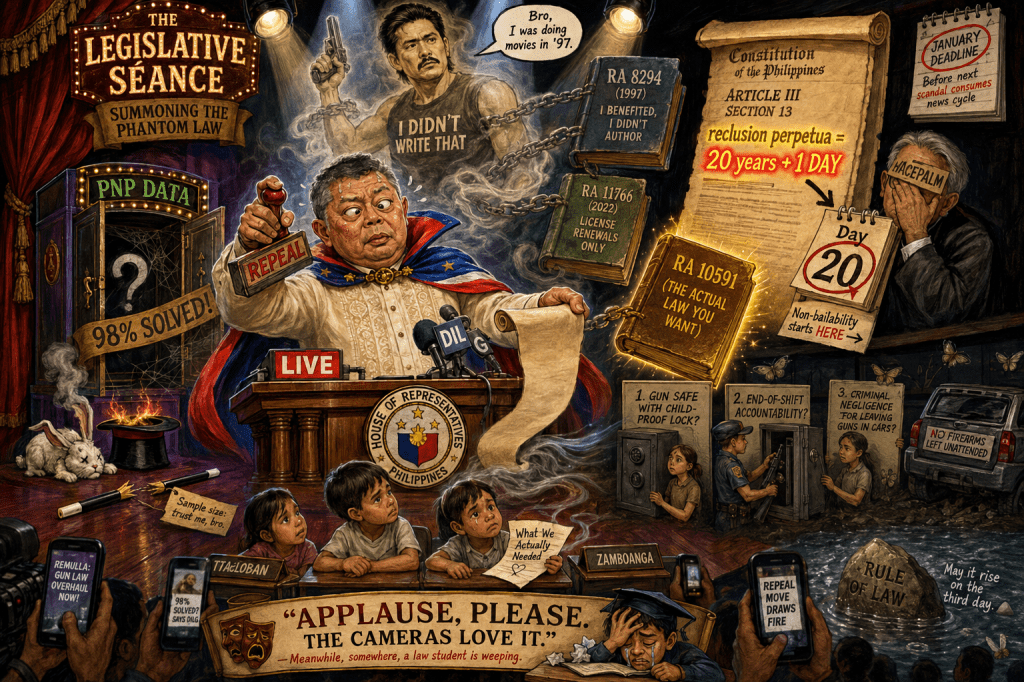
Ladies and gentlemen, I give you Secretary Jonvic Remulla’s crusade against the phantom “Robin Padilla Law.”
Let us be clear about what happened. Two school shootings. Children dead. A nation grieving. And into this maelstrom steps the Department of the Interior and Local Government (DILG) chief with a proposal so simple it sounds profound: make possession of loose firearms non-bailable with a 20-year maximum penalty.
Applause, please. The cameras love it.
Except — and here is where the investigative journalist’s eyebrow begins its slow, skeptical ascent — Remulla cannot seem to identify which law he wants amended.
THE THREE-STATUTE SHELL GAME
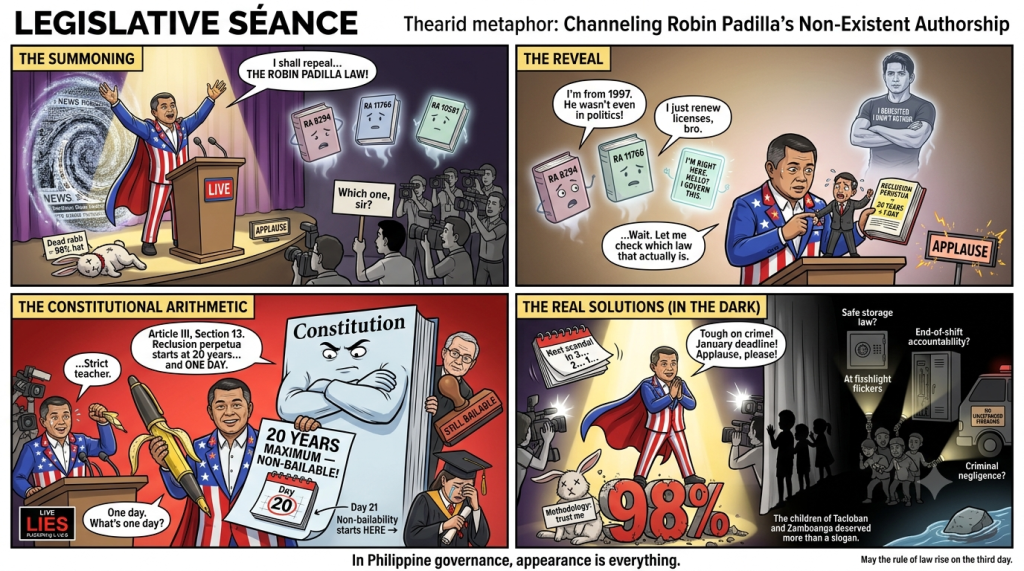
In the days following the Zamboanga shooting, Remulla told reporters the problem was the “Robin Padilla Law.” He asked Congress to repeal it. The initial reports identified this law as Republic Act No. 8294 (An Act Amending the Provisions of Presidential Decree No. 1866) — the 1997 statute that amended the martial-law-era Presidential Decree No. 1866 (PD 1866) and lowered penalties for illegal firearms possession.
But wait. Days later, after consulting what one presumes were actual lawyers, the narrative shifted. Now the target was Republic Act No. 11766 (An Act Fixing the Validity Period of the License to Own and Possess, Registration, and Permit to Carry Firearms Outside of Residence or Place of Business) — a 2022 law fixing license validity periods and permit renewal cycles. The Philippine News Agency (PNA) article under review dutifully reports this, calling RA 11766 the “Robin Padilla Law” over “claims” that the senator crafted it.
And here is where the thing unravels like a cheap barong.
RA 11766 is not the Comprehensive Firearms and Ammunition Regulation Act. That is Republic Act No. 10591 (Comprehensive Firearms and Ammunition Regulation Act), passed in 2013. RA 11766 merely amended Sections 7 and 19 of RA 10591 concerning license and permit validity. It contains not a single provision about bail. Not a syllable about penalties for illegal possession. It is, in the grand scheme of Philippine firearms jurisprudence, a legislative footnote.
Meanwhile, RA 8294 — the actual “Robin Padilla Law” of folk memory — was never authored by Padilla. He wasn’t even in politics in 1997. He was a beneficiary. The Supreme Court applied RA 8294 retroactively to reduce his sentence in 1997. That’s it. That’s the whole connection. The law was not named after him. It was not passed for him. It simply happened to help him.
So when Remulla stands before the nation and demands the repeal of the “Robin Padilla Law,” he is asking Congress to amend a law that doesn’t govern the subject, named after a man who didn’t author it, in response to a crime that the law he should be targeting already penalizes.
Somewhere, a law student is weeping.
THE CONSTITUTIONAL ARITHMETIC PROBLEM
But the farce deepens. Let us examine Remulla’s actual proposal with the precision it deserves — which is to say, none, because he didn’t bother.
He wants loose firearms possession to carry a maximum penalty of 20 years, and to be non-bailable.
Now, I am a humble blogger, not a constitutional law professor, but even I can read Article III, Section 13 of the 1987 Constitution:
“All persons, except those charged with offenses punishable by reclusion perpetua when evidence of guilt is strong, shall, before conviction, be bailable…”
Reclusion perpetua begins at 20 years and one day.
Remulla’s proposed maximum is 20 years flat.
Do you see the problem? The constitutional door to non-bailability swings open at reclusion perpetua. Remulla’s proposal stops one day short. One. Single. Day.
This is not a minor drafting error. This is the legislative equivalent of showing up to a gunfight with a banana. If Congress enacts this as described, every single accused loose-firearms offender will still be entitled to bail as a matter of right under Rule 114, Section 4 of the Rules of Court. The courts will have no choice. The proposal is self-defeating.
Unless — and here is the chilling possibility — Congress simply declares it non-bailable and dares the Supreme Court to strike it down. We have seen this gambit before. The Anti-Terrorism Act of 2020 (Republic Act No. 11479). The Dangerous Drugs Act (Republic Act No. 9165). Philippine legislators have a fondness for passing constitutionally dubious statutes and letting the judiciary clean up the mess years later, after the damage is done.
Remulla, a former governor with no law degree, may be forgiven for not knowing. But what’s the DILG legal staff’s excuse?
THE 98% MYTH AND OTHER NUMBERS PULLED FROM THE VOID
Then there is Remulla’s favorite statistic: 98% of gun-related crimes involve loose firearms.
Where does this number come from? What study? What methodology? What sample size? What time period? What definition of “loose firearm”?
The PNA report doesn’t say. The DILG press releases don’t say. The Philippine National Police (PNP), as far as the public record shows, hasn’t released the underlying data.
This is the rhetorical equivalent of a magician pulling a rabbit from a hat, except the rabbit is dead and the hat is on fire.
And even if the 98% figure were true — which I am not conceding — it proves prevalence, not causation. It doesn’t establish that making possession non-bailable will reduce gun crime. It doesn’t account for the fact that in both recent school shootings, the firearms were legally owned and legally issued. The Zamboanga shooter’s father was a Bureau of Customs employee who left his service weapon in a vehicle. The Tacloban shooter reportedly accessed a PNP-issued firearm.
These were not loose firearms in the criminal sense. They were lawful firearms that became loose through negligent storage.
Remulla’s proposal would not have prevented either tragedy.
THE NEGLIGENCE GAP REMULLA CONVENIENTLY IGNORES
This is where the satirical veneer begins to crack, and genuine anger seeps through.
Remulla could have proposed a safe-storage statute. He could have demanded criminal liability for licensed owners who negligently allow children access to firearms. He could have pushed for enhanced penalties for government employees who leave service weapons in vehicles. He could have called for mandatory gun safes, ammunition separation, and vehicle storage protocols for uniformed personnel.
These would have been directly responsive to the tragedies. These would have addressed the actual failure mode.
Instead, he chose the path of least political resistance: blame criminals, demand harsh penalties, name-drop Robin Padilla, and avoid the uncomfortable question of why government-issued firearms keep ending up in the hands of children.
This is not governance. This is theater.
And the audience — a grieving, frightened, information-starved public — deserves better.
THE POLITICAL ECONOMY OF TOUGH TALK
Let us not be naive. Remulla is a seasoned politician from the Cavite political dynasty. He knows that “tough on crime” rhetoric polls well. He knows that attacking a celebrity senator — even indirectly — generates headlines. He knows that school shootings create a legislative window that must be exploited quickly, before the next scandal (flood control, confidential funds, garbage contracts) consumes the news cycle.
And so we get the January deadline. The rush. The urgency. The “we can solve so many crimes” hyperbole.
But what we do not get is a single piece of evidence that the proposal, as described, would survive constitutional scrutiny, would deter actual criminals, or would prevent the next child from finding a loaded pistol in a parked SUV.
We get the appearance of action. And in Philippine governance, as any veteran observer knows, appearance is everything.
WHAT SHOULD ACTUALLY HAPPEN
If I may be so bold, allow me to propose an alternative.
First, amend the correct statute. That is RA 10591, Section 28. Not RA 8294. Not RA 11766. The law you are trying to fix is already there, and it already has a graduated penalty structure. Work with it.
Second, create a distinct offense for negligent firearm storage. This would directly address the Zamboanga and Tacloban fact patterns. Gradate penalties based on whether the negligence resulted in death, injury, or merely risk. Hold licensed owners and government employees to a higher standard.
Third, impose stricter custody rules for government-issued firearms. Service weapons should not be left in vehicles. There should be mandatory lockboxes, end-of-shift accountability, and disciplinary consequences for violations. This is an administrative reform that requires no constitutional amendment and no new criminal statute.
Fourth, release the actual data. If the PNP has a study showing 98% of gun crimes involve loose firearms, publish it. Methodology, sample, time period, definitions. Let the public evaluate the claim. Sunshine is the best disinfectant, as a wise jurist once said.
Fifth, and finally, stop blaming Robin Padilla for a law he didn’t write, didn’t pass, and didn’t control. The man’s actual legislative record on firearms is a matter of public record. Attack the statutes, not the folk legend.
CONCLUSION: THE RULE OF LAW, RESURRECTED OR BURIED
The Philippine legal system has survived martial law, nine constitutions, and countless rounds of legislative malpractice. It will survive Jonvic Remulla’s press conferences.
But the rule of law is not a machine that runs itself. It requires public officials to speak accurately, draft carefully, and govern honestly. When a Cabinet secretary cannot correctly identify the statute he wants amended, when he proposes a penalty that is constitutionally stillborn, when he invokes statistics without sources and deadlines without plans — the rule of law does not rise. It sinks.
Slowly, quietly, beneath the weight of its own discarded promises.
I am not saying Remulla’s instincts are entirely wrong. The firearms problem is real. Loose guns are a menace. Negligent owners should face consequences.
But instinct without rigor is just impulse. And impulse, in public policy, kills.
The children of Tacloban and Zamboanga deserved more than a slogan.
They deserved competent governance.
And so do we all.
May the rule of law rise on the third day. 🪨
— Barok
Key Citations
A. Legal & Official Sources
- The 1987 Constitution of the Republic of the Philippines. Official Gazette of the Republic of the Philippines, 1987, http://www.officialgazette.gov.ph/constitutions/the-1987-constitution-of-the-republic-of-the-philippines/the-1987-constitution-of-the-republic-of-the-philippines-article-iii/.
- Presidential Decree No. 1866. Codifying the Laws on Illegal/Unlawful Possession, Manufacture, Dealing In, Acquisition or Disposition, of Firearms, Ammunition or Explosives or Instruments Used in the Manufacture of Firearms, Ammunition or Explosives, and Imposing Stiffer Penalties for Certain Violations Thereof and for Relevant Purposes. 29 June 1983, http://www.officialgazette.gov.ph/1983/06/29/presidential-decree-no-1866-s-1983/.
- Republic Act No. 8294. An Act Amending the Provisions of Presidential Decree No. 1866, as Amended. 6 June 1997, http://www.officialgazette.gov.ph/1997/06/06/republic-act-no-8294/.
- Republic Act No. 10591. An Act Providing for a Comprehensive Law on Firearms and Ammunition and Providing Penalties for Violations Thereof (Comprehensive Firearms and Ammunition Regulation Act). 29 May 2013, lawphil.net/statutes/repacts/ra2013/ra_10591_2013.html.
- Republic Act No. 11766. An Act Fixing the Validity Period of the License to Own and Possess, Registration, and Permit to Carry Firearms Outside of Residence or Place of Business, Amending for the Purpose Sections 7 and 19 of Republic Act No. 10591. 6 May 2022, lawphil.net/statutes/repacts/ra2022/ra_11766_2022.html.
- Republic Act No. 11479. An Act to Prevent, Prohibit and Penalize Terrorism, Thereby Repealing Republic Act No. 9372, Otherwise Known as the “Human Security Act of 2007” (Anti-Terrorism Act of 2020). 3 July 2020, http://www.officialgazette.gov.ph/2020/07/03/republic-act-no-11479/.
- Republic Act No. 9165. An Act Instituting the Comprehensive Dangerous Drugs Act of 2002, Repealing Republic Act No. 6425, Otherwise Known as the Dangerous Drugs Act of 1972, as Amended. 7 June 2002, lawphil.net/statutes/repacts/ra2002/ra_9165_2002.html.
- Rules of Court. Rule 114 (Bail). lawphil.net/courts/rules/rc_110-127_1985.html.
B. News Reports
- Caliwan, Christopher Lloyd. “Remulla Urges Congress to Give Gun Laws More Teeth.” Philippine News Agency, 19 Aug. 2026, http://www.pna.gov.ph/articles/1282567.



Leave a Reply