How a Judge Out-Lawyered Seven Defense Attorneys Without Breaking a Sweat
By Louis “Barok” C. Biraogo | August 26, 2026
THEY say the wheels of justice grind slowly, but in the hallowed halls of the Sandiganbayan Third Division, they have recently been grinding with a deafening screech.
We find ourselves not in the realm of pesos and plunder, but in the echo chamber of the courtroom, where the very nature of a judge’s duty is being questioned. The Office of the Special Prosecutor (OSP), wielding a 69-page legal cudgel, has asked Associate Justice Ronald B. Moreno to step aside from the malversation trial of former Senator Ramon “Bong” Revilla Jr. The charge is not bribery, not conflict of interest, but something far more insidious and difficult to prove: the corrosion of impartiality.
This is not just a fight over a bail ruling. This is a fight for the soul of the Sandiganbayan, and the line between a vigorous search for truth and the assumption of the advocate’s robe.
The Spectacle of the Numbers
Let us dispense with pleasantries. The heart of the Ombudsman’s motion is a statistical anomaly so glaring it demands an explanation.
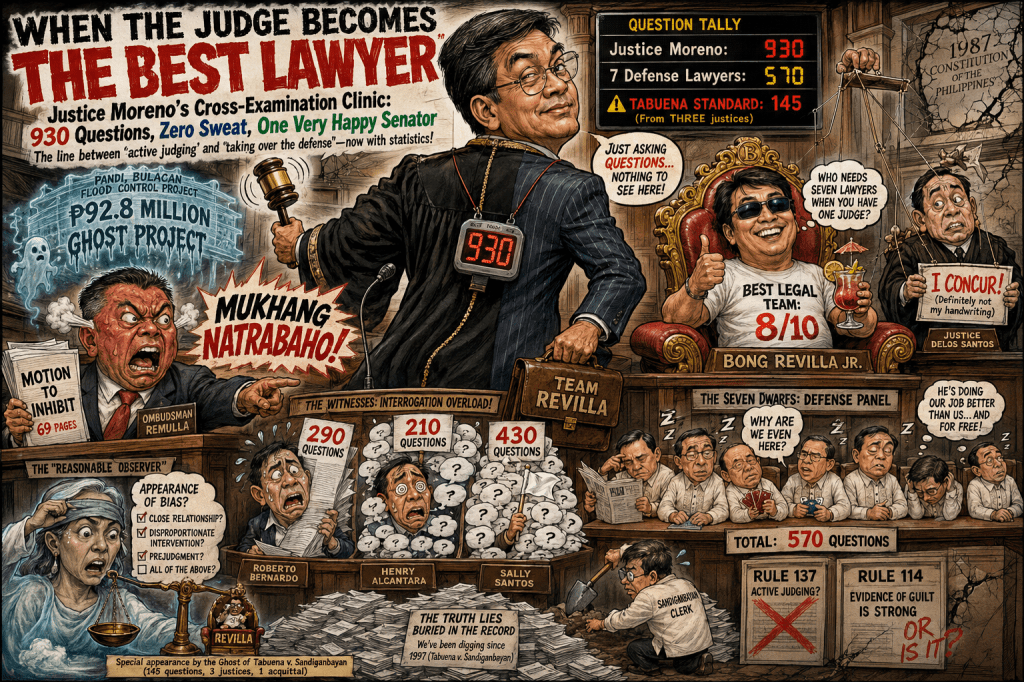
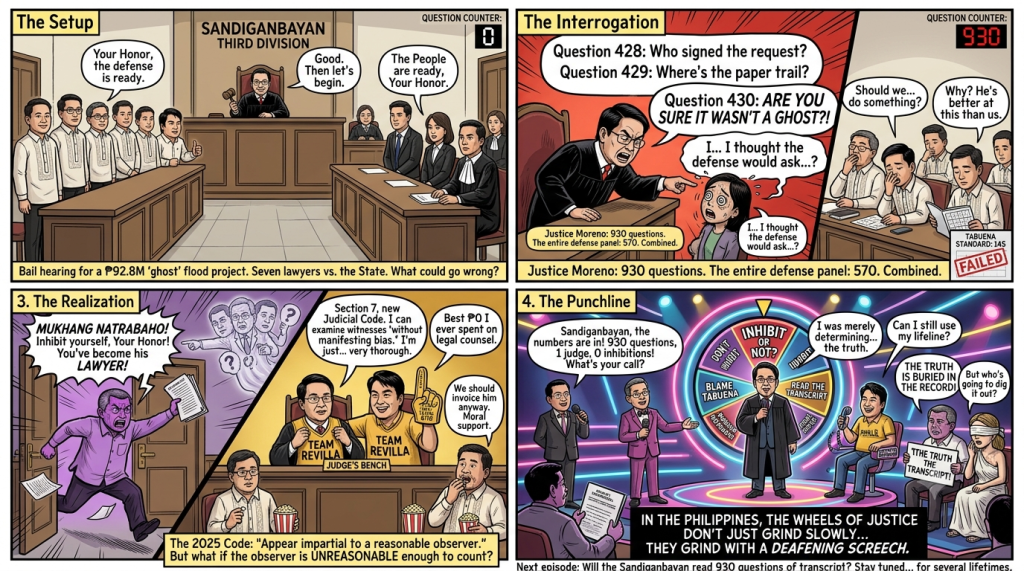
During the bail hearings for the alleged ₱92.8-million ghost flood-control project in Pandi, Bulacan, Justice Moreno engaged in a veritable cross-examination of the prosecution’s own witnesses. According to the OSP, he asked former Department of Public Works and Highways (DPWH) Undersecretary Roberto Bernardo 290 questions. The combined defense counsel for all seven accused? Only 210.
He asked former district engineer Henry Alcantara 210 questions. The defense? 190.
And in the most staggering display, he asked SYMS Construction’s Sally Santos 430 questions. The entire defense panel, representing all of the accused, managed a paltry 170.
Let that sink in. One magistrate, in a single hearing, asked more questions than seven lawyers defending their clients’ liberty. In total, Justice Moreno allegedly fired off 930 questions against the prosecution’s key witnesses.
The ghost of Tabuena v. Sandiganbayan (G.R. Nos. 103501-03) looms large. In that landmark 1997 case, the Supreme Court acquitted the accused after finding that a three-justice panel had asked a combined 145 questions, effectively transforming them into “magistrate and advocate” and denying the accused the “cold neutrality of an impartial judge.” If 145 questions from three justices was constitutionally alarming, what are we to make of 430 from one?
The legal framework is airtight: While Rule 137 of the Rules of Court (Rule 137) grants a judge discretion to inhibit for “just or valid reasons,” the A.M. No. 25-04-04-SC (2025 Code of Judicial Conduct and Accountability) has raised the stakes. Under Canon 3, a judge must not only be impartial but must appear impartial to a “reasonable, fair-minded and informed observer.”
But here is the rub, and I must be fair to the good Justice. The new Code, in Section 7, explicitly allows a judge to “take an active part in examining a witness to determine their credibility, as well as the truth of their testimony, without manifesting bias or prejudice.”
The Devil in the Transcript
The battle, therefore, will not be won on arithmetic alone. It will be won or lost in the granular details of the transcript.
A bail hearing for a non-bailable offense like malversation involving over ₱76 million is not a passive affair. The 1987 Constitution and Rule 114 of the Rules of Court (Rule 114) require the judge to determine if the “evidence of guilt is strong.” To do that, a judge must probe. He must test. He must be skeptical.
Justice Moreno has every right to ask: “Where is the paper trail? Did Revilla personally sign a request? Is the testimony of state witnesses reliable?”
The Ombudsman’s strongest argument is not the raw number of questions, but the tenor. The motion alleges “unfair, unreasonable, disrespectful” behavior and statements in open court suggesting there was “no evidence against accused Revilla as proponent.”
This is the crux. A judge who asks 500 questions to clarify a complex paper trail is a hero of jurisprudence. A judge who asks 500 questions to dismantle the prosecution’s witness and suggest the accused is innocent before the defense has even rested is an advocate in a black robe. This is the “cumulative effect” the prosecution is banking on.
Furthermore, the timing is far from sour grapes. This motion came after state witness Bernardo’s explosive testimony detailing cash deliveries to Revilla’s compound. The Ombudsman is trying to protect the integrity of the remaining proceedings from what they perceive as a hostile bench.
The Symmetry of Irony
We must also appreciate the beautiful, tragic irony of the situation.
In February, it was Revilla who sought to inhibit the Division Chair, Justice Karl Miranda, citing a conflict of interest. The court—with Moreno and Delos Santos concurring—denied it, rightly demanding “extrinsic evidence” of bias and chiding the defense for speculation.
Now, the prosecution seeks the ouster of Moreno. The defense will accuse the Ombudsman of “judge shopping.” The prosecution will say they are preserving due process. The legal standard, however, remains the same: clear and convincing evidence.
Can the Sandiganbayan grant the motion to remove Moreno without validating Revilla’s earlier, failed attempt to remove Miranda? If they deny it, are they ignoring the appearance of bias under the new Code?
This symmetry forces the court to show its hand. Will it apply the law with blind consistency, or will the outcome dictate the reasoning?
The Remulla Factor and Institutional Integrity
We cannot ignore the elephant in the room: Ombudsman Jesus Crispin Remulla.
He is a man I hold in high regard for his integrity and institutional mandate. He is fighting a two-front war: against the deeply entrenched culture of impunity, and against the public perception of a “fix.” His “mukhang natrabaho” comment, while criticized as intemperate, was the cry of a man deeply frustrated by a system that seems to bend for the powerful.
The motion filed by Special Prosecutor Mariflor Punzalan-Castillo is legally separate from Remulla’s rhetoric. But politically, they are inextricably linked. If the motion fails and Moreno remains, the public narrative of a “fix” for Revilla—a narrative fueled by years of acquittals in his Priority Development Assistance Fund (PDAF) cases—will solidify into gospel.
Yet, I must also defend the Judiciary’s mandate. Ombudsman Remulla prosecutes; he does not dictate. The danger of allowing a prosecutor to successfully remove a judge simply for ruling against the state is a chilling threat to judicial independence. If we allow this, we invite a world where judges fear to rule against the government, lest they be branded corrupt or biased and driven from the bench.
The Verdict
Where does this leave us?
Justice Moreno has a strong defense. He can point to the independent concurrence of Justice Delos Santos as proof that his conclusion on bail was not an aberration born of bias, but a legitimate legal interpretation. He can claim that his questioning was a necessary stress test of a prosecution case heavily reliant on immunized witnesses—men who, in his own colorful language, may have been “given immunity” despite being the ones who “made a mess” (katarantaduhan).
But the Ombudsman has a serious case. The appearance of impartiality is the bedrock of public trust. In a case involving a political dynasty, hundreds of millions of pesos, and a ghost project in Bulacan, the public must believe the judge is not just the defense’s best friend on the bench. The sheer volume of questioning, if proven to be advocacy-driven, crosses the line from “active judging” into “taking over the defense.”
The Unflinching Conclusion:
The solution here is not to cave to the “appearance of bias” standard lightly, nor to reflexively protect a colleague. The Sandiganbayan must do the hard, unglamorous work: read the transcripts.
They must look beyond the numbers and parse the language. Was Justice Moreno seeking clarity, or was he leading the witness? Was he testing credibility, or was he providing the alibi?
Secretary Remulla has a difficult, necessary role. He must fight for the State, but he must also respect the institution he fights before. His office was right to file this motion. It is a legitimate procedural remedy designed to ensure a fair fight. But he must now step back and let the Judiciary rule on its own conduct.
If the transcripts reveal a pattern of hostility and prejudgment, inhibition is the only path to preserve the integrity of this trial. If they reveal merely a strict judge doing his job, the motion must fail, and the Ombudsman must steel himself for battle under the gavel of a man who doubts his case.
The rule of law cannot survive if the powerful manipulate the courts. But neither can it survive if judges become champions of the accused. The truth—as it always does in this tormented country—lies buried in the record. Let us hope the Sandiganbayan has the courage to dig it out.
Key Citations
A. Legal & Official Sources
- The 1987 Constitution of the Republic of the Philippines. Official Gazette of the Republic of the Philippines, 1987, http://www.officialgazette.gov.ph/constitutions/1987-constitution/.
- Rule 137 of the Rules of Court. Disqualification of Judicial Officers. Lawphil Project, Arellano Law Foundation, lawphil.net/courts/supreme/rc/rc_137_judicial.html.
- Rule 114 of the Rules of Court. Bail. Lawphil Project, Arellano Law Foundation, http://www.lawphil.net/courts/rules/rc_110-127_1985.html.
- A.M. No. 25-04-04-SC. The 2025 Code of Judicial Conduct and Accountability. Supreme Court of the Philippines, 11 Nov. 2025, sc.judiciary.gov.ph/wp-content/uploads/2025/12/A.M.-NO.-25-04-04-SC.pdf.
- Tabuena v. Sandiganbayan, G.R. Nos. 103501-03 & 103507. Supreme Court of the Philippines, 17 Feb. 1997, lawphil.net/judjuris/juri1997/feb1997/gr_103501-03_1997.html.
B. News Reports
- Mendoza, John Eric. “Sandigan Justice Who Approved Revilla Bail Asked to Inhibit Over ‘Bias’.” Inquirer.net, 25 Aug. 2026, https://newsinfo.inquirer.net/2292116/sandigan-justice-who-approved-revilla-bail-asked-to-inhibit-over-bias.
- “Ang Hirap Maging Mahirap”: The PAO Scandal That Proves Government Contempt Is Nothing New

- “Far-Off” My Axx: Malacañang’s Claire Castro Drowns in Her Own Legal Gaslighting
- “Forthwith” to Farce: How the Senate is Killing Impeachment—And Why Enrile’s Right (Even If You Can’t Trust Him)

- “HINDI AKO NAG-RESIGN!”

- “I Know Nothing”: Baste Duterte’s Amnesia Defense Meets ₱33M in GenCorp Contracts

- “I’m calling you from my new Globe SIM. Send load!”

- “Mahiya Naman Kayo!” Marcos’ Anti-Corruption Vow Faces a Flood of Doubt

- “Manageable” Debt, Unmanageable Lies: DBM’s ₱21 Trillion Fairy Tale

- “Meow, I’m calling you from my new Globe SIM!”

- “Natrabaho”: One Word, One Ombudsman, and a Judiciary on Trial

- “No Special Jail for Crooks!” Boying Remulla Slams VIP Perks for Flood Scammers

- “Philippine-Controlled” or Yankee Gas Station? The Davao Fuel Depot Farce Exposed








Leave a Reply