
Sara Duterte’s Campaign Rally Disguised as an Impeachment Trial — and the Senate’s Complicity Therein
By Louis ‘Barok‘ C Biraogo — August 27, 2026
“Prove it with evidence, not insults” is a devastating battle cry—especially when the prosecution keeps handing you the ammunition.
Kweba ni Barok
I. The Statement That Was Actually a Scalpel
On August 26, 2026—Day 19 of the Senate impeachment trial—Vice President Sara Duterte released a one-page statement so surgically precise it might as well have been drafted by a pathologist performing an autopsy on the prosecution’s credibility.
“Prove the impeachable offense with evidence—not insults, speculation, or political theatrics.”
She’s not wrong. That’s the terrifying part.
The statement cites three specific episodes: Senator Raffy Tulfo calling hostile witness Gina Acosta “stupid… in the name of blind loyalty” (Day 17); prosecutor Mae Divinagracia asking witness Lemuel Ortonio about Duterte being the “architect” and “mastermind” of the confidential-fund scheme (Day 18); and an unnamed witness’s earlier “brat” characterization—most plausibly traceable to National Bureau of Investigation (NBI) Director Melvin Matibag’s cross-examination over his own column calling her “bratinella,” a term originating from Rodrigo Duterte himself.
Each episode, if you squint, looks like a violation of the very rules the impeachment court pretends to enforce. Each one makes the prosecution look less like constitutional guardians and more like frustrated undergrads who didn’t study for the final.
But here’s the sleight-of-hand: the statement makes you focus on three episodes while ignoring fifteen boxes of documentary evidence, hostile-witness admissions, Anti-Money Laundering Council (AMLC) reports, Commission on Audit (COA) disallowances, and bank records.
It’s a magician’s trick. Look at my left hand while my right hand makes the actual case disappear.
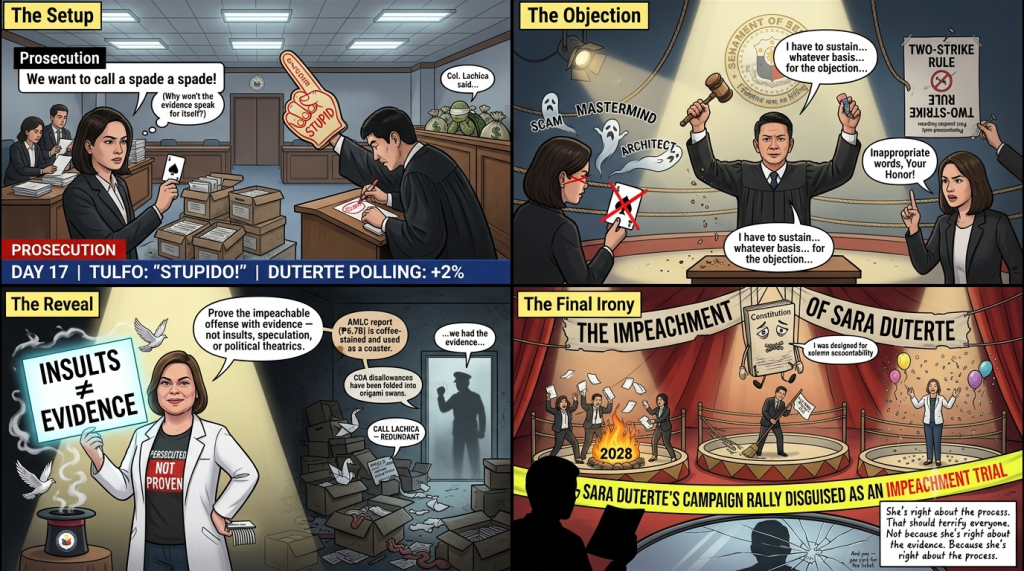
Sara Duterte’s impeachment magic trick: making 15 boxes of evidence disappear while you watch the insults.
II. A Taxonomy of Prosecutorial Desperation
Episode One: Tulfo’s “Stupid”
A sitting senator-judge—sworn to “impartial justice”—called a witness “stupid” on the record, in front of cameras, in front of the nation.
Acosta’s testimony was evasive to the point of performance art. She transferred ₱125 million in confidential funds to a security chief who wasn’t even a bonded disbursing officer. When pressed, her answers made “I don’t recall” sound like a confession of competence.
But the moment a senator-judge resorts to name-calling, he’s conceded the evidence isn’t doing the work. He’s become a heckler at a trial, not a judge.
Tulfo’s “stupid” isn’t an argument. It’s an admission of failure.
Episode Two: The “Mastermind” Objection
Divinagracia asked Ortonio about Duterte being the “architect” and “mastermind.” Defense objected. Presiding Officer Francis Escudero sustained the objection, directing the prosecution to use “more acceptable” language.
Divinagracia’s response? “We want to call a spade a spade.”
No, you want to call a spade a murder weapon before proving it’s even a spade.
The prosecution’s job is to elicit facts, not feed witnesses conclusions for the cameras.
Episode Three: The “Brat” That Wasn’t
This one is particularly delicious because it reveals the prosecution’s own hypocrisy.
Matibag was confronted by defense counsel about his prior column calling Duterte a “bratinella.” He responded—accurately—that the label originated with Rodrigo Duterte himself.
So the “insult” Duterte complains about was: (1) elicited by her own defense team; (2) from a prosecution witness; (3) about a column he wrote; (4) where the insult was coined by her own father.
You cannot make this up.
Duterte lumps this with the other “insults” as evidence of prosecutorial misconduct. It is, in fact, evidence of the defense’s cross-examination and the prosecution’s witness being dragged through his own editorial history.
The fact that she can get away with this—that the public will nod along—is the entire problem.
III. The Escudero Two-Strike Rule: Validation Without Consequence
The same day Duterte’s statement dropped, Escudero issued a “two-strike rule” for Rule 18 violations—the bar on public commentary about trial merits.
The order applies symmetrically. It threatens escalating sanctions—fines up to ₱30,000, Integrated Bar of the Philippines (IBP) or Supreme Court referral for lawyers.
But it is prospective only.
Tulfo faces no retroactive sanction for “stupid.” Divinagracia faces none for “mastermind.” The “bratinella” imbroglio is untouched.
It’s the institutional equivalent of a parent telling children, “From now on, no hitting,” after one child has already punched the other and the other has filed a complaint.
Duterte’s camp reads this as validation without consequence. The prosecution reads it as warning without teeth. The public watches a trial that increasingly resembles a political food fight.
IV. What Duterte Is Really Doing
Sara Duterte is not asking for a fair trial. She’s asking for a narrative. And she’s winning.
Her statement is a campaign document wrapped in legal language.
What she wants you to remember: “Insults are not evidence.” “The prosecution is engaging in political theatrics.” “The government is focused on impeachment instead of flooding and poverty.”
What she wants you to forget: ₱612.5 million in confidential funds with documented liquidation irregularities. Hostile-witness admissions about personal authorization. AMLC reports of ₱6.7 billion in suspicious transactions. COA disallowances. The authenticated recording of her own voice allegedly threatening assassination.
The “insults” she cites are real. They are improper. They are exactly what the impeachment court should prevent.
But they are also irrelevant to the underlying evidence.
A senator’s “stupid” comment doesn’t erase fifteen boxes of records. The “mastermind” objection doesn’t invalidate COA findings. The “bratinella” exchange doesn’t expunge AMLC reports.
Duterte’s genius—effective, if not admirable—is making the public believe decorum problems prove a weak case, rather than prosecutorial frustration with evasive witnesses and media-conscious overreach.
She has taken the prosecution’s worst moments and elevated them to the entire narrative.
V. The Prosecution’s Dirty Little Secret
Here’s what House prosecutors don’t want you to know: they are making exactly the mistakes Duterte is accusing them of making.
Not the “insults” part—that’s surface-level.
The deeper problem: the prosecution has not clearly articulated a theory connecting documentary evidence to constitutional impeachment standards.
They have evidence of irregularity. Evidence of questionable documentation. Hostile-witness admissions that Duterte was “informed” and “authorized.”
But “informed” and “authorized” are not the same as “personally directed misappropriation for personal gain.”
They need to prove the ₱125 million transferred to a non-bonded security chief was not poor administration but deliberate diversion. They need to prove ₱6.7 billion in suspicious transactions is not complicated family finances but unexplained wealth tied to public office.
And they need to do this with evidence, not adjectives.
They keep reaching for “mastermind” because the evidence, while substantial, isn’t yet doing the work on its own. Tulfo called Acosta “stupid” because the witnesses who could make the case are hostile, evasive, or absent.
They’re losing the public narrative because they’ve allowed Duterte to define the terms.
VI. The Lachica Problem
The prosecution has indicated it likely won’t call Col. Raymund Dante Lachica—the security chief who received the ₱125 million—directly, deeming his testimony “redundant.”
This is either strategic brilliance or a confession of weakness, and the prosecution hasn’t signaled which.
If Lachica would corroborate documents and provide direct testimony about Duterte’s instructions, calling him is essential, not redundant.
If Lachica would provide exculpatory or ambiguous testimony—saying funds were used legitimately, or that Duterte’s instructions were vague—then avoiding him is a calculated risk.
But the public will notice. They’ll ask: “Why isn’t the prosecution calling the man who actually received the money?”
If the answer is “redundant,” the public will wonder why direct testimony is unnecessary when documents and hostile witnesses leave gaps.
Duterte’s “prove it with evidence” becomes more powerful if the prosecution is seen as avoiding key witnesses.
VII. The Political Calculus: 2028 Is the Only Math That Matters
Conviction means removal and permanent disqualification. The most formidable 2028 presidential candidate is eliminated.
Acquittal means she remains Vice President, with a persecution narrative propelling an even stronger campaign. The impeachment becomes a political gift—”they tried to destroy me and failed.”
Senator-judges know this. Prosecutors know this. Duterte knows this.
“Insults are not evidence” is not just legal argument. It’s campaign slogan. It’s rallying cry. It’s a way of converting every prosecutorial misstep into political ammunition.
Every time a prosecutor says “mastermind,” Duterte’s polling goes up. Every time a senator calls a witness “stupid,” her supporters feel vindicated. Every time the court struggles with decorum, public faith erodes.
The prosecution is fighting a legal battle and a PR war—and losing both.
VIII. The Institutional Collapse We’re Watching
Beyond politics, beyond 2028, beyond the Marcos-Duterte drama, something deeper is happening.
The impeachment process is being revealed as structurally incapable of handling high-profile, politically charged cases with constitutional dignity.
Senate rules—Rule 18, the oath of impartiality—are being tested and found wanting. The “two-strike rule” admits existing rules weren’t enforced. Escalating sanctions acknowledge the system relies on good faith from participants with no incentive to act in good faith.
The Supreme Court already intervened once, voiding the first impeachment on procedural grounds. It may intervene again.
But the Court cannot make senator-judges behave like judges. It cannot make prosecutors stop grandstanding. It cannot make Duterte stop treating trial as campaign stop.
The impeachment court is not a court. It’s a political body performing quasi-judicial functions, revealing the limits of that fiction in real time.
IX. What Should Happen vs. What Probably Will
What should happen:
The prosecution should stop using loaded language, focus on documents, and call Lachica if material. Senator-judges should face retroactive sanctions for “stupid.” Escudero should apply the two-strike rule evenhandedly—including to Duterte’s own OVP statement if it constitutes commentary on merits. The trial should proceed with evidence, not rhetoric.
What probably will happen:
The prosecution will continue struggling with hostile witnesses and may avoid Lachica. Tulfo will face no consequences. The two-strike rule will be selectively applied. Duterte will continue using trial as campaign platform, and her polling will remain stable or improve. The trial will drag toward 2028, deepening public cynicism.
The real question isn’t whether the prosecution’s case is strong—it is, in parts, strong enough for serious consideration.
The real question is whether the process can survive the case.
On current evidence: probably not.
X. The Final Irony
Sara Duterte is right about one thing: impeachment must rest on evidence, not insults.
She’s wrong about what the evidence shows.
The tragedy: the prosecution handed her the “insults” argument on a silver platter, allowing her to distract from actual evidence of financial irregularities, questionable liquidations, and personal involvement.
The greater tragedy: the Senate impeachment court—charged with determining whether the Vice President betrayed public trust—has become a venue for grandstanding, name-calling, and political theater.
The Constitution’s impeachment process was designed as solemn accountability. It has become, in all parties’ hands, a political circus with constitutional stakes.
And Sara Duterte—of all people—is the one pointing out the dysfunction.
That should terrify everyone involved. Not because she’s right about the evidence.
Because she’s right about the process.
— Louis “Barok” C. Biraogo
Kweba ni Barok
August 26, 2026
Key Citations
A. News Articles
- Hernando-Malipot, Merlina, et al. “VP Sara Tells Prosecutors: Prove Impeachable Offense with Evidence, Not Insults.” Manila Bulletin, 26 Aug. 2026, https://mb.com.ph/2026/08/26/vp-sara-tells-prosecutors-prove-impeachable-offense-with-evidence-not-insults.
- “Duterte Trial: Acosta ‘Stupid in the Name of Blind Loyalty’ – Tulfo.” Philippine Daily Inquirer, 24 Aug. 2026, https://newsinfo.inquirer.net/2290947/duterte-trial-acosta-stupid-in-the-name-of-blind-loyalty-tulfo.
- “Impeachment Court Strikes Off ‘Scam,’ ‘Mastermind’ in VP Sara Duterte Trial.” GMA News Online, 25 Aug. 2026, https://www.gmanetwork.com/news/topstories/nation/999843/impeachment-court-strikes-off-scam-mastermind-in-vp-sara-duterte-trial/story/.
- Lalu, Gabriel. “Matibag: It Was Rodrigo Duterte Who First Called Sara a ‘Bratinella.’” Philippine Daily Inquirer, 21 July 2026, https://newsinfo.inquirer.net/2267800/matibag-it-was-rodrigo-duterte-who-first-called-sara-a-bratinella.
- Locus, Sundy. “Escudero ‘Wipes Slate Clean’ on Past Sub Judice Remarks but Warns of Sanctions.” Rappler, 26 Aug. 2026, https://www.rappler.com/philippines/escudero-ruling-sub-judice-rule-violations-warns-sanctions/.
B. Reports & Studies
- Reganit, Jose Cielito. “AMLC Reports P6.7B in ‘Red-Flag’ Transactions Tied to VP Sara Accounts.” Philippine News Agency, 22 Apr. 2026, https://www.pna.gov.ph/articles/1273472.
- “Articles of Impeachment against Sara Duterte.” Wikisource, 2026, https://en.wikisource.org/wiki/Articles_of_impeachment_against_Sara_Duterte.
C. Official Websites
- Office of the Vice President of the Philippines. Official Website, https://ovp.gov.ph/.
- Anti-Money Laundering Council. Official Website, https://www.amlc.gov.ph/.
- Commission on Audit. Official Website, https://www.coa.gov.ph/.
- National Bureau of Investigation. Official Website, https://nbi.gov.ph/.
- Integrated Bar of the Philippines. Official Website, https://www.ibp.ph/.
- “First Impeachment of Sara Duterte.” Wikipedia, https://en.wikipedia.org/wiki/First_impeachment_of_Sara_Duterte.
- “Ang Hirap Maging Mahirap”: The PAO Scandal That Proves Government Contempt Is Nothing New
- “Far-Off” My Axx: Malacañang’s Claire Castro Drowns in Her Own Legal Gaslighting
- “Forthwith” to Farce: How the Senate is Killing Impeachment—And Why Enrile’s Right (Even If You Can’t Trust Him)
- “HINDI AKO NAG-RESIGN!”

- “I Know Nothing”: Baste Duterte’s Amnesia Defense Meets ₱33M in GenCorp Contracts

- “I’m calling you from my new Globe SIM. Send load!”

- “Mahiya Naman Kayo!” Marcos’ Anti-Corruption Vow Faces a Flood of Doubt

- “Manageable” Debt, Unmanageable Lies: DBM’s ₱21 Trillion Fairy Tale
- “Meow, I’m calling you from my new Globe SIM!”

- “Natrabaho”: One Word, One Ombudsman, and a Judiciary on Trial
- “No Special Jail for Crooks!” Boying Remulla Slams VIP Perks for Flood Scammers

- “Philippine-Controlled” or Yankee Gas Station? The Davao Fuel Depot Farce Exposed





Leave a Reply