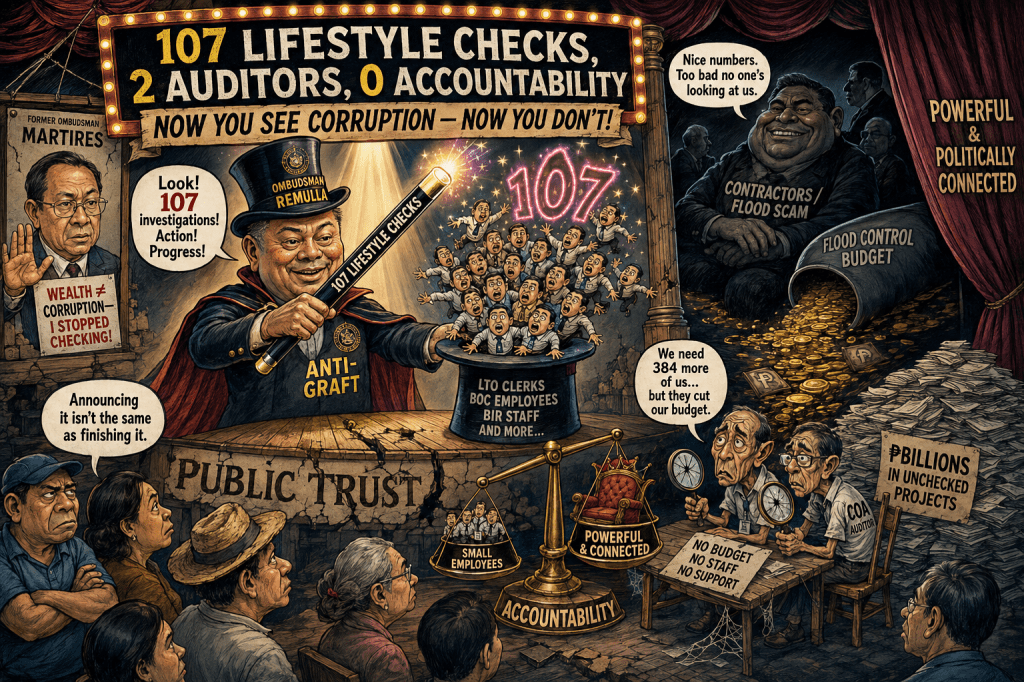
Now You See Corruption, Now You Don’t: The Prestige of Philippine Anti-Graft Theater
By Louis ‘Barok‘ C. Biraogo | August 28, 2026
GATHER round, mga ka-kweba, because the theater of Philippine governance has once again opened its curtains. This week’s matinee? A tale of two admissions that, on their face, appear to have nothing to do with one another.
One is a headline engineered to inspire awe: 107 officials under lifestyle check, a number that suggests a government finally serious about corruption. The other is a quiet confession delivered during a budget hearing, a bureaucratic whisper that most reporters buried beneath the more sensational lede: the Commission on Audit (COA) still doesn’t have enough auditors to find a ghost project if it tripped over one.
But here at the Kweba, we don’t do surface readings. We do forensics. And when you examine the cadaver of this particular news cycle, you discover something far more interesting than either story alone. You discover an accountability chain that is only as strong as its weakest link—and that link, my friends, is currently held together with spit and the audacity of men who believe announcing investigations is the same as conducting them.
I. THE POLITICAL THEATER OF 107
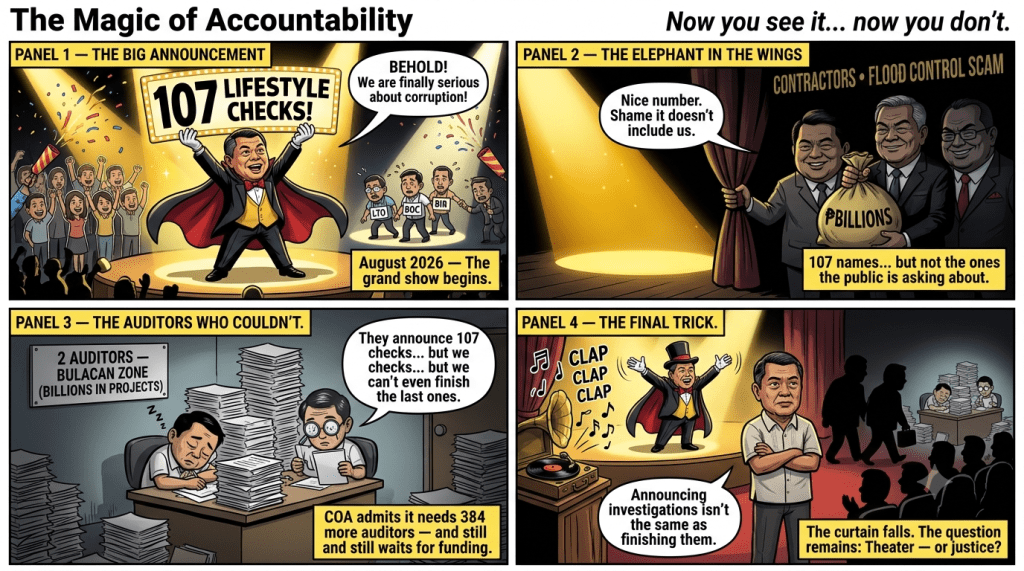
Let us begin with the number itself. One hundred and seven. It has a certain biblical weight to it, doesn’t it? It suggests comprehensiveness. It suggests action. It suggests, to the casual news consumer scrolling through their feed, that the Ombudsman is finally doing what his predecessor spent seven years refusing to do.
Ombudsman Jesus Crispin “Boying” Remulla, the former Justice Secretary turned constitutional watchdog, wants you to know that he is not Samuel Martires. Where Martires saw “vague and illogical” provisions, Remulla sees a constitutional mandate. Where Martires worried about “weaponized” Statements of Assets, Liabilities and Net Worth (SALNs), Remulla sees tools that had been left to rust. Where Martires asked “what business is it of ours how people live?” Remulla answers with a number: 107.
But here’s the thing about numbers. They are excellent at creating impressions and terrible at creating accountability.
What does “under lifestyle check” actually mean? Does it mean 107 officials have been formally investigated, with subpoenas issued and bank records requested? Or does it mean 107 names have been entered into a spreadsheet, cross-referenced against property databases, and flagged for further review? Does it mean 107 cases will be filed next month? Or does it mean 107 people will spend the next three years wondering if they should hire lawyers?
Remulla didn’t say. And no one in Congress thought to ask.
The Philstar report—the same report that has been dutifully repackaged by every outlet from here to Davao—contains the Ombudsman’s targeting rationale: these are “income-generating agencies” where “most of the lifestyle sins happen.” The Land Transportation Office (LTO). The Bureau of Customs (BOC). Perhaps the Bureau of Internal Revenue (BIR). These are the agencies where cash flows like water and where a lowly clerk can, through the magic of “facilitation fees,” accumulate assets that would make a congressman blush.
The logic is not without merit. If you wanted to find unexplained wealth, you could do worse than start with agencies where money changes hands in unmarked envelopes. But there’s a difference between risk-based targeting and stereotyping, and Remulla’s formulation—while perhaps rhetorically satisfying—does little to establish which one he’s actually doing.
More importantly, it doesn’t answer the question that should be hanging over this entire exercise: What about the flood control scandal?
II. THE ELEPHANT IN THE ROOM WEARING A CONGRESSIONAL PIN
Because here’s the thing that should bother anyone who takes anti-corruption seriously. The Ombudsman has already announced that 26 members of the House of Representatives—the so-called “congtractors”—are under scrutiny for their alleged connections to government contracting. He has described Davao City as a possible “epicenter” of flood-control corruption. He has accused the camp of former Speaker Martin Romualdez of orchestrating witness recantations in the flood-control case.
And yet, the number he chose to publicize this week was 107—a figure composed almost entirely of nameless bureaucrats from agencies with limited political cover.
I want to be very precise here, because this is important. Nothing in the public record establishes that Remulla is protecting anyone. The fact that he’s announced investigations into congressmen at all is more than many of his predecessors have done. The fact that he’s publicly identified Romualdez’s camp—Romualdez being the President’s cousin, for those keeping score at home—suggests a willingness to go where the evidence leads, even when that evidence leads uncomfortably close to Malacañang.
But the optics, as they say in politics, are not ideal.
When you announce 107 lifestyle checks against LTO and BOC officials—people who cannot fight back effectively, people who lack the legal resources and political connections to make your life difficult—while the legislators who allegedly turned the flood control budget into a personal ATM remain at the “fact-finding” stage, you invite a particular critique. You invite the critique that you are doing what is easy rather than what is necessary.
This is not a new pattern. It is the Filipino anti-corruption playbook, refined over decades: sacrifice the replaceable to protect the powerful, announce investigations to create the impression of action, and hope that the public’s attention span expires before anyone asks what actually happened to those investigations.
Whether Remulla breaks this pattern remains to be seen. But the early indicators are not encouraging.
III. THE MARTIRES DOCTRINE AND ITS DISCONTENTS
Let us take a moment to appreciate the sheer audacity of Samuel Martires’s tenure as Ombudsman.
Here is a man who was appointed by President Duterte in 2018, took one look at the legal architecture of Philippine anti-corruption law, and decided—unilaterally, without legislative amendment or judicial review—that a significant portion of it was unenforceable. His reasoning was that the “modest living” requirement under RA 6713—the Code of Conduct and Ethical Standards for Public Officials and Employees—is “vague and illogical,” a conclusion he reached without bothering to propose a legislative fix. His solution was not to propose clarifying legislation or to issue guidelines that would make the standard more objective. His solution was to simply stop enforcing it.
This is what institutional self-neutering looks like. It is the Ombudsman equivalent of a police chief deciding that because the murder statute doesn’t define “malice aforethought” with sufficient precision, he will no longer investigate homicides.
But here’s what makes this particularly galling. Martires, as an Associate Justice of the Supreme Court, had participated in the 2018 decision in Republic v. Sereno, which held that the SALN requirement is not merely formal but substantive—that failure to comply with it constitutes a lack of integrity. He knew, or should have known, that the Supreme Court had already addressed the “vagueness” argument and found it wanting. He simply chose to ignore it.
There are only two possible explanations for this. Either Martires genuinely believed that the Supreme Court was wrong and that his interpretation of the Constitution somehow superseded theirs, or he was serving a different master entirely—a President who had no interest in seeing his allies subjected to lifestyle scrutiny.
I know which explanation I find more plausible.
What matters now is that Remulla has reversed course. He has restored the practice that Martires shelved. He has reopened the SALN access that Martires restricted. He has, in effect, declared war on the Martires Doctrine—and by extension, on the Duterte-era philosophy of anti-corruption as public relations rather than public policy.
For this, he deserves credit. Not uncritical credit, because uncritical credit is how we ended up with Martires in the first place. But credit nonetheless.
IV. THE CONSTITUTIONAL ARCHITECTURE (Or: Why Remulla Has the Law on His Side)
Let me be clear about something that the breathless coverage has largely obscured: Remulla is on exceptionally strong legal ground here.
The 1987 Constitution is not subtle about this. Article XI, Section 1 declares that “public office is a public trust” and requires officials to “lead modest lives.” This is not a suggestion. It is not a guideline. It is a constitutional mandate, written in the language of obligation, imposed on every person who accepts public office.
RA 6713, the Code of Conduct and Ethical Standards, operationalizes this mandate in Section 4(h), which requires officials to “lead modest lives appropriate to their positions and income” and prohibits “extravagant or ostentatious display of wealth in any form.”
RA 1379, otherwise known as the Forfeiture Law, is the oldest tool in the forfeiture arsenal, the oldest tool in the forfeiture arsenal, creates the operative presumption: property “manifestly out of proportion” to an official’s salary and lawful income is presumed prima facie to have been unlawfully acquired. Section 6 shifts the burden to the official to explain the source of the wealth.
RA 3019, the Anti-Graft and Corrupt Practices Act, reproduces this presumption and adds automatic dismissal grounds for officials who cannot account for their wealth.
RA 6770, the Ombudsman Act, gives the Ombudsman broad investigative authority, including the power to investigate “any act or omission of any public officer or employee” that “appears to be illegal, unjust, improper, or inefficient.”
The Supreme Court has blessed this architecture repeatedly. Cabal v. Kapunan upheld the burden-shifting mechanism against due process and self-incrimination challenges. The Marcos jewelry forfeiture cases reaffirmed the “manifestly out of proportion” presumption. Office of the Ombudsman v. Valencia recognized that evidence of a lavish lifestyle grossly disproportionate to government income can constitute substantial evidence of administrative dishonesty.
And in Republic v. Rabusa, the Court recognized that unexplained wealth cases can fall within the statutory exceptions to bank secrecy—meaning that the Ombudsman may, under certain circumstances, access bank records that would otherwise be confidential.
This is not a weak legal position. This is a fortress.
The problem is not that Remulla lacks authority. The problem is that authority alone is insufficient.
V. THE AUDITOR SHORTAGE THAT EVERYONE SHOULD BE TALKING ABOUT
Here is where the story takes a turn that most coverage missed entirely.
During the same budget hearing where Remulla announced the 107 lifestyle checks, COA Chairman Gamaliel Cordoba and Assistant Commissioner Lorna Cabochan made a separate admission. COA, they said, still needs almost 400 additional field auditors. The Department of Budget and Management (DBM) had removed 716 positions from COA’s plantilla—removed them—and had only restored 332.
Let that sink in. The agency constitutionally responsible for auditing every government transaction, every peso spent, every project funded, is operating with a field-auditor deficit so severe that its own leadership is warning of a “repeat performance of 2025″—the year the flood-control scandal erupted.
And here’s the detail that should make your blood run cold: according to Akbayan Representative Percival Cendaña, the Department of Public Works and Highways (DPWH)’s first district engineering office in Bulacan—ground zero for the flood-control scandal—had only two auditors assigned to it.
Two auditors. For an office responsible for auditing infrastructure projects worth billions of pesos.
What do two auditors do when faced with the volume of transactions that flow through a major DPWH engineering office? They triage. They prioritize. They sign off on what they can, defer what they can’t, and hope that nothing explodes before the next audit cycle.
This is not auditing. This is a performance of auditing.
And it matters because lifestyle checks are not self-executing. They are the investigative equivalent of a promise—a promise to examine whether an official’s wealth is commensurate with their income. But to make that determination, you need evidence. You need SALN entries, BIR records, property records, bank data, and—crucially—audit findings that establish whether the official had access to illicit funds in the first place.
Without COA’s field auditors doing the preventive work—identifying irregular transactions, flagging suspicious disbursements, verifying that projects actually exist—the Ombudsman’s lifestyle checks are doing forensic accounting on a body that was never properly monitored while it was still breathing.
The ₱2.5 billion that COA is requesting for 146 additional pre-audit teams is not a luxury. It is the minimum necessary to prevent the next flood-control scandal from happening in the first place.
And yet, as of this writing, Congress has not committed to funding it.
VI. THE VERDICT ON REMULLA: Cautious, Conditional, and Completely Earned
So where does this leave us?
Let me be honest about my assessment of Ombudsman Remulla. He is, at the very least, a marked improvement over his predecessor. Samuel Martires spent seven years dismantling the Ombudsman’s institutional credibility, treating the office as a vehicle for protecting the powerful rather than holding them accountable. Remulla, whatever his flaws, has at least recognized that the Martires Doctrine was a disaster and has taken concrete steps to reverse it.
The resurrection of lifestyle checks is legally sound. The targeting of high-risk agencies is, in principle, defensible. The willingness to confront the flood-control scandal—even if progress has been slower than the public deserves—suggests that this is not merely theater.
But caution is warranted. And the caution stems from three specific concerns.
- First, the opacity. Announcing “107 officials” without providing any breakdown by agency, rank, or stage of investigation is not transparency. It is the appearance of transparency, which is often worse. The public cannot evaluate an investigation it cannot see. Congress cannot exercise oversight over a process it cannot examine. And the 107 officials themselves—some of whom may be entirely innocent—cannot defend themselves against an accusation that has no specifics attached to it.
- Second, the selectivity optics. The fact that the 107 are concentrated in agencies with limited political cover, while the legislators allegedly involved in the flood-control scandal remain at an earlier stage of investigation, creates a perception problem that will not be resolved by assertion alone. Remulla needs to demonstrate, through action rather than rhetoric, that the same evidentiary standards apply to the powerful and the powerless alike.
- Third, the institutional capacity gap. It is all well and good to announce lifestyle checks. But if COA cannot provide the audit trail necessary to corroborate findings of unexplained wealth, those checks will produce headlines, not convictions. And headlines without convictions are how institutions lose credibility.
VII. THE CLOSING ARGUMENT
The Philippine anti-corruption story is a cycle. It follows a pattern that is depressingly familiar to anyone who has followed governance in this country for more than a few years.
A scandal erupts. A new official is appointed to fix it. That official announces sweeping investigations and ambitious reforms. The public applauds. Time passes. The investigations stall. The reforms are quietly shelved. The official moves on. Nothing changes.
The question that Remulla faces is whether he will break this cycle or become another entry in it.
The legal authority is there. The constitutional mandate is there. The political moment—with the flood-control scandal still fresh and public anger still acute—is there.
But the structural support is not. The COA auditor shortage means that the preventive function of anti-corruption is compromised. The political pressure from above means that the Ombudsman’s independence will be tested. The temptation to prioritize easy targets over powerful ones means that the appearance of justice will constantly threaten to substitute for the reality of it.
Remulla has made a start. He has reversed Martires. He has announced investigations. He has put names and numbers into the public record.
But starts are not finishes. And the Filipino public—cynical, exhausted, but still watching—is waiting to see which one this is.
Barok’s Verdict: CAUTIOUS APPLAUSE
The Ombudsman has resumed enforcing laws his predecessor chose to ignore, which is the minimum required of his office. Whether this represents genuine institutional renewal or merely a more sophisticated form of political theater depends on factors that no press release can establish: the depth of the investigations, the neutrality of their application, and the willingness to let the evidence lead where it leads—even when it leads to Malacañang’s doorstep.
The 107 will be watching. So will we.
Key Citations
A. Legal & Official Sources
- Constitution of the Republic of the Philippines. 1987. Official Gazette, http://www.officialgazette.gov.ph/constitutions/1987-constitution/.
- Republic Act No. 1379. An Act Declaring Forfeiture in Favor of the State Any Property Found to Have Been Unlawfully Acquired by Any Public Officer or Employee. 18 June 1955. Lawphil, lawphil.net/statutes/repacts/ra1955/ra_1379_1955.html.
- Republic Act No. 3019. Anti-Graft and Corrupt Practices Act. 17 Aug. 1960. Lawphil, lawphil.net/statutes/repacts/ra1960/ra_3019_1960.html.
- Republic Act No. 6713. Code of Conduct and Ethical Standards for Public Officials and Employees. 20 Feb. 1989. Official Gazette, https://www.officialgazette.gov.ph/1989/02/20/republic-act-no-06713/.
- Republic Act No. 6770. The Ombudsman Act of 1989. 17 Nov. 1989. Official Gazette, http://www.officialgazette.gov.ph/1989/11/17/republic-act-no-6770/.
- Cabal v. Kapunan. G.R. No. L-19052. Supreme Court of the Philippines, 29 Dec. 1962. Lawphil, http://www.lawphil.net/judjuris/juri1962/dec1962/gr_l-19052_1962.html.
- Republic v. Sereno. G.R. No. 237428. Supreme Court of the Philippines, 11 May 2018. Supreme Court E-Library, elibrary.judiciary.gov.ph/thebookshelf/showdocs/1/64083.
- Office of the Ombudsman v. Valencia. G.R. No. 183890. Supreme Court of the Philippines, 13 Apr. 2011. Supreme Court E-Library, elibrary.judiciary.gov.ph/thebookshelf/showdocs/1/36395.
- Republic v. Rabusa. G.R. No. 208183. Supreme Court of the Philippines, 2 Aug. 2022. Lawphil, lawphil.net/judjuris/juri2022/aug2022/gr_208183_2022.html.
B. News Articles
- Cruz, James Patrick. “COA Says It Lacks 384 Auditors to Keep Watch over Public Funds.” Rappler, 26 Aug. 2026, http://www.rappler.com/philippines/commission-audit-lack-manpower-budget-2027/.
- Galvez, Daphne. “Ombudsman Says 107 Government Execs on Lifestyle Checks.” Philstar.com, 27 Aug. 2026, http://www.philstar.com/headlines/2026/08/27/2552114/ombudsman-says-107-government-execs-lifestyle-checks.
- Gavilan, Jodesz. “Ombudsman Probe Tags Romualdez as ‘Central Figure’ in Flood Control Corruption Scheme.” Rappler, 20 July 2026, http://www.rappler.com/philippines/ombudsman-investigation-martin-romualdez-central-figure-flood-control-corruption/.
- Inquirer Staff. “‘A Cause for Concern’: COA Admits Shortage of Auditors.” Inquirer.net, 25 Aug. 2026, newsinfo.inquirer.net/2292354/a-cause-for-concern-coa-admits-shortage-of-auditors.
- Mangaluz, Jean. “COA on Why Auditors Missed the Flood Control Scam in Bulacan.” Philstar.com, 13 Oct. 2025, http://www.philstar.com/headlines/2025/10/13/2479619/coa-why-auditors-missed-flood-control-scam-bulacan.
- Manila Bulletin Staff. “Remulla Calls Davao ‘Epicenter of Flood Control’—but Changes Tone Quickly After.” Manila Bulletin, 25 Aug. 2026, mb.com.ph/2026/08/25/remulla-calls-davao-epicenter-of-flood-control-but-changes-tone-quickly-after.
- Panti, Llanesca T. “Martires Stops Lifestyle Checks on Public Officials, Says Wealth Does Not Translate to Corruption.” GMA News Online, 22 Sept. 2020, http://www.gmanetwork.com/news/topstories/nation/756625/martires-stops-lifestyle-checks-on-public-officials-says-wealth-does-not-translate-to-corruption/story/.
- Rappler Staff. “Ombudsman Remulla Lifts Duterte-Time SALN Restriction Rule.” Rappler, 14 Oct. 2025, http://www.rappler.com/philippines/ombudsman-boying-remulla-lifts-duterte-saln-restriction-rule/.
- Trazo, Carlos. “Remulla: ‘Congtractors’, Engineers among Almost 200 People Involved Flood Control Mess.” ABS-CBN News, 2 Oct. 2025, http://www.abs-cbn.com/news/nation/2025/10/2/remulla-congtractors-engineers-among-almost-200-people-involved-flood-control-mess-0029.






Leave a Reply