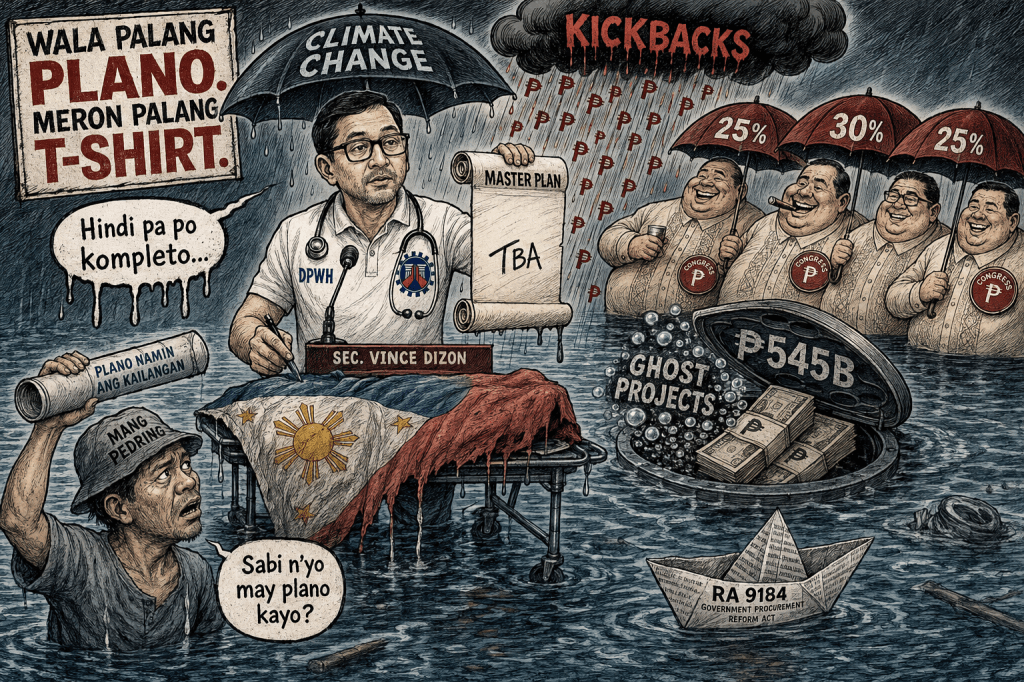
The DPWH’s New Strategy: Confess to Everything, Fix Nothing, Blame the Rain
By Louis ‘Barok‘ C. Biraogo — August 27, 2026
SO, let me get this straight.
Secretary Vince Dizon—the man appointed as the great, incorruptible “cleaner” of the Department of Public Works and Highways (DPWH)—marched into the House Committee on Appropriations and, with the calm of a surgeon announcing the patient died hours ago, declared that the national government has no complete master plans for flood mitigation.
Not a single one. Nationwide.
He said, and I quote from the report, “Hindi pa po kompleto ang ating master plans nationwide.” Then he doubled down: the National Capital Region—the seat of government, the crown jewel, the place where a single afternoon thunderstorm turns EDSA into a water park—has no master plan except in Quezon City, Pasig, Marikina, and Manila.
And then, with a straight face that would make a poker champion weep with envy, he blamed climate change for why we can’t use old plans.
Ah, yes. Climate change. The all-purpose villain. The same climate change that has been scientifically documented since, oh, the 1980s. The same climate change that the Philippines legislated against in 2009 with Republic Act No. 9729 (Climate Change Act of 2009). The same climate change that has been the subject of countless UN conferences, papal encyclicals, and Greta Thunberg’s Twitter feed for decades.
And we’re supposed to believe that the DPWH—an agency that has spent P545 billion on flood control from 2022 to 2025—just discovered that climate change might affect drainage?
This isn’t an admission. This is a confession to gross inexcusable negligence.
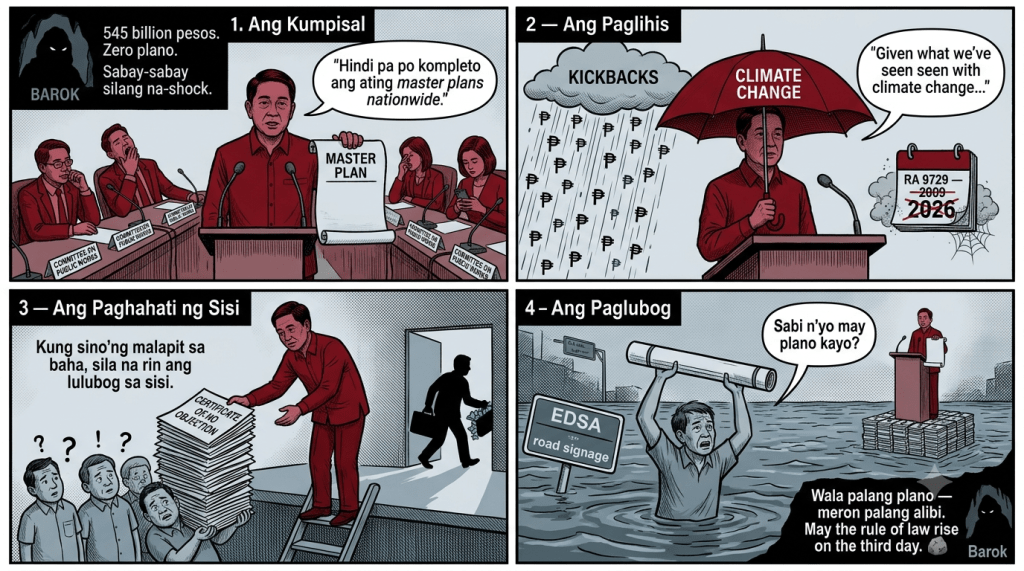
The Art of the Deflective Confession
Let me be very clear about what happened in that hearing room. This was not a moment of courageous transparency. This was a calculated, sophisticated, and deeply cynical political maneuver.
The timing is impeccable. Dizon made this statement during budget deliberations for 2027. The proposed flood control budget is P107.4 billion—the lowest since 2019. Congress is sniffing around. The ghost projects scandal is still fresh. The “Trillion Peso March” happened in September 2025. Former Appropriations Chair Zaldy Co has fled to Europe after alleging P1 billion was delivered to a Justice Undersecretary on behalf of the President.
And here comes Dizon: “Actually, we never had proper plans. So the problem isn’t corruption—it’s that we don’t have master plans! Give us money for planning!”
This is the classic bureaucratic two-step:
- Confess to a systemic failure that implicates everyone and therefore no one.
- Demand more money and more time to “fix” it.
- Blame the local governments by requiring “certificates of no objection” and coordination with Regional Development Councils, Provincial Development Councils, and Local Development Councils.
That last part is particularly delicious. Dizon wants local government units (LGUs) to sign off on DPWH projects. Why? So that when the next ghost project is discovered, the local officials can share the liability. It’s not a coordination mechanism—it’s a liability diffusion mechanism.
Under the Local Government Code of 1991 (Republic Act No. 7160), flood control remains a national mandate. You can’t just shove that responsibility onto mayors and governors and call it “coordination.” That’s called an unfunded mandate with a side of scapegoating.
The Ghosts of Billions Past
Let’s talk about what happens when you spend P545 billion without master plans.
You get 421 validated ghost projects. You get 15 contractors cornering P100 billion. You get the Discaya and Co families—the twin dynasties of disaster—who between them controlled nearly P47 billion in flood control contracts while holding sway over the House Appropriations Committee.
You get a system where, according to witness testimony, legislators took 25 to 30 percent of project costs as kickbacks. Where district engineers acted as glorified bagmen. Where contractors were forced into “mutual benefit agreements” that benefited everyone except the Filipino taxpayer.
And now Dizon tells us the foundational problem is that we didn’t have enough paperwork?
No. The foundational problem is that the DPWH has been run as a criminal enterprise, and the lack of master plans was not an oversight—it was a feature. You can’t have ghost projects if you have rigorous, scientifically validated master plans. You can’t funnel billions to favored contractors if projects must adhere to a comprehensive, publicly available plan. You can’t manufacture “emergency” appropriations if there’s already a clear roadmap for what needs to be built and where.
The absence of master plans was the point.
The Climate Change Alibi
Dizon said, “Alam naman po natin given what we have seen with climate change, the updating of master plan is critical because they have a direct impact on the engineering design of the infrastructures that need to be built.”
Yes, Secretary. We know. The entire scientific community has known. The Climate Change Act of 2009—which was passed when you were still working for the Bases Conversion and Development Authority (BCDA)—explicitly mandated that local governments regularly update their Local Climate Change Action Plans. The DPWH has had sixteen years to comply with the spirit and letter of that law.
Sixteen years.
In that time, we’ve had Typhoon Ondoy (2009), Typhoon Yolanda (2013), Typhoon Ulysses (2020), and countless other disasters that turned streets into rivers and homes into coffins. And the DPWH’s response was to spend half a trillion pesos on projects that, in hundreds of cases, did not exist.
Dizon’s climate change excuse is not just scientifically obvious—it’s legally damning. Under Republic Act No. 3019 (Anti-Graft and Corrupt Practices Act), Section 3(e), public officials are liable for causing “undue injury to any party, including the Government” through “gross inexcusable negligence.” Failure to develop flood mitigation master plans for over a decade while spending billions on unplanned projects is the very definition of that offense.
The Supreme Court in Amposta-Mortel v. People (2023) affirmed that a “lackadaisical attitude towards duties” constitutes sufficient basis for criminal liability. If that’s the standard, then the entire DPWH leadership—past and present—should be lawyering up.
The Legal Black Hole
Let’s get technical for a moment, because the legal implications of Dizon’s statement are staggering.
Under the Government Procurement Reform Act (Republic Act No. 9184), all procurement must be conducted “in accordance with the Annual Procurement Plan” and must be “meticulously and judiciously planned.” For infrastructure projects, this includes considerations of “engineering design and acquisition of right-of-way.”
If there were no master plans, then there was no proper planning. If there was no proper planning, then every flood control project procured under the old system is potentially voidable.
Every contract. Every disbursement. Every P545 billion pesos.
The Ombudsman’s ongoing preliminary investigation into flood control anomalies should take note: Dizon has just handed them a roadmap for prosecution. He has effectively testified—under oath, in a public congressional hearing—that his agency lacked the foundational documents required by law to justify its own spending.
And yet, he will not be prosecuted. Because the Ombudsman is fiercely independent—except when it isn’t, which is whenever it matters. Because the Sandiganbayan is clogged. Because the political system is designed to absorb confessions like this and convert them into talking points for the next election cycle.
The Dizon Gambit: Reformer or Fall Guy?
I have to admit, there’s a chance—a slim, perhaps delusional chance—that Dizon is sincere. That he looked at the wreckage of the DPWH and decided that the only way forward was radical honesty. That he wants to actually complete master plans, integrate climate science, and rebuild the agency from the ground up.
His track record at the BCDA and Department of Transportation (DOTr) suggests he’s competent. He generated revenues, completed projects, and didn’t get caught in any major scandals. That’s a low bar, but in this administration, it’s practically heroic.
But here’s the thing about being a reformer in the Marcos administration: the system doesn’t reward it.
His predecessor, Manuel Bonoan, was also supposed to be a competent technocrat. He resigned after the President publicly condemned the flood control corruption—served up as a sacrificial lamb while the real beneficiaries of the P545 billion scheme remained untouchable.
Dizon is now walking the same tightrope. If he genuinely tries to complete master plans and restructure procurement, he will face opposition from:
- Congress—where members have grown fat on construction commissions.
- Contractors—who will resist any transparency that threatens their profit margins.
- The Palace itself—if investigations get too close to allies like Speaker Romualdez, who Zaldy Co accused of collecting P56 billion.
If he backs down, he becomes Bonoan 2.0: a footnote in the history of another failed cleanup.
If he pushes forward, he becomes a target.
The best-case scenario is that he completes the master plans, uses them to block ghost projects, and creates a paper trail that forces future administrations to maintain standards. The worst-case scenario is that he ends up like so many Filipino reformers before him: isolated, frustrated, and eventually replaced by someone more “pragmatic.”
The Real Master Plan
Here’s what I want to know: Who benefits from the continued absence of master plans?
Follow the money.
Without master plans, projects are approved on an ad hoc basis—meaning they are approved based on political connections rather than technical necessity. This is how ghost projects are born. This is how a family like the Discayas can amass P16 billion in income by 2021. This is how the House Appropriations Committee becomes a clearinghouse for contractor commissions.
With master plans, all of that becomes harder. You can’t invent a flood control project in a congressional district that happens to be owned by the committee chairman. You can’t duplicate projects across agencies. You can’t pad costs when the scope of work is clearly defined by a scientifically validated plan.
The master plan is not just a technical document. It is a weapon against corruption. And the fact that it doesn’t exist is not an accident—it is the result of deliberate, sustained sabotage by every institution that profits from chaos.
Dizon knows this. The question is whether he has the political will—and the political backing—to do something about it.
Based on his statement, I’m not optimistic. His emphasis on LGU “certificates of no objection” suggests he’s more interested in spreading blame than accepting responsibility. His climate change deflection suggests he wants to frame this as a technical challenge rather than a criminal enterprise. His timing suggests he cares more about protecting the 2027 budget than protecting Filipino lives.
The Verdict
Secretary Vince Dizon has confessed to a crime. Not his own crime, perhaps, but the crime of an entire system that has failed the Filipino people for generations.
The failure to complete flood mitigation master plans is not a bureaucratic oversight. It is a betrayal of public trust that has cost lives, destroyed communities, and wasted half a trillion pesos. It is a violation of the Climate Change Act of 2009, the Government Procurement Reform Act, the Anti-Graft and Corrupt Practices Act, and the Code of Conduct and Ethical Standards for Public Officials and Employees (Republic Act No. 6713).
And yet, Dizon delivered this confession as if he were announcing a minor administrative inconvenience. “Hindi pa po kompleto ang ating master plans nationwide.” As if this were a simple status update rather than an indictment of everything the DPWH has done since 2009.
The Philippines does not need more confessions. We need consequences.
We need the Ombudsman to actually file charges. We need the Sandiganbayan to actually convict. We need the President to actually fire people—not just the sacrificial lambs, but the architects of the system.
And we need a master plan—not just for floods, but for justice.
But I’m not holding my breath.
After all, in a country where the budget is a suggestion, the law is a guideline, and accountability is a punchline, what’s one more admission of failure?
Dizon’s confession changes nothing. It simply confirms what we’ve known all along: the flood control system was never designed to stop floods.
It was designed to stop money from reaching the people who actually need it.
And in that sense, it has worked perfectly.
Barok’s Take:
Secretary Dizon, if you’re reading this: Prove me wrong. Release the master plans. Publish the procurement records. Name the ghost project beneficiaries. Do something other than talk.
Because right now, you’re just the latest in a long line of officials who confess to the rot while doing nothing to clean it.
And the Filipino people are drowning.
— Barok out.
Key Citations
A. Legal & Official Sources
- Republic Act No. 9729. An Act Mainstreaming Climate Change into Government Policy Formulations, Establishing the Framework Strategy and Program on Climate Change, Creating for this Purpose the Climate Change Commission, and for Other Purposes. 2009, lawphil.net/statutes/repacts/ra2009/ra_9729_2009.html.
- Republic Act No. 7160. An Act Providing for a Local Government Code of 1991. 1991, http://www.lawphil.net/statutes/repacts/ra1991/ra_7160_1991.html.
- Republic Act No. 3019. Anti-Graft and Corrupt Practices Act. 1960, lawphil.net/statutes/repacts/ra1960/ra_3019_1960.html.
- Republic Act No. 9184. An Act Providing for the Modernization, Standardization and Regulation of the Procurement Activities of the Government and for Other Purposes. 2003, http://www.lawphil.net/statutes/repacts/ra2003/ra_9184_2003.html.
- Republic Act No. 6713. An Act Establishing a Code of Conduct and Ethical Standards for Public Officials and Employees. 1989, http://www.lawphil.net/statutes/repacts/ra1989/ra_6713_1989.html.
- Amposta-Mortel v. People. G.R. No. 220500, 8 Feb. 2023, lawphil.net/judjuris/juri2023/feb2023/gr_220500_2023.html.
B. News Reports
- Sampang, Dianne. “Dizon: Flood Mitigation Structures Master Plans Not Yet Complete.” INQUIRER.net, 26 Aug. 2026, https://newsinfo.inquirer.net/2292605/dizon-flood-mitigation-structures-master-plans-not-yet-complete. Accessed 26 Aug. 2026.

- “Ang Hirap Maging Mahirap”: The PAO Scandal That Proves Government Contempt Is Nothing New

- “Far-Off” My Axx: Malacañang’s Claire Castro Drowns in Her Own Legal Gaslighting
- “Forthwith” to Farce: How the Senate is Killing Impeachment—And Why Enrile’s Right (Even If You Can’t Trust Him)

- “HINDI AKO NAG-RESIGN!”

- “I Know Nothing”: Baste Duterte’s Amnesia Defense Meets ₱33M in GenCorp Contracts

- “I’m calling you from my new Globe SIM. Send load!”

- “Mahiya Naman Kayo!” Marcos’ Anti-Corruption Vow Faces a Flood of Doubt

- “Manageable” Debt, Unmanageable Lies: DBM’s ₱21 Trillion Fairy Tale

- “Meow, I’m calling you from my new Globe SIM!”

- “Natrabaho”: One Word, One Ombudsman, and a Judiciary on Trial

- “No Special Jail for Crooks!” Boying Remulla Slams VIP Perks for Flood Scammers

- “Philippine-Controlled” or Yankee Gas Station? The Davao Fuel Depot Farce Exposed








Leave a Reply