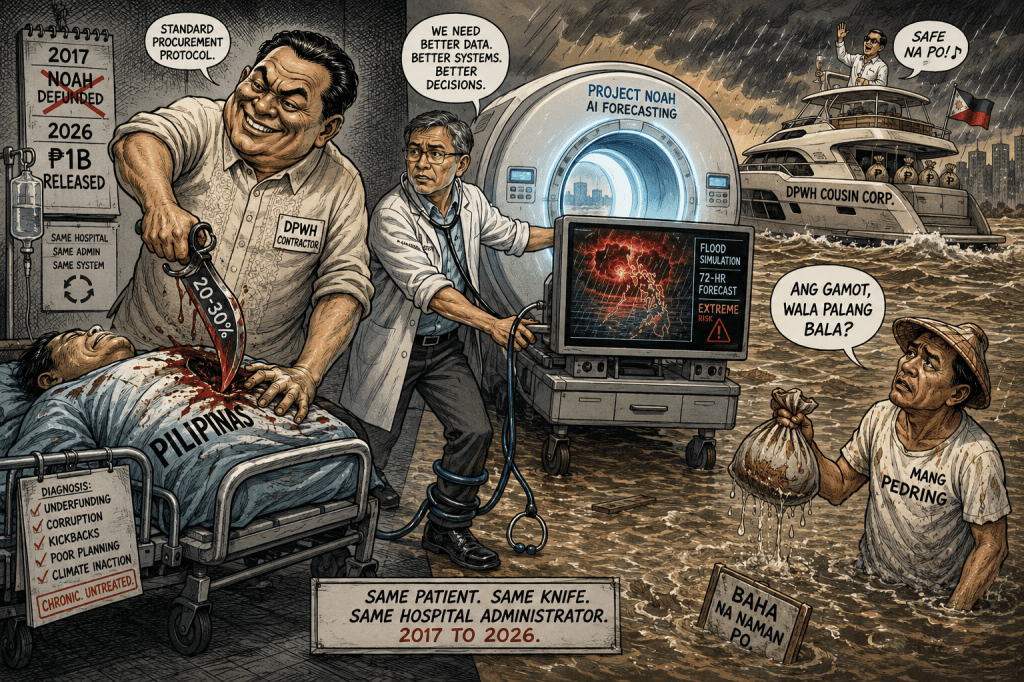
The DPWH Builds Fiction, and NOAH Is Expected to Fact-Check It
By Louis ‘Barok‘ C. Biraogo — August 28, 2027
THE Marcos administration, in a move dripping with either profound enlightenment or desperate political theater, has just handed the University of the Philippines a cool ₱1 billion for Project NOAH (Nationwide Operational Assessment of Hazards).
The stated goal? To use Artificial Intelligence (AI)-assisted forecasting and hyper-detailed mapping to stop the government from building useless, wasteful, and sometimes entirely fictional flood control projects.
Let that sink in. We have reached the point where the national government is paying scientists to predict whether the Department of Public Works and Highways (DPWH) is about to build a wall that will either do nothing or actively drown the next town over.
The central figure in this technocratic drama is Dr. Mahar Lagmay, a man whose professional life has been a Sisyphean struggle to insert logic into the gaping maw of Philippine infrastructure spending.
His thesis is elegantly simple: before you spend billions on concrete, simulate the flood. It is a proposition so fundamentally sane that, in the context of the Philippine bureaucracy, it reads as a radical act of sedition.
And make no mistake, Barok is here for it. Lagmay is, and has always been, the real deal. While politicians were busy renaming typhoons and posing for photos in rubber boots, Lagmay was building the actual digital infrastructure required to keep people alive.
The fact that he had to fight tooth and nail to keep this project from being defunded into oblivion in 2017—only to see the DPWH’s budget for flood control more than double in the same period—tells you everything you need to know about where the priorities of the Philippine state lie. It lies not with the scientist, but with the contractor.
But Barok is not a fanboy. Barok is an analyst. And when you peel back the layers of this very expensive, very shiny new toy, you find a terrifying paradox: We are buying a top-of-the-line MRI machine to diagnose a patient who is being actively stabbed by the hospital administrator.

“The Unbearable Truth of ‘Garbage In, Garbage Out’”
Lagmay himself warned us: “AI is just a tool… Garbage in, garbage out.” This is the man’s own admission that his billion-peso supercomputer has a fatal flaw. It is entirely dependent on the honesty of the DPWH.
The recent scandals—the “ghost projects” in Davao, the “mock bidding” investigated by the Senate, the whistleblowers weeping about substandard cement and 20-30% kickbacks—reveal that the primary output of the DPWH is not flood mitigation. It is the systematic manufacture of lies.
Let’s play this out. Suppose DPWH proposes a ₱5 billion riverwall in some congressman’s district. Lagmay’s computers run the simulation. The physics are clear: this wall will act as a dam, raising water levels upstream by two meters and bankrupting a farming community. What happens next?
If NOAH is merely an “advisory” body—a suggestion box for corrupt engineers—the science is worthless. The DPWH will do what it has always done: ignore the nerd, pave the river, pocket the 20% differential, and blame the subsequent disaster on “climate change.”
This is the dangerous illusion of technocratic substitution. We are being sold the narrative that if only our maps were 1-meter resolution instead of 10-meter, the corruption would magically stop. It won’t.
A fraudster doesn’t care if you point a better camera at him; he cares if you have the authority to revoke his contract and send him to the Sandiganbayan.
“The Institutional Cannon Fodder”
The proposal to distribute LiDAR-equipped drones to State Universities and Colleges (SUCs) is a masterstroke of optics and a potential disaster of management.
It sounds great: decentralizing science! Empowering the youth! But Barok has seen the inside of a Philippine SUC. The drones will arrive. They will be unboxed for a photo op. A janitor will be assigned to “guard” them. The LiDAR sensors will be confused with WiFi routers.
Within eighteen months, they will be corroded paperweights because the budget for maintenance was re-aligned to a “Team Building” seminar in Tagaytay.
Institutional capacity is the bottleneck, not hardware. If Lagmay thinks he can build a permanent national institution on the back of one-off budget releases and the goodwill of politicians, he is building his house on sand.
The history of NOAH proves this. It was born in 2012, nearly killed in 2017, and only resurrected when the stench of the current administration’s incompetence became too strong to ignore.
Marcos Jr. needs Lagmay. He needs the sheen of science to wash off the stink of the “Infrastructure Commission” he created while his allies were allegedly hauling bags of cash out of the DPWH. This isn’t a partnership; it’s a hostage situation. Lagmay is being used as a human shield.
“The Only Way This Works”
If Lagmay wants this ₱1 billion to mean anything other than a PR deflection, he must stop being polite.
There is a staggeringly simple answer staring us in the face: the science must be made legally consequential.
Congress is currently stuffed with members who are, or were, public works contractors. There is a conflict of interest so vast it has its own gravitational pull. Asking these people to voluntarily subject their projects to an independent hydrologic audit is like asking a vampire to invest in garlic futures.
Therefore, NOAH cannot be a “partner” to the DPWH. It must be an auditor. It must be a gatekeeper.
Here is the Barok Proposal. Every flood control project above a certain threshold—say, ₱50 million—should be required to pass a “Flood Project Evidence File” review. This file, generated by NOAH and independent engineers, must prove, with data, that the structure will not worsen flooding elsewhere.
This file must be published online before procurement begins. If the project proceeds without this certificate, the Commission on Audit (COA) must automatically disallow it, and the Ombudsman should start drafting the graft charges.
If Lagmay’s models find that a DPWH project is hydrological nonsense, and the DPWH ignores him, Lagmay must have the statutory authority to release that data to the public. He must be able to stand on the steps of the Senate and say, “The Emperor has no floodwalls, only a kickback scheme.”
Will that happen? Probably not. The political establishment wants a mascot, not a referee. They want to fund the AI so the AI can say “the water is very wet,” while they continue to sell the sandbags with holes in them.
“The Verdict”
Barok supports this funding, but with the grim resignation of a man watching a doctor patch a bullet wound with a band-aid while the shooter is still in the room.
Mahar Lagmay is a genius operating in a kleptocracy that views genius as a nuisance. The science is sound. The technology is world-class. The intent is noble.
But unless this project comes with the power to stop the bulldozers, it is merely the most expensive and sophisticated weather report in the world—a high-resolution chronicle of our own impending doom, narrated politely while the city drowns and the contractors sail away on their yachts.
Prove me wrong, government. Make the data binding. Make the physics compulsory. Or admit that the ₱1 billion is just a bribe to keep the scientists quiet while the floodwaters—and the kickbacks—keep rising.
Key Citations
A. Reports & Studies
- Ateneo School of Government. “Flood Control Budget More Than Doubled Since 2015.” BusinessWorld, 23 Sept. 2025, https://www.bworldonline.com/the-nation/2025/09/23/700431/flood-control-budget-more-than-doubled-since-2015/.
- “Flood Control Projects Scandal in the Philippines.” Wikipedia, Wikimedia Foundation, https://en.wikipedia.org/wiki/Flood_control_projects_scandal_in_the_Philippines.
- “Project NOAH (Philippines).” Wikipedia, Wikimedia Foundation, https://en.wikipedia.org/wiki/Project_NOAH_(Philippines).
B. News Articles
- Ferreras, Vince Angelo. “DBM Releases P1B for Project NOAH AI-Powered Flood Forecasting.” GMA News Online, 24 Aug. 2026, https://www.gmanetwork.com/news/scitech/science/999655/dbm-releases-p1b-for-project-noah-ai-powered-flood-forecasting/story/.
- “Can Project NOAH’s P1B Stop Wasteful Flood-Control Projects? Scientist Explains.” Philstar.com, 26 Aug. 2026, https://www.philstar.com/headlines/climate-and-environment/2026/08/26/2551722/can-p1b-forecasting-stop-wasteful-flood-control-projects-scientist-explains.
- Mateo, Janvic. “Gov’t Shuts Down Project NOAH.” Philstar.com, 2 Feb. 2017, https://www.philstar.com/business/science-and-environment/2017/02/02/1668037/govt-shuts-down-project-noah.
- “Ombudsman Urged to Probe Davao Flood Control Projects.” Rappler, 19 May 2026, https://www.rappler.com/philippines/mindanao/ombudsman-probe-davao-flood-control-projects/.
- “Insertions in the Storm: When Flood Control Feeds the Corrupt.” Inquirer.net, 16 Sept. 2025, https://newsinfo.inquirer.net/2109126/insertions-in-the-storm-when-flood-control-feeds-the-corrupt.
- “ICI Files Complaint vs Co, Villanueva, Estrada, Others.” Rappler, 29 Oct. 2025, https://www.rappler.com/philippines/ici-complaint-recommendation-zaldy-co-joel-villanueva-jinggoy-estrada/.
C. Official Websites
- University of the Philippines. University of the Philippines, https://up.edu.ph/.
- UP NOAH Center. Nationwide Operational Assessment of Hazards, https://noah.up.edu.ph/.
- UP Resilience Institute. “About Us.” UP Resilience Institute, https://resilience.up.edu.ph/about-us-2/.
- Department of Public Works and Highways. DPWH, https://www.dpwh.gov.ph/.
- Presidential Communications Office. “President Marcos Signs EO 94 Creating Independent Commission for Infrastructure.” PCO, 11 Sept. 2025, https://pco.gov.ph/news_releases/president-marcos-signs-eo-94-creating-independent-commission-for-infrastructure/.
- Sandiganbayan. Sandiganbayan, https://sb.judiciary.gov.ph/.
- Commission on Audit. COA, https://www.coa.gov.ph/.
- Office of the Ombudsman. Ombudsman, https://www.ombudsman.gov.ph/.

- ₱9 Billion in ‘Savings’? DILG’s Fire Truck Deal Smells Like Smoke

- ₱8B BBM Pork: CCTV for Every Captain’s Kumpare?

- ₱8.9 Billion, 331 Ghost Police Stations: The TIKAS Scandal Explained

- ₱8.4 Billion, 42,000 Barangays, 1 Election: The “Bawat Barangay Makikinabang” Vote-Buying Masterclass

- ₱75 Million Heist: Cops Gone Full Bandit

- ₱63 to the Dollar: The Only Thing Falling Faster Than the Peso Is the Government’s Credibility

- ₱6.77B Ghost Haunts Duterte: RTC Dismisses Mans Carpio’s Desperate Plea

- ₱6.77 Billion and Zero Cash: The Sara Duterte SALN Math That Doesn’t Add Up

- ₱6.7-Trillion Temptation: The Great Pork Zombie Revival and the “Collegial” Vote-Buying Circus

- ₱58.53B, Zero Receipts: The LGSF Pork Barrel Nobody Wants to Name
- ₱53 Million Man Tells ₱695-a-Day Workers to Stop Being ‘Mayabang’: The Audacity of BSP’s Remolona

- ₱4.4 Billion and a Witness Who Can’t Explain It: The Duterte Impeachment’s Most Expensive Non-Answer









Leave a Reply