Where’s the List? The Constitutional Right to Information Meets the Administrative Right to Obfuscate
By Louis ‘Barok‘ C. Biraogo — August 29, 2026
I. The Miracle at the House Appropriations Committee
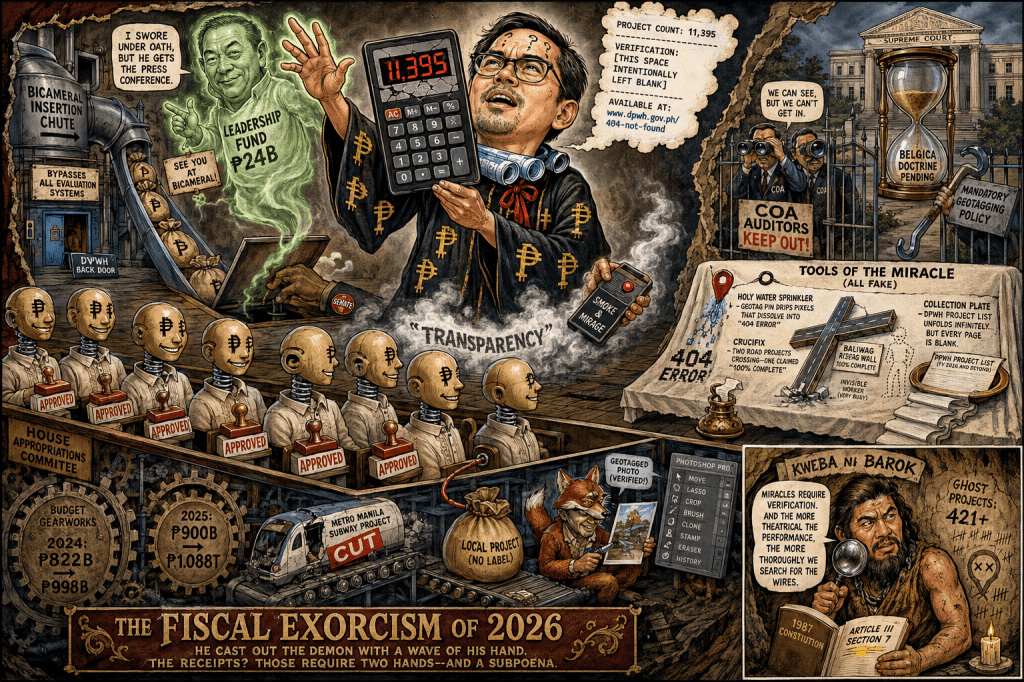
Gather round, mga ka-kweba, for we have witnessed something remarkable: a fiscal exorcism performed before the House Committee on Appropriations.
On August 27, 2026, Secretary Vince Dizon declared that the demon of duplication had been cast out of the Department of Public Works and Highways’ (DPWH) 2027 budget. The unclean spirit of the “leadership fund”—that alleged ₱24-billion discretionary slush his predecessor swore existed under oath—had been banished. “Wala, wala,” Dizon intoned, and the congregation nodded solemnly.
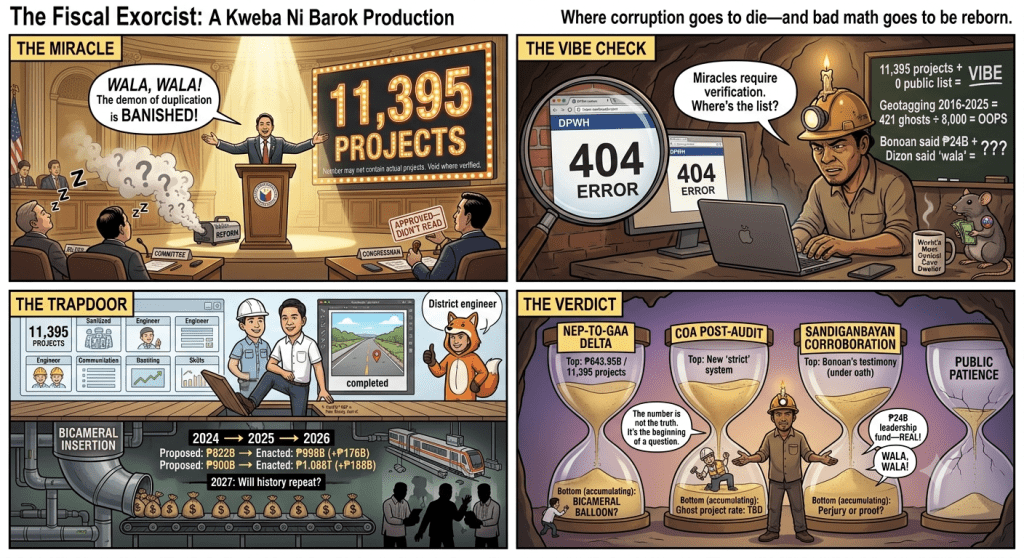
The numbers were impressive. From a high of 25,545 projects in 2024, DPWH’s proposal had been purified down to 11,395. The budget itself? ₱643.95 billion—a 21.59% increase. Because apparently, you can do less with more.
But here at Kweba ni Barok, we have a simple rule: miracles require verification. And the more theatrical the performance, the more thoroughly we search for the wires.
II. The Number That Cannot Be Checked
“11,395” is a number with no publicly available referent. It floats in the ether like an impressive cloud—visible, weighty, impossible to grasp.
There is no published list. No disaggregated breakdown. No independent verification by the Commission on Audit (COA), the Department of Budget and Management (DBM), or any civil-society organization capable of counting to 11,395 without losing its place.
This is not an accident. It is a feature.
The number sounds like accountability. It has the aesthetic of reform—precise, quantifiable, definitive. But until someone outside DPWH’s institutional skin can examine the underlying project list, “11,395” is not a fact. It is a vibe.
The technology exists. The constitutional right to information exists—Article III, Section 7, repeatedly affirmed from Chavez v. PCGG to Akbayan v. Aquino. The infrastructure exists to make every project transparent: location, cost, implementing office, geotagged photograph, program of work.
But as of this writing? Nothing.
What we have instead is a claim that DPWH’s “strict project evaluation system” has already weeded out the duplicates. The evaluator has evaluated itself. The fox has filed its own security audit of the henhouse. And we are all expected to applaud.
III. The Ghost of Geotagging Past
Geotagging is not a new idea. It is a recycled idea. And here at Kweba ni Barok, we check expiration dates.
The regime was introduced in 2016 by then-Secretary Mark Villar as the anti-corruption silver bullet. Satellite imagery! Drone surveillance! The Infratrack app! The future had arrived, wrapped in the flag.
How did that work out?
By 2025, Villar himself—now a sitting senator—was publicly warning that contractors had learned to alter geotagged photographs to unlock payment for work never performed. The Department of Justice’s (DOJ) November 2025 review found the system “did not prove effective,” having missed more than 421 confirmed ghost projects among just 8,000 inspected. That is a failure rate of roughly one in nineteen. If a medical test missed cancer at that rate, the hospital would be burned to the ground and the ashes salted.
And now, in 2026, Secretary Dizon is reintroducing the same fundamental technology—geotagged photos, coordinate stamps, engineer sign-offs—as if it were novel. The same instrument that failed for nearly a decade. The same chain of sign-off that allowed a Bulacan district engineer to certify a ₱55-million project existing only on paper. The same “verification” architecture that produced a Baliwag river wall marked “100% complete” with no construction found on site.
This is not reform. This is déjà vu with a press release.
COA has independently responded by fast-tracking its own mandatory geotagging policy—anchored not in DPWH’s internal chain of command, but in the Commission’s independent verification authority. This is the institutional equivalent of a parent deciding that, after years of trusting the teenager to do their own homework, adult supervision might be necessary.
Dizon’s plan does not mention COA integration. It mentions “district engineers and their regional directors” signing off on photographs. The same people who signed off before. The same people who missed 421 ghost projects.
Forgive us if we are not overcome with confidence.
IV. The “Leadership Fund” That Dares Not Speak Its Name
Let us be precise, because precision matters.
Dizon’s claim is forward-looking: the 2027 proposal contains no leadership fund. This is a narrow, defensible proposition. It may even be true.
But the way it has been deployed—the “Wala, wala” delivered with papal finality—serves a broader purpose. It attempts to bury the historical question under a prospective denial. It is the budgetary equivalent of saying “I don’t currently have a mistress” when asked whether you have ever committed adultery.
The historical question is: did a leadership fund exist in 2024–2025?
On this point, we have sworn testimony from Manuel Bonoan—Dizon’s immediate predecessor—that senators received ₱500 million to ₱1 billion each, roughly ₱24 billion in aggregate. We have the Independent Commission for Infrastructure’s interim report naming specific lawmakers and alleging percentage-based kickbacks. We have testimony given before the Sandiganbayan, under oath, with criminal liability for perjury.
We have, in other words, evidence. Contested evidence, yes. Evidence from an interested party facing his own graft and plunder charges, certainly. But evidence nonetheless—and not the kind that can be waved away with “Wala, wala.”
Dizon’s denial does not rebut Bonoan’s testimony. It avoids it. It changes the subject from what happened in 2025 to what is proposed for 2027. The effect is to place two narratives in the public sphere:
- Bonoan’s narrative: The leadership fund was real, systemic, and operated through mechanisms still being uncovered.
- Dizon’s narrative: The leadership fund does not exist now, which is the only thing that matters.
The second narrative is politically convenient. It allows the administration to claim credit for reform without ever definitively accounting for what came before. It is the fiscal equivalent of a presidential pardon—moving forward without looking back.
But here at Kweba ni Barok, we insist on looking back.
V. The Bicameral Black Box
Here is what should genuinely terrify anyone who believes in fiscal accountability: the National Expenditure Program (NEP) is not the General Appropriations Act (GAA).
The document Dizon presented—with its 11,395 projects and ₱643.95 billion—is not the document that will become law. Between the NEP and the GAA stands the bicameral conference committee, that mysterious chamber where budgets are reconciled, line items born and killed, and where—according to available evidence—DPWH’s budget has historically expanded well beyond its NEP baseline.
The record:
- 2024: DPWH proposed ₱822.2 billion. Enacted: ₱997.9 billion. Increase: ₱175.7 billion.
- 2025: DPWH proposed ₱900.0 billion. Enacted: ₱1.088 trillion. Increase: ₱188 billion.
- Department of Transportation (DOTr), in those same cycles: Cut by ₱92.9 billion to ₱140.4 billion, with Metro Manila Subway and North-South Commuter Railway funding stripped to create “fiscal space.”
“Fiscal space.” What a lovely euphemism. In practice, it means: money is taken from projects that are hard to steal from, and given to projects that are easy to steal from. Foreign-assisted infrastructure with international oversight? Cut. Locally funded projects with minimal scrutiny and maximum discretionary control? Expanded.
This is not a bug. It is the system working exactly as designed.
And here is the terrifying implication: none of the projects inserted at the bicameral stage have passed through Dizon’s “strict project evaluation system.” They are not part of the 11,395. They have not been screened for duplication or right-of-way issues. They have not been geotagged. They are outside the system—and they are precisely where corruption has historically concentrated.
Senator Panfilo Lacson has already flagged “questionable” lump-sum infrastructure items in the 2027 NEP—aggregate amounts with no line-item breakdown, the same defect species that enabled the 2025 scandal. If the bicameral committee repeats its 2023–2025 pattern—and there is no evidence suggesting it will not—then the “11,395 disciplined projects” will be swamped by insertions that never saw Dizon’s evaluation at all.
The reform will be a Potemkin village: a beautiful facade facing the House chamber, with the same old machinery grinding away behind it.
VI. The Legal Shadow
Hanging over all of this is pending litigation and settled doctrine that Dizon’s reforms do not address.
The Belgica Doctrine. The Supreme Court’s 2013 ruling in Belgica v. Ochoa established that legislators may not, after a lump-sum appropriation is enacted, personally identify the specific projects or beneficiaries that the lump sum will fund. That identification power belongs to the itemizing process built into the General Appropriations Bill itself. A “leadership fund” is, by definition, a lump sum whose recipients are chosen after enactment by discretion rather than itemized in the GAB. Bonoan’s testimony therefore describes not merely an ethical breach but a constitutionally suspect mechanism—the exact species of post-enactment legislative identification that Belgica condemned.
The Constitutional Guardrails. Article VI, Section 25(1) bars Congress from increasing the appropriations recommended by the President—the precise guardrail implicated whenever DPWH’s enacted GAA total rises above its NEP-stage figure. Section 25(2) requires that appropriations relate specifically to a stated purpose. Section 29(1) demands that no money be paid from the Treasury except pursuant to an appropriation made by law. Each of these provisions bears directly on the lump-sum infrastructure items Lacson has flagged and the bicameral insertions that have historically expanded DPWH’s budget.
The Pending Supreme Court Cases. Oral arguments concluded on July 14, 2026 in consolidated petitions challenging unprogrammed appropriations: Lagman’s challenge to the ₱449.5-billion 2024 insertion; the Filipinos for Peace, Justice, and Progress Movement’s challenge to the DPWH Special Road Fund’s 2025 increase; and Erice and de Lima’s challenge to the ₱150.9-billion 2026 appropriation. The Court’s December 5, 2025 ruling voiding a PhilHealth fund transfer—with Justice Hernando arguing that unprogrammed appropriations are constitutionally infirm “in any form”—suggests growing judicial skepticism of the fiscal mechanisms that have enabled DPWH’s budget growth.
If the Court rules that bicameral insertions of unprogrammed appropriations are unconstitutional, it would retroactively validate the exact species of scrutiny this dossier applies. It would mean that the “fiscal space” created by cutting DOTr and expanding DPWH was not merely unethical—it was illegal.
But until that ruling comes, the bicameral committee operates in a shadow zone. And Dizon’s reforms operate in that same shadow, their credibility hostage to a process he does not control.
VII. The Structural Problem
The Philippine infrastructure budget is structurally optimized for corruption. Not accidentally—by design:
- Lump-sum appropriations that provide aggregate amounts without line-item breakdowns.
- Bicameral insertions that bypass the executive’s project evaluation systems.
- Parametric formulas that allocate funds to districts based on historical patterns rather than demonstrated need.
- “Fiscal space” maneuvers that redirect funds from hard-to-steal foreign-assisted projects to easy-to-steal local projects.
- Geotagging regimes that have demonstrably failed to catch ghost projects but provide the appearance of verification.
Into this machine steps Secretary Dizon, armed with a five-point checklist and a project-count reduction. The checklist is real. The reduction is real. The question is whether these changes alter the underlying incentive structure or merely rebrand it.
A “strict project evaluation system” sounds wonderful until you realize that the people who designed it are the same people who presided over the 2025 scandal. The geotagging requirement sounds rigorous until you remember that contractors have been altering geotagged photos for years. The “no leadership fund” denial sounds definitive until you recognize that a discretionary mechanism can be discontinued in name while persisting in substance through other channels.
The fundamental problem is not technical. It is institutional. The budget process is a multi-stage game in which each stage—NEP preparation, House consideration, Senate consideration, bicameral reconciliation—offers opportunities for value to be extracted. Dizon has tightened one stage. He has not touched the others. And the other stages are where the real money moves.
VIII. What Would Actual Reform Look Like?
First, publish everything. The full 11,395-project list, with locations, costs, implementing offices, and geotagged photographs, available to any citizen with an internet connection. The technology exists. The legal framework exists. Only the political will is absent.
Second, integrate COA verification into the process. Not as an after-the-fact audit, but as a real-time check. If a district engineer certifies a project complete, a COA auditor should independently verify before payment is released.
Third, kill the bicameral insertion mechanism. Senate Finance Committee chair Jose Victor Ejercito has publicly pledged to bar any bicameral insertion absent from both House and Senate versions. This pledge should be codified in the GAA itself.
Fourth, mandate line-item transparency. No lump sums. No “for later distribution” line items. No aggregate amounts without project-level detail. If a project is too embarrassing to itemize, it is too corrupt to fund.
Fifth, pursue the big fish. Not just district engineers and regional directors, but the political architects of the system. If Bonoan’s testimony is true, senators who accepted leadership fund allocations should be indicted. If Dizon’s denial is true, Bonoan should be prosecuted for perjury. The two propositions cannot coexist indefinitely.
IX. The Tests That Will Resolve the Matter
Three tests exist, and each will resolve within the ordinary budget-and-audit calendar:
First: The NEP-to-GAA Delta Test. Does DPWH’s enacted 2027 total remain near ₱643.95 billion and 11,395 projects, or does it balloon through bicameral insertions? This resolves when the 2027 GAA is signed, around December 2026 or January 2027.
Second: The COA Post-Audit Test. Does COA’s 2027–2028 fraud-audit cycle find ghost projects within the smaller, “disciplined” portfolio at a materially lower rate than the roughly 1-in-19 pattern documented in 2025? This resolves progressively over 2027–2028.
Third: The Sandiganbayan Corroboration Test. Does further testimony or documentary evidence independently corroborate Bonoan’s “leadership fund” figure, or does it collapse under cross-examination? This resolves on the Sandiganbayan’s own calendar.
Absent all three, “11,395” and “wala” remain what they are today: plausible assertions from an interested party, neither confirmed nor falsified in fact.
X. The Verdict, Such As It Is
Secretary Dizon has presented a budget that looks cleaner than its predecessors. The project count is down. The documentation requirements are up. The regional allocation is marginally more equitable. These are real changes, deserving acknowledgment.
But “looks cleaner” is not the same as “is clean.” The available evidence suggests that the underlying institutional dynamics—the bicameral insertion mechanism, the lump-sum appropriations, the failed geotagging regime, the opaque project list—remain substantially intact.
The most charitable reading: Dizon has installed a better filter at the front of the pipe. The water looks clearer. But the pipe behind the filter is the same pipe, connected to the same reservoir, operated by the same utility company.
The most cynical reading: the filter is the product—a visible, headline-generating artifact designed to reassure the public that something has been done, while the real action continues behind the scenes.
The truth is less comfortable than either hagiography or heresy. Dizon is neither reformer nor racketeer—he is the bureaucratic Buddha, serene atop a lotus of spreadsheets, blessing the waters while the pipes below remain unchanged. He has not broken the machine; he has merely polished one gear and called it a revolution. This is not a morality tale. It is maintenance work dressed as prophecy.
XI. What Happens Next
The 2027 budget will move through the House, the Senate, and the bicameral conference committee. Each stage offers opportunities for insertions that have never seen Dizon’s evaluation system. Each stage offers opportunities for the “fiscal space” maneuver that has historically expanded DPWH’s allocation.
If the enacted budget matches the NEP—if DPWH remains at 11,395 projects and ₱643.95 billion—then Dizon’s reforms will have survived their first real test. If it balloons, we will know that the “strict project evaluation system” was never more than a suggestion.
COA will eventually audit. The Sandiganbayan will eventually rule. The Supreme Court will eventually decide.
But here at Kweba ni Barok, we do not wait for eventualities. We insist on questions now:
Where is the list?
Where is the COA integration?
Where is the line-item transparency?
Where is the accountability for the people who built the machine?
Until these questions are answered—not with rhetoric, not with “Wala, wala,” not with a project count that cannot be independently verified—the reforms are provisional. They are a bet placed on the future, backed by the collateral of Dizon’s credibility, with odds set by an institution that has spent decades perfecting the art of looking reformed without actually changing.
The number is not the truth. It is, at most, the beginning of a question.
Louis “Barok” C. Biraogo
Kweba ni Barok
Where corruption goes to die
May the rule of law rise on the third day. 🪨
Key Citations
A. Reports & Studies
- Independent Commission for Infrastructure. Interim report recommending charges over an alleged kickback scheme in flood-control insertions. Reported in Mendoza, John Eric. “ICI recommends charges vs Estrada, Villanueva, Co and others.” Philippine Daily Inquirer, 29 Oct. 2025.
- Congressional Policy and Budget Research Department. Agency Budget Notes: DPWH FY 2025. House of Representatives, 2024.
B. News Articles
- Quismorio, Ellson. “‘Wala’: DPWH chief Dizon flatly denies Bonoan’s ‘leadership fund’ claim.” Manila Bulletin, 26 Aug. 2026.
- “No ‘leadership fund’ in DPWH’s proposed 2027 budget – Dizon.” Philippine Daily Inquirer, 26 Aug. 2026.
- Mangaluz, Jean. “DPWH awards only 32% of projects in 2026 amid bidding delays — Dizon.” GMA News Online, 26 Aug. 2026.
- “Marcos admin’s infra budget set at P1.47-T for 2027—DBM.” GMA News Online, 27 Aug. 2026.
- Mendoza, John Eric. “Bonoan: ‘All senators’ got share of ‘leadership fund.’” Philippine Daily Inquirer, 13 Aug. 2026.
- “EXPLAINER: What was ‘leadership fund’ in the national budget?” GMA News Online, 13 Aug. 2026.
- Mangaluz, Jean. “421 flood control projects found to be ‘ghosts.’” Philstar.com, 9 Oct. 2025.
- “Mark Villar: Faked geotagged photos from contractors is clear fraud.” Philippine Daily Inquirer, 25 Aug. 2025.
- Panti, Llanesca T. “Alcantara admits certifying P55-M Bulacan flood control project as complete.” GMA News Online, 2 Sept. 2025.
- “‘Angry’ PBBM vows to go after those behind Baliwag ghost project.” Philippine News Agency, 20 Aug. 2025.
- “COA wants mandatory geotagging to prevent ‘ghost’ infra projects.” Malaya Business Insight, 2 Dec. 2025.
- Nazario, Dhel. “Lacson flags ‘questionable’ infra lump sums in proposed 2027 budget.” Manila Bulletin, 15 Aug. 2026.
- Mangaluz, Jean. “How lawmakers’ add-ons swelled DPWH’s budget by P540B.” Philstar.com, 18 Sept. 2025.
- “JV Ejercito vows to end last-minute budget insertions.” Philippine Daily Inquirer, 17 Aug. 2026.
- Panaligan, Rey G. “SC holds oral arguments on petitions vs unprogrammed funds, special accounts in 2024, 2025, 2026 national budgets.” Manila Bulletin, 5 Apr. 2026.
- “Unprogrammed funds in any form unconstitutional, says SC justice.” Philippine Daily Inquirer, 8 Dec. 2025.
C. Official Websites
- Republic of the Philippines. The 1987 Constitution of the Republic of the Philippines. Official Gazette.
- Supreme Court of the Philippines. “Press Briefer, December 05, 2025.” (PhilHealth fund-transfer ruling).
- Lagman, Edcel C. “Rep. Edcel C. Lagman made good his commitment to challenge before the Supreme Court…” Official website of Rep. Edcel C. Lagman, Jan. 2024.
- Department of Public Works and Highways. Official Website.
- Commission on Audit. Official Website.
D. Legal & Official Sources
- Constitution of the Republic of the Philippines. 1987. Official Gazette, http://www.officialgazette.gov.ph/constitutions/1987-constitution/.
- Belgica v. Ochoa, G.R. No. 208566 (Supreme Court of the Philippines 19 Nov. 2013).
- Chavez v. Presidential Commission on Good Government, G.R. No. 130716 (Supreme Court of the Philippines 9 Dec. 1998).
- Akbayan Citizens Action Party v. Aquino, G.R. No. 170516 (Supreme Court of the Philippines 16 July 2008).
- Araullo v. Aquino III, G.R. No. 209287 (Supreme Court of the Philippines 2014).

- ₱8B BBM Pork: CCTV for Every Captain’s Kumpare?
- ₱8.9 Billion, 331 Ghost Police Stations: The TIKAS Scandal Explained

- ₱8.4 Billion, 42,000 Barangays, 1 Election: The “Bawat Barangay Makikinabang” Vote-Buying Masterclass

- ₱75 Million Heist: Cops Gone Full Bandit

- ₱6.77B Ghost Haunts Duterte: RTC Dismisses Mans Carpio’s Desperate Plea
- ₱6.77 Billion and Zero Cash: The Sara Duterte SALN Math That Doesn’t Add Up

- ₱6.7-Trillion Temptation: The Great Pork Zombie Revival and the “Collegial” Vote-Buying Circus

- ₱58.53B, Zero Receipts: The LGSF Pork Barrel Nobody Wants to Name
- ₱53 Million Man Tells ₱695-a-Day Workers to Stop Being ‘Mayabang’: The Audacity of BSP’s Remolona
- ₱4.4 Billion and a Witness Who Can’t Explain It: The Duterte Impeachment’s Most Expensive Non-Answer
- ₱3.06 Billion for Evacuation Centers—But Nobody Knows Where They’ll Stand (Or If They’ll Exist)
- ₱16 Billion, 280 Accounts, 8 Helicopters: Boying Remulla’s Case Against the Yaps Is Not a Drill





Leave a comment