From Ghost Projects to Phantom Revenues: The Complete Guide to Budgetary Gaslighting
By Louis ‘Barok’ C. Biraogo — August 29, 2026
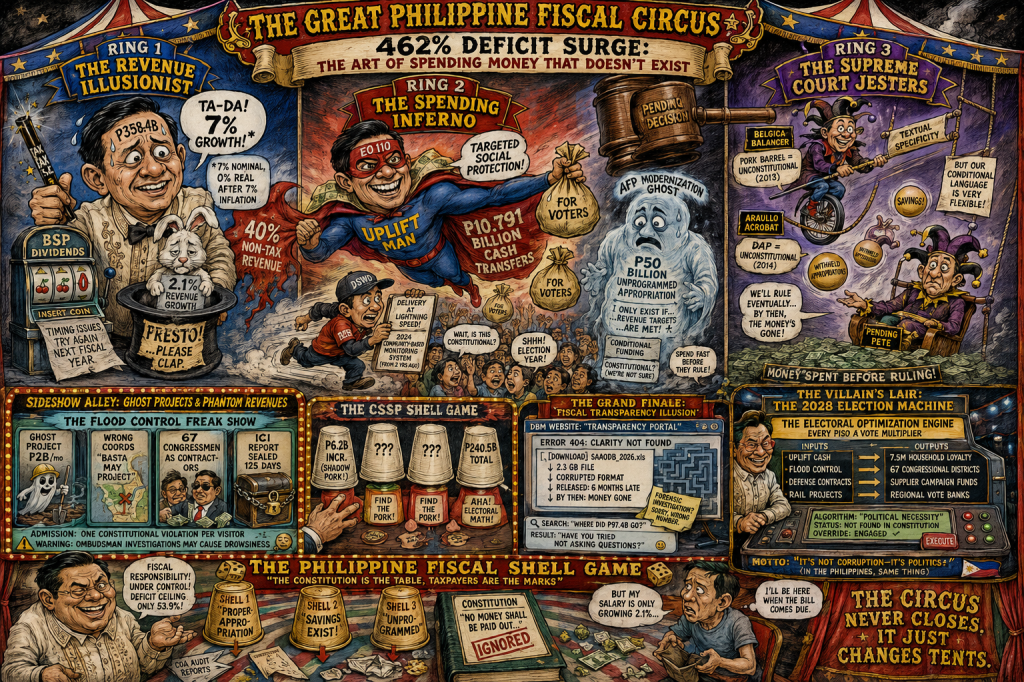
AH, the sweet, familiar smell of fiscal panic mixed with the acrid stench of political opportunism. It’s budget season in the Philippines, and the national pastime isn’t basketball—it’s watching grown men in barongs perform elaborate rhetorical gymnastics to explain why a 462% deficit surge is simultaneously “totally normal” and “a national emergency requiring immediate cash transfers to 7.5 million conveniently located voters.”
The Bureau of the Treasury just dropped its July 2026 fiscal report, and the headlines write themselves: “Deficit Balloons 462%!” “Spending Explodes 20%!” “Revenue Anemic at 2.1%!” Meanwhile, the administration’s spin doctors are working overtime to explain that this is all part of the plan, that everything is fine, that the deficit is “only” 53.9% of the annual ceiling, and that if you just look at the right numbers in the right order while squinting and ignoring the smoke coming from the Treasury, you’ll see that this is actually responsible governance.
Let me translate for the uninitiated: We’re spending money we don’t have, on things we can’t fully explain, at a pace that would make a bankruptcy attorney blush, all while the Supreme Court is literally deciding whether our funding mechanisms are constitutional.
But here’s the real story—the one buried beneath the fiscal forensics and the constitutional hair-splitting: The 462% figure isn’t just a number. It’s a smokescreen. A beautifully constructed, mathematically accurate, politically explosive distraction that allows everyone to argue about percentages while the real money changes hands in the shadows.
🔥 The Philippine government didn’t lose fiscal control—they never had it.
I. The Arithmetic of Misdirection
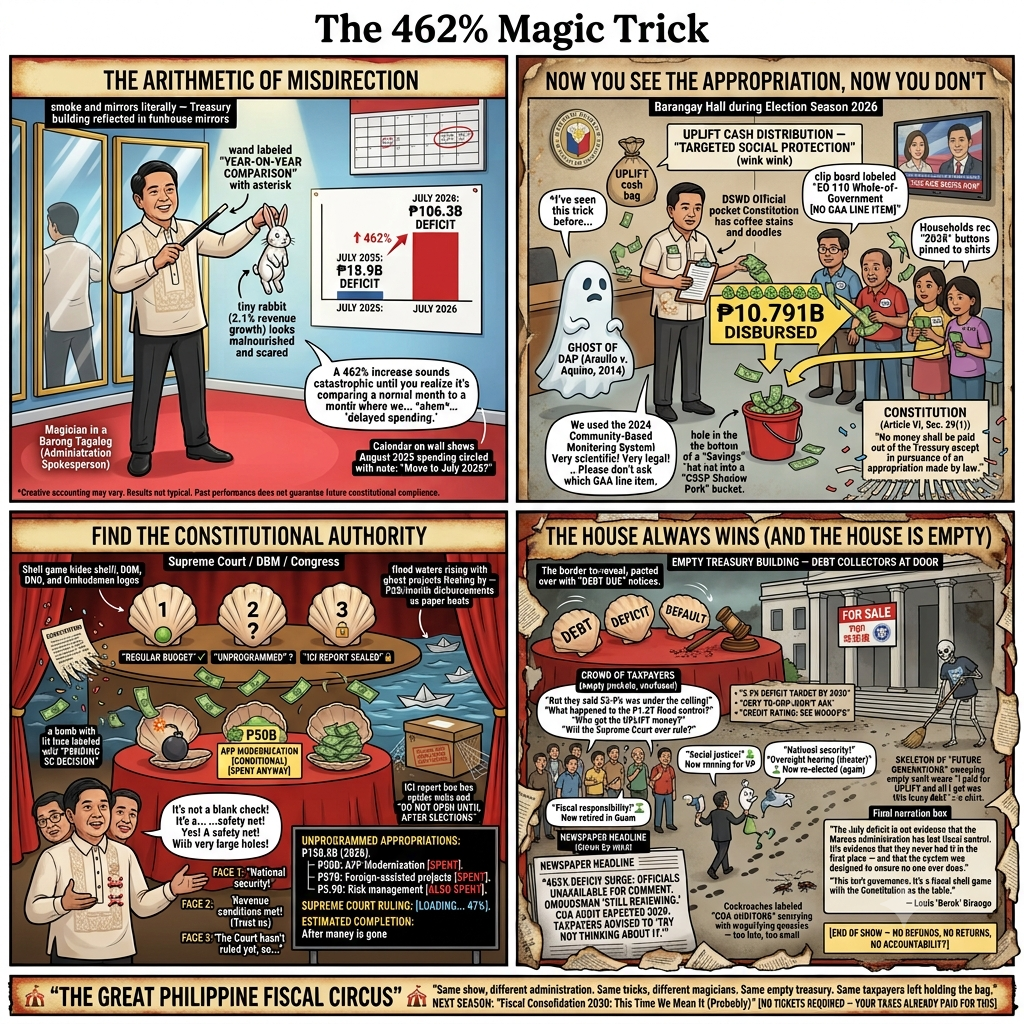
Let’s start with the obvious: a 462% increase sounds catastrophic until you realize it’s comparing a P106.3 billion July deficit to last year’s P18.9 billion—a figure so low it suggests either extraordinary fiscal discipline or, more likely, creative accounting that delayed spending into August.
The administration’s defenders are quick to point out that the year-to-date deficit is “only” 53.9% of the annual ceiling, and that seven months have passed (58.3% of the year), so technically we’re under the proportional limit. This is the fiscal equivalent of saying, “I’ve only spent 54% of my salary by July 31st, so I’m doing great!”—while ignoring that your credit card is maxed out, your rent is due, and your salary is growing at 2.1% while your expenses are growing at 19.8%.
But here’s what everyone’s missing: The 462% figure is the perfect distraction because it’s too dramatic to ignore and too misleading to be useful. While everyone argues about whether a 462% increase is “alarming” or “expected,” the real story is happening in the shadows of the budget’s line items.
II. The UPLIFT Program: Social Justice or Vote-Buying Machine?
Let’s talk about UPLIFT—the Unified Package for Livelihood, Industry, Food, and Transport. It’s the administration’s flagship response to the Middle East conflict’s economic impacts, providing cash assistance to 7.5 million households. By August 17, the Department of Social Welfare and Development (DSWD) had already disbursed P10.791 billion to 5.39 million households.
Coincidentally, this massive cash transfer program is launching in an election year. The May 2026 mid-term elections just concluded, but the 2028 presidential race begins the day after. And what better way to ensure voter loyalty than by literally handing out cash to 7.5 million households?
The administration argues this is “targeted social protection” during an oil-price shock. The opposition argues it’s “vote-buying on a national scale.” The truth, as always, is more complicated and more cynical: It can be both simultaneously.
Here’s the legal sleight of hand: UPLIFT was funded through Executive Order No. 110, which created the “whole-of-government framework.” But an executive order cannot create an appropriation. Article VI, Section 29(1) of the Constitution is clear: “No money shall be paid out of the Treasury except in pursuance of an appropriation made by law.”
So the question isn’t whether UPLIFT is politically motivated—of course it is. The question is: Which appropriation law actually authorized the P10.791 billion already disbursed? Was it a properly itemized line item in the 2026 General Appropriations Act (GAA)? Or was it cobbled together from “savings” that may not actually exist, using the same legal gymnastics that got the Disbursement Acceleration Program (DAP) declared unconstitutional in Araullo v. Aquino?
The DSWD claims beneficiaries were identified using the 2024 Community-Based Monitoring System. That’s better than political discretion, but it doesn’t answer the constitutional question. And it certainly doesn’t explain why the program was announced months before implementation, then executed with lightning speed during a spending surge that conveniently coincides with election season.
III. The Defense Modernization Shell Game
Now let’s talk about the Armed Forces of the Philippines (AFP) Modernization Program—the P423.7 billion defense budget, including P50 billion in unprogrammed appropriations. That’s right: P50 billion in conditional funding for weapons systems, contingent on revenue performance.
The administration argues this is necessary for national security. The South China Sea threat is real. The modernization program is long overdue. The constitutional mandate for an independent foreign policy requires military capability.
All true. All irrelevant to the real question: Why is more than half of the modernization funding “unprogrammed”?
Unprogrammed appropriations are the legal equivalent of a blank check with conditions. They can only be released when “clearly defined triggers and tests are met”—namely, revenue performance and savings availability. But here’s the catch: The Supreme Court is currently hearing oral arguments on whether unprogrammed appropriations are constitutional at all.
The Belgica v. Ochoa decision in 2013 declared the pork barrel system unconstitutional for, among other things, failing to textually itemize projects. Araullo v. Aquino in 2014 declared DAP unconstitutional for creating “savings” through withholding appropriations. The pending case on unprogrammed appropriations could similarly declare that Congress cannot delegate its power of the purse through conditional lump-sum appropriations that leave spending discretion to the executive.
If the Court rules against unprogrammed appropriations, the entire P150 billion in the 2026 budget—including P50 billion for AFP modernization and P97 billion for foreign-assisted projects—becomes constitutionally suspect. The July spending surge would then represent not just fiscal irresponsibility but potentially unconstitutional expenditure.
And yet, the administration is spending like the Court’s ruling doesn’t matter. Either they know something we don’t, or they’re spending the money before it can be taken away.
IV. The Flood Control Scandal: The Ghost in the Budget Machine
This is where the July deficit becomes genuinely sinister. The Philippines is drowning in a corruption scandal of epic proportions: P1.2 trillion in flood-control appropriations from 2022-2025, with P450-500 billion in legislative insertions at their peak. “Ghost projects” with P2 billion monthly disbursements supported by spurious documents. Projects approved with wrong geographic coordinates—”basta may project” (just have a project). Sixty-seven members of Congress acting as public works contractors for their own state-funded projects.
The Independent Commission for Infrastructure (ICI) submitted its report on March 31, 2026. One hundred twenty-five days later, that report has not been publicly released. It’s been turned over to the Ombudsman, but the public—the people whose money was allegedly stolen—cannot read it.
Meanwhile, the administration has ordered 10% budget cuts across agencies, but July spending still surged 19.82%. The Convergence and Special Support Program (CSSP)—the “shadow pork” mechanism—actually increased by P6.2 billion in the 2026 budget, reaching P240.5 billion.
So here’s the question: Is the July spending surge a coincidence, or is it a deliberate acceleration to spend money before the ICI report becomes public and triggers investigations that would freeze disbursements?
The timing is suspicious. The spending categories are suspicious. The lack of transparency is damning.
V. The Fiscal Transparency Illusion
The Bureau of the Treasury’s fiscal report is a masterpiece of selective disclosure. It tells you the aggregate numbers—revenues, expenditures, deficit—but it doesn’t tell you which specific projects received the P97.4 billion year-on-year spending increase. It doesn’t identify which contractors got paid. It doesn’t reconcile the spending with physical accomplishments.
The government’s own Statement of Appropriations, Allotments, Obligations, Disbursements and Balances (SAAODB) provides the data necessary for forensic fiscal investigation. But that data is buried in the Department of Budget and Management (DBM) website, formatted in ways that resist analysis, and released with enough delay to ensure that by the time anyone can scrutinize it, the money is already spent.
What should happen is obvious: The government should publish a “July Fiscal Transparency Ledger” showing, for every major spending program:
- The exact appropriation authority
- The agency responsible
- The contractors or beneficiaries
- The physical output delivered
- The procurement method used
- The Commission on Audit (COA) findings
What will actually happen is equally obvious: Nothing. Because transparency would reveal the very networks that benefit from opacity.
VI. The Constitutional Crisis Everyone’s Ignoring
While everyone’s arguing about percentages, the fundamental constitutional question remains unresolved: Can the executive branch spend money that Congress only conditionally appropriated, when the conditions haven’t been met, using savings that may not exist, on programs that may not be properly itemized?
The Supreme Court’s pending decision on unprogrammed appropriations could retroactively invalidate much of the July spending surge. The Belgica and Araullo precedents suggest the Court is willing to strike down executive spending mechanisms that lack textual specificity and constitutional authority.
But here’s the political reality: The Court’s decision is months away. By then, the July spending will be ancient history. The contractors will have been paid. The beneficiaries will have received their cash. The political benefits will have accrued. And the Court’s ruling will be largely academic.
This is the genius of the system: Spend first, litigate later, and by the time the litigation concludes, the spending has achieved its political purpose.
VII. The Revenue Collapse Nobody’s Talking About
Let’s talk about the revenue side of the equation. The 2.1% overall revenue growth in July is pathetic. The 40% collapse in non-tax revenues is explained by Bangko Sentral ng Pilipinas (BSP) dividend timing, but that’s cold comfort. The Bureau of Internal Revenue (BIR) collected P358.4 billion, up 7%—but with inflation at 6-7%, that’s essentially flat in real terms.
The real problem: The government’s spending growth (7% year-to-date) is outpacing revenue growth (5% year-to-date) by a widening margin. If this continues, the deficit ceiling of P1.658 trillion will be breached. Interest payments of P950 billion will consume an ever-larger share of the budget. And the debt-to-GDP ratio will keep climbing.
The administration’s response? A vague commitment to “fiscal consolidation” with a target of reducing the deficit to 3.5% of GDP by 2030. That’s four years away. In the meantime, they’re spending like there’s no tomorrow—because politically, there might not be.
VIII. The Election Machine
Let’s be blunt: The Philippines is already positioning for the 2028 presidential election. The May 2025 midterms are a fading memory, but the real battle—the race to succeed Marcos—has quietly begun, and every peso spent in July 2026 is a down payment on that ambition.
The UPLIFT cash transfers target 7.5 million households. The flood control projects target specific congressional districts. The defense modernization contracts target specific suppliers. The rail projects target specific regions. Every peso is being deployed with one eye on economic necessity and the other on electoral math.
This isn’t corruption per se. It’s politics. And in the Philippines, the line between the two has always been blurred.
The problem is that the Constitution doesn’t recognize “political necessity” as a valid basis for spending without proper appropriation. The law doesn’t care whether UPLIFT beneficiaries vote for the administration. The law cares whether the money was properly authorized, properly obligated, properly disbursed, and properly accounted for.
And on those questions, the July spending surge raises more red flags than a communist rally.
IX. The Legal Framework: Tools for Accountability or Weapons of Political Warfare?
Let’s review the legal arsenal available for accountability:
- Article VI, Section 29(1) of the Constitution: No money shall be paid out of the Treasury except pursuant to an appropriation made by law.
- Article VI, Section 25(5): No transfer of appropriations, except augmentation from savings for constitutional officers.
- Belgica v. Ochoa (2013): Pork barrel unconstitutional for violating separation of powers, non-delegability, specificity, and public accountability.
- Araullo v. Aquino (2014): DAP unconstitutional for creating “savings” through withholding appropriations and cross-border transfers.
- RA 3019 (Anti-Graft and Corrupt Practices Act): Prohibits causing undue injury to the government through manifest partiality, evident bad faith, or gross inexcusable negligence.
- RA 6713 (Code of Conduct and Ethical Standards): Requires public officials to employ government resources “efficiently, effectively, honestly and economically.”
- RA 12009 (New Government Procurement Act): Emphasizes transparency, competitiveness, efficiency, and accountability in procurement.
- COA’s Constitutional Authority: Article IX-D, Section 2 gives COA broad authority to audit and disallow irregular, unnecessary, excessive, extravagant, or unconscionable expenditures.
This is a formidable legal framework. It provides multiple pathways for accountability. The question is whether anyone will use it.
X. The Likely Outcomes
Here’s my prediction, and it’s not optimistic:
The Supreme Court will rule on unprogrammed appropriations. If they declare them unconstitutional, the July spending surge will be retroactively suspect. But enforcement will be complicated by the fact that the money is already spent. The Court will likely issue guidance for future budgets, but won’t unwind past spending.
The ICI report will eventually be released. But by then, the contractors will have lawyered up, the politicians will have covered their tracks, and the public will have moved on to the next scandal. The report will generate headlines for a week, then disappear into the Ombudsman’s backlog.
The COA will conduct audits. But COA is underfunded and understaffed relative to the scale of government spending. Their audits will be thorough but slow. By the time they issue findings, the responsible officials will have retired, moved on, or been re-elected.
The deficit will continue to widen. Revenue growth will remain anemic. Spending will accelerate as the 2028 election approaches. The debt-to-GDP ratio will climb. Credit rating agencies will issue warnings. And the cycle will repeat.
XI. What Should Happen vs. What Will Happen
What should happen:
- The Supreme Court should rule on unprogrammed appropriations with maximum speed and clarity. The pending case should be resolved before the 2027 budget is passed, providing constitutional guidance for future spending.
- The ICI report should be released immediately. The public has a right to know what their money was spent on—or not spent on.
- COA should conduct targeted audits of the July spending surge. The P97.4 billion year-on-year increase should be traced peso-by-peso, from appropriation to disbursement to physical accomplishment.
- The administration should publish a transparency ledger. Every major spending program should be documented with legal authority, agency, contractor, and output.
- Congress should exercise genuine oversight. Not political theater, but actual investigation of whether spending complied with the GAA and the Constitution.
What will happen:
- The Supreme Court will take its time. The case is complex, the stakes are high, and the Court has no incentive to rush.
- The ICI report will remain sealed. The Ombudsman’s investigation will proceed at glacial pace.
- COA will issue findings years from now. Too late to matter, too late to recover lost funds.
- The administration will issue press releases. Claiming fiscal responsibility while spending accelerates.
- Congress will hold hearings. That generate soundbites but no accountability.
XII. The Bottom Line
The 462% deficit surge is not a crisis. It’s a symptom—of a system that has mastered the art of spending money without accountability, of appropriating without specificity, of disbursing without transparency, and of auditing without consequence.
The real scandal isn’t the number. It’s the system that produced the number and will continue producing similar numbers long after this fiscal year ends.
The Philippine government has perfected the art of fiscal improvisation: spending money it doesn’t have, on projects it can’t fully document, through mechanisms it can’t constitutionally defend, for purposes it won’t publicly disclose.
And when the bill comes due—in the form of higher interest rates, credit rating downgrades, or constitutional invalidation—the same officials who authorized the spending will be long gone, leaving the taxpayers to pay the tab.
This isn’t governance. It’s a fiscal shell game with the Constitution as the table.
The July deficit is not evidence that the Marcos administration has lost fiscal control. It’s evidence that they never had it in the first place—and that the system was designed to ensure no one ever does.
Key Citations
A. Reports & Studies
- Bureau of the Treasury. “NG Budget Deficit Widens to Php 106.3 Billion in July 2026.” Republic of the Philippines, 27 Aug. 2026, http://www.treasury.gov.ph/wp-content/uploads/2026/08/COR-Press-Release-July-2026.pdf.
- Development Budget Coordination Committee. “193rd DBCC Joint Statement.” Department of Finance, July 2026, http://www.dof.gov.ph/wp-content/uploads/2026/07/193rd-DBCC-Joint-Statement.pdf.
- Department of Budget and Management. “Unprogrammed Appropriations in the FY 2026 National Budget Lowest since 2019.” DBM, 5 Jan. 2026, http://www.dbm.gov.ph/index.php/management-2/3768-unprogrammed-appropriations-in-the-fy-2026-national-budget-lowest-since-2019-government-vows-to-protect-it-from-abuse.
B. News Articles
- Inquirer.net. “Gov’t budget gap widens 462% in July.” Philippine Daily Inquirer, 27 Aug. 2026, business.inquirer.net/607856/govt-budget-gap-widens-462-in-july.
- Cabuenas, Jon Viktor D. “PH fiscal deficit widens to P106.3 billion in July.” GMA News Online, 27 Aug. 2026, http://www.gmanetwork.com/news/money/economy/1000056/ph-fiscal-deficit-widens-to-p106-3-billion-in-july/story/.
- GMA News. “DSWD: Over 5.57M households receive UPLIFT cash aid.” GMA News Online, 26 Aug. 2026, http://www.gmanetwork.com/news/topstories/nation/999994/dswd-over-5-57m-households-receive-uplift-cash-aid/story/.
- “Flood control projects scandal in the Philippines.” Wikipedia, Wikimedia Foundation, en.wikipedia.org/wiki/Flood_control_projects_scandal_in_the_Philippines.
C. Official Websites & Legal Authorities
- Republic of the Philippines. “THE 1987 CONSTITUTION OF THE REPUBLIC OF THE PHILIPPINES – ARTICLE VI.” Official Gazette, http://www.officialgazette.gov.ph/constitutions/the-1987-constitution-of-the-republic-of-the-philippines/the-1987-constitution-of-the-republic-of-the-philippines-article-vi/.
- Office of the President. “Executive Order No. 110.” Supreme Court E-Library, 24 Mar. 2026, elibrary.judiciary.gov.ph/thebookshelf/showdocs/5/101100.
- Presidential Communications Office. “President Marcos expands UPLIFT with additional aid for low-income Filipinos.” PCO, 16 July 2026, pco.gov.ph/news_releases/president-marcos-expands-uplift-with-additional-aid-for-low-income-filipinos/.
- Belgica v. Ochoa, G.R. No. 208566, 19 Nov. 2013, lawphil.net/judjuris/juri2013/nov2013/gr_208566_2013.html.
- Araullo v. Aquino, G.R. No. 209287, 1 July 2014, lawphil.net/judjuris/juri2014/jul2014/gr_209287_2014.html.
- Supreme Court of the Philippines. “SC Sets Oral Arguments on Consolidated GAA Cases.” Supreme Court, 23 Jan. 2026, sc.judiciary.gov.ph/sc-sets-oral-arguments-on-consolidated-gaa-cases/.
- Government Procurement Policy Board. “New Government Procurement Act or Republic Act No. 12009.” GPPB-TSO, http://www.gppb.gov.ph/new-government-procurement-act-or-republic-act-no-12009/.
- Republic Act No. 3019. Anti-Graft and Corrupt Practices Act, www.officialgazette.gov.ph/1959/08/17/republic-act-no-3019/.
- Republic Act No. 6713. Code of Conduct and Ethical Standards for Public Officials and Employees, www.officialgazette.gov.ph/1989/02/20/republic-act-no-6713/.

- “Ang Hirap Maging Mahirap”: The PAO Scandal That Proves Government Contempt Is Nothing New
- “Far-Off” My Axx: Malacañang’s Claire Castro Drowns in Her Own Legal Gaslighting
- “Forthwith” to Farce: How the Senate is Killing Impeachment—And Why Enrile’s Right (Even If You Can’t Trust Him)
- “HINDI AKO NAG-RESIGN!”

- “I Know Nothing”: Baste Duterte’s Amnesia Defense Meets ₱33M in GenCorp Contracts
- “I’m calling you from my new Globe SIM. Send load!”

- “Mahiya Naman Kayo!” Marcos’ Anti-Corruption Vow Faces a Flood of Doubt

- “Manageable” Debt, Unmanageable Lies: DBM’s ₱21 Trillion Fairy Tale
- “Meow, I’m calling you from my new Globe SIM!”

- “Natrabaho”: One Word, One Ombudsman, and a Judiciary on Trial
- “No Special Jail for Crooks!” Boying Remulla Slams VIP Perks for Flood Scammers
- “Philippine-Controlled” or Yankee Gas Station? The Davao Fuel Depot Farce Exposed



Leave a comment