By Louis “Barok” C. Biraogo — August 29, 2026
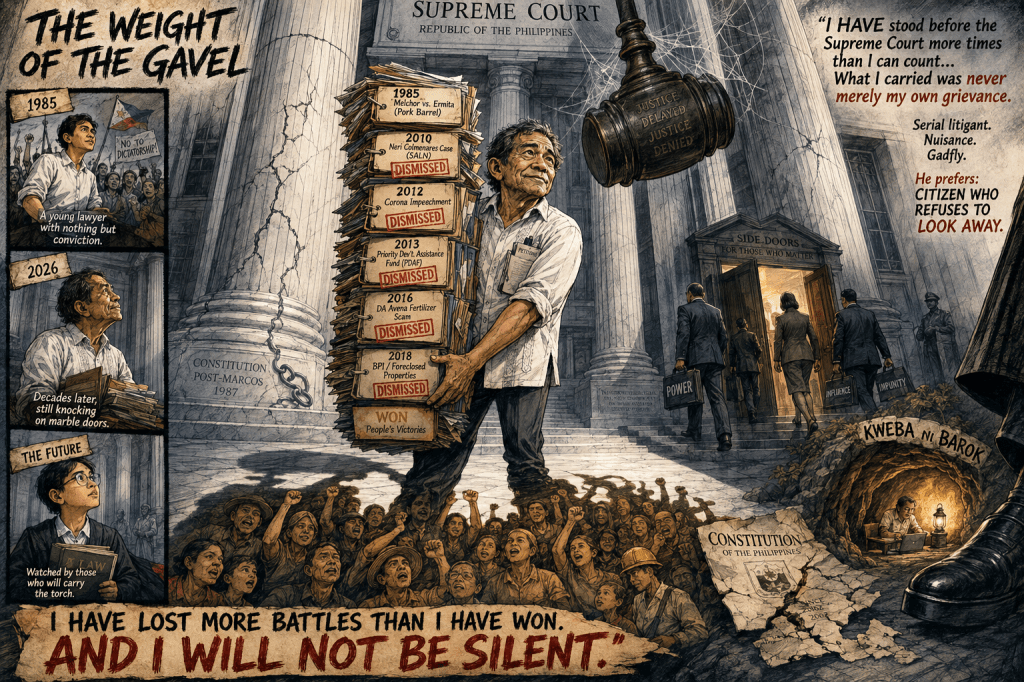
I HAVE stood before the Supreme Court of the Republic of the Philippines more times than I can count without reference to records. Each time, the marble halls felt the same—cold, imposing, indifferent to the man standing before them. But what I carried into those halls was never merely my own grievance. It was the accumulated hope of citizens who believe, perhaps against all evidence, that the law can be made to serve justice rather than power.
I am Louis “Barok” C. Biraogo. Some call me a serial litigant, a label I have learned to wear with a certain wry acceptance. Others have called me a nuisance, an idealist, a gadfly. I prefer to think of myself simply as a citizen who refuses to look away.
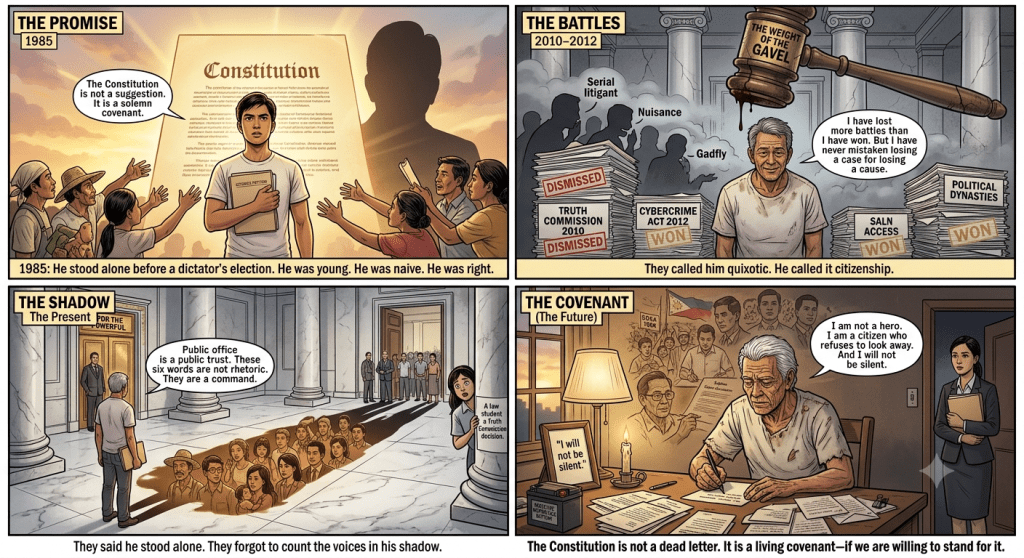
The first case I filed before the Supreme Court was in 1985, when I challenged the legality of the snap presidential election called by a dictator desperate to legitimize his rule. I was younger then, perhaps more naive, but I understood something fundamental: that the Constitution is not a suggestion, not a decoration, not a document to be invoked only when convenient. It is the solemn covenant between a people and their government—and when that covenant is broken, someone must stand and say so, even if that someone stands alone.
That case was dismissed. So were others. I have lost more battles than I have won. But I have never mistaken losing a case for losing a cause.
The Call to Public Trust
My understanding of public trust did not come from law books. It came from watching ordinary Filipinos navigate a system that seemed designed to exhaust them. It came from seeing government offices where the poor waited hours for a single signature while the powerful walked through side doors. It came from realizing that the gap between what the Constitution promised and what the people received was not merely a legal problem—it was a moral emergency.
Public office is a public trust. These six words, enshrined in our Constitution, are not rhetoric. They are a command. The power that public officials wield is not their own; it is loaned to them by the people, and it must be returned with interest in the form of service, integrity, and accountability.
I learned this early. I learned it in the Marcos years, when I saw what happens when power is exercised without constitutional constraint. I learned it in the decades after, when I saw that removing a dictator is not the same as building a democracy. The structures of accountability—the Ombudsman, the courts, the Commission on Elections—only work when citizens demand that they work. Institutions do not police themselves. They must be watched, prodded, challenged, and, when necessary, sued.
This is why I have filed cases that some consider quixotic: against the Philippine Truth Commission in 2010, which the Supreme Court ultimately declared unconstitutional; against the Cybercrime Prevention Act in 2012, which threatened freedom of expression in the digital age; against the political dynasty provision that Congress has refused to implement for over three decades; against restrictions on public access to Statements of Assets, Liabilities, and Net Worth, which strike at the heart of transparency.
Each of these cases was not merely a legal dispute. It was a test of whether our democracy’s institutions could withstand the pressure of power. It was a question of whether the Constitution would be treated as a living covenant or a dead letter.
The Meaning of Transcendental Importance
The legal doctrine of “transcendental importance” is, in my experience, both a shield and a sword. It is a shield because it protects the right of citizens to bring cases that affect the public interest even when they cannot show personal injury. It is a sword because it cuts through the procedural barriers that often prevent justice from being done.
But beyond the legal definition, transcendental importance is a moral standard. An issue has transcendental importance when it affects not just the litigants before the court, but the very character of the nation. It involves questions that will echo through generations: Can the President create investigative bodies without congressional authorization? Can Congress evade constitutional commands through inaction? Can the government restrict speech in the name of security? Can public officials hide their wealth from the people they serve?
These are not technical questions. They are questions about what kind of nation we will become.
I have been criticized for invoking transcendental importance too liberally. The Supreme Court has, on several occasions, reminded me that public importance does not automatically confer standing, that taxpayer status does not transform every policy disagreement into a constitutional case, that mandamus cannot compel Congress to legislate. These are fair criticisms. The doctrine must have limits, or it becomes a license for judicial overreach.
But I would respectfully submit that the opposite error is more dangerous: the error of treating constitutional violations as ordinary disputes, of allowing procedural technicalities to shield unconstitutional conduct, of permitting the powerful to hide behind standing requirements while the public interest suffers.
The Filipino people deserve leaders who uphold the Constitution not when it is convenient but when it is difficult. They deserve citizens who speak when others remain silent. They deserve a legal system that recognizes that some questions are too important to be dismissed on technical grounds.
The Weight of Responsibility
I will not pretend that this path has been easy. It has cost me time, money, relationships, and peace of mind. I have been mocked in the press. I have been accused of political motivation, of seeking attention, of being a tool of one faction or another. I have watched cases I believed in deeply dismissed with barely a paragraph of explanation.
There have been moments of doubt. Moments when I wondered whether the system I was fighting for was capable of reform. Moments when the marble halls felt less like temples of justice and more like mausoleums of broken promises.
But then I think of the ordinary Filipinos who have written to me, who have approached me in public, who have thanked me for saying what they could not say. I think of the young law students who tell me they were inspired by the Truth Commission case, who now understand that constitutional law is not an academic exercise but a living struggle. I think of the consumer who bought a defective motorcycle battery and found himself facing a corporate machine determined to crush him—a case I pursued because I understood what it meant to be a small person against a big system.
These moments are rare. They do not pay the bills. They do not silence the critics. But they are enough. They are reminders that the work matters, even when the results are uncertain.
I have also learned that criticism is not always wrong. I am not infallible. Some of my cases may have been premature. Some of my arguments may have been overly ambitious. I have had to accept that the Constitution does not always provide the remedy I seek, that some changes must come from Congress rather than the courts, that patience is sometimes a form of wisdom.
But accepting the limits of litigation is not the same as accepting the limits of hope. I continue to file cases because I continue to believe that the law can be an instrument of justice. I continue to challenge unconstitutional conduct because I continue to believe that power must be accountable. I continue to speak because silence is not neutrality; it is surrender.
A Voice for the Voiceless
I want to be clear about what my advocacy is not. It is not opposition for its own sake. It is not a desire to tear down institutions. It is not a vendetta against any particular administration or political party.
My advocacy is, at its core, an act of love. Love for a country that has given me everything and asked for little in return. Love for a Constitution that was written with the blood and sacrifice of ordinary Filipinos who dared to dream of a better nation. Love for a people who deserve better than what they have too often received.
When I challenged the Truth Commission, I was not opposing the pursuit of justice. I was insisting that justice must be pursued through constitutional means. When I challenged the Cybercrime Prevention Act, I was not defending criminals. I was defending the right of every Filipino to speak freely without fear of prosecution. When I challenged restrictions on SALN access, I was not seeking to embarrass any particular official. I was seeking to preserve the principle that public officials must be transparent about their wealth.
These distinctions matter. They are the difference between advocacy rooted in principle and advocacy rooted in ideology. They are the difference between building up and tearing down.
To the ordinary Filipino who wonders why these legal battles matter, I say: They matter because they determine whether your voice will be heard, whether your vote will be counted, whether your taxes will be spent honestly, whether your rights will be protected, whether your children will inherit a nation worth loving.
To the public servant who feels burdened by scrutiny, I say: The scrutiny is not an attack on you personally. It is a defense of the office you hold. The transparency we demand is not meant to humiliate you but to honor the trust the people have placed in you.
To the young person wondering whether the law can be a tool for justice, I say: It can be. But only if you are willing to wield it with courage, patience, and humility. The law is not a magic wand. It is a tool that must be sharpened through study, wielded through advocacy, and maintained through vigilance.
Faith in the People, Hope for the Future
I have not lost hope. This may surprise those who have followed my cases and seen the setbacks. But hope, in my understanding, is not the same as optimism. Optimism is the belief that things will get better on their own. Hope is the conviction that things can get better if we are willing to work for it.
I have hope because I have seen the power of ordinary citizens to change the course of history. I saw it in 1986, when millions of Filipinos stood together to reclaim their democracy. I have seen it in the years since, in the slow, halting, imperfect progress toward a more accountable government. I see it now, in the young people who are demanding more from their leaders, who are organizing, speaking out, and refusing to accept the cynicism that too often passes for wisdom.
The work of building a nation where the rule of law prevails is long and difficult. It requires patience, courage, and the willingness to lose more often than we win. It requires the humility to accept that we will not see the completion of the work we begin. It requires the faith that our efforts, however inadequate, will contribute to a future we may never witness.
I am not a hero. I am not a prophet. I am a citizen who has been given the privilege of serving his country through the law. I have tried to use that privilege honestly, to speak truth to power, to defend the Constitution, to protect the voiceless.
I will continue to do so, not because I believe I will always succeed, but because I believe the attempt is itself a form of victory. Every case I file is a declaration that the Constitution still matters, that the people still have a voice, that justice is still worth pursuing.
This is my commitment. This is my calling. This is my life’s work.
And I will not be silent.
Louis “Barok” C. Biraogo is the founder and voice behind the Kweba ni Barok blog. He has been a petitioner in numerous Supreme Court cases involving constitutional law, government accountability, and public interest since 1985.
- “Ang Hirap Maging Mahirap”: The PAO Scandal That Proves Government Contempt Is Nothing New

- “Far-Off” My Axx: Malacañang’s Claire Castro Drowns in Her Own Legal Gaslighting
- “Forthwith” to Farce: How the Senate is Killing Impeachment—And Why Enrile’s Right (Even If You Can’t Trust Him)
- “HINDI AKO NAG-RESIGN!”

- “I Know Nothing”: Baste Duterte’s Amnesia Defense Meets ₱33M in GenCorp Contracts

- “I’m calling you from my new Globe SIM. Send load!”

- “Mahiya Naman Kayo!” Marcos’ Anti-Corruption Vow Faces a Flood of Doubt

- “Manageable” Debt, Unmanageable Lies: DBM’s ₱21 Trillion Fairy Tale
- “Meow, I’m calling you from my new Globe SIM!”

- “Natrabaho”: One Word, One Ombudsman, and a Judiciary on Trial
- “No Special Jail for Crooks!” Boying Remulla Slams VIP Perks for Flood Scammers

- “Philippine-Controlled” or Yankee Gas Station? The Davao Fuel Depot Farce Exposed





Leave a comment