
Ghost Projects, Recycled Photos, and the 33% Kickback That Made It All Possible
By Louis ‘Barok‘ C. Biraogo — August 30, 2026
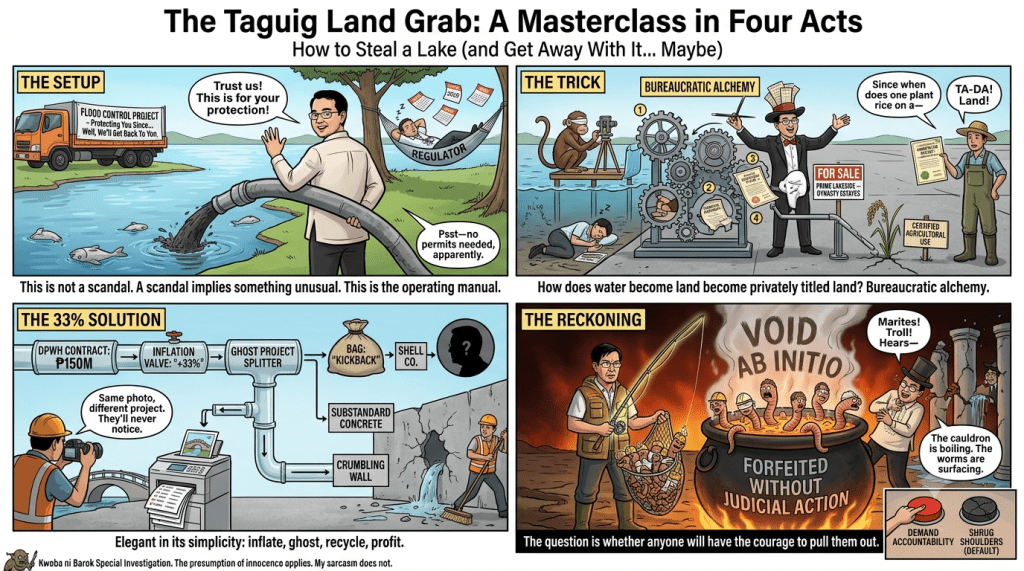
LET me be perfectly clear about what we are witnessing here. This is not a scandal. A scandal implies something unusual. Something aberrant.
What Senator Panfilo Lacson has dragged out of the murky depths of Laguna Lake is not an aberration. It is the operating manual—the playbook that has kept this country’s political dynasties fat and happy for generations.
And make no mistake: this is a dynasty operation. The Cayetanos didn’t build a political machine in Taguig by accident. They built it with concrete—38.83 hectares of concrete, fill material, and reclaimed lakebed that nobody asked permission for.
I. How to Disappear a Lake
Let us begin with the most delicious irony of this entire affair. The Philippine Reclamation Authority—the very agency created to regulate reclamation—has confirmed that not a single permit was issued. Not one. Zero. Nada.
Imagine walking into a bank and walking out with ₱50 million, then telling the police, “But I meant to fill out a withdrawal slip.” That is essentially what has happened here, except the “bank” is a lake, and the “money” is 38.83 hectares of public domain converted into private land.
Presidential Decree No. 3-A (The Reclamation Law of 1973) states:
“The reclamation of areas under water, whether foreshore or inland, shall be limited to the National Government or any person authorized by it under a proper contract. All reclamation made in violation of this provision shall be forfeited to the State without need of judicial action.”
Without need of judicial action.
The law is so clear that it doesn’t even require a court to declare the reclamation illegal. It is automatically forfeited. And yet, somehow, mysteriously, titles were issued.
II. The Magic Trick: Turning Water into Title
Here is where the story transforms from a mere regulatory violation into something far more sinister.
The Land Registration Authority is now “investigating” the original certificates of title covering the reclaimed land. Some of these titles apparently originated from homestead patents—the legal mechanism designed for agricultural settlers who cultivate agricultural land.
Since when, I must ask, does one plant rice on a lakebed?
The Supreme Court has been remarkably clear. In Republic v. Heirs of Daquer, the Court held that a homestead patent cannot lawfully convey property that was never alienable and disposable public land. In Republic v. Bacas, the Court held that a land-registration court has no jurisdiction over non-registrable public property.
Republic Act 4850—the Laguna Lake Development Authority (LLDA) Charter—expressly provides that reclaimed land belongs to the Authority, while the resulting lakeshore remains national-government property.
So the question becomes: How does water become land become privately titled land?
The answer, if Lacson’s investigation is correct, is a masterwork of bureaucratic alchemy:
- Step One: Secure appropriations for “slope protection” and “flood control.”
- Step Two: Use that money to dump fill material into Laguna Lake.
- Step Three: Wait for the fill to create new “land.”
- Step Four: Commission a survey that—what a coincidence!—treats this new land as if it had always existed.
- Step Five: Secure a homestead patent for “agricultural” land.
- Step Six: Obtain an original certificate of title.
- Step Seven: Sell, transfer, or develop the land.
- Step Eight: Profit.
It is, quite literally, a land-manufacturing scheme disguised as a flood-control program.
III. The 33% Solution
Now let us discuss Lacson’s most explosive allegation: the 33% kickback scheme.
According to Lacson, contractors in Taguig were required to kick back roughly one-third of their contract value to the people who controlled the Department of Public Works and Highways (DPWH) district office. The mechanism, if true, is elegant in its simplicity: the contract is inflated to absorb the kickback; the work is either not done, partially done, or done with substandard materials; the “accomplishment” is documented with recycled photographs—the same geotagged images used to bill for different projects; and the money flows from DPWH → contractor → shell company → political operator → somewhere.
Lacson has not explicitly named the ultimate beneficiary. But he has stated that district engineers in Taguig who did not follow the “instructions” of Alan Peter Cayetano were replaced.
Cayetano, of course, denies everything. He calls Lacson a “Senator-Judge troll” relying on “hearsay.”
Which brings us to the question: Who is telling the truth?
IV. The Defense: Political Theatre
Cayetano’s defense rests on several pillars:
Pillar One: “The projects benefited residents.”
This is the classic “ends justify the means” argument. But if the projects actually provided flood protection, why are there ghost projects? Why are there recycled photographs? Why are there double appropriations for the same project?
The existence of actual infrastructure does not negate the existence of fake infrastructure—the fake projects are how you pay for the real ones and line your pockets simultaneously.
Pillar Two: “Lacson is politically motivated.”
This is almost certainly true. Lacson and Cayetano are political rivals. Both may harbor ambitions for higher office. But political motivation does not make evidence disappear.
If Lacson has documents showing double appropriations, recycled photographs, and unauthorized reclamation, those documents exist regardless of why Lacson decided to investigate. Cayetano’s attack on Lacson’s motives is a classic deflection strategy—and it only works if the audience is willing to ignore the underlying evidence.
Pillar Three: “I had no direct control over DPWH.”
This is technically true. A congressman—even a former Senate President—does not formally control DPWH district operations. But “control” in Philippine politics does not operate through formal org charts. It operates through patronage, influence, and fear.
Lacson’s allegation that district engineers who did not follow Cayetano’s “instructions” were replaced is, if true, a textbook example of informal political control.
V. A Rogues’ Gallery of Institutional Failure
The Land Registration Authority (LRA)
The LRA is now “investigating” the titles. How noble. How proactive. How fashionably late.
To be fair, the LRA is not the villain of this story. It is, at worst, the unwitting notary—the clerk who stamps the paperwork while the real magic happens upstream. If lakebed was converted into titled land, the rot likely began long before the Registry of Deeds ever saw a document.
The LRA’s “investigation” is less a tacit admission of failure than a bureaucratic fire drill—the institutional equivalent of a fire department arriving at a burned-out building and announcing, “We are now investigating the fire.” It may not have started the blaze, but it certainly certified the ashes as prime real estate.
Still, one must ask: if the Torrens system is the gold standard of Philippine property law, how does a lakebed slip through with a homestead patent and a straight face? Someone in the chain of custody was asleep at the wheel—or worse, holding the stamp while others steered.
The Philippine Reclamation Authority (PRA)
The reclamation has been ongoing—according to Lacson—since 2019. That is seven years of unauthorized reclamation. Seven years of fill material. Seven years of titles being issued.
And the PRA only now confirms that no permits were secured? Where was the PRA in 2019? In 2021? In 2023? The PRA is either criminally negligent or willfully blind.
The Department of Public Works and Highways (DPWH)
The DPWH is not a victim here. It is the instrument. The 33% kickback scheme, if true, operated through DPWH procurement processes. The recycled photographs were used in DPWH billing documents. The double appropriations flowed through DPWH budget lines.
VI. The Ombudsman: The Reluctant Referee
The Office of the Ombudsman has begun a “fact-finding investigation.” Let us be charitable: the Ombudsman’s job is not an easy one. It is constitutionally mandated to investigate corruption, yet chronically underfunded, perpetually understaffed, and politically outgunned. It is the institutional equivalent of a traffic enforcer trying to ticket a convoy of armored SUVs.
Will this case be different? The Ombudsman has issued subpoenas to DPWH, PRA, LRA, and the Taguig Registry of Deeds. That is a start—more than a press release, less than a prosecution. But the real test will be whether the Ombudsman can sustain the investigation when the political winds shift, as they inevitably do.
The question is not whether the Ombudsman is brave. It is whether the system allows bravery to matter.
I am cautiously—very cautiously—watching.
VII. A Legal Armageddon for the Land Grabbers
Chavez v. Public Estates Authority (G.R. No. 133250)
The Supreme Court’s landmark decision in Chavez is devastating to the private-title theory. Reclaimed lands remain subject to constitutional and statutory limitations governing public-domain property.
The legal chain must be: lawful reclamation → lawful classification → lawful disposition → legally qualified recipient → valid title. Skip any step, and the entire chain collapses. In Taguig, the first step is already broken.
Republic v. Heirs of Daquer (G.R. No. 193657)
A homestead patent cannot lawfully convey property that was not disposable public land. Land that was, until recently, underwater is not alienable and disposable. It is lakebed. It is public domain.
A homestead patent issued over reclaimed lakebed is not merely irregular—it is void ab initio. It is a legal nullity.
Republic v. Bacas
The State is not necessarily barred by prescription from attacking a judgment involving non-registrable public property. A land-registration court has no jurisdiction over such property.
This means the State can potentially move to cancel the Taguig titles regardless of how long they have been registered. The land grabbers are sitting on a legal time bomb.
VIII. The Political Calculus
Lacson’s investigation of Taguig is, at least in part, a political attack designed to weaken Cayetano’s home turf and enhance Lacson’s anti-corruption credentials.
But here is the thing: the attack only works if the corruption is real. Lacson cannot manufacture 38.83 hectares of reclaimed lakebed. He cannot fabricate PRA’s confirmation that no permits were issued. He cannot invent the LRA’s investigation.
That is what makes this controversy so dangerous for Cayetano. He cannot simply dismiss it as “political persecution.” He must explain the evidence. He must account for the reclamation. He must justify the titles.
So far, he has not done so.
IX. A Nation of Institutional Failure
The Taguig controversy is not an isolated case. It is a symptom of systemic failure:
- Institutional fragmentation creates gaps between agencies.
- Political patronage fills those gaps with corrupt actors.
- Documentary fraud conceals the corruption.
- Institutional inertia prevents detection.
- Political calculation prevents enforcement.
- Whistleblower courage finally exposes the scandal.
- Belated investigation attempts to salvage institutional credibility.
We have seen this pattern in the pork barrel scam, the Mamasapano fiasco, the COVID-19 procurement scandals, and now the Taguig reclamation. Until the underlying disease changes—a political system that rewards loyalty over competence, patronage over integrity, silence over accountability—we will continue to watch politicians convert public resources into private wealth.
X. What Should Happen Now
First, the area discrepancy must be resolved. Is it 38.83 hectares or 80 hectares? The fact that even the reported area is inconsistent suggests a fundamental lack of precision.
Second, the LRA must complete its title audit and publish its findings. Every OCT/TCT should be traced back to its original registration proceeding.
Third, the PRA must complete forfeiture proceedings and issue a definitive determination of the legal status of the reclaimed land.
Fourth, the Ombudsman must act with urgency. This is not a case that should languish for years.
Fifth, the DPWH must conduct an internal investigation of the Taguig district office. The 33% kickback scheme, if real, could not have operated without the complicity of DPWH officials.
Sixth, the Cayetanos—if they are innocent—should welcome this investigation. They should demand transparency. Their failure to do so speaks volumes.
XI. The Cauldron of Worms
Senator Lacson called this controversy a “cauldron of worms.” The metaphor is apt. Worms do not exist in isolation. They breed. They multiply. They create entire ecosystems of corruption that feed on institutional weakness and political patronage.
The Taguig reclamation scandal is not just about 38.83 hectares of lakebed. It is about how political dynasties convert public resources into private wealth. It is about how government agencies fail to perform their regulatory functions. It is about how the Torrens system—the foundation of Philippine property law—can be manipulated to legitimize theft.
And it is about whether anyone will be held accountable.
The Ombudsman has a choice: thorough investigation or bland exoneration. The PRA has a choice: complete forfeiture or negotiated settlement. The DPWH has a choice: expose corruption or protect the guilty.
And the Filipino people have a choice: demand accountability or shrug our shoulders and accept that this is just how things work.
The cauldron is boiling. The worms are surfacing. The question is whether anyone will have the courage to pull them out.
This has been a Kweba ni Barok special investigation. For the sake of the Republic, let us hope it is not the last.
DISCLAIMER: The allegations discussed herein are based on publicly available information as of August 29, 2026. The presumption of innocence applies to all accused persons pending final judicial determination. The author reserves the right to be vindictively sarcastic at the expense of public officials who treat public resources as their personal property.
Key Citations
A. Legal & Official Sources
- Chavez v. Public Estates Authority, G.R. No. 133250. Supreme Court of the Philippines, 9 July 2002. Lawphil.
- Republic v. Heirs of Daquer, G.R. No. 193657. Supreme Court of the Philippines, 4 Sept. 2018. Lawphil.
- Republic v. Bacas, G.R. No. 182913. Supreme Court of the Philippines, 20 Nov. 2013. LawPhil.
- Presidential Decree No. 3-A. 11 Jan. 1973. Philippine Reclamation Authority.
- Republic Act No. 4850. 18 July 1966. Senate of the Philippines Legislative Reference Bureau.
B. News Articles
- Valente, Catherine S. “Lacson seeks forfeiture of Taguig reclaimed land.” The Manila Times, 5 Aug. 2026.
- Valente, Catherine S. “Lacson, Cayetano trade barbs: Flood of truth vs cauldron of worms.” The Manila Times, 4 Aug. 2026.
- Ombay, Giselle. “Lacson: LRA checking land titles linked to Taguig reclamation.” GMA News Online, 28 Aug. 2026.
- “Cayetano denies Taguig reclamation allegations, calls Lacson ‘marites.’” The Filipino Times, 4 Aug. 2026.
- Valente, Catherine S. “‘Ombudsman on track in Taguig reclamation probe.’” The Manila Times, 20 Aug. 2026.
C. Official Websites
- Philippine Reclamation Authority. Official website.
- Land Registration Authority. Official website.
- Office of the Ombudsman. Official website.
- Department of Public Works and Highways. Official website.
- Laguna Lake Development Authority. Official website.

- ₱8B BBM Pork: CCTV for Every Captain’s Kumpare?

- ₱8.9 Billion, 331 Ghost Police Stations: The TIKAS Scandal Explained

- ₱8.4 Billion, 42,000 Barangays, 1 Election: The “Bawat Barangay Makikinabang” Vote-Buying Masterclass

- ₱75 Million Heist: Cops Gone Full Bandit

- ₱6.77B Ghost Haunts Duterte: RTC Dismisses Mans Carpio’s Desperate Plea
- ₱6.77 Billion and Zero Cash: The Sara Duterte SALN Math That Doesn’t Add Up

- ₱6.7-Trillion Temptation: The Great Pork Zombie Revival and the “Collegial” Vote-Buying Circus

- ₱58.53B, Zero Receipts: The LGSF Pork Barrel Nobody Wants to Name
- ₱53 Million Man Tells ₱695-a-Day Workers to Stop Being ‘Mayabang’: The Audacity of BSP’s Remolona

- ₱4.4 Billion and a Witness Who Can’t Explain It: The Duterte Impeachment’s Most Expensive Non-Answer

- ₱3.06 Billion for Evacuation Centers—But Nobody Knows Where They’ll Stand (Or If They’ll Exist)
- ₱16 Billion, 280 Accounts, 8 Helicopters: Boying Remulla’s Case Against the Yaps Is Not a Drill









Leave a comment