Remulla’s Receipt: Coach Knew the Currents—Yet Rolled the Dice With Non-Swimmers
By Louis ‘Barok’ C Biraogo — June 27, 2026
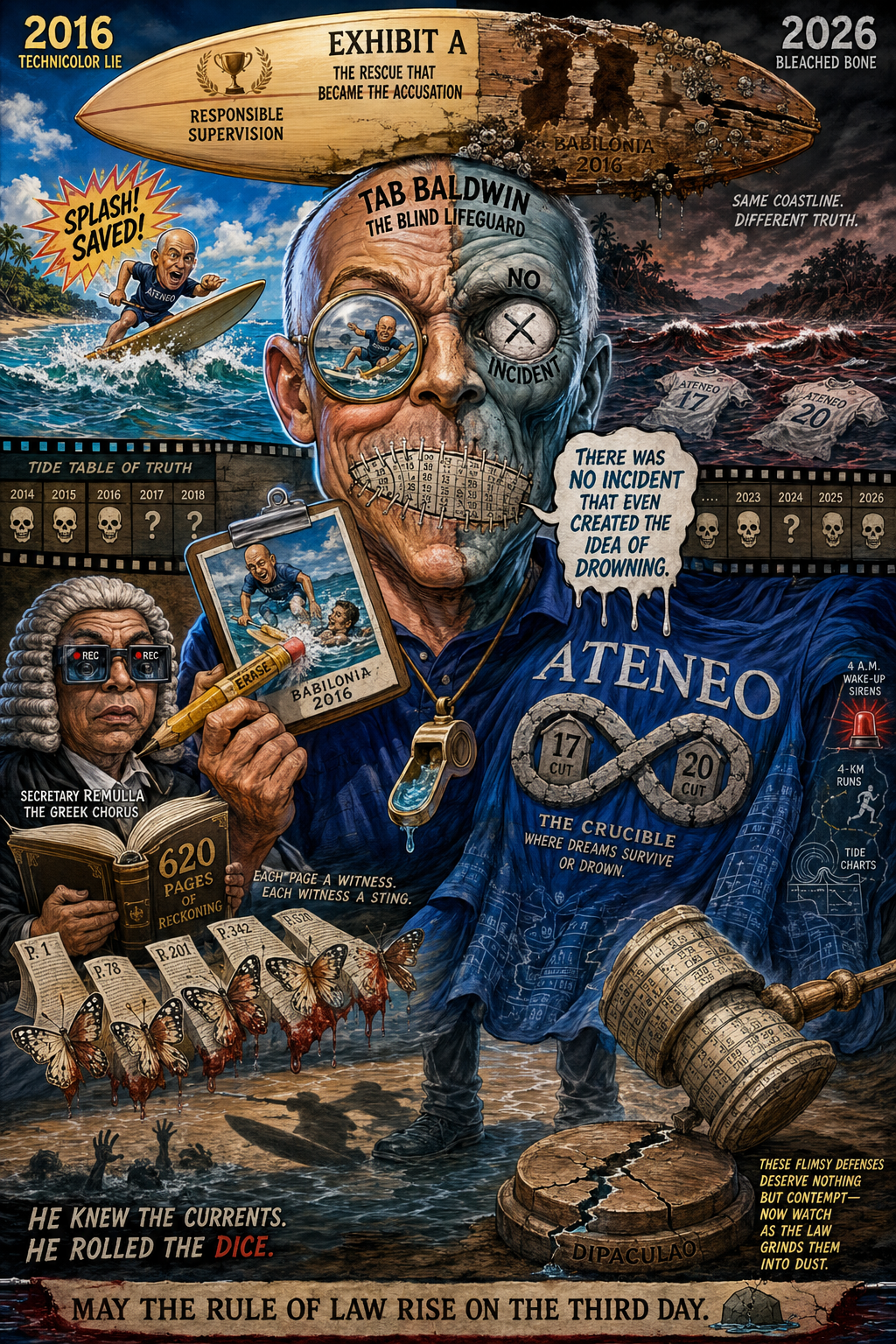
THE Criminal Investigation and Detection Group (CIDG)’s 620-page recommendation isn’t just an investigative report—it’s an indictment, a narrative of preventable tragedy written in witness affidavits and tide tables. And at its explosive center sits a single, devastating contradiction: Tab Baldwin told investigators “there was no incident that even created the idea of drowning.” Yet Norman Aaron Black and GBoy Babilonia, two former Blue Eagles, have now sworn under the fluorescent lights of an official probe that they nearly drowned in 2016 at that very same Dipaculao coastline.
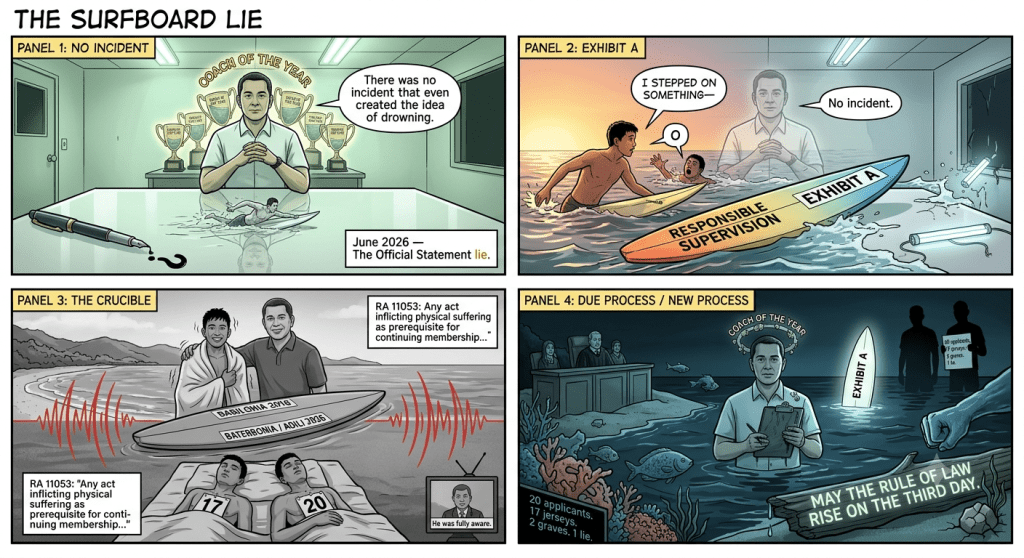
Let that sink in, mga ka-kweba. The same coach who personally paddled a surfboard out to rescue a panicking Babilonia now claims nothing ever happened that foreshadowed death. This is not a semantic dispute over what “near-drowning” means. This is either a catastrophic failure of memory bordering on perjury, or a calculated lie by a man who understood—with ten years of chilling clarity—exactly what his training regime could produce: dead athletes.
Baldwin’s defenders, and there are still some, will retreat to familiar ground. This was a tragic accident, they’ll argue. Athletic conditioning is not a fraternity initiation. Memories fade over a decade. The coach’s rescue of Babilonia proves supervision, not recklessness. These are the arguments of a defense grasping at legal straws while two young men lie in graves.
These flimsy defenses deserve nothing but contempt—now watch as the law grinds them into dust.
Exhibit A: The Surfboard Rescue Baldwin Now Denies
The defense’s “accident” narrative collapses the moment you accept—as Remulla has now publicly established—that Baldwin had direct, personal knowledge of the lethal potential of those Aurora waters. Foreseeability is the linchpin of criminal negligence under Article 365 of Act No. 3815, otherwise known as the Revised Penal Code. You cannot claim a tragedy was unforeseeable when you, coach, used your own surfboard to prevent it years earlier. The rescue that Baldwin might present as a badge of responsible supervision is, in truth, the prosecution’s Exhibit A. It is an admission that he knew non-swimmers could panic, that currents could overpower collegiate athletes, and that without immediate intervention, his players would die. To conduct the same activity in 2026, with five known non-swimmers including the deceased Divine Adili, is not merely negligence. It is reckless imprudence that flirts with dolus eventualis—the grim legal concept where one doesn’t intend a result but foresees it as a possible consequence and proceeds anyway.
Semantics about “near-drowning” versus “panic” won’t fly either. When Norman Black’s affidavit states he “almost drowned and gave up” until a coach intervened, that is not a minor scare. That is a prima facie case that the activity placed lives in mortal peril. Baldwin’s “I never denied rescue incidents” line, which his camp will surely float, is the desperate hairsplitting of a man who knows his own words to the CIDG—“no incident that even created the idea of drowning”—are now on the record, contradicted by at least two witnesses. In a court of law, that’s called impeachment by prior inconsistent statement. In the court of public opinion, it’s called being caught.
RA 11053’s Crucible: Is Athletic “Boot Camp” Just Hazing by Another Name?
The legal question that will define this case for Philippine jurisprudence is whether a grueling athletic boot camp, explicitly tied to final University Athletic Association of the Philippines (UAAP) roster cuts, falls under Republic Act No. 11053 (Anti-Hazing Act of 2018). Baldwin’s defenders call it a stretch. I call it the exact scenario the law was expanded to capture.
Section 3 of RA 11053 defines hazing as any act that inflicts physical or psychological suffering as a “prerequisite for… continuing membership” in an organization. The CIDG’s findings paint a brutal picture: 4 a.m. wake-up calls, a four-kilometer run, punishments for losers, and then a seawater exercise conducted at high tide. This was the crucible to determine which 17 of 20 players would wear the Ateneo jersey. If this structured ordeal, designed to test worthiness under pain of physical punishment, does not meet the statutory definition of hazing, then what does? The Supreme Court has long held that penal laws are to be construed liberally in favor of the accused, but that principle has a limit. It does not require us to blind ourselves to the plain text of a law born from the blood of hazing victims like Atio Castillo. Baldwin and his 10 co-respondents, under Section 14(a), face reclusion perpetua if convicted. That is not prosecutorial overreach. That is the logical, legal consequence of an activity that ended in fatalities.
Even if the Department of Justice (DOJ) hesitates on the novel hazing theory, Baldwin cannot escape. Article 365’s reckless imprudence resulting in homicide is a legal safety net that requires only a lack of precaution a reasonable person would have taken. A reasonable person, knowing what Baldwin knew, would have had certified lifeguards, mandatory flotation devices for non-swimmers, and real-time tide monitoring. The absence of all three is negligence so gross it screams for accountability. The hazing charge is the sword. The negligence charge is the dagger. Either way, the prosecution can and must draw blood.
Remulla’s Narration: Transparency or Anchoring the DOJ’s Verdict?
This brings me to a delicate but necessary critique. Secretary Jonvic Remulla’s public performance—reading verbatim excerpts from witnesses, drawing conclusions about Baldwin’s “full awareness,” and narrating the CIDG’s case like a seasoned prosecutor—is both a service and a spectacle. The service is transparency in a case that has drawn national fury. The spectacle, however, is a Cabinet official effectively conducting a trial by press conference before the Department of Justice (DOJ) has even begun its constitutionally mandated preliminary investigation.
I praise the Philippine National Police-Criminal Investigation and Detection Group (PNP-CIDG)’s work. Three hundred twenty hours of interviews with sixty respondents, spanning six hundred twenty pages, is a masterclass in investigatory thoroughness. But Remulla’s framing risks creating a dangerous anchoring effect that compresses the DOJ’s institutional room to maneuver. Any downgrade from hazing charges, any finding of insufficient evidence against the student managers or utility staff lumped in with the 11 respondents, will now be publicly perceived not as prosecutorial discretion but as a whitewash. Remulla has, perhaps inadvertently, backed the DOJ into a corner where only a full-throated indictment will satisfy the public. Due process is not a technicality, and the Bill of Rights in Article III of the 1987 Constitution of the Republic of the Philippines is not optional. The case against Baldwin is devastatingly strong on its merits. It does not need a Cabinet secretary’s narration to make it so.
Ateneo’s Catastrophic Blind Eye: In Loco Parentis Meets Two Graves
Ateneo’s defense—that administrators didn’t know about the beach activity beforehand—is the most damning indictment of all. A university that positions itself as in loco parentis did not know its head coach, a foreign national on an Alien Employment Permit, was exposing its student-athletes to drowning hazards in a remote Aurora town. This is not institutional exoneration. It is a catastrophic failure of oversight that demands sanctions from the UAAP. The La Salle suspension of Season 69 for recruitment violations is the floor, not the ceiling. Two deaths demand a season-long suspension of the men’s basketball program, a complete overhaul of athletic safety governance, and a Commission on Higher Education (CHED)-mandated safety protocol for all schools nationwide.
The families of Rene Baterbonia and Divine Adili deserve more than video apologies. They deserve criminal convictions, civil damages under Articles 2176 and 2180 of Republic Act No. 386, otherwise known as the Civil Code of the Philippines, and a legal precedent that ensures no coach ever again confuses “stretching limits” with betting young lives on the mercy of the sea. The DOJ must now show the courage to indict. The courts must show the wisdom to convict. And the nation must demand a justice that is not merely performed for cameras, but delivered in verdicts.
May the rule of law rise on the third day. 🪨
Key Citations
A. Legal & Official Sources
- The 1987 Constitution of the Republic of the Philippines. Official Gazette of the Republic of the Philippines, 1987, http://www.officialgazette.gov.ph/constitutions/1987-constitution/.
- Act No. 3815. An Act Revising the Penal Code and Other Penal Laws. Official Gazette of the Republic of the Philippines, 8 Dec. 1930, http://www.officialgazette.gov.ph/1930/12/08/act-no-3815-s-1930/.
- Republic Act No. 11053. An Act Prohibiting Hazing and Regulating Other Forms of Initiation Rites of Fraternities, Sororities, and Other Organizations, and Providing Penalties for Violations Thereof, Amending for the Purpose Republic Act No. 8049. 29 June 2018, elibrary.judiciary.gov.ph/thebookshelf/showdocs/2/85055.
- Republic Act No. 386. The Civil Code of the Philippines. Official Gazette of the Republic of the Philippines, 18 June 1949, http://www.officialgazette.gov.ph/1949/06/18/republic-act-no-386/.
B. News Reports
- “Former Ateneo players contradict Tab Baldwin claim of no prior drowning scare.” GMA News Online, GMA Network, 26 June 2026, http://www.gmanetwork.com/news/sports/basketball/992771/ateneo-players-tab-baldwin-drowning-scare/story/.
- “Baldwin, ex-Ateneo players clash over past near-drownings —Remulla.” Inquirer.net, Inquirer Interactive, Inc., 26 June 2026, newsinfo.inquirer.net/2253267/baldwin-ex-ateneo-players-clash-over-past-near-drownings-remulla.
- Villar, Joey. “La Salle Banned for One Season.” Philstar.com, 22 Apr. 2006, http://www.philstar.com/sports/2006/04/22/332642/la-salle-banned-one-season.

- ₱8B BBM Pork: CCTV for Every Captain’s Kumpare?

- ₱8.9 Billion, 331 Ghost Police Stations: The TIKAS Scandal Explained

- ₱8.4 Billion, 42,000 Barangays, 1 Election: The “Bawat Barangay Makikinabang” Vote-Buying Masterclass

- ₱75 Million Heist: Cops Gone Full Bandit

- ₱6.77B Ghost Haunts Duterte: RTC Dismisses Mans Carpio’s Desperate Plea

- ₱6.77 Billion and Zero Cash: The Sara Duterte SALN Math That Doesn’t Add Up

- ₱6.7-Trillion Temptation: The Great Pork Zombie Revival and the “Collegial” Vote-Buying Circus

- ₱58.53B, Zero Receipts: The LGSF Pork Barrel Nobody Wants to Name
- ₱53 Million Man Tells ₱695-a-Day Workers to Stop Being ‘Mayabang’: The Audacity of BSP’s Remolona

- ₱4.4 Billion and a Witness Who Can’t Explain It: The Duterte Impeachment’s Most Expensive Non-Answer
- ₱3.06 Billion for Evacuation Centers—But Nobody Knows Where They’ll Stand (Or If They’ll Exist)
- ₱16 Billion, 280 Accounts, 8 Helicopters: Boying Remulla’s Case Against the Yaps Is Not a Drill









Leave a comment