
Coached Testimony Crumbles as NBI Demands Truth, Not Theater
By Louis ‘Barok‘ C. Biraogo — June 9, 2026
FROM the cave — where I watch these spectacles with the cold detachment of a forensic pathologist who has seen too many bodies dressed up as heroes — the “18 ex-guards” controversy is not a scandal. It is a Matryoshka doll of deception. Each layer you crack reveals another, smaller, more rotten one inside. The outer shell promises blockbuster corruption. The next hides a targeted strike on an impeachment prosecution. Deeper still lies a Senate civil war. At the core sits the institutionalized rot where whistleblowing and fabrication have become interchangeable weapons of political combat.
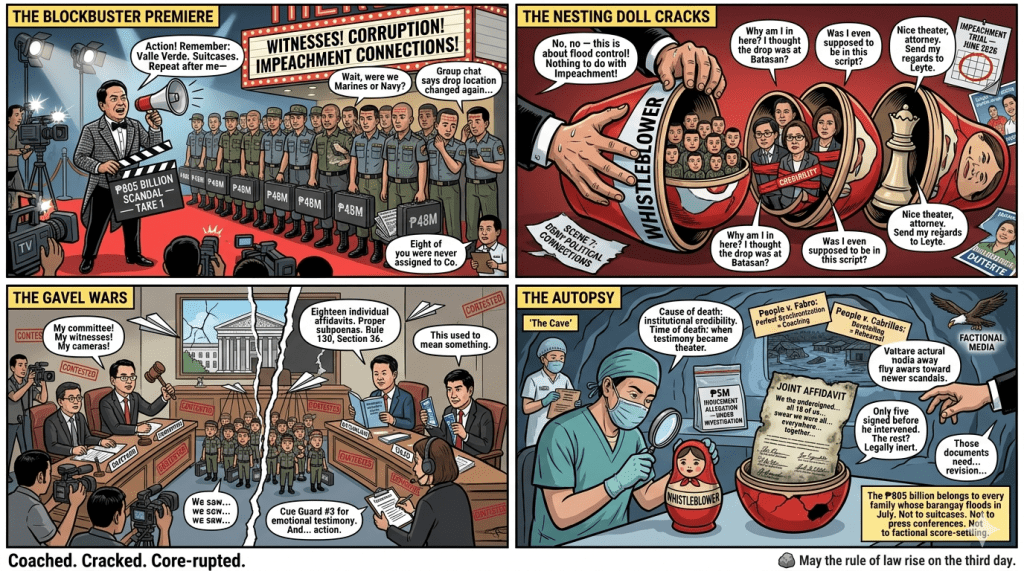
When 18 witnesses share a single, photocopied “Joint Affidavit,” it’s not synchronization—it’s a rehearsal.
Shell One: The ₱805 Billion Suitcase Shell Game
On the surface, lawyer Levito Baligod presents a cinematic tale. Eighteen former bodyguards claim they repeatedly carried suitcases — each allegedly stuffed with ₱48 million — from the Valle Verde residence of former Representative Elizaldy “Zaldy” Co. The cash, tied to anomalous flood-control projects, supposedly flowed through a group-chat-coordinated network to various politicians. The total figure floated: a staggering ₱805 billion. Names surfaced. Delivery logistics were described with cinematic precision.
Even this outer layer wobbles under its own weight. Baligod publicly corrected an erroneous inclusion of Representative Leila De Lima. The alleged drop-off location for Representative Joel Chua reportedly migrated from the Batasang Pambansa complex to a townhouse. The Armed Forces clarified that most were no longer Marines at the relevant time; the Philippine Navy added that four were never members and the majority had been dishonorably discharged. National Bureau of Investigation (NBI) Director Melvin Matibag stated that eight of the eighteen were never assigned to Co at all.
These are not peripheral details. They are fractures in the foundation. Where are the bank records, CCTV stills, authenticated chat logs, or forensic financial trails? So far the blockbuster rests almost entirely on collective testimonial assertion.
Shell Two: Impeachment Sabotage Masquerading as Whistleblowing
Crack the shell and the real payload appears. The names most aggressively highlighted — House prosecutors Gerville Luistro, Joel Chua, Leila De Lima, Terry Ridon, and impeachment spokesperson Zia Alonto-Adiong — are not random. They are the very lawyers preparing the case against Vice President Sara Duterte. House leaders correctly labeled the operation an attempt to destroy the credibility of the prosecution panel ahead of the impeachment trial.
The timing is surgical. Allegations that had circulated earlier exploded into coordinated Senate testimony and press conferences precisely as the impeachment calendar tightened. Baligod’s documented political ties to the Duterte camp — past endorsements, campaign imagery, and the Vice President’s unannounced appearance in his Leyte territory welcomed by his brother-in-law — are not conspiracy theory. They are observable facts that any competent defense lawyer will weaponize. This layer is not about recovering stolen public funds. It is about weakening the constitutional mechanism designed to hold the powerful accountable.
Shell Three: Senate Civil War — The Gavel as Factional Ammunition
Deeper still, the doll serves the concurrent war for control of the Senate. The Cayetano bloc staged a contested hearing featuring the eighteen as star witnesses even after the Gatchalian majority had declared positions vacant and reorganized committees. The ex-guards appeared before the Cayetano bloc’s forum and conspicuously avoided the rival Tulfo-led Blue Ribbon Committee amid the contested Senate leadership dispute. Defensor was reportedly coordinating their movements and strategy.
This is not legislative oversight. It is visual warfare. Cayetano’s side needed bodies in chairs and cameras rolling to project continuing authority. The Gatchalian side responded with procedural rigor — demanding individual affidavits and proper subpoenas — which simultaneously serves the rule of law and neutralizes the narrative bomb. Every ruling, every no-show, every competing subpoena now carries constitutional consequences for the legitimacy of future Senate actions, including the impeachment trial itself. The eighteen ex-guards have been reduced to props in a factional custody battle over the gavel.
The Rotten Core: Coached Testimony, Defective Affidavits, and the Blurred Line Between Whistleblower and Operative
At the center lies the legal and moral cancer. The Ombudsman and National Bureau of Investigation (NBI) are not engaging in bureaucratic sabotage by demanding eighteen separate affidavits. They are enforcing Section 36, Rule 130 of the Rules of Court: a witness may testify only to facts within personal knowledge. A single joint affidavit in which every signatory appears to swear to events only some of them could have witnessed is facially defective. It creates hearsay problems, prevents meaningful cross-checking, and triggers the Supreme Court’s long-standing warning — repeated in People v. Fabro and People v. Cabrillas — that perfectly dovetailing narratives are badges of coaching, not credibility. Human memory is imperfect. Perfect synchronization smells like rehearsal.
Baligod’s conduct at the NBI compounds the rot. National Bureau of Investigation (NBI) Director Matibag reported that while all eighteen were interviewed, only five signed statements before Baligod intervened — reportedly to review documents and, in one account, to attempt to rip them. That conduct raises serious questions under the Code of Professional Responsibility and Accountability (candor to tribunals, prohibition on dishonest conduct) and potentially Presidential Decree No. 1829 (Obstruction of Justice). Only five signed. The rest remain legally inert.
The credibility autopsy is merciless. The venue shift on a material fact. The late addition of Representative Alvarez after he allegedly refused to endorse an impeachment complaint against President Marcos — suggesting a political enemies list rather than evidence-based accusations. The admitted De Lima error. The NBI’s finding that nearly half the group had no assignment to Co. These are not minor inconsistencies; they are structural defects.
If the core allegations are true, potential liability is severe: Republic Act No. 3019 (Anti-Graft and Corrupt Practices Act) Sections 3(b), 3(e), and 3(g) for the recipients and Co; Revised Penal Code (Act No. 3815) Articles 210 and 211 (direct and indirect bribery); Republic Act No. 7080 (An Act Defining and Penalizing the Crime of Plunder) if thresholds are met; and Republic Act No. 9160 (Anti-Money Laundering Act of 2001) linkages. If the allegations are fabricated, the ex-guards and Baligod face Article 183 of the Revised Penal Code (Perjury), Articles 180–184 (false testimony), Article 363 of the Revised Penal Code (Incriminating Innocent Persons), Republic Act No. 10175 (Cybercrime Prevention Act of 2012), and obstruction charges. Baligod additionally risks Integrated Bar of the Philippines disciplinary proceedings and Supreme Court sanctions under Rule 139-B of the Rules of Court.
Motivations follow from observable actions rather than mind-reading. A subset of the eighteen may possess genuine knowledge; others appear recruited for volume and optics (the reported ₱5 million inducement allegation is under NBI investigation). Baligod appears to be maximizing political detonation over prosecutorial viability. Co occupies an ambiguous pivot position. The Cayetano bloc seeks survival through spectacle; the Gatchalian bloc uses process as both shield and scalpel. The NBI and Ombudsman are attempting to preserve institutional credibility while being conscripted into factional combat.
The Reckoning: Institutions Must Pick Law Over Political Theater
The deeper pathology is this: genuine flood-control corruption — documented in Commission on Audit (COA) reports long before any joint affidavit — is being shielded by the very political operation that claims to expose it. When defective testimony and procedural manipulation become the delivery system for accountability claims, the corrupt win either way. If the witnesses collapse, the underlying anomalies are tarred by association. If institutions bend the rules to accommodate the operation, they lose legitimacy.
From the cave I offer no comforting illusions. The path forward is unglamorous and must be walked anyway.
The Ombudsman must enforce the individual-affidavit requirement within a strict deadline or dismiss without prejudice — while simultaneously exercising its motu proprio power under Republic Act No. 6770 (The Ombudsman Act of 1989) to investigate the flood-control anomalies through COA audits and DPWH records that require no witness affidavit. The NBI must complete the Defensor bribery investigation and authenticate any digital evidence under the Rules on Electronic Evidence. The Senate must resolve its leadership dispute through the Supreme Court if necessary and allow the properly constituted Blue Ribbon Committee to function. The Integrated Bar must examine Baligod’s conduct. Congress must finally reform the Witness Protection Program to insulate it from DOJ political control. Civil society and the press must stop conflating the credibility of the messenger with the veracity of the underlying documentary corruption.
The ₱805 billion — or whatever fraction is real — belongs to every family whose barangay floods in July, not to suitcases, press conferences, or factional score-settling. The performance has run its course.
Now comes the hard part.
Now comes the part where institutions are forced to prove they still serve the rule of law — enforcing rules, demanding proper evidence, and delivering justice long after the spotlights have dimmed and the political vultures have flown to fresher carcasses.
🪨 May the rule of law rise on the third day.
— Barok
Key Citations
A. Legal & Official Sources
- Philippines. Republic Act No. 3019. Anti-Graft and Corrupt Practices Act, 17 Aug. 1960. The Lawphil Project, lawphil.net/statutes/repacts/ra1960/ra_3019_1960.html.
- Philippines. Republic Act No. 7080: An Act Defining and Penalizing the Crime of Plunder. 12 July 1991. Lawphil Project, lawphil.net/statutes/repacts/ra1991/ra_7080_1991.html.
- Philippines. Republic Act No. 9160: An Act Defining the Crime of Money Laundering, Providing Penalties Therefor and for Other Purposes. 29 Sept. 2001. Lawphil Project, lawphil.net/statutes/repacts/ra2001/ra_9160_2001.html.
- Philippines. Republic Act No. 6770: An Act Providing for the Functional and Structural Organization of the Office of the Ombudsman, and for Other Purposes. 17 Nov. 1989. Lawphil Project, lawphil.net/statutes/repacts/ra1989/ra_6770_1989.html.
- Philippines. Republic Act No. 10175: An Act Defining Cybercrime, Providing for the Prevention, Investigation, Suppression and the Imposition of Penalties Therefor and for Other Purposes. 12 Sept. 2012. Lawphil Project, lawphil.net/statutes/repacts/ra2012/ra_10175_2012.html.
- Philippines. Supreme Court. Presidential Decree No. 1829. Penalizing Obstruction of Apprehension and Prosecution of Criminal Offenders, 16 Jan. 1981. The Lawphil Project, lawphil.net/statutes/presdecs/pd1981/pd_1829_1981.html.
- Philippines. Revised Penal Code: Act No. 3815. An Act Revising the Penal Code and Other Penal Laws. 8 Dec. 1930. Lawphil Project, lawphil.net/statutes/acts/act1930/act_3815_1930.html.
- Philippines. Supreme Court. Rules of Court. Revised Rules on Evidence (Rules 128-134), as amended, 1 July 1989 (further amended by A.M. No. 19-08-15-SC, effective 1 May 2020). The Lawphil Project, lawphil.net/courts/rules/rc_128-134_evidence.html.
- Philippines. Supreme Court. Rules of Court. Rule 139-B, Disbarment and Discipline of Attorneys, effective 1 June 1988 (as amended). The Lawphil Project, lawphil.net/courts/rules/rc_139-b_1988.html.
- Philippines. Supreme Court. Code of Professional Responsibility and Accountability. A.M. No. 22-09-01-SC, 11 Apr. 2023. Chan Robles Virtual Law Library, chanrobles.com/rulesofcourt/2023codeofprofessionalresponsibility.php.
- Philippines. Supreme Court. People v. Fabro. G.R. No. 95089, 11 Aug. 1997. The Lawphil Project, lawphil.net/judjuris/juri1997/aug1997/gr_95089_1997.html.
- Philippines. Supreme Court. People v. Cabrillas. G.R. No. 193833, 15 Oct. 2014. The Lawphil Project, lawphil.net/judjuris/juri2014/oct2014/gr_193833_2014.html.
B. News Reports
- Lalu, Gabriel. “18 Affidavits Needed to Probe Co’s 18 Ex-Guards –NBI, Ombudsman.” INQUIRER.net, 8 June 2026, newsinfo.inquirer.net/2242943/18-affidavits-needed-to-probe-cos-18-ex-guards-nbi-ombudsman.
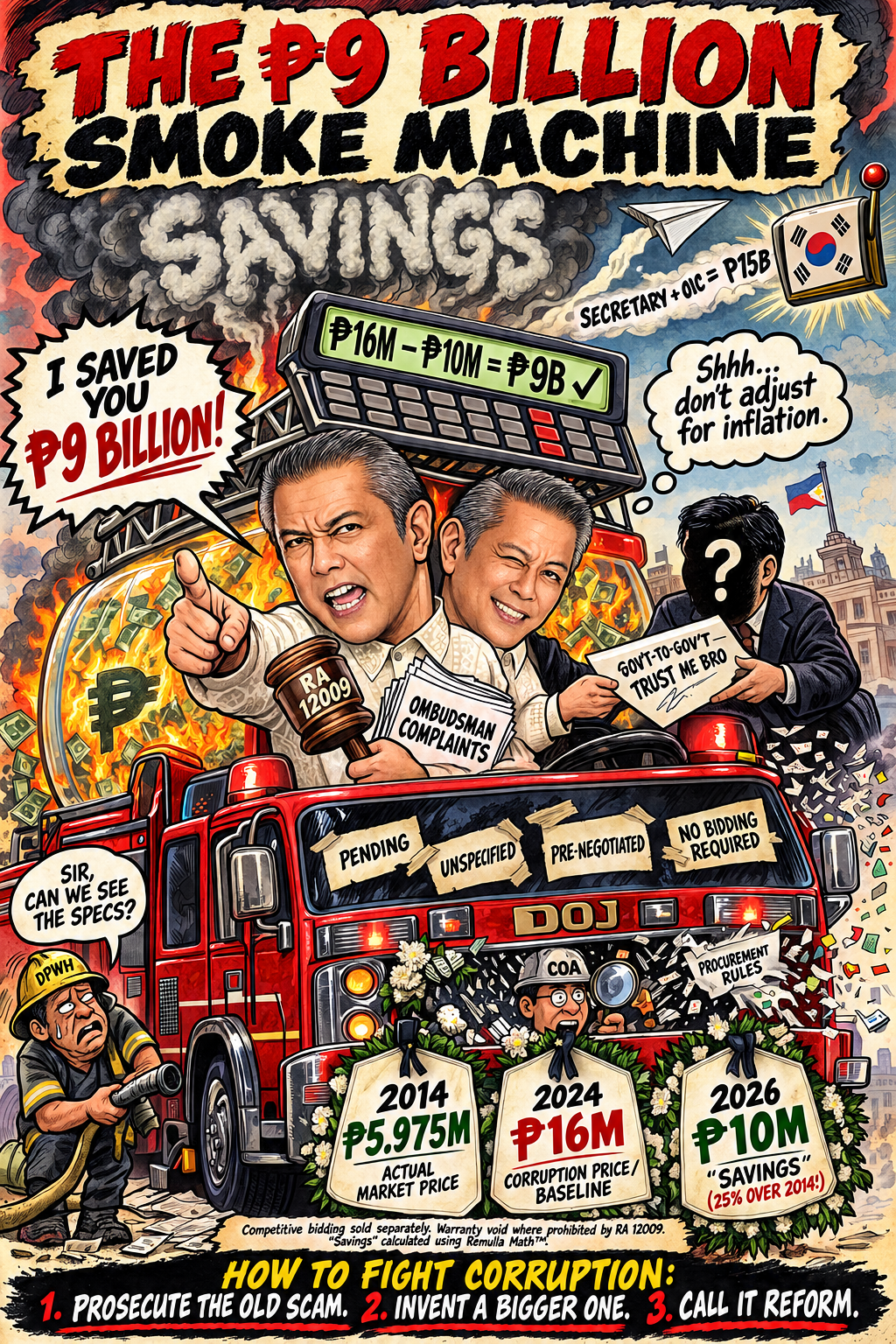
- ₱9 Billion in ‘Savings’? DILG’s Fire Truck Deal Smells Like Smoke

- ₱8B BBM Pork: CCTV for Every Captain’s Kumpare?
- ₱8.9 Billion, 331 Ghost Police Stations: The TIKAS Scandal Explained

- ₱8.4 Billion, 42,000 Barangays, 1 Election: The “Bawat Barangay Makikinabang” Vote-Buying Masterclass

- ₱75 Million Heist: Cops Gone Full Bandit

- ₱6.77B Ghost Haunts Duterte: RTC Dismisses Mans Carpio’s Desperate Plea
- ₱6.77 Billion and Zero Cash: The Sara Duterte SALN Math That Doesn’t Add Up

- ₱6.7-Trillion Temptation: The Great Pork Zombie Revival and the “Collegial” Vote-Buying Circus

- ₱58.53B, Zero Receipts: The LGSF Pork Barrel Nobody Wants to Name
- ₱53 Million Man Tells ₱695-a-Day Workers to Stop Being ‘Mayabang’: The Audacity of BSP’s Remolona
- ₱4.4 Billion and a Witness Who Can’t Explain It: The Duterte Impeachment’s Most Expensive Non-Answer
- ₱3.06 Billion for Evacuation Centers—But Nobody Knows Where They’ll Stand (Or If They’ll Exist)




Leave a Reply