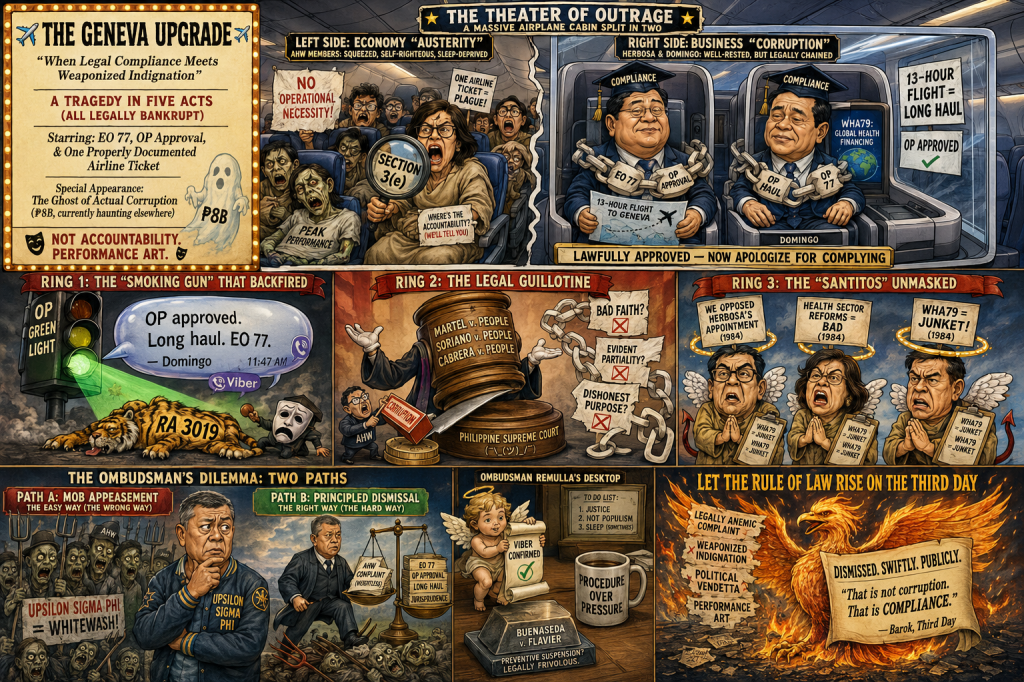
When Legal Compliance Meets Weaponized Indignation
By Louis ‘Barok‘ C. Biraogo — June 10, 2026
THE Alliance of Health Workers (AHW) has filed what may be the most legally anemic Ombudsman complaint in recent memory: a demand to investigate, and even preventively suspend, Health Secretary Teodoro Herbosa and Undersecretary Albert Francis Domingo because an official long-haul diplomatic flight to the World Health Assembly was upgraded from economy to business class after the Office of the President (OP) gave its explicit blessing under Executive Order No. 77, s. 2019 (Prescribing Rules and Regulations and Rates of Expenses and Allowances for Official Local and Foreign Travels of Government Personnel). In a country where real plunder cases involving billions rot in the docket, the AHW wants the Ombudsman to treat a properly authorized travel entitlement as corruption worthy of taxpayer-funded spectacle. This is not accountability. This is performance art dressed in the borrowed robes of moral outrage, and it collapses the moment the facts are allowed to speak.
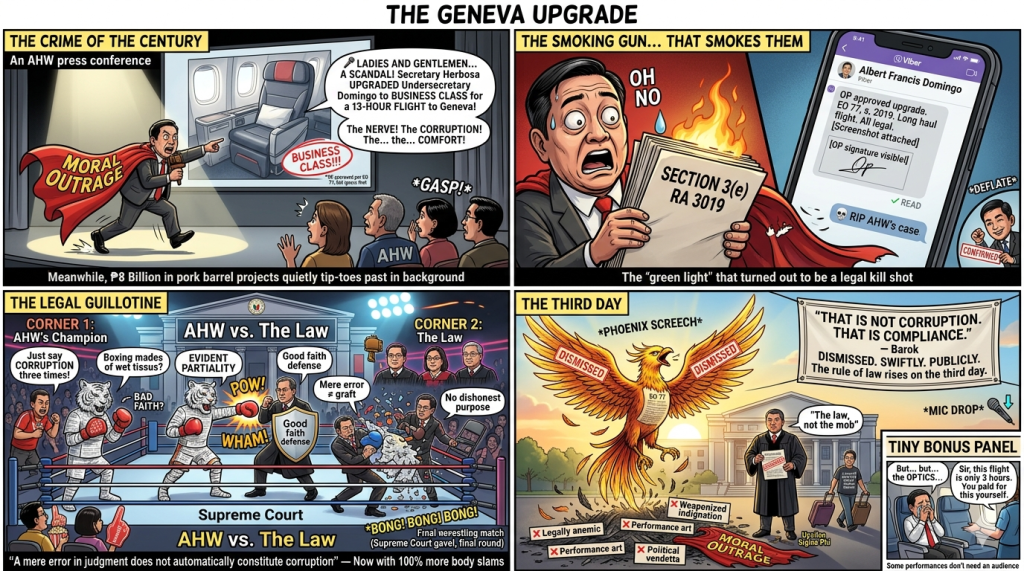
The OP Green Light: The Smoking Gun That Executed the Farce
The single fact that ends this complaint is now beyond dispute. In a direct Viber message to this writer, Undersecretary Albert Francis Domingo confirmed that the Office of the President approved the business-class upgrade for the Geneva trip, as required under Executive Order No. 77, s. 2019 for undersecretaries on long-haul flights. That approval is the legal kill shot. Everything else the AHW offers — the timing relative to austerity circulars, the optics, the wounded cries of “no operational necessity” — is political theater performed after the fact.
The austerity directives (OP Memorandum Circular No. 114 and DBM National Budget Circulars 602 and 603) imposed aggregate spending discipline on Maintenance and Other Operating Expenses. They did not, and could not, repeal or suspend the specific, rank-based travel entitlements codified in EO 77, a 2019 executive order that remains the governing framework for official foreign travel. When Herbosa and Domingo secured the highest-level exception the law itself contemplates — presidential imprimatur — they did not defy austerity; they complied with the precise legal mechanism that permits business-class travel for senior officials on flights exceeding four hours. A lawful presidential approval is not “bad faith.” It is a procedural shield. The symbolism argument the AHW peddles is a political grievance, not a cognizable legal claim.
RA 3019’s Paper Tiger: Legal Guillotine for a Hollow Charge
Executive Order No. 77, s. 2019 explicitly authorizes undersecretaries to fly business class on long-haul routes, subject only to Office of the President approval. The Manila–Geneva route is indisputably long-haul. By obtaining that approval, Herbosa and Domingo did not merely stay within the rules; they followed the most stringent exemption process the regulation provides. That fact alone defeats any claim that the upgrade was unauthorized or irregular.
The AHW’s anchor on Section 3(e) of Republic Act No. 3019 (Anti-Graft and Corrupt Practices Act) is equally brittle. Particularly instructive is Martel v. People (G.R. Nos. 224720-23, February 2, 2021), where the Supreme Court acquitted the accused despite irregularities in the procurement process. The Court ruled that a violation of procurement laws does not, by itself, establish evident bad faith or manifest partiality under Section 3(e). Good faith reliance on existing regulations or procedures remains a complete defense when there is no showing of dishonest purpose or corrupt motive. This principle was reiterated in Soriano v. People (G.R. No. 238282, April 26, 2022) and Cabrera v. People (G.R. Nos. 191611-14, April 6, 2022), where the Court stressed that evident bad faith requires a palpable and dishonest purpose, not mere error of judgment or procedural lapses. A mere error in judgment does not automatically constitute corruption.
Republic Act No. 6713 (Code of Conduct and Ethical Standards for Public Officials and Employees)’s modesty and simplicity clauses fare no better. True professionalism under that statute is not self-flagellating penury; it is the effective discharge of official duties. Representing the Philippines at the World Health Assembly — an assembly the country had only recently presided over — is not a junket. It is high-stakes diplomacy on global health financing and policy. Arriving rested and functional after a thirteen-hour flight is not extravagance; it is operational competence. The law does not require senior officials to arrive haggard and diminished in the name of performative austerity.
Santitos Unmasked: AHW’s Political Vendetta and Frivolous Prayer
The Alliance of Health Workers (AHW) is not a neutral civic watchdog. Founded in 1984, it opposed Herbosa’s appointment from the outset because of his support for certain health-sector reforms. Its complaint is the latest installment in a sustained institutional campaign against a sitting secretary. That history does not disqualify the filing, but it strips away the halo of disinterested moral authority the group claims. When an organization with a documented agenda to remove an official suddenly discovers “corruption” in a single, properly approved airline ticket, the motivation is not mysterious.
Their “no operational necessity” argument is particularly galling in its ignorance. An undersecretary at WHA79 is not a passive seat-filler at a conference. He is the nation’s representative in negotiations that affect health financing, pandemic preparedness, and Philippine interests on the global stage. The notion that economy class on a long-haul flight is equally conducive to peak performance is either naiveté or deliberate obtuseness. The real subversion of public interest would be forcing a senior official into conditions that impair his capacity to advocate effectively for the country.
The prayer for preventive suspension under Section 24 of Republic Act No. 6770 (Ombudsman Act of 1989) is legally frivolous. Buenaseda v. Flavier (G.R. No. 106719, 1993) held that the Ombudsman may impose preventive suspension if the evidence of guilt is strong and the charge involves dishonesty, oppression, grave misconduct, or neglect in the performance of duty, or if the respondent’s continued stay in office may prejudice the case or the interest of the government. None of these elements are remotely satisfied here. The financial injury is modest, the approval was obtained at the highest level, and the only “prejudice” the AHW can claim is to its own political narrative. This is not a precautionary measure; it is an abuse of process.
Remulla’s True Test: Principled Dismissal or Mob appeasement?
The insinuation that Ombudsman Jesus Crispin Remulla’s fraternal ties to Herbosa through Upsilon Sigma Phi will produce a whitewash is itself the red herring. For Remulla to dismiss a complaint this legally hollow is not an act of fraternal protection. It is an act of institutional courage and intellectual honesty. The true test of his independence is not reflexive prosecution to appease a noisy complainant; it is the principled refusal to let the Ombudsman’s office be weaponized for political vendettas dressed up as legal grievances. A prosecutor’s duty runs to the law and the evidence, not to the loudest mob or the most convenient optics.
The Office of the Ombudsman must move with deliberate speed to issue a resolution of outright dismissal for lack of probable cause. Anything less rewards the conversion of a lawful, documented travel entitlement into a manufactured scandal. Herbosa and Domingo followed the letter of EO 77 and secured the required presidential approval. That is not corruption. That is compliance. The complaint is legally bankrupt, politically opportunistic, and factually contradicted by the very confirmation that should have ended this farce before it began.
Dismiss it. Swiftly. Publicly. And let the rule of law rise on the third day.
— Barok
DISCLAIMER: This dispatch is published for public interest commentary and legal education purposes. All legal citations reflect statutes and jurisprudence in force as of June 10, 2026. This does not constitute legal advice. The Viber confirmation from Undersecretary Domingo is reported as received; all persons retain the presumption of innocence and constitutional rights to due process.
Key Citations
A. Legal & Official Sources
- Executive Order No. 77, s. 2019. Prescribing Rules and Regulations and Rates of Expenses and Allowances for Official Local and Foreign Travels of Government Personnel. 15 Mar. 2019. lawphil.net/executive/execord/eo2019/pdf/eo_77_2019.pdf.
- Republic Act No. 3019. Anti-Graft and Corrupt Practices Act. 17 Aug. 1960. lawphil.net/statutes/repacts/ra1960/ra_3019_1960.html.
- Martel v. People, G.R. Nos. 224720-23, 2 Feb. 2021. Supreme Court of the Philippines, elibrary.judiciary.gov.ph/thebookshelf/showdocs/1/67194.
- Cabrera v. People, G.R. Nos. 191611-14, 6 Apr. 2022. Supreme Court of the Philippines, elibrary.judiciary.gov.ph/thebookshelf/showdocs/1/68360.
- Soriano v. People, G.R. No. 238282, 26 Apr. 2022. Supreme Court of the Philippines, elibrary.judiciary.gov.ph/thebookshelf/showdocs/1/68354.
- Republic Act No. 6713. Code of Conduct and Ethical Standards for Public Officials and Employees. 1989. lawphil.net/statutes/repacts/ra1989/ra_6713_1989.html.
- Republic Act No. 6770. Ombudsman Act of 1989. 1989. lawphil.net/statutes/repacts/ra1989/ra_6770_1989.html.
- Buenaseda v. Flavier. G.R. No. 106719. Supreme Court, 21 Sep. 1993. lawphil.net/judjuris/juri1993/sep1993/gr_106719_1993.html.
- Memorandum Circular No. 114. Adoption of Economy Measures. Office of the President, 6 Mar. 2026, https://pco.gov.ph/wp-content/uploads/2026/03/20260306-MC-114-FRM.pdf.
- National Budget Circular No. 602. Adoption of Economy Measures and Reduction of Maintenance and Other Operating Expenses. Department of Budget and Management, 23 Apr. 2026, https://www.dbm.gov.ph/wp-content/uploads/Issuances/2026/National-Budget-Circular/NATIONAL-BUDGET-CIRCULAR-NO-602.pdf.
- National Budget Circular No. 603. Surrender of Unspent Appropriations for the UPLIFT Program. Department of Budget and Management, 4 May 2026, https://www.dbm.gov.ph/wp-content/uploads/Issuances/2026/National-Budget-Circular/NATIONAL-BUDGET-CIRCULAR-NO.-603.pdf.
B. News Reports
- “Group Seeks Ombudsman Probe on Herbosa, Domingo for Alleged Flight Upgrade for Latter.” The Manila Times, 9 June 2026, http://www.manilatimes.net/2026/06/09/news/national/group-seeks-ombudsman-probe-on-herbosa-domingo-for-alleged-flight-upgrade-for-latter/2361114/.
- ₱9 Billion in ‘Savings’? DILG’s Fire Truck Deal Smells Like Smoke
- ₱8B BBM Pork: CCTV for Every Captain’s Kumpare?
- ₱8.9 Billion, 331 Ghost Police Stations: The TIKAS Scandal Explained

- ₱8.4 Billion, 42,000 Barangays, 1 Election: The “Bawat Barangay Makikinabang” Vote-Buying Masterclass
- ₱75 Million Heist: Cops Gone Full Bandit

- ₱6.77B Ghost Haunts Duterte: RTC Dismisses Mans Carpio’s Desperate Plea
- ₱6.77 Billion and Zero Cash: The Sara Duterte SALN Math That Doesn’t Add Up

- ₱6.7-Trillion Temptation: The Great Pork Zombie Revival and the “Collegial” Vote-Buying Circus

- ₱58.53B, Zero Receipts: The LGSF Pork Barrel Nobody Wants to Name
- ₱53 Million Man Tells ₱695-a-Day Workers to Stop Being ‘Mayabang’: The Audacity of BSP’s Remolona
- ₱4.4 Billion and a Witness Who Can’t Explain It: The Duterte Impeachment’s Most Expensive Non-Answer
- ₱3.06 Billion for Evacuation Centers—But Nobody Knows Where They’ll Stand (Or If They’ll Exist)




Leave a Reply