Inside Dizon’s Legal Fiction: Why “Automatic Accountability” Is Neither Automatic Nor Legal
By Louis ‘Barok‘ C. Biraogo — August 31, 2026
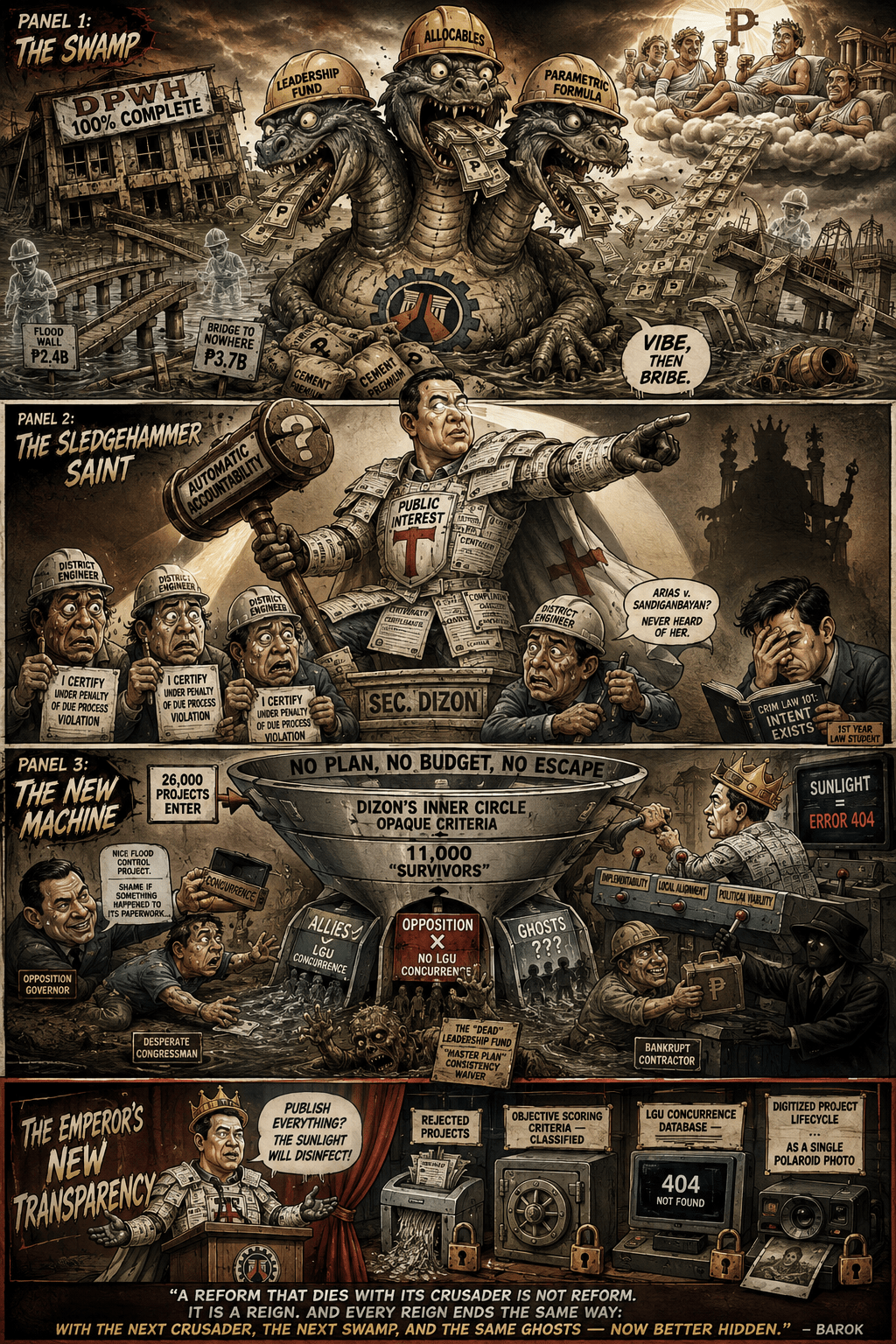
FEAST your eyes on the Department of Public Works and Highways, the hallowed institution where “100% complete” is a state of mind rather than a physical reality. Where cement bags are apparently filled with Monopoly money, where “ghost projects” are the only things that get built on time, and where a “leadership fund” sounds less like a governance tool and more like a slush fund for the political gods of Mount Olympus.
Into this swamp strides our new, self-anointed crusader, Secretary Vince Dizon, armed not with a sword, but with a policy he believes will make District Engineers tremble: “No Plan, No Budget.”
On its face, it’s a slogan so simple, so commonsensical, it makes you wonder what the hell was happening before. Did we previously operate on a “Vibe, Then Bribe” policy? Was the previous protocol “Whim, Then Sluice”?
Dizon’s reformist zeal is as commendable as it is theatrical. He promises to slash the number of projects and, more dramatically, threatens that a District Engineer (DE) who signs a certification for a “ghost” project will face an “open-and-shut case.”
But hold on, dear readers of the Kweba. Let us not be swept away by the powerful current of performative integrity.
Because when a man with that much power starts talking about “automatic accountability,” I don’t just smell a rat. I smell a rat who has lawyered up, studied the Constitution, and is trying to build a very specific, very powerful, and potentially very dangerous machine.
The Sledgehammer and the Scalpel
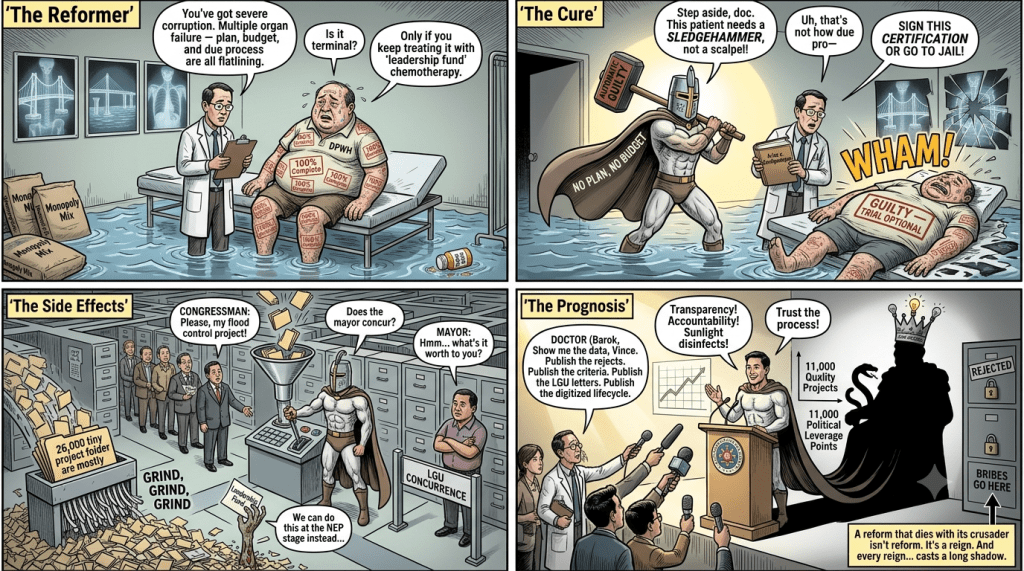
The most legally audacious—and frankly, boneheaded—assertion from the Secretary is this notion of “automatic” liability upon signature. Dizon has publicly stated that a DE who signs a project later found to be defective is automatically held accountable, an “open-and-shut case.”
Que horror. Any first-year law student who has stayed awake through Criminal Law 101 knows that the Philippine justice system does not operate on strict liability for public officials.
We have this little thing called the Revised Penal Code, which requires criminal intent or, at minimum, gross inexcusable negligence for offenses like graft under Republic Act (RA) 3019 (Anti-graft and Corrupt Practices Act). We have a little doctrine called Arias v. Sandiganbayan, a veritable shield for the beleaguered bureaucrat, which recognizes that officials handle mountains of paperwork and cannot be expected to divine fraud from every document thrust before them.
Dizon is trying to use a sledgehammer to do the work of a scalpel. By claiming a signature equals guilt, he reveals either a profound misunderstanding of the very laws he is sworn to enforce, or a cynical desire to terrify the lower ranks into submission while he centralizes power at the top.
This is the political equivalent of a mob boss telling his soldiers, “If you get caught, you’re on your own.”
But the far more intriguing and insidious aspect of this reform is the “No Plan, No Budget” mandate, specifically its requirement for Local Government Unit (LGU) concurrence.
The LGU Concurrence Conundrum: A Veto in Sheep’s Clothing?
Dizon frames LGU concurrence as a harmonious alignment of local and national priorities. It sounds lovely, like a bureaucratic duet.
But let’s look at the law. Section 17(c) of the Local Government Code is crystal clear: national government-funded projects are generally not subject to the whims of local governments, except in specific cases.
So, what is Dizon doing? He is, perhaps with noble intentions, constructing a system where a mayor or governor can potentially hold a national project hostage for political reasons.
This is not just a policy choice; it is a direct challenge to the constitutional primacy of the national government in matters of national infrastructure.
The intent is obvious to anyone with a suspicious mind—and my mind is perpetually suspicious. By granting LGUs this de facto veto power, Dizon is not just ensuring projects “fit the local plan.” He is creating a new layer of political gatekeeping, one that can be weaponized against political opponents or used to extract concessions.
What happens when a governor from the opposition party refuses to issue “concurrence” for a critical flood control project in a congressman’s district? Does the project die? Does the congressman have to grovel? The opportunities for new forms of corruption are breathtaking.
The Specter of the “Leadership Fund” and the Centralization of Power
This brings us to the ghost at the feast: the “leadership fund.” Former Secretary Bonoan has alleged this mechanism existed to accommodate legislative insertions. Dizon claims it’s dead. But is he killing the beast, or simply feeding it at a different trough?
Dizon’s reforms are a masterclass in power consolidation. He slashes the number of projects, ostensibly to improve quality. But this also means he and his inner circle will now have near-total control over which projects survive.
Every eliminated project creates a desperate congressman, a furious mayor, or a bankrupt contractor. They will all come to the new master, cap in hand, asking for a piece of the remaining, shrunken pie.
The “no plan, no budget” rule, the LGU concurrence requirement, the personal certifications—these all serve to funnel discretionary power upwards. Before, a corrupt DE might take a bribe to certify a ghost project.
Now, the system is so centralized that the bribe for a project’s inclusion in the budget might have to be directed to the very top, hidden within the opaque criteria of “master plan consistency” or “implementability.”
Dizon claims to be eliminating the “allocables” and “parametric formulas” of the old regime. But by creating a more centralized, more discretionary, and less transparent project selection process, he risks replacing a distributed, chaotic corruption with a highly efficient, monopolistic one.
The Bottom Line: Show Me the Data, Vince
I do not doubt that Secretary Dizon is a man of action. I do not doubt that the flood control scandal is real, vast, and rotted to the core.
A man doesn’t file cases against 20 of his own personnel and 4 contractors unless he’s either genuinely angry or performing for an audience. Perhaps it’s both.
But the problem with crusaders is that they often become the very thing they set out to destroy: autocrats. Dizon is not just changing the rules of the game; he is attempting to rewrite the Constitution through department policy.
His rhetoric on “automatic liability” is legally illiterate and violates the most basic principles of due process. His LGU concurrence scheme is a legal overreach that invites new forms of political racketeering. And his centralization of project selection is a governance time bomb.
The real test of Dizon’s reforms will not be how many projects he cuts or how many DEs he threatens. It will be whether he can create a system that is transparent, auditable, and resilient enough to survive his own departure.
If his entire anti-corruption framework rests on the cult of his own personality and the terror of his pronouncements, then it is not a reform. It is a reign.
So, Secretary Dizon, you want to prove us cynics wrong? It’s simple. Publish every rejected project. Publish the reason for rejection. Publish the objective scoring criteria used. Publish the proof of LGU concurrence. Publish the complete digitized lifecycle of every project from concept to payment.
If you do that, you won’t need to threaten anyone with “automatic” prosecution. The sunlight will do the disinfecting for you. But if you don’t, then your “reform” is just another ghost project, waiting to be exposed.
Key Citations
A. News Articles
- Amojelar, Darwin G. “Dizon Sues DPWH Engineers, Contractors over Flood Control Mess.” Manila Standard, 11 Sept. 2025, https://manilastandard.net/business/314641549/dizon-sues-dpwh-engineers-contractors-over-flood-control-mess.html.
- “EXPLAINER: What Was ‘Leadership Fund’ in the National Budget?” GMA News Online, 13 Aug. 2026, https://www.gmanetwork.com/news/topstories/nation/998462/explainer-what-is-leadership-fund-in-the-national-budget/story/.
- “Ex-DPWH Chief Bonoan: There’s ‘Leadership Fund’ in NEP.” Manila Bulletin, 23 Sept. 2025, https://mb.com.ph/2025/09/23/ex-dpwh-chief-bonoan-theres-leadership-fund-in-nep.
- Ronda, Ranier Allan. “Sweeping DPWH Budget Reforms Set.” Philstar.com, 28 Aug. 2026, https://www.philstar.com/headlines/2026/08/28/2552341/sweeping-dpwh-budget-reforms-set.
- “‘Wala’: DPWH Chief Dizon Flatly Denies Bonoan’s ‘Leadership Fund’ Claim.” Manila Bulletin, 26 Aug. 2026, https://mb.com.ph/2026/08/26/wala-dpwh-chief-dizon-flatly-denies-bonoans-leadership-fund-claim.
- “Marcos Promised a Crackdown on Flood Control Corruption. What Happened a Year Later?” Rappler, 26 July 2026, https://www.rappler.com/philippines/marcos-promise-crackdown-flood-control-corruption-year-later/.
B. Laws & Jurisprudence
- Arias v. Sandiganbayan, G.R. No. 81563, 19 Dec. 1989. The Lawphil Project, https://lawphil.net/judjuris/juri1989/dec1989/gr_81563_1989.html.
- Republic Act No. 3019. “Anti-Graft and Corrupt Practices Act.” Official Gazette of the Republic of the Philippines, 17 Aug. 1960, https://www.officialgazette.gov.ph/1960/08/17/republic-act-no-3019/.
- Republic Act No. 7160. “Local Government Code of 1991.” Official Gazette of the Republic of the Philippines, 10 Oct. 1991, https://www.officialgazette.gov.ph/1991/10/10/republic-act-no-7160/.
- Act No. 3815. “Revised Penal Code of the Philippines.” The Lawphil Project, 8 Dec. 1930, https://lawphil.net/statutes/acts/act1930/act_3815_1930.html.
- “The 1987 Constitution of the Republic of the Philippines – Article III.” Official Gazette of the Republic of the Philippines, https://www.officialgazette.gov.ph/constitutions/the-1987-constitution-of-the-republic-of-the-philippines/the-1987-constitution-of-the-republic-of-the-philippines-article-iii/.
C. Official Websites
- Department of Public Works and Highways. DPWH Official Website. https://www.dpwh.gov.ph/.
- “Flood Control Projects Scandal in the Philippines.” Wikipedia, https://en.wikipedia.org/wiki/Flood_control_projects_scandal_in_the_Philippines.
- “Manuel Bonoan.” Wikipedia, https://en.wikipedia.org/wiki/Manuel_Bonoan.
- “Vince Dizon.” Wikipedia, https://en.wikipedia.org/wiki/Vince_Dizon.

- ₱8B BBM Pork: CCTV for Every Captain’s Kumpare?

- ₱8.9 Billion, 331 Ghost Police Stations: The TIKAS Scandal Explained

- ₱8.4 Billion, 42,000 Barangays, 1 Election: The “Bawat Barangay Makikinabang” Vote-Buying Masterclass

- ₱75 Million Heist: Cops Gone Full Bandit

- ₱6.77B Ghost Haunts Duterte: RTC Dismisses Mans Carpio’s Desperate Plea



Leave a Reply