
The COMELEC Philosopher’s Stone: Turning Stray Votes into a Congressional Majority
By Louis “Barok” C. Biraogo | August 30, 2026
THERE is a particular species of political survival in this archipelago that does not rely on votes, charisma, or even the law as it is written. It relies on something far more potent: the law as it can be weaponized. And nowhere is that alchemy more brazen—or more legally fragile—than in the curious case of Rep. Bienvenido “Benny” Abante Jr., the man who finished second in Manila’s 6th District but now warms a seat in the House of Representatives.
The narrative you have been fed—by Facebook posts, by partisan TikTokers, by the endless churn of Manila’s political rumor mills—is deceptively simple: “The Supreme Court killed the second-placer rule, so Abante is in danger.” You are supposed to clap. You are supposed to share. You are supposed to feel that the arc of jurisprudence has finally bent toward justice.
But as is so often the case in Philippine election law, the simple story is a lie. The real story is darker, more technical, and infinitely more satisfying for anyone who enjoys watching powerful men squirm on the edge of a legal precipice.
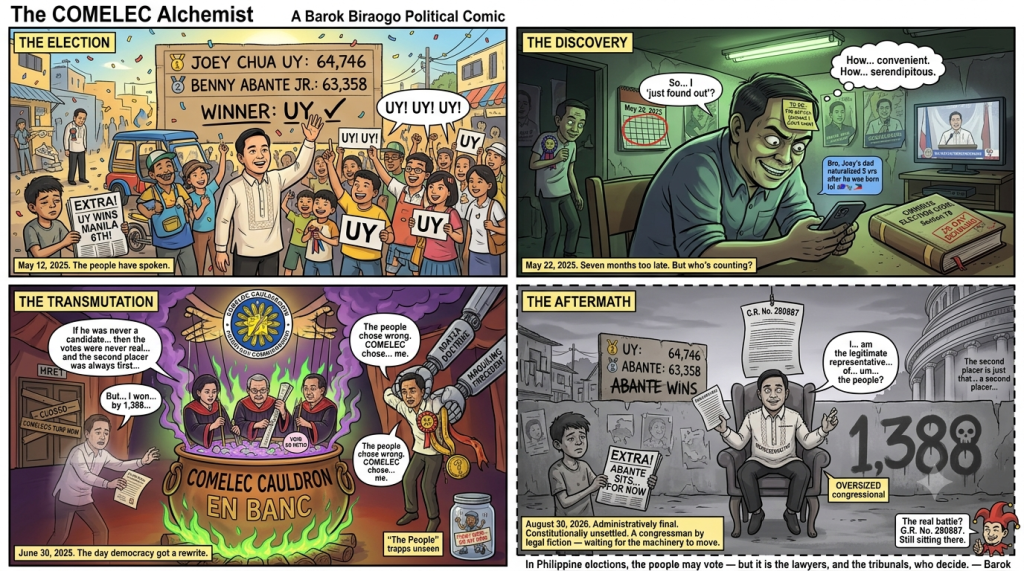
The Numbers That Do Not Lie
Let us begin with the numbers, because numbers do not lie, even when lawyers do.
- 64,746 votes for Luis “Joey” Chua Uy.
- 63,358 votes for Benny Abante Jr.
A margin of 1,388 souls. Uy won. The people of Manila’s 6th District—flawed, mortal, democratic—chose him. But the people do not get the final word in this Republic. The Commission on Elections (COMELEC) does. And COMELEC, in its infinite quasi-judicial wisdom, decided that the people had chosen wrong.
The Citizenship Problem and the Late Petition
Here is where the legal alchemy begins.
Uy, you see, had a citizenship problem. Not the garden-variety “his grandfather was Chinese” problem that afflicts half of Manila’s political class. No, this was the full constitutional catastrophe: a father naturalized five years after Uy’s birth, a mother whose own citizenship was allegedly lost upon marrying an alien, and a 1935 Constitution that did not hand out natural-born status like sampaguita at a tourism booth.
But here is the rub—the ugly, uncomfortable, procedural rub that Abante’s defenders do not want you to examine too closely: Abante filed his petition to cancel Uy’s certificate of candidacy (COC) on May 22, 2025—ten days after the election, and seven months after the 25-day filing window for Section 78 petitions had slammed shut.
Let that sink in. The Omnibus Election Code gives candidates twenty-five days from the filing of a COC to challenge a material misrepresentation. Twenty-five days. Not seven months. Not after the voters have already spoken. Not after you have lost by 1,388 votes and suddenly discovered a citizenship controversy that had somehow escaped your attention during the entire campaign.
Abante, by his own admission, learned of Uy’s citizenship issue after the election, from an acquaintance in Australia. How convenient. How serendipitous. How utterly characteristic of Philippine politics, where legal principles are discovered only when they serve the interests of the discoverer.
How COMELEC Crowned Abante
COMELEC, of course, was happy to oblige. The Second Division voided Uy’s COC ab initio—from the beginning, as though he had never been a candidate at all—and declared Abante “the only qualified candidate who garnered the highest number of votes.” The En Banc affirmed. The Certificate of Finality was issued. Abante was proclaimed on July 8, 2025, and has been legislating ever since.
What Mangudadatu Actually Decided
Now, the Facebook post you have seen—the one breathlessly announcing that Abante’s victory is “under fire”—is technically correct that the Supreme Court’s August 26, 2026 resolution in Mangudadatu v. COMELEC has reignited the controversy. But it is also, in the grand tradition of viral misinformation, fundamentally misleading.
The Mangudadatu ruling did not, by its own express terms, reach congressional seats. It dealt with local elective positions—governors, mayors, and the like—where the Local Government Code provides a ready-made successor. A vice governor. A vice mayor. Someone the voters already elected. The Court, in its August 26, 2026 resolution, was careful to say that it was not deciding the application of the second-placer doctrine to national elective offices.
So, no, the Supreme Court did not just invalidate Benny Abante’s congressional seat. Anyone who tells you otherwise is either lying or illiterate. (Given the quality of legal discourse on Facebook, the latter is more likely.)
The Doctrines of Aratea and Maquiling
But—and this is where the story gets interesting—the Mangudadatu ruling did something far more dangerous to Abante’s position than a direct reversal could have. It yanked the doctrinal rug out from under the specific legal fiction that COMELEC used to crown him.
Abante’s proclamation did not rest on the crude “second-placer rule” that Mangudadatu killed. It rested on the more sophisticated—and until recently, more respectable—doctrine of Aratea v. COMELEC and Maquiling v. COMELEC. That doctrine says: if a candidate’s COC is void ab initio, then he was never really a candidate, and every vote cast for him is a stray vote. The “second placer” is not really second; he is first among the valid candidates.
It is a neat trick. It transforms a loser into a winner without having to win. And COMELEC applied it with gusto to Uy’s case, despite the fact that Uy was not merely disqualified after the fact—he was proclaimed, took his oath, and was, by every traditional measure, a Member of Congress when COMELEC decided to unmake him.
The Mangudadatu Court, in its finality, said something that should send a chill down the spine of every COMELEC commissioner who signed off on Abante’s proclamation:
“The second placer is just that, a second placer.”
And:
The Court was speaking about a governorship. But the words are not so easily contained. They linger. They echo. They have a way of attaching themselves to other cases, other contests, other men who finished second and yet found themselves seated.
Did COMELEC Even Have Jurisdiction?
And here is the sharper, more dangerous question that the Facebook post misses entirely: Did COMELEC even have jurisdiction to act?
This is where the legal ground truly shifts beneath Abante’s feet.
The Constitution is not subtle. Article VI, Section 17 vests in the House of Representatives Electoral Tribunal (HRET) the “sole” jurisdiction over contests relating to the election, returns, and qualifications of House Members. Sole. Exclusive. Not shared with COMELEC. Not subject to a quasi-judicial workaround.
The Supreme Court has been saying this for decades. Lazatin v. HRET. Robles v. HRET. Aggabao v. COMELEC. Vinzons-Chato v. COMELEC. Limkaichong v. COMELEC. The doctrine is a drumbeat: once a winning congressional candidate is proclaimed, takes his oath, and assumes office, COMELEC’s jurisdiction ends. HRET’s begins.
Uy was proclaimed on May 13, 2025. He took his oath on May 26, 2025. The constitutional start of the 20th Congress was June 30, 2025.
COMELEC’s En Banc ruling that effectively unseated Uy? June 30, 2025. The very day the new Congress convened. The very day Uy’s term was supposed to begin.
Now, did Uy actually “assume office”? The House refused to recognize him. He was not allowed to enter the official roll. He was, in the eyes of the institution, a nullity. But does that matter for jurisdictional purposes? Or is it the kind of bootstrap argument that would make a first-year law student blush?
COMELEC’s position—articulated with varying degrees of coherence—is that because Uy’s COC was void ab initio, there was never a valid proclamation to begin with, and therefore HRET jurisdiction never attached. It is a beautiful loop. A perfect circle of legal reasoning. And it is entirely dependent on the very premise that Mangudadatu has now called into question.
The Case Still Sitting in G.R. No. 280887
The Supreme Court has had more than a year to rule on Uy’s petition for certiorari (G.R. No. 280887). It has declined to issue a temporary restraining order (TRO). It has declined to issue a status quo ante order. It has allowed Abante to sit, function, and collect his salary while the jurisdictional question festers.
Why?
The cynical answer: the Supreme Court does not want to touch this. It is a political grenade wrapped in a constitutional puzzle, and the Court—already battered by years of Duterte-era attacks, already struggling to maintain its legitimacy—would rather let sleeping congressmen lie.
But the cynical answer is not always the right answer. Sometimes the Court is merely waiting for the right case, the right procedural posture, the right moment to strike. And the finality of Mangudadatu—which the Court could have quietly resolved without the dramatic press briefer—might just be the signal that the moment is approaching.
Consider the timing. The Mangudadatu resolution was released on August 27, 2026. The Facebook post you are reading is dated August 30, 2026. The political landscape is charged. Abante has become a visible endorser of the Duterte impeachment complaints—a fact that conveniently aligns him with the Marcos-Romualdez faction, and against the Duterte faction that spent 2025 trying to defeat him.
And Uy? Uy has every incentive to fight. He won the election. He took the oath. He has a colorable claim to being the legitimate Representative of Manila’s 6th District. And now, thanks to Mangudadatu, he has fresh ammunition.
There Is No Clean Answer
But here is the uncomfortable truth that neither camp wants to admit: There is no clean answer.
If the Supreme Court were to rule that COMELEC lacked jurisdiction—that HRET should have decided the citizenship question—the remedy would not be to simply reinstall Uy. It would be to nullify COMELEC’s action and remand the question to HRET. Which would then have to decide whether Uy is a natural-born Filipino. Which would take months, if not years. During which time, what happens to the seat?
If HRET were to rule that Uy is indeed natural-born, Abante would be out. But if HRET were to rule that Uy is not, the question of succession becomes a constitutional headache. There is no vice-congressman. There is no automatic successor. Article VI, Section 9 contemplates a special election—but no special election was called, and none is likely to be, given the electoral calendar and the expense.
The cleanest solution, from a democratic perspective, would have been a special election. Let the people of Manila’s 6th District choose, again, between the two men. But that would require Congress to act, and Congress—which currently includes Benny Abante—has no incentive to do so.
So we are left with a legal vacuum, filled by a man who finished second, sustained by a doctrine that may no longer exist, in a forum that may never have had jurisdiction, while the Supreme Court watches in silence.
And the rest of us? We watch the Facebook posts. We read the viral takes. We nod along to the simplified narratives that flatten complexity into slogans. We are told that the Supreme Court has “rejected the second placer rule” and we imagine that justice is being done. But justice, in this Republic, is rarely so straightforward.
The truth is that Benny Abante’s seat rests on a foundation that is administratively final but constitutionally unsettled. He is a walking, legislating, committee-chairing legal ambiguity. And the only thing more embarrassing than the fact that he is there is the fact that nobody—not the Supreme Court, not HRET, not COMELEC—seems willing to definitively say whether he belongs there.
So, to the netizens demanding review: you are not wrong. There are grounds for review. There are serious, non-frivolous questions about jurisdiction, about procedure, about the very legitimacy of the doctrine that lifted a second placer into a first placer’s seat.
But do not mistake the Mangudadatu finality for a court order. It is not. It is a weather vane, pointing in a direction the Supreme Court may or may not choose to travel. Abante is not “under fire” in the sense of being actively targeted by a judicial decree. He is under fire in the sense that the intellectual and doctrinal foundations of his victory are now openly, publicly, and perhaps permanently in question.
The real battle is not on Facebook. It is in G.R. No. 280887. It is in the HRET, should Uy ever file there. It is in the slow, grinding, opaque machinery of Philippine jurisprudence.
And until that machinery moves, Benny Abante will remain what he has been for over a year: a congressman by legal fiction, a winner by institutional inertia, and a living testament to the enduring truth that in Philippine elections, the people may vote, but it is the lawyers—and the tribunals—who decide.
— Barok
Key Citations
A. Legal & Official Sources
- Commission on Elections. “Omnibus Election Code, Article IX, Section 78.” www.comelec.gov.ph/?r=References/RelatedLaws/OmnibusElectionCode/OECArt9.
- Official Gazette. “Republic Act No. 7160, Local Government Code of 1991.” 10 Oct. 1991, www.officialgazette.gov.ph/1991/10/10/republic-act-no-7160/.
- Official Gazette. “The 1987 Constitution of the Republic of the Philippines – Article VI.” www.officialgazette.gov.ph/constitutions/the-1987-constitution-of-the-republic-of-the-philippines/the-1987-constitution-of-the-republic-of-the-philippines-article-vi/.
- Aratea v. Commission on Elections, G.R. No. 195229, 9 Oct. 2012, jur.ph/jurisprudence/summary/aratea-v-commission-on-elections.
- Lazatin v. House of Representatives Electoral Tribunal, G.R. No. 84297, 8 Dec. 1988, jur.ph/jurisprudence/summary/lazatin-v-house-of-representatives-electoral-tribunal.
- Limkaichong v. Commission on Elections, 601 Phil. 751 (2009), elibrary.judiciary.gov.ph.
- Mangudadatu v. Commission on Elections, G.R. Nos. 260219 & 260231 (resolution denying reconsideration with finality, 26 Aug. 2026).
- Maquiling v. Commission on Elections, G.R. No. 195649, 16 Apr. 2013, jur.ph/jurisprudence/digest/maquiling-v-commission-on-elections.
- Robles v. House of Representatives Electoral Tribunal, G.R. No. 118597 (1995), lawphil.net/judjuris/juri1995/jul1995/gr_118597_1995.html.
- Uy v. Commission on Elections, G.R. No. 280887, Ad Cautelam Petition for Certiorari and Prohibition, sc.judiciary.gov.ph/wp-content/uploads/2025/07/G.R.-No.-280887-Ad-Cautelam-Petition-for-Certiorari-and-Prohibition.pdf.
- Vinzons-Chato v. Commission on Elections, G.R. No. 172131, 2 Apr. 2007, jur.ph/jurisprudence/digest/vinzons-chato-v-commission-on-elections.
B. News Articles
- Facebook post cited in the article. 30 Aug. 2026, www.facebook.com/share/p/19LLoDGJWr/.
- Bolledo, Jairo. “Supreme Court Affirms Ruling: No ‘Second Placer Rule’ in Local Elections.” Rappler, 27 Aug. 2026, www.rappler.com/philippines/supreme-court-affirms-decision-abandoning-second-placer-rule-local-elections/.
- Patinio, Ferdinand. “Comelec Orders Abante Proclamation as Manila 6th District Rep.” Philippine News Agency, 30 June 2025, www.pna.gov.ph/articles/1253208.
- Patinio, Ferdinand. “Comelec Proclaims Abante as Manila 6th District Rep.” Philippine News Agency, 8 July 2025, www.pna.gov.ph/articles/1253812.
- Patinio, Ferdinand. “Abante: House Has the Numbers to Pursue VP Sara Impeachment.” Philippine News Agency, 21 Feb. 2026, www.pna.gov.ph/articles/1269500.
- Rita, Joviland. “SC Abandons ‘Second Placer’ Rule in Local Polls.” GMA News Online, 27 Aug. 2026, www.gmanetwork.com/news/topstories/nation/1000057/sc-abandons-second-placer-rule-in-local-polls/story/.
C. Official Websites
- Commission on Elections. Official COMELEC Website. http://www.comelec.gov.ph.
- House of Representatives. “Hon. Bienvenido M. Abante Jr.” Congress of the Philippines, www.congress.gov.ph/house-members/view/memberships/?member=E003&page=0.
- “Ang Hirap Maging Mahirap”: The PAO Scandal That Proves Government Contempt Is Nothing New

- “Far-Off” My Axx: Malacañang’s Claire Castro Drowns in Her Own Legal Gaslighting

- “Forthwith” to Farce: How the Senate is Killing Impeachment—And Why Enrile’s Right (Even If You Can’t Trust Him)

- “HINDI AKO NAG-RESIGN!”

- “I Know Nothing”: Baste Duterte’s Amnesia Defense Meets ₱33M in GenCorp Contracts

- “I’m calling you from my new Globe SIM. Send load!”

- “Mahiya Naman Kayo!” Marcos’ Anti-Corruption Vow Faces a Flood of Doubt

- “Manageable” Debt, Unmanageable Lies: DBM’s ₱21 Trillion Fairy Tale

- “Meow, I’m calling you from my new Globe SIM!”

- “Natrabaho”: One Word, One Ombudsman, and a Judiciary on Trial

- “No Special Jail for Crooks!” Boying Remulla Slams VIP Perks for Flood Scammers

- “Philippine-Controlled” or Yankee Gas Station? The Davao Fuel Depot Farce Exposed








Leave a Reply